The Ventilation Trials: Small Effects, Real Signal
The advice to sleep with a window cracked traces back to one small dormitory experiment. The studies since are more mixed than the advice suggests. This page walks the intervention literature honestly: what the anchor trial measured, how large the effects were, which later trials came back null, and what it means for one bedroom.
What the evidence supports
- Same-room crossover trials found small but significant improvements in objectively measured sleep as ventilation increased.
- Gains concentrate where ventilation was worst — deep sleep and awakenings improved when air exchange rose sharply.
- The change can be unnoticeable: an inaudible fan matched an open window, without the noise trade-offs.
What remains uncertain
- Effect sizes sit near the edge of what people notice; the 2025 review calls for validation before treating any threshold as a target.
- Later field work is mixed — door-opening arms and a Shanghai summer study lowered CO₂ without improving sleep.
- Trials are small (14–36 people), mostly actigraphy rather than polysomnography, and none followed clinical outcomes over time.
Evidence last reviewed: October 5, 2026. Conclusions may change as new research is published.
The Anchor Trial: Strøm-Tejsen 2016
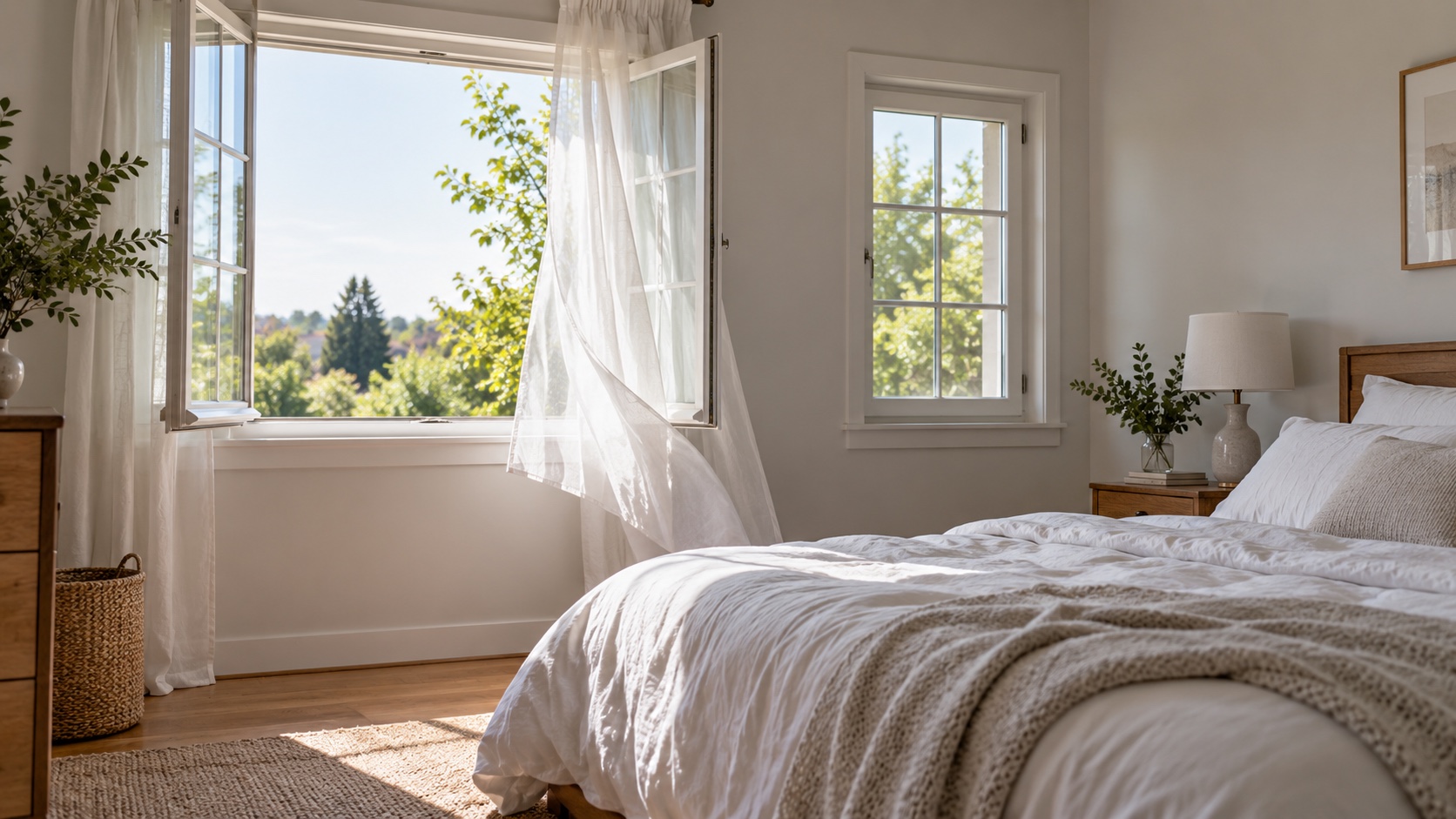
Nearly every line of bedroom-air advice traces back to one 2016 paper in Indoor Air. Strøm-Tejsen and colleagues ran two field experiments in student dormitory rooms in Denmark — 14 occupants in the pilot, 16 in the second. Each slept a week per condition in balanced order, logged by wristwatch actigraphs and morning questionnaires.
In the pilot, opening a window did it: average overnight CO₂ fell from 2,585 to 660 ppm — roughly ten times the air exchange. In the second, an inaudible supply fan ran when CO₂ passed 900 ppm, taking the average from 2,395 to 835 ppm with no perceptible noise or draught, and temperatures did not differ between conditions.
What improved: actigraphy-measured sleep quality, perceived air freshness, next-day sleepiness and concentration, and a logic-task score — all significantly better in the ventilated weeks. It lacked polysomnography, clinical endpoints, and long follow-up.
What “Improved Sleep Quality” Actually Means
The phrase sounds bigger than the measurement behind it. The anchor trial — like most of the field since — assessed sleep with actigraphy, a wristwatch that infers sleep from movement, not a lab's polysomnography. Actigraphy is practical — and noisy enough to disagree with how a night felt. The sleep-tracking topic owns reading small signals honestly.
The differences were significant but modest — a few percentage points in deep sleep and awakenings, not transformed nights. The field's 2025 review is candid: when studies asked people how they slept, subjective ratings changed less consistently, with about half finding no effect. A small objective signal can be real and still sit below the threshold of feeling.
- 🔬 Movement, not brain waves — actigraphy is a proxy; polysomnography is the reference standard and most bedroom trials skipped it.
- 📏 Small margins — conditions separate by a few percentage points in group averages, not hours of extra sleep.
- 🗓️ A week per condition — long enough to detect a group difference, short enough for night-to-night variation to hide it.
The Replications and the Nulls
Does the result hold outside dormitories? The most direct test ran in 40 Danish bedrooms in winter (Fan et al., Building and Environment, 2022): an ordinary week, then a week with windows or doors flipped — 29 bedrooms changed enough to analyze. Windows open: CO₂ fell and sleep was longer and rated better. Doors open: CO₂ fell just as far and nothing improved — a door connects the bedroom to the dwelling, not to fresh air.
The trials, nulls included:
| Study | Design | N | CO₂ conditions | Sleep outcome | Direction |
|---|---|---|---|---|---|
| 🛏️ Strøm-Tejsen 2016, pilot (Indoor Air) | Crossover, dorms | 14 | 2,585 → 660 ppm (window) | Quality improved; air fresher | Improved |
| 🛏️ Strøm-Tejsen 2016, main (Indoor Air) | Crossover, dorms | 16 | 2,395 → 835 ppm (silent fan) | Improved; less sleepy, better focus | Improved |
| 🪟 Fan 2022 (Building and Environment) | 40-bedroom field intervention | 29 usable | Windows 2,310 → 904; doors 2,916 → 1,415 ppm | Windows better; doors unchanged | Mixed |
| 🔁 Fan 2023 (Science of The Total Environment) | Single-blind, fan speed covert | 29 (12–23 usable) | Low / moderate / high weeks | Less deep sleep, more awakenings at low | Improved |
| ☀️ Yan 2024 (Building and Environment) | Summer field intervention, Shanghai | 50 | Window or door open; CO₂ fell both ways | Windows: shorter REM; doors: none | No benefit |
| 🧪 Kang 2024 (Building and Environment) | Field-lab crossover, 2 nights/level | 36 | 750 / 1,000 / 1,300 ppm | Efficiency −1.3 / −1.8%; wake +5 / +8 min | Worse above 1,000 |
The strongest replication came in 2023: a single-blind, four-week intervention in 29 Belgian bedrooms, fan speeds covertly changed week by week (Science of The Total Environment). Where settings clearly separated CO₂, higher ventilation meant more deep sleep and fewer awakenings; across the 23 bedrooms with a clean high-versus-low contrast, deep sleep was significantly shorter at the low setting. Cognition never differed — and only some rooms produced contrasts clean enough to analyze.
Then the nulls, which are why this page exists. A 2024 summer study in Shanghai (50 bedrooms) ran the same logic in heat: open windows lowered CO₂ but brought in heat, PM2.5, and noise — REM sleep got shorter — and open doors did nothing. The 2025 review of 17 papers agrees, conditionally: ventilation affects sleep on average, but the effect depends on season, city, and what the incoming air carries — a case for revisiting standards, not a settled rule.
Why Effects Are Small
None of this makes the positive trials wrong — sleep is noisy, ventilation a modest lever. Why they look small:
- 🎯 The rooms at issue are the bad ones — benefits should be largest where the baseline is worst; an airy bedroom has little to win.
- 📊 Small samples, varied sleepers — 14 to 36 people can reliably detect only sizeable shifts; a modest effect may miss significance in any study.
- 🌡️ Many inputs, noisy measures — temperature, noise, light, and schedule move the same actigraphy numbers, and week-long windows blur the rest.
- 🕰️ It predates the nulls — a smaller earlier dormitory crossover, discussed in the 2016 paper, found no significant effects.
⚖️ Small but real — or too small to feel?
Both can be true. A few percentage points is a measurable group average; whether you would feel it — or whether it beats a cooler room or quieter street — no trial can tell you. Where the room is genuinely stuffy and outdoor air is clean, the change is cheap and plausibly worthwhile; where it is already fine, expect a null.
The Dose Question
If ventilation helps, how much does it take? No personal threshold is validated — but a working ladder sits on real measurements. 36 healthy adults slept two nights at each of three levels — 750, 1,000, and 1,300 ppm average overnight CO₂, balanced order (Building and Environment, 2024). Sleep efficiency fell 1.3–1.8% at the higher levels; time awake rose about 5 and 8 minutes.
- 🪜 Where the line sits — the 2025 review found no disturbance below 1,000 ppm and proposed keeping bedrooms at or under 800 ppm as a precaution, given sensor error; a target for standards, not a switch. The measurement page owns what a reading can and cannot tell you.
- 📟 Real rooms run far above it — a 2026 study of 20 damp-flagged Wellington bedrooms found CO₂ indicating inadequate ventilation; an earlier survey saw peaks up to 4,000 ppm.
- 🧭 The practical stance — lower is plausible-better and cheap where outdoor air is clean and quiet; the how-to page owns the trade-offs.
What Would Settle It
Three upgrades would move this from promising to settled:
- 🧪 Bigger randomized trials — controlled studies run 14 to 36 people; the Belgian trial needed most of its 29 rooms to find analyzable contrasts.
- 🛌 Lab-grade measurement — polysomnography on a subsample, so effects are read from sleep architecture, not movement.
- 🌍 Many climates and seasons — Danish winter and Shanghai summer behaved differently; single-site results should not stretch across geographies.
- 🔬 The pollution side — the door-opening null suggests CO₂ is a marker, not the mechanism; trials varying pollutants independently would isolate what ventilation does.
Until then, the case rests on plausibility, small positive trials, and a near-zero price. The rest of the room is on the bedroom-engineering page.
Questions, Answered Briefly
- ❓ Did any trial show a large sleep improvement? No. Positive results are modest group-level shifts — deep-sleep minutes and fewer awakenings, not extra hours in bed.
- ❓ Why do some trials find nothing — is CO₂ the problem? Cutting the number is not the same as fixing the air: door-opening lowered CO₂ without changing what the sleeper breathed, and the review notes no study has shown pure CO₂ below 5,000 ppm disturbing sleep.
- ❓ What about next-day focus? Two of eleven studies that measured it found gains — the 2016 anchor and the 2022 window arm. Possible, not promised.
- ❓ So should I sleep with the window open? If the room is stuffy and outdoor air is clean and quiet, it is a cheap, plausible-better default; if it is smoky, hot, or loud, the calculus flips.
The Bottom Line
- The effect is real but small — the best crossover trials found modest but significant sleep improvements when ventilation was sharply increased.
- The wins are conditional — door-opening and summer-window interventions lowered CO₂ without improving sleep; what the air carries matters more.
- The dose works in targets, not switches — the 2025 review proposes at or under 800 ppm; 1,000 ppm is the lowest level where disturbance has been measured.
- Treat it as physiology and practice, not a fix — cheap, plausibly-better habit territory; persistent sleep problems are a conversation with a professional, not a ventilation setting.
Related Topics
- Strøm-Tejsen et al., "The effects of bedroom air quality on sleep and next-day performance," Indoor Air (2016)
- Fan et al., "A field intervention study of the effects of window and door opening on bedroom IAQ, sleep quality, and next-day cognitive performance," Building and Environment (2022)
- Fan et al., "A single-blind field intervention study of whether increased bedroom ventilation improves sleep quality," Science of The Total Environment (2023)
- Yan et al., "Does window/door opening behaviour during summer affect the bedroom environment and sleep quality in a high-density sub-tropical city," Building and Environment (2024)
- Kang et al., "Ventilation causing an average CO₂ concentration of 1,000 ppm has negative impacts on sleep: a field-lab study on healthy youth," Building and Environment (2024)
- Akimoto et al., "New research on bedroom ventilation and sleep quality suggests that building standards should be revisited (ASHRAE 1837-RP)," Science and Technology for the Built Environment (2025)
- Bennett et al., "Stuffy nights: elevated bedroom carbon dioxide concentrations indicate inadequate ventilation in Wellington homes," New Zealand Medical Journal (2026)