Potassium and Magnesium: The Food-First Minerals
Ask which supplement lowers blood pressure and potassium comes up first — and for once the trials back the reputation, mostly. This page separates the mineral with the strongest evidence in this series from the one with plausible but smaller effects, and it flags the kidney question that changes the math for a large slice of adults. The food-first framing is not politeness; it is where the evidence lives.
What the evidence supports
- Higher potassium intake from food is consistently associated with lower blood pressure in meta-analyses and cohorts.
- Potassium supplementation lowers systolic pressure by roughly 3–5 mmHg in pooled trials, with larger effects in people whose readings are already elevated.
- Magnesium supplementation is associated with small average reductions, mostly in people with low baseline intake.
What remains uncertain
- Whether supplement-form potassium delivers the same long-term benefits as food-form potassium, for outcomes rather than readings.
- Which magnesium dose, form, and duration matter, and who actually benefits.
- Stroke and heart-event data come mostly from observational cohorts, not randomized trials.
Evidence last reviewed: August 20, 2026. Conclusions may change as new research is published.
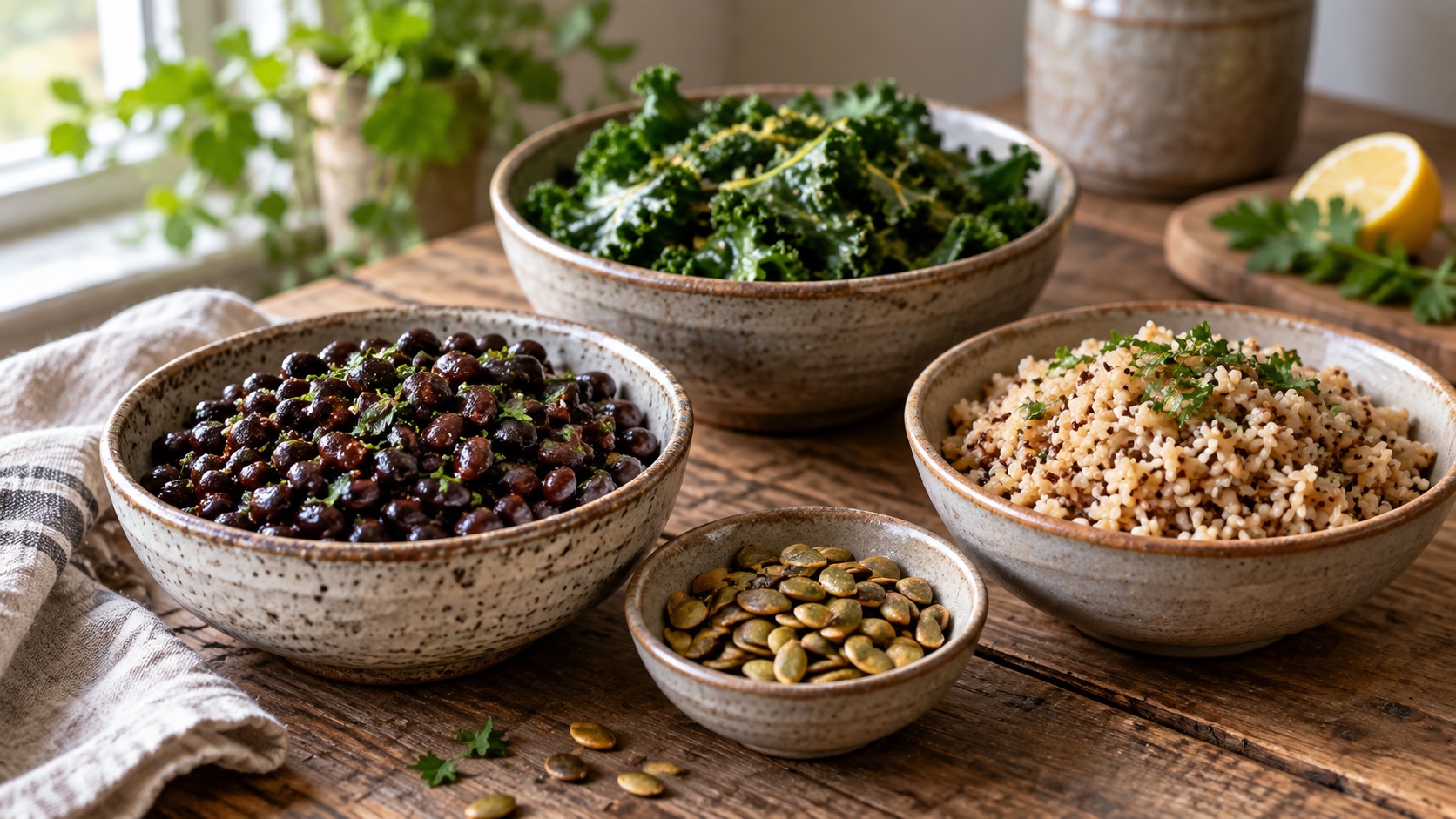
Two Minerals, One Big Difference in Evidence
The pairing is natural — both are minerals, both appear in the same foods, both sit in the same supplement aisle — but their evidence records are not twins. Potassium has decades of trials, several meta-analyses, and guideline-level attention. Magnesium has fewer trials, smaller effects, and more conditional results. The parent topic Supplements & Blood Pressure frames the whole question, and the Blood Pressure Protocol owns the lifestyle levers that outrank every bottle on this page.
- 🔑 Potassium is the headline mineral — its trial record is bigger and cleaner than any other supplement in this series.
- 🧂 Magnesium is the supporting act — real effects, but smaller and conditional on who you are and where you start.
- 🥗 Both live in the same foods — greens, beans, nuts, seeds, potatoes, yogurt, and fish cover most of the dose.
- ⚖️ Neither replaces treatment — prescribed blood-pressure medication stays the clinician's call; supplements sit beside it, never under it.
Product picks are generic categories, not brands. We may earn a commission on Amazon or iHerb purchases at no cost to you — this never changes our evidence conclusions. Full disclosure
Magnesium supplement
May correct inadequate intake; evidence for specific sleep benefits remains limited.
⚠️ Can cause diarrhea or abdominal discomfort; kidney disease and medication interactions require professional guidance.
Check price on Amazon →What the Potassium Trials Show
Potassium's reputation rests on real data. A landmark 1997 meta-analysis of randomized trials found potassium supplementation lowered systolic pressure by roughly 4–5 mmHg in people with elevated readings and about half that in people with normal readings. A 2013 BMJ systematic review reached a similar place from a larger pool of trials, and a 2020 dose-response analysis found the association strengthening with intake — on the order of a 1 mmHg drop per additional gram of daily potassium. Effects are consistently larger in people with higher starting pressures, which is exactly the pattern a real signal produces.
- 📊 Elevated pressure sees more — pooled trials show roughly 4–5 mmHg systolic in hypertension versus about 2 mmHg across all adults.
- 📈 The dose-response is visible — more potassium, more association, up to a point that the trials never really probe.
- 🥬 The DASH pattern proves the food route — the DASH diet, rich in potassium foods, lowered pressure in controlled feeding trials without a single supplement capsule.
- ⚠️ The trials used supplements — and that is exactly where the caution lives, because a capsule dose bypasses the checks that food provides.
Magnesium: Plausible, Modest, and Conditional
Magnesium's record is a quieter version of the same story. A 2016 meta-analysis of double-blind placebo-controlled trials found magnesium supplementation lowered systolic pressure by roughly 2 mmHg on average, with a similar diastolic figure, at doses around 350–400 mg daily. The effect appears strongest in people with low magnesium intake or frank deficiency — which means the people who benefit are the people who are already short. For everyone else, the average shrinks toward the noise.
- 📉 About 2 mmHg systolic on average — real, but roughly half the potassium figure and conditional on baseline.
- 🎯 Deficiency is the target — trials in people with low intake show the clearest effect; well-fed adults see less.
- 💊 Dose and form vary — 300–400 mg appears in the trials; higher doses add gastrointestinal upset, not benefit.
- 🥜 Food fixes deficiency first — pumpkin seeds, almonds, cashews, oats, and beans carry enough for most adults.
| Source | What the trials show | Verdict |
|---|---|---|
| 🍌 Potassium from food | DASH-style patterns consistently associated with lower readings | Strong |
| 🧂 Potassium supplements | Roughly 3–5 mmHg systolic; kidney and medication checks belong first | Moderate |
| 🥜 Magnesium from food | Part of a healthy pattern; small direct effect on its own | Moderate |
| 💊 Magnesium supplements | About 2 mmHg on average; GI upset at higher doses | Limited |
Canned beans and lentils
A lower-friction way to use legumes where an article gives a concrete food-first practice.
⚠️ Increase gradually if gas is troublesome; people with IBS or a prescribed diet may need individualized guidance.
Check price on Amazon →Who Benefits Most — and Who Doesn't
The averages hide a wide spread, and the spread is where the practical question lives. Potassium's effect is consistently larger in people with elevated readings, in older adults, and in people whose diets are low in potassium to begin with — which describes most adults. The people who see little are the people already eating the pattern, or already on a well-managed regimen where the room to move is small.
- 📈 Elevated readings see the most — the higher the starting pressure, the larger the average effect.
- 🥗 Low-intake diets see the most — closing a real gap beats topping up a full tank.
- 🩺 People on well-managed medication see less — the room to move is smaller, and the interaction check matters more.
- 🧂 The kidney question applies to everyone — food amounts are generally fine; concentrated products are the decision point.
Food First: Where These Minerals Actually Live
The food-first rule is not a compromise; it is the strongest version of the evidence. Food delivers these minerals with the rest of the DASH-style pattern — fiber, protein, and a dozen other compounds — at doses the body is built to handle. Supplements deliver the mineral alone, at capsule strength, with the kidney and interaction questions that come with any concentrated dose.
- 🥬 Greens and beans lead potassium — spinach, Swiss chard, white beans, and lentils beat the banana per serving.
- 🥔 Potatoes with skin are heavy hitters — a baked potato with skin carries more potassium than most people assume.
- 🍌 The banana is real but overrated — a medium banana has roughly 420 mg; a cup of cooked spinach has more.
- 🥜 Nuts and seeds carry magnesium — pumpkin seeds, almonds, cashews, and oats cover the dose.
- 🐟 Yogurt, salmon, and avocado round out both — the pattern is more useful than any single star food.
- 🧂 Watch the hidden swap — many salt substitutes are potassium chloride and deliver a supplement-size dose without a label that says supplement.
Kidneys Change the Whole Calculation
Kidney function determines how much potassium the body holds onto and how quickly medications clear. As kidney function declines, potassium handling shifts and the margin between helpful and harmful narrows. Roughly 38% of US adults 65 and older live with chronic kidney disease, which makes this a mainstream question rather than an edge case — and it is why the clinician handoff belongs before the bottle, not after.
- 🧪 eGFR is the number to know — kidney labs tell you how your body handles potassium and how fast it clears medications.
- 💊 ACE inhibitors and ARBs change the math — they reduce potassium excretion, so adding potassium can stack toward a dangerous range.
- 💧 Potassium-sparing diuretics point the same direction — double caution with any potassium addition.
- 🩺 The handoff is the rule — a clinician or pharmacist with your labs decides whether any potassium product is appropriate.
⚠️ Kidneys first
Before any potassium-containing product — supplement, salt substitute, or sports drink — check kidney function with your clinician. If you take an ACE inhibitor, ARB, or potassium-sparing diuretic, adding potassium without a handoff can push serum potassium into a dangerous range. The pharmacist is the right first call; this page is not a clearance.
Questions, Answered Briefly
- ❓ Can I get enough potassium from food? — most adults fall short of the WHO target, so the gap is common; the DASH-style pattern is the template for closing it.
- ❓ How much potassium is too much? — for healthy kidneys, food amounts are hard to overdo; supplement doses and salt substitutes are where the question becomes real.
- ❓ Does magnesium help with leg cramps? — small trials and clinical experience suggest it may for some people; it is not a pressure lever worth chasing on its own.
- ❓ Do I need labs before starting? — if you are 60 or older, diabetic, or on any blood-pressure medication, a kidney check with your clinician is the right first step.
- ❓ Can I take both minerals together? — food-first versions of both are part of the same pattern; combined supplements deserve the same kidney check and handoff.
- ❓ Is a potassium supplement ever the right call? — sometimes, for specific people with specific labs — and that decision belongs to the clinician who can see both.
- ❓ What about magnesium for sleep or stress? — those are separate questions with their own small literatures; pressure is not the reason to take it.
- ❓ How long until the monitor moves? — weeks, if at all; the effects here are single-digit mmHg, and the monitor is the honest referee.
The Bottom Line
- Potassium from food is the strongest mineral story. Greens, beans, potatoes, yogurt, and fish, toward the WHO target, with the DASH pattern as the template.
- Magnesium is conditional, not automatic. Small average effects, mostly in people with low intake; food sources come first.
- Kidneys govern the potassium question. CKD, ACE inhibitors, ARBs, and potassium-sparing diuretics all warrant a clinician or pharmacist handoff before any supplement.
- No bottle replaces prescribed treatment. Supplements sit beside medication decisions, never under them.
Related Topics
- Whelton PK, et al. "Effects of oral potassium on blood pressure: meta-analysis of randomized controlled clinical trials," JAMA (1997)
- Aburto NJ, et al. "Effect of increased potassium intake on cardiovascular risk factors and disease: systematic review and meta-analyses," BMJ (2013)
- Filippini T, et al. "Potassium Intake and Blood Pressure: A Dose-Response Meta-Analysis of Randomized Controlled Trials," Journal of the American Heart Association (2020)
- Zhang X, et al. "Effects of Magnesium Supplementation on Blood Pressure: A Meta-Analysis of Randomized Double-Blind Placebo-Controlled Trials," Hypertension (2016)
- Kass L, et al. "Effect of magnesium supplementation on blood pressure: a meta-analysis of randomized clinical trials," European Journal of Clinical Nutrition (2012)
- World Health Organization, "Guideline: Potassium intake for adults and children" (2012)
- Palmer BF, "Managing hyperkalemia caused by inhibitors of the renin-angiotensin-aldosterone system," New England Journal of Medicine (2004)