Beetroot and Dietary Nitrate: The Nitrate Question
A single glass of beetroot juice can lower blood pressure within hours — the effect is real, reproducible, and one of the more surprising findings in this corner of nutrition science. The harder questions are about the weeks: does daily nitrate keep working, for whom, and at what cost? This page walks the acute data, the repeated-dose data, and the caution list that decides who should get the effect from vegetables instead of bottles.
What the evidence supports
- A single dose of beetroot juice lowers systolic pressure for several hours in most small trials.
- Daily intake for days to weeks is associated with lower readings in pooled analyses.
- The mechanism — dietary nitrate to nitrite to nitric oxide — is well characterized in humans.
What remains uncertain
- Whether effects persist past a few weeks or translate to outcomes over years.
- The optimal dose and form; individual responses vary a great deal.
- Safety data in older adults, kidney disease, and people on multiple medications are thin.
Evidence last reviewed: August 20, 2026. Conclusions may change as new research is published.
How Nitrate Becomes a Vasodilator
Dietary nitrate follows a peculiar path: absorbed from the gut, concentrated in saliva, reduced to nitrite by bacteria in the mouth, and then converted to nitric oxide in the body — a signaling molecule that relaxes vessel walls. This nitrate–nitrite–nitric oxide pathway is why beetroot works at all, and it explains two practical quirks: the effect depends on the oral bacteria doing their job, and it follows the rise and fall of nitrite in the blood over a few hours.
- 🦷 The mouth is the engine room — oral bacteria convert nitrate to nitrite; antibacterial mouthwash measurably blunts the effect.
- 🫁 Nitric oxide relaxes vessel walls — the pressure drop follows the rise in circulating nitrite.
- ⏱️ Timing is tight — plasma nitrite peaks a few hours after a dose, and the pressure effect rides that curve.
- 🥗 The pathway is dietary — nitrate is not a drug smuggled into food; it is a normal part of many vegetables.
Product picks are generic categories, not brands. We may earn a commission on Amazon or iHerb purchases at no cost to you — this never changes our evidence conclusions. Full disclosure
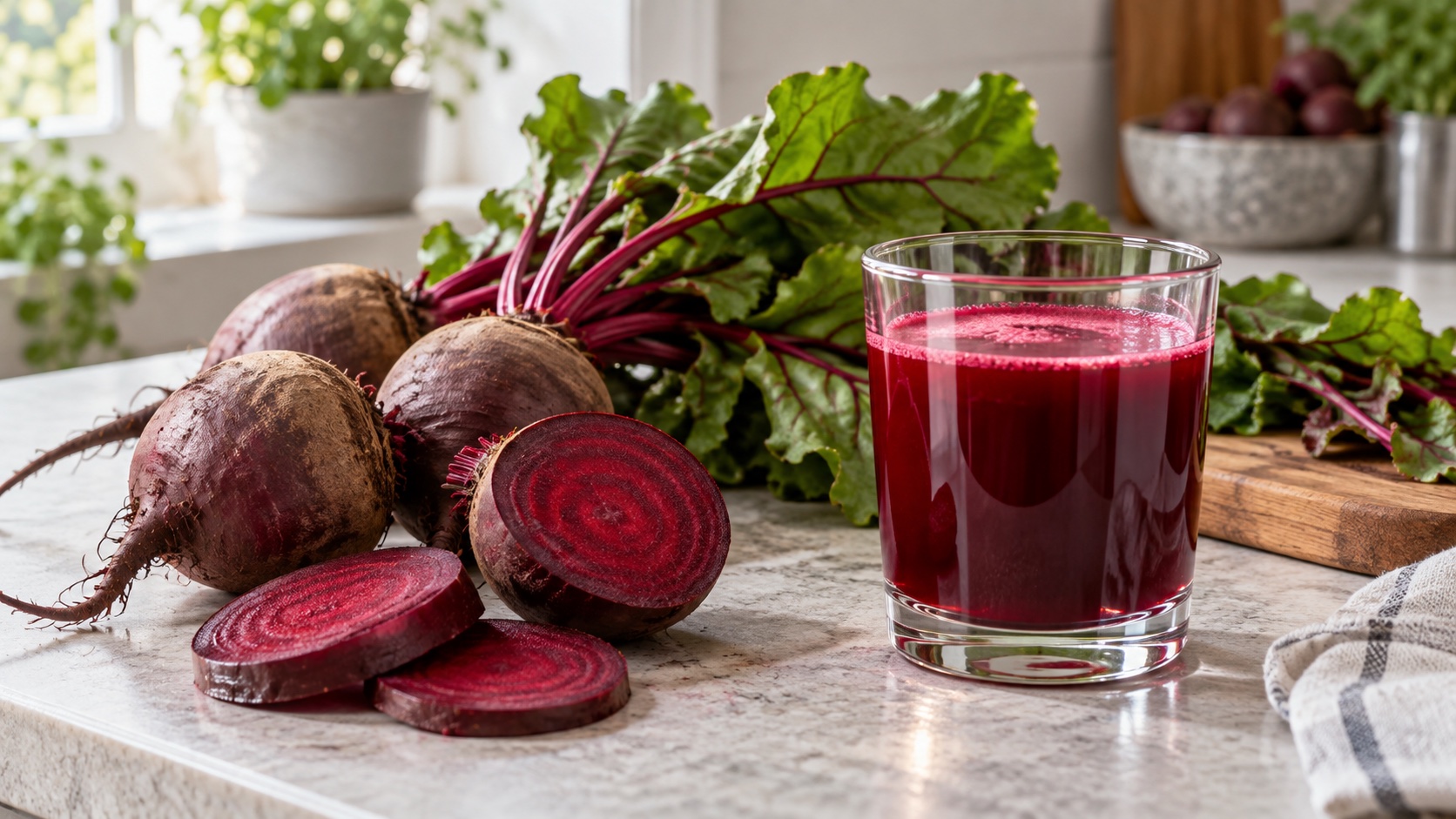
Beetroot juice
A convenient nitrate-rich vegetable-juice option for people who choose it as food or a beverage.
⚠️ Can color urine or stool; nitrate-rich juice may be unsuitable for some people with kidney-stone concerns, low blood pressure, or blood-pressure medicines. It is not a substitute for clinical care.
Check price on Amazon →The Acute Dose: What One Glass Does
The classic experiment is simple: 500 mL of beetroot juice, a few hours of waiting, and a systolic reading several mmHg lower than placebo. The landmark 2008 trial reported drops of roughly 10 mmHg systolic at the two-to-three-hour mark, and the pattern has reproduced across small trials since — larger effects in people with higher starting readings, smaller in everyone else, and a predictable fade as nitrite clears.
- 🥤 500 mL is the classic dose — about two small glasses, and most acute trials use something similar.
- 📉 Roughly 5–10 mmHg systolic acutely — the range across trials, larger with higher starting pressure.
- ⏳ It wears off within hours — the acute effect is a window, not a baseline shift.
- 🧪 Response varies person to person — gut bacteria, saliva, and baseline pressure all shape the number you would see.
The Dose Question: How Much Nitrate Is Enough
The trials cluster around a fairly narrow dose window: 250–500 mL of juice or roughly the equivalent in nitrate salts. More is not clearly better — the conversion pathway saturates, and the extra oxalate, sugar, or cost buys little. The practical version of the dose question is simpler: a serving of nitrate-rich vegetables a day puts most people in the same range as the low end of the trial doses.
- 🧪 The trials cluster at 250–500 mL of juice — or the salt equivalent, and the window is narrow.
- ⛔ More is not clearly better — the conversion pathway saturates past a point.
- 🥗 A serving of arugula or spinach lands in the low end of the trial range — food doses are trial-adjacent, not trial-remote.
- 🧃 Batch variation is real — the same bottle is not the same dose twice, which is one more argument for vegetables.
Repeated Doses: The Two-Week Picture
Daily dosing keeps the effect alive, at least for a while. A 2013 systematic review and meta-analysis found daily nitrate or beetroot juice associated with roughly 4–5 mmHg lower systolic pressure, with larger effects in people with elevated readings. A six-week placebo-controlled trial in patients already on antihypertensives reported about 7.7 mmHg systolic and 2.4 mmHg diastolic, and a four-week trial in older overweight adults found a similar systolic figure. The catch is that nearly all of this rests on small samples and short windows.
- 📚 Meta-analysis: roughly 4–5 mmHg systolic — daily nitrate, larger effects in elevated pressure.
- 🩺 The 6-week trial: ~7–8 mmHg systolic — real, but a small sample of treated hypertensives.
- ❓ Durability is the open question — few trials run past a month, and none reports outcome effects.
- 🧪 Washout is real — pressure drifts back toward baseline when the nitrate stops, which is honest news.
Who Should Be Cautious
The caution list is short but specific, and it is where the clinician handoff lives. Nitrate handling changes with kidney disease, and beetroot itself carries oxalate — an ingredient in some kidney stones. People on blood-pressure medications can see an additive drop, and combining nitrate with nitrate-based angina medicines or certain erectile-dysfunction drugs can push pressure too far. The parent topic Supplements & Blood Pressure and the Blood Pressure Protocol cover the measurement and the levers that surround this one.
- 🫘 Kidney disease changes the math — nitrate handling shifts, and beetroot's oxalate is a stone question for some people.
- 💊 Blood-pressure medications can stack — an additive drop is possible; monitoring with your care team is the answer.
- 🩸 Nitrate-based angina medicines and some ED drugs — combining can drop pressure too far.
- 👶 Keep the juice away from infants — infant methemoglobinemia is a documented food-safety concern, not a rumor.
⚠️ The juice is not for everyone
If you have kidney disease, take blood-pressure medication, or use nitrate-based or erectile-dysfunction medications, the beetroot bottle deserves a clinician or pharmacist check before it becomes a habit. This page describes what trials report; it does not prescribe.
| Form | What the data show | Caution |
|---|---|---|
| 🧃 Beetroot juice (250–500 mL) | Best-studied form; acute and short-term effects | Oxalate, sugar, cost |
| 🧂 Nitrate salts (capsules) | Dose-precise studies, same direction | Less food context |
| 🍠 Nitrate-rich vegetables | Food-first route; modest and safe | Preferred |
| 🥤 Concentrated "beet shots" | Marketing-heavy; doses vary | Check the label |
Food Sources Before Bottles
Nitrate is not rare in food — several vegetables carry more per serving than a glass of juice, which makes the food-first version of this story unusually easy. Arugula and spinach top the charts, beetroot and celery sit close behind, and a salad can deliver the dose without the oxalate concentration of a juice, the added sugar, or the price tag.
- 🥗 Arugula and spinach lead — a serving rivals a small glass of juice on nitrate content.
- 🍠 Beetroot, celery, radish, and lettuce follow — everyday vegetables, everyday doses.
- 🔥 Cooking leaches nitrate — raw or lightly cooked keeps more of it in the food.
- 🧂 Processed meats are a different story — added nitrite in processed meat sits in a different food-safety context than vegetable nitrate.
- 🥬 Frozen and canned options retain nitrate reasonably well — processing is not the enemy; leaching into cooking water is.
Questions, Answered Briefly
- ❓ Does the juice have to be fresh? — nitrate content varies by batch and storage; the trials used standardized products, which is worth remembering when your glass is stronger or weaker.
- ❓ Will it keep working at week eight? — unknown; almost no trial runs that long, which is the honest summary of the durability question.
- ❓ Is a beetroot shot before exercise the same thing? — the sports world uses similar products for performance; the pressure data come from juice and salts, not shots.
- ❓ I use mouthwash daily. Does that kill the effect? — antibacterial mouthwash reduces the conversion step, and some studies show a blunted response.
- ❓ Should I tell my clinician about beetroot? — yes, especially with blood-pressure medication, kidney disease, or a history of kidney stones; the list-and-handoff rule from the safety check applies.
- ❓ Does cooking destroy the effect? — it reduces nitrate content; raw or lightly cooked greens keep more, which is one more point for salads.
- ❓ Can I get the same from celery juice or other vegetables? — nitrate content varies by vegetable and batch; arugula, spinach, beet, and celery are the reliable picks.
- ❓ Is there a downside to daily greens? — for healthy kidneys, no; the caution list on this page is about juice, salts, and specific medications, not vegetables.
- ❓ What does a reading change mean for my risk? — a lower reading is associated with lower risk, but a biomarker change is not an outcome; the long-term trials simply do not exist here.
The Bottom Line
- The acute effect is real and short. Hours, reproducible, and dose-tied — the strongest part of the nitrate story.
- Repeated-dose data are small but consistent. Days to weeks of daily nitrate keeps pressure lower in most trials.
- Kidneys, medications, and stones decide who skips the bottle. The caution list is short and specific; the handoff is not optional for people on it.
- Vegetables deliver the same nitrate with more context. Arugula, spinach, and beetroot beat the bottle on every other variable.
Related Topics
- Webb AJ, et al. "Acute blood pressure lowering, vasoprotective, and antiplatelet properties of dietary nitrate via bioconversion to nitrite," Hypertension (2008)
- Kapil V, et al. "Dietary nitrate provides sustained blood pressure lowering in hypertensive patients: a randomized, phase 2, double-blind, placebo-controlled study," Hypertension (2015)
- Siervo M, et al. "Inorganic nitrate and beetroot juice supplementation reduces blood pressure in adults: a systematic review and meta-analysis," Journal of Nutrition (2013)
- Jajja A, et al. "Beetroot supplementation lowers daily systolic blood pressure in older, overweight subjects," Nutrition Research (2016)
- Vanhatalo A, et al. "Acute and chronic effects of dietary nitrate supplementation on blood pressure and the physiological responses to moderate-intensity and incremental exercise," American Journal of Physiology — Regulatory, Integrative and Comparative Physiology (2010)
- Lundberg JO, et al. "Roles of dietary inorganic nitrate in cardiovascular health and disease," Cardiovascular Research (2011)