Garlic, CoQ10 and Omega-3: Three Popular Picks
These three bottles outsell almost everything else in the blood-pressure aisle, and each carries a different evidence story. Garlic has the most consistent trial record. CoQ10 has enthusiastic small trials and a cool Cochrane review. Omega-3 has decades of cardiovascular research and a modest average effect on pressure. This page grades each honestly, then asks the question the marketing skips: what does study quality actually let you conclude?
What the evidence supports
- Garlic preparations, especially aged garlic extract, are associated with lower systolic pressure in several meta-analyses, mainly in people with elevated readings.
- CoQ10 shows pressure reductions in small trials, mostly in hypertensive subgroups.
- Omega-3 fatty acids at gram-level doses are associated with small average reductions.
What remains uncertain
- Which garlic preparation and dose to prefer; most trials are short.
- CoQ10's effect size rests on small, heterogeneous trials with mixed funding.
- Whether omega-3's small average effect matters for an individual, and the bleeding-interaction question at high doses.
Evidence last reviewed: August 20, 2026. Conclusions may change as new research is published.
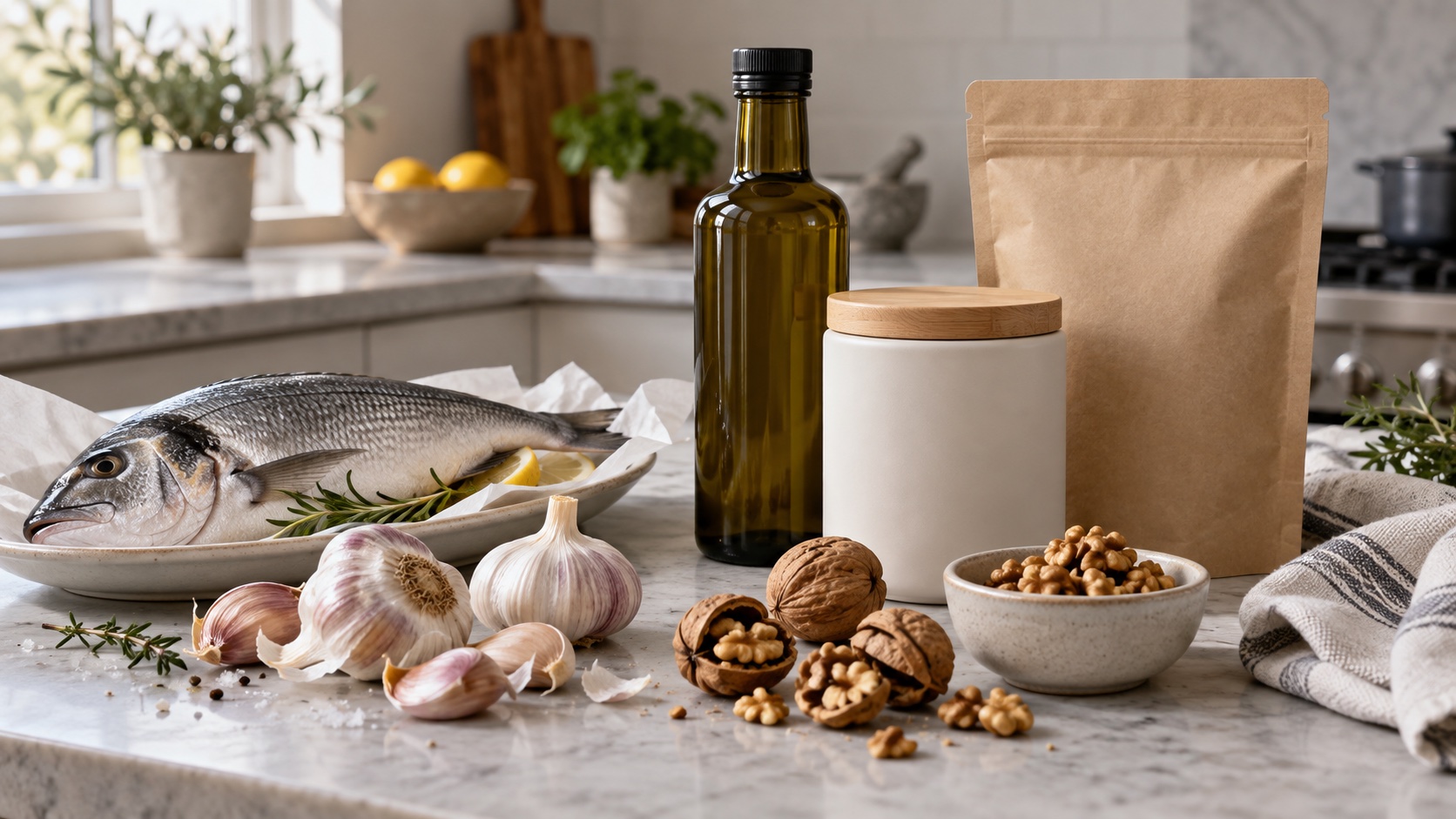
Three Bottles, Three Evidence Stories
Grouping these three together is a habit of the supplement aisle, not of the evidence base. They share a shelf and a marketing budget, but their trial records diverge sharply: garlic has repeated meta-analyses pointing the same direction, omega-3 has a huge cardiovascular literature with a small pressure signal, and CoQ10 has a handful of small trials that have not convinced the systematic reviewers. The Supplements & Blood Pressure topic frames the whole series, and the Blood Pressure Protocol holds the levers that outrank all three bottles.
- 🧄 Garlic: consistency — meta-analyses across preparations point the same direction, mainly in elevated pressure.
- 💊 CoQ10: enthusiasm — headline effects from small trials, a cool review from the group that looks hardest.
- 🐟 Omega-3: volume — a vast literature, a modest average effect, and a dose question.
- ⚖️ None of them prescribes itself — every bottle on this page sits beside treatment decisions, never under them.
Product picks are generic categories, not brands. We may earn a commission on Amazon or iHerb purchases at no cost to you — this never changes our evidence conclusions. Full disclosure
Omega-3 EPA/DHA supplement
May help people with low fish intake meet EPA/DHA intake goals; outcome benefits vary by population and dose.
⚠️ May cause gastrointestinal effects and can matter for bleeding risk or medication interactions at higher doses; seek advice when relevant.
Check price on Amazon →Garlic: The Most Consistent Trial Record
Garlic's reputation survives contact with the data. Meta-analyses of randomized trials — including a 2008 review in BMC Cardiovascular Disorders and a 2016 update in the Journal of Nutrition — report systolic reductions of roughly 4–10 mmHg in people with elevated pressure, with little effect in people with normal readings. The trials cluster around aged garlic extract at 240–960 mg daily or garlic powder at 600–1200 mg, and most run eight to twelve weeks. That is a real, if modest, signal — and it is the strongest one on this page.
- 🧄 Aged garlic extract dominates the trials — 240–960 mg daily is the common range.
- 📉 Roughly 4–10 mmHg systolic in elevated pressure — the range across meta-analyses, hedged and honest.
- 🩺 Little effect in normal readings — the same pattern every real pressure intervention shows.
- ⏳ Weeks, not days — the trials run two to three months, and the effect emerges on that schedule.
CoQ10: Small Trials, Mixed Results
CoQ10's headline number comes from a 2007 meta-analysis of twelve small trials reporting roughly 11 mmHg systolic reductions, mostly in hypertensive patients, at doses around 100–200 mg daily. The trials were short, small, and variable — the whole meta-analysis rests on a few hundred participants — and a 2014 Cochrane review found insufficient evidence to support CoQ10 for preventing cardiovascular disease. Plausible mechanism, small trials, cool reviewers: the honest grade is mixed.
- 📏 ~11 mmHg in pooled small trials — mostly hypertensive patients, mostly short windows.
- 🧪 Sample sizes are tiny — the headline rests on a few hundred participants across twelve trials.
- 📚 The Cochrane counterweight — the 2014 review found insufficient evidence for outcomes, which is the sober version of the story.
- 💊 Doses around 100–200 mg/day appear in the trials — and quality varies enough that the dose is the least of the questions.
Omega-3: Modest, Dose-Dependent, Well Studied
Omega-3 has the opposite problem from CoQ10: no shortage of research, and a small average effect. A metaregression of randomized trials found roughly 2 mmHg systolic reduction at gram-level EPA and DHA doses, with a hint of more effect at higher doses and in people with elevated pressure. Decades of fish-intake cohorts point the same general direction. The average is real but small, the dose needed is large, and the interaction questions at high doses are real — which makes omega-3 the most-studied and least-exciting bottle on this page.
- 🐟 Roughly 2 mmHg systolic on average — at gram-level EPA and DHA doses, larger in elevated pressure.
- 📈 Dose-dependence appears — more omega-3, larger average effect, up to the gram scale.
- 🥗 Fish first — food intake carries the same fatty acids plus protein and context.
- 🩸 High doses meet anticoagulants — a real interaction question for the pharmacist, not a footnote.
| Supplement | Trial dose | Reported systolic effect | Tier |
|---|---|---|---|
| 🧄 Garlic (aged extract or powder) | 240–1200 mg/day | ~4–10 mmHg in elevated pressure | Best supported |
| 💊 CoQ10 | 100–200 mg/day | ~11 mmHg in small hypertensive trials | Modest |
| 🐟 Omega-3 (EPA + DHA) | 2–4 g/day | ~2 mmHg average | Modest |
| 🧴 Multi-ingredient "BP blends" | Varies | No reliable trial support | Limited |
A Note on Doses and Preparations
Preparation matters more than brand. Garlic's trials used standardized aged garlic extract or powder, CoQ10's used ubiquinone at 100–200 mg, and omega-3's used EPA plus DHA at gram doses — not the "heart blend" on the endcap. A bottle that lists no dose, a proprietary blend, or a serving size smaller than the daily recommendation is asking you to guess.
- 🧄 Standardized garlic is the trial-tested form — aged extract or powder with a listed active-compound figure.
- 💊 CoQ10 forms vary — ubiquinone appears in the trials; the newer form is a marketing upgrade, not an evidence upgrade.
- 🐟 Omega-3 labels hide the EPA and DHA split — the combined gram dose is the number that matters.
- 🧴 "Proprietary blends" are the giveaway — if the dose is not listed, the label is the product.
What Study Quality Tells You
The difference between garlic and CoQ10 is not mechanism; it is trial quality. Duration, sample size, funding, and outcome measurement decide how much a headline is worth, and the supplement literature is full of headlines built on short, small, sponsored trials. Reading the meta-analysis instead of the label is the whole game.
- ⏳ Duration — most trials run weeks, not years; durability is unknown for every bottle here.
- 🧮 Sample size — CoQ10's headline number comes from a pool smaller than many single diet trials.
- 💰 Funding — industry-sponsored trials skew positive; the disclosure line is worth reading.
- 🎯 Outcomes — no supplement trial in this space shows stroke or heart-event effects, and none should be sold as doing so.
- 🔁 Replication — a finding that repeats across independent groups is worth more than a single dramatic trial, which is why garlic leads this trio.
⚠️ Interactions live here too
Garlic can add to anticoagulant effects, CoQ10 interacts with warfarin, and gram-dose omega-3 can lengthen clotting times. Anyone on blood thinners or blood-pressure medication should run the list past a clinician or pharmacist before starting any of these — and never stop a prescribed medication to make room for a bottle.
Questions, Answered Briefly
- ❓ Can I take all three? — nothing here forbids it on paper, but the interaction check with your pharmacist comes first, and stacking bottles is not the same as adding their averages.
- ❓ Fresh garlic or capsules? — the trials used standardized preparations; fresh garlic is fine food, but the trial record belongs to the extracts.
- ❓ Why does garlic smell like the whole story? — the allicin and sulfur compounds are also the antiplatelet chemistry behind the bleeding caution; the active ingredient is the interaction risk.
- ❓ Is omega-3 from food enough? — two oily-fish servings a week is the dietary guidance; the gram-level doses in the pressure trials generally exceed food intake.
- ❓ How do I know a "BP blend" is weak? — if the label lists everything and the trial record lists nothing, the blend is the giveaway; the tier table on the summary page grades this pattern.
- ❓ Is there any harm in trying one bottle for a month? — with the interaction check done and a clinician aware, a trial period is a reasonable experiment; the monitor is the referee.
- ❓ Do these supplements help if I already eat well? — the effects are smaller still; the food pattern is the floor and the ceiling for most people.
- ❓ What about omega-3 for heart health beyond pressure? — the broader cardiovascular literature is a separate, larger story; this page grades pressure effects only.
- ❓ When would I see anything on the monitor? — weeks, if at all, and mostly in elevated readings; the measurement protocol is the referee.
The Bottom Line
- Garlic leads the trio on evidence consistency. Multiple meta-analyses, elevated-pressure effects, weeks-scale schedule.
- CoQ10 is small trials and a cool Cochrane review. Plausible, underpowered, and honestly graded as mixed.
- Omega-3 is modest, dose-dependent, and better from fish. A small average that needs gram doses to appear.
- Disclose everything; nothing here replaces prescribed treatment. The interaction check belongs before the first bottle.
Related Topics
- Ried K, et al. "Effect of garlic on blood pressure: a systematic review and meta-analysis," BMC Cardiovascular Disorders (2008)
- Ried K, "Garlic Lowers Blood Pressure in Hypertensive Individuals, Regulates Serum Cholesterol, and Stimulates Immunity: An Updated Meta-analysis and Review," Journal of Nutrition (2016)
- Rosenfeldt FL, et al. "Coenzyme Q10 in the treatment of hypertension: a meta-analysis of the clinical trials," Journal of Human Hypertension (2007)
- Flowers N, et al. "Co-enzyme Q10 supplementation for the primary prevention of cardiovascular disease," Cochrane Database of Systematic Reviews (2014)
- Geleijnse JM, et al. "Blood pressure response to fish oil supplementation: metaregression analysis of randomized trials," Journal of Hypertension (2002)
- Appel LJ, et al. "Does supplementation of diet with 'fish oil' reduce blood pressure? A meta-analysis of controlled clinical trials," Archives of Internal Medicine (1993)
- Mozaffarian D, Wu JHY, "Omega-3 fatty acids and cardiovascular disease: effects on risk factors, molecular pathways, and clinical events," Journal of the American College of Cardiology (2011)