Acrylamide: The Toast Question
Should browned toast be on your worry list? This page gives the honest version: acrylamide is a real compound with real animal evidence, and the human picture is much less dramatic than the headlines suggest. The interesting part is scale — how a nearly fourfold change in one slice compares with everything else in your day.
What the evidence supports
- Acrylamide forms naturally in starchy foods — bread, potatoes, coffee — during high-temperature cooking, through the same Maillard browning reaction that gives toast its flavor (EFSA, 2015).
- Europe's food-safety authority concluded in 2015 that acrylamide and its metabolite glycidamide are genotoxic and carcinogenic in animals, and could not set a tolerable daily intake for dietary exposure.
- Large human studies spanning decades have not found a consistent association between dietary acrylamide and any cancer — the National Cancer Institute's summary of the epidemiology.
- The practical levers are concrete and overlap with good cooking: lighter browning for toast and fried potatoes, and keeping raw potatoes out of the refrigerator.
What remains uncertain
- Human intake estimates rely on diet questionnaires and food tables, and people's recall of how brown they cook things is imprecise — one reason the human studies disagree with each other.
- No randomized trial has tested dietary acrylamide against cancer outcomes, and none is realistically coming; the question will stay observational.
- Whether a small effect exists at typical dietary intakes — as opposed to the much higher doses used in animal studies — remains unresolved.
Evidence last reviewed: October 7, 2026. Conclusions may change as new research is published.
A Population Question, Not a Poisoning One
Nothing on this page is about acute poisoning. Acrylamide does not make anyone feel unwell at meal doses; the question scientists are arguing about is statistical — whether decades of eating more or less of certain browned foods shifts cancer rates across a whole population. That distinction changes how the evidence should be read. A hazard being real (the compound can damage DNA in laboratory systems) is different from a risk being large at the doses ordinary diets actually deliver.
It also explains why regulators could not simply name a safe daily limit. For compounds that interact with DNA directly, the standard toxicology assumption is that no exposure threshold can be treated as definitively harmless — so EFSA's 2015 opinion, after reviewing the animal and human data, did not set a tolerable daily intake. That is a statement about uncertainty at the margins, not a verdict on your breakfast.
What Acrylamide Actually Is
In food, acrylamide is a by-product of browning. It forms when the amino acid asparagine — plentiful in potatoes and grains — reacts with certain sugars at high temperatures (above roughly 120°C) in low-moisture conditions: frying, roasting, baking, and toasting (EFSA, 2015). The very Maillard reaction that makes toast taste like toast produces traces of it. It shows up in potato crisps, French fries, bread crusts, biscuits, and coffee. Acrylamide was first detected in foods only in 2002, when analytical chemistry caught up with something likely present since humans started cooking over fire (EFSA).
In the body, some of it converts into glycidamide, a more reactive molecule that can bind DNA. That reactivity is the basis of the animal hazard finding — and the reason the human studies keep being run.
What the Human Studies Found
The animal case is real and serious. Rodents given acrylamide in drinking water developed tumors, and the U.S. National Toxicology Program lists acrylamide as "reasonably anticipated to be a human carcinogen" on that basis.
The human case is where the picture softens. The National Cancer Institute's fact sheet summarizes the epidemiology bluntly: a large number of human studies — both case-control and cohort designs — have found no consistent evidence that dietary acrylamide is associated with the risk of any type of cancer. One structural reason is measurement. Nobody can reliably recall how browned their food was over the past decade, so even the best intake estimates are rough, which blurs real effects and manufactures noise.
There is a smoking footnote that matters for scale. People who smoke carry three to five times higher acrylamide exposure markers in their blood than people who do not (NCI) — because tobacco smoke is its own major exposure route. On the exposure ledger, a cigarette is simply in a different league from a slice of toast.
The Scale Problem
Here is the part most acrylamide coverage skips. EFSA's exposure analysis put the share of average adult dietary intake at up to about 49 percent from fried potato products, around 34 percent from coffee, and around 23 percent from soft bread. Toast lives inside that last category.
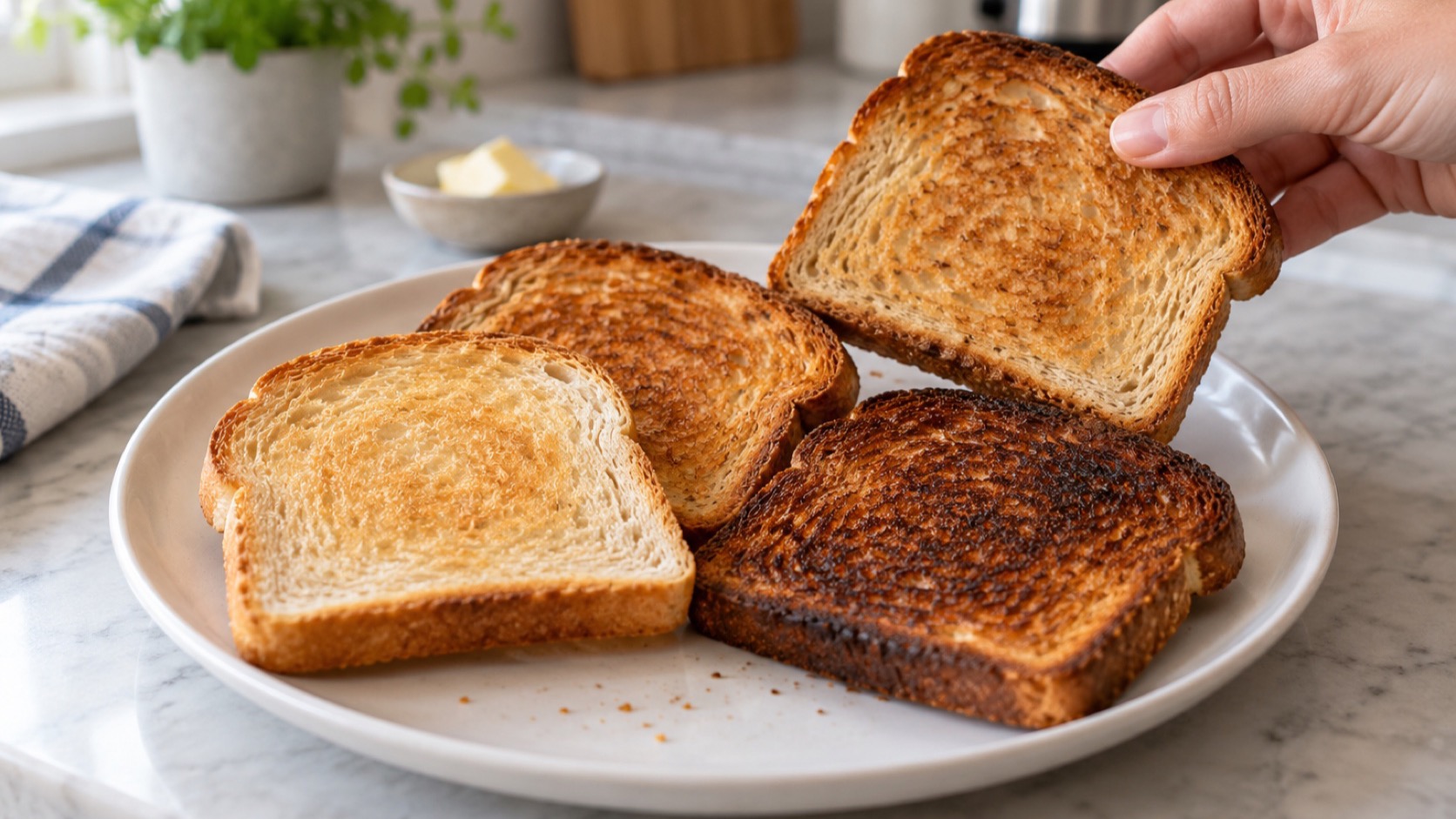
How small can a toast choice be? In the comparison summarized in the EFSA opinion, toasting bread for five minutes instead of three raised acrylamide in the bread itself from roughly 31 to 118 micrograms per kilogram — while moving average total dietary exposure by only about 2.4 percent. One contributor changed by close to four times; the total barely moved.
What Actually Reduces It
The reductions that agencies actually advise are mundane. None of them requires new equipment, and all of them stop short of giving up the foods:
| Situation | Practical move | Backing |
|---|---|---|
| 🍞 Toast and bread | Go golden, not deep brown — stop before the dark stage. The NCI's own phrasing is "decreasing cooking time to avoid heavy crisping or browning." | NCI fact sheet |
| 🥔 Raw potatoes | Store them cool and dark, not in the refrigerator — cold storage raises the sugars that later become acrylamide when the potato is fried. | NCI; EFSA |
| 🍟 Fried potatoes | Cook lighter than the darkest fry; discard very dark and burnt pieces; follow the package's cooking instructions rather than improvising. | EFSA; FDA |
| ☕ Coffee | Not really a home lever — roasting is industrial. Coffee's contribution is a fact about populations, not a knob in your kitchen. | EFSA exposure data |
🍞 The one-line toast answer
Toasting lighter meaningfully reduces the acrylamide in the slice — from roughly 118 back toward 31 micrograms per kilogram in the EFSA comparison — but because toast is a minor contributor overall, the move shifts your total exposure by only about 2 percent. Do it because golden toast tastes like toast; do not do it while bracing for anything.
Questions, Answered Briefly
- 😟 So is my toast dangerous? No — at toast doses this is a small, long-term statistical question, and lighter toasting shrinks it further. It is not an acute-toxicity situation at any plausible amount of toast.
- 🍟 Do I need to quit chips and fries? Not over this compound in isolation. "Lighter, golden, less often" is the direction the rest of the nutrition evidence points anyway — the acrylamide story just adds a nudge with the same sign.
- ☕ Is coffee a problem here? Coffee is a large share of population exposure, yet human studies have not tied dietary acrylamide to cancer. Coffee's own ledger involves different questions than this one.
- 🌀 Does an air fryer change things? It browns with high, dry heat, like roasting — so the golden-not-dark rule applies there too. The degree of browning matters more than the appliance.
- 🥕 Should roasted vegetables worry me? Vegetables are not among the major contributors in EFSA's exposure analysis — the fried potato, coffee, and bread trio does the heavy lifting — so the roasting pan itself is not the issue.
- 🧒 Are children affected differently? Exposure per kilogram of body weight runs higher in children (EFSA), and the same cooking advice covers them. Very dark fried food is the easiest thing to skip entirely.
The Honest Reading
If this page compressed to one sentence, it would be: the compound deserves its listing, and your toast does not deserve your worry. The moves that make a measurable difference — pushing fried potatoes toward golden, keeping raw potatoes out of the cold, leaving the burnt chips on the tray — are the same moves a cook would make for flavor and texture.
Acrylamide is also just one of the browning chemistries. The same high-heat, low-moisture conditions that brown meat form HCAs and PAHs — the charring page takes that apart — and browning of all kinds forms advanced glycation end products, covered on the AGEs page. Each of those carries its own evidence weight, and each is a smaller per-person risk than the food-safety basics on the leftovers page — the part of this topic with rules you should genuinely follow.
If you are pregnant, immunocompromised, or cooking for young children or older adults, that ranking matters more, not less — the safety rules are the ones to get right, and this statistics question can wait. It all sits inside the parent topic, Cooking, Char & Storage.
The Bottom Line
- The hazard is real; the everyday alarm is not. Acrylamide is genotoxic and carcinogenic in animal studies, and large human studies have not shown a consistent cancer link at dietary doses.
- Scale decides where effort goes. Fried potato products and coffee dominate population exposure; toast browning moves total intake by a couple of percent.
- The practical moves are cheap. Toast golden instead of dark, keep raw potatoes cool and dark rather than refrigerated, and skip burnt fried pieces — all agency-endorsed, none dramatic.
- Food safety outranks acrylamide arithmetic. The kitchen risks with decisive rules are storage, reheating, and cross-contamination. Treat this page as population statistics, not an emergency.
Related Topics
- EFSA Panel on Contaminants in the Food Chain, "Scientific Opinion on acrylamide in food," EFSA Journal (2015) — efsa.europa.eu
- National Cancer Institute, "Acrylamide and Cancer Risk" (fact sheet) — cancer.gov
- U.S. Food and Drug Administration, "Acrylamide" — fda.gov
- National Toxicology Program, Report on Carcinogens (acrylamide: "reasonably anticipated to be a human carcinogen") — ntp.niehs.nih.gov