Charring, HCAs and PAHs
Char is where grilling gets its flavor — and where two families of compounds form that laboratory studies flag as mutagenic. This page separates the chemistry from the scare: what HCAs and PAHs are, how much of them ordinary grilling produces, what decades of human research have and have not shown, and the practical moves that shrink the exposure without giving up the grill.
What the evidence supports
- The formation chemistry is well understood: cooking muscle meat at high temperatures forms HCAs from amino acids, sugars, and creatine, while fat dripping onto hot surfaces produces PAH-laden smoke that settles back onto the meat (NCI).
- Both compound families are mutagenic in laboratory systems, and animal studies have produced tumors — at doses far above ordinary eating.
- Human population studies have not established a definitive link: the colorectal-cancer associations with grilled-meat compounds are modest and mixed (Cross & Sinha, 2004).
- Cancer-prevention guidance is nonetheless simple and consistent: do not eat charred or blackened food, and avoid cooking meat directly over a flame where possible (WCRF/AICR).
What remains uncertain
- Human studies struggle to isolate grill compounds from everything else that travels with a heavy-grill diet — processed meat, low fiber, body weight.
- No randomized trial has tested charring against cancer outcomes, and none is coming; this field will stay observational.
- Whether occasional well-done grilling meaningfully shifts personal risk, rather than being a rounding error next to overall diet quality, remains unresolved.
Evidence last reviewed: October 7, 2026. Conclusions may change as new research is published.
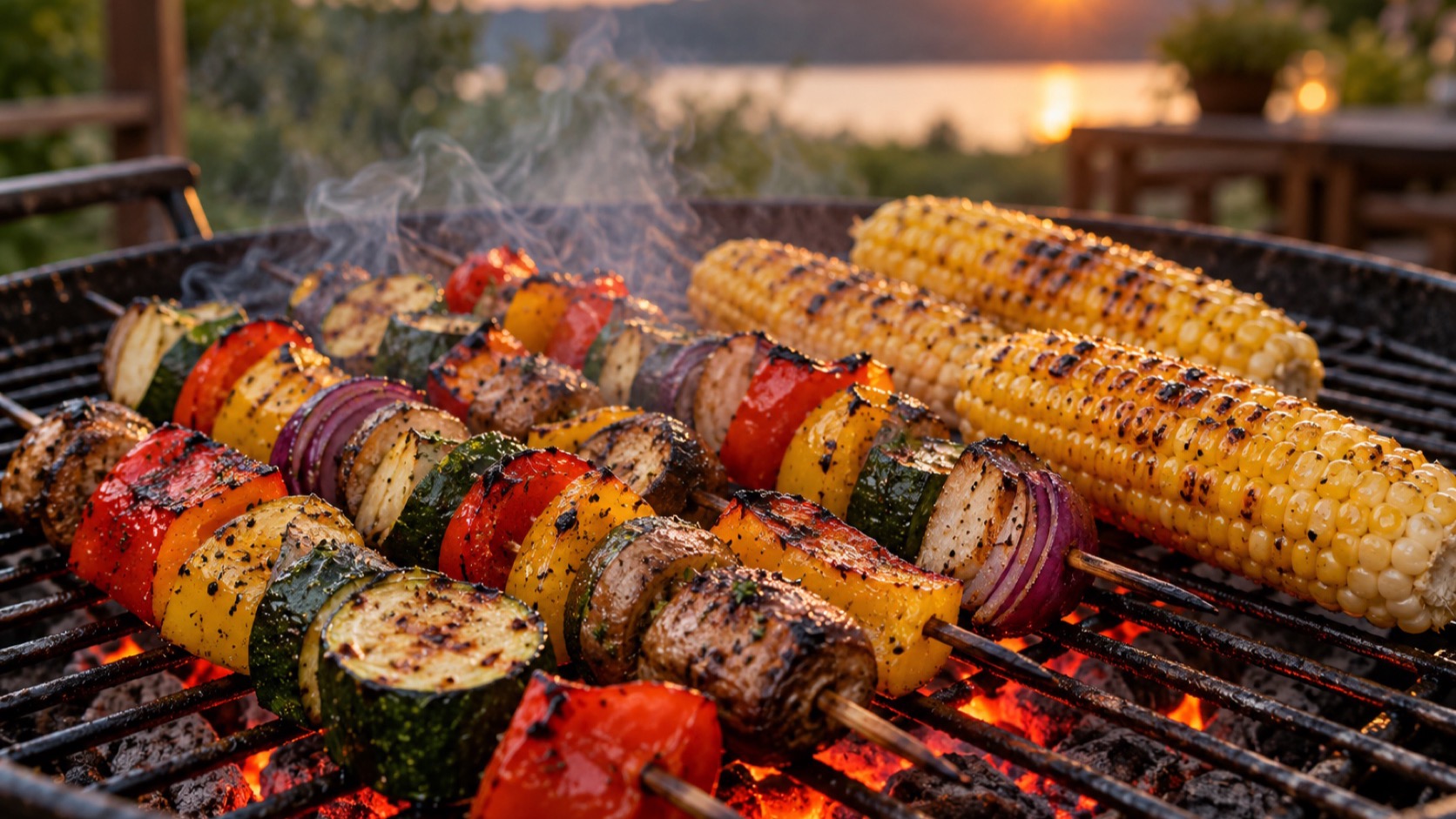
Two Families, One Hot Grill
The National Cancer Institute defines the players plainly: heterocyclic amines (HCAs) and polycyclic aromatic hydrocarbons (PAHs) are chemicals formed when muscle meat — beef, pork, fish, or poultry — is cooked with high-temperature methods such as pan frying or grilling directly over an open flame. In laboratory experiments, both have been found to be mutagenic, meaning they can cause changes in DNA that may raise cancer risk.
That is the honest starting point: a real chemical story with real laboratory findings. The rest of this page is about the two questions the laboratory cannot answer — how much forms in a real kitchen, and what that has meant for real people.
The Chemistry in Plain Terms
- 🥩 HCAs form inside the meat. Amino acids, sugars, and creatine — a compound found in muscle — react at high temperatures. Above roughly 300°F, as in grilling or pan frying, formation climbs; well-done, grilled, or barbecued chicken and steak carry the highest concentrations (NCI).
- 💨 PAHs form in the smoke. When fat and juices drip onto a heated surface or open fire, the resulting flames and smoke carry PAHs that adhere to the meat's surface. Smoking meats forms them too (NCI).
- 🥦 Vegetables are not the HCA story. No creatine, no HCA formation to speak of — the charred-vegetable question is mostly about the same "don't eat blackened food" guidance, not about meat chemistry.
- 🍞 Browning in starch is a different compound. The browned-starch side of browning — toast, fries, coffee — is acrylamide territory, which the toast page covers. Same heat, different chemistry.
What the Human Evidence Shows
The animal case is serious on paper: rodents fed diets supplemented with HCAs developed tumors of the breast, colon, liver, and other organs, and PAH-fed rodents developed cancers as well. But the NCI is careful to add the number that matters — the doses used were equivalent to thousands of times what a person consumes in a normal diet.
In people, the picture stays modest. The NCI's summary states that population studies have not established a definitive link between HCA and PAH exposure from cooked meats and cancer in humans, and the foundational review by Cross and Sinha (2004) describes the human evidence as mixed and modest. One structural reason: heavy-grill diets travel with other things — more processed meat, less fiber — and statistics struggle to separate the travelers.
Processed meat deserves its own line here, because it is the part of the meat ledger with the most consistent human evidence. IARC's 2015 evaluation classified processed meat in its highest hazard group — a hazard classification, not a personal risk number — and the ultra-processed foods topic owns that evidence in full. Charring is a separate, smaller line item next to it.
The Guideline and the Overclaim
Here is where most grill coverage slides off the rails in one direction or the other. In one direction: "grilling causes cancer" — a headline the human data do not support at typical intakes. In the other: "it's just char, relax" — which ignores a laboratory finding serious enough that cancer-prevention bodies put "do not eat charred or blackened food" in writing.
Both statements can be held honestly at once. A hazard being real — these compounds can mutate DNA — is not the same as the risk being large at the doses a normal diet delivers. The animal doses were thousands of times higher; the human associations are modest; and the guideline is cheap to follow. That combination is exactly what "avoid blackening, without alarm" looks like.
🔥 Char is a guideline signal, not a verdict
The "do not eat charred or blackened food" line is a low-cost habit aimed at a plausible, if modest, long-term risk — not a judgment that any single grilled dinner did damage. Read it the way you would read "don't sunburn": it shapes the pattern, not the one-off. The heavier meat questions — processed meat, portion patterns — are settled elsewhere, with better data.
Practical Moves at the Grill
Every one of these has a laboratory rationale behind it, and none of them ruins the meal:
- 🧂 Marinate first. Marinades have consistently reduced HCA formation in lab studies; even a brief soak counts. Flavor is the point; the reduction is a bonus.
- ♨️ Partially pre-cook. A few minutes in the oven or microwave shortens the time the meat spends over high heat — and the time it spends forming HCAs.
- 🔁 Flip often. Frequent turning keeps any one surface from spending long stretches against the heat and reduces charring per side.
- ✂️ Trim the fat. Less fat means fewer drippings, and fewer drippings mean less smoke carrying PAHs back onto the meat.
- 🚒 Dodge the flare-ups. When fat ignites, move the meat to a cooler zone until the flames die down — the smoke plume is the PAH delivery system.
- 🌡️ Lower the heat — but don't undercook. Medium heat and a thermometer is the combination; avoiding char is never a reason to serve undercooked meat. The food-safety page owns those temperatures, and food safety wins that trade every time.
The Methods, With Honest Badges
How the main cooking approaches compare, with the confidence levels kept honest. "Avoid blackening" is guidance; the rest is formation chemistry:
| Method | What forms | Read |
|---|---|---|
| 🔥 Direct flame, charred | HCAs rise with temperature and time; PAHs from fat-driven smoke settle on the surface | Avoid blackening |
| 🍖 Grilled, trimmed and flipped | Fewer drippings and shorter high-heat contact — the same cookout, less formation | Manageable |
| 🍳 Pan-fried, well done | HCAs track doneness and time at high heat; a lighter sear forms less | Watch doneness |
| 🍲 Braised, stewed, steamed | Wet heat stays below the formation window; no smoke contact | Lower formation |
| 🥦 Grilled vegetables | No creatine, so little HCA formation — PAHs remain a meat-surface story | Not the concern here |
All of this sits inside the parent topic, Cooking, Char & Storage, which keeps the series map — and the practical hierarchy — in one place.
Questions, Answered Briefly
- 🍗 Is grilled chicken safer than grilled steak? Doneness and charring matter more than the animal: well-done, grilled chicken and steak both carry the highest HCA concentrations (NCI).
- 🗓️ Does frequency matter more than method? Yes — this is a habit question. A few charred cookouts a year are not the pattern the guidance is aimed at; a weekly heavily-charred-and-processed-meat routine is.
- 🥓 What about smoked meats? Smoking forms PAHs directly, and most smoked meats are also processed meats — so they sit in the better-studied bucket, covered by the ultra-processed topic.
- 💊 Can anything undo the compounds after cooking? Nothing in the evidence supports a countermeasure after the fact; the levers all sit upstream, at the grill. Treat products claiming otherwise with the usual skepticism.
- 🩺 Who should read this page differently? If you are pregnant, immunocompromised, or cooking for young children or older adults, the food-safety rules matter more, not less — that is the kitchen risk with decisive rules, and it is one page over in this series.
The Bottom Line
- The chemistry is solid; the human story is modest and unfinished. HCAs and PAHs are mutagenic in the lab, animal studies used extreme doses, and population studies have not established a definitive link.
- The guideline and the headline are different things. "Don't eat charred or blackened food" is a cheap habit; "grilling causes cancer" is an overclaim at typical intakes. Hold both honestly.
- The moves are simple. Marinate, pre-cook, flip often, trim fat, dodge flare-ups, lower the heat — each has a rationale, none ruins dinner.
- Never trade food safety for char avoidance. Undercooked meat is the bigger and more certain kitchen risk; char is the small statistics question riding on top of it.
Related Topics
- Cross AJ & Sinha R, "Meat-related mutagens/carcinogens in the etiology of colorectal cancer," Environmental and Molecular Mutagenesis (2004) — pubmed.ncbi.nlm.nih.gov
- National Cancer Institute, "Chemicals in Meat Cooked at High Temperatures and Cancer Risk" — cancer.gov
- World Cancer Research Fund / American Institute for Cancer Research, Cancer Prevention Recommendations — wcrf.org
- International Agency for Research on Cancer, IARC Monographs Volume 114: Red Meat and Processed Meat (2015) — iarc.who.int