Leftovers and the Food-Safety Floor
Most pages in this series hedge, qualify, and wait for better data. This one does not have to. Refrigeration, reheating, and cross-contamination are the kitchen risks with decisive, actionable rules — published by federal agencies, measured in millions of illnesses a year, and cheap to follow. If you remember one page from this topic, make it this one.
What the evidence supports
- Refrigerate perishable food within 2 hours — 1 hour if the air temperature is above 90°F — and keep the refrigerator at or below 40°F (FDA/CDC guidance).
- Most cooked leftovers keep for 3 to 4 days refrigerated, and reheat to an internal 165°F; hot-held food stays safe at or above 140°F.
- Cooling speed is a rule, not a detail: use shallow containers and refrigerate promptly so leftovers cool quickly. Keeping raw meat and poultry separate from ready-to-eat foods is a separate control — together, the two reduce both bacterial growth and cross-contamination.
- The stakes are measurable: CDC estimates roughly 48 million foodborne illnesses, 128,000 hospitalizations, and 3,000 deaths in the U.S. each year. Safe handling reduces household risk; the CDC estimate does not quantify what share is preventable by consumer practices.
What remains uncertain
- Your home's exact risk is unknowable in advance — contamination events are sporadic, and one lapse does nothing visible most of the time. The rules manage probabilities, not certainties.
- Fridge and freezer thermometers are rare in practice, so a meaningful share of kitchens run warmer than the 40°F target without anyone knowing.
Evidence last reviewed: October 7, 2026. Conclusions may change as new research is published.
The One Part of This Topic With Clear Rules
Everything else in this series — acrylamide, charring compounds, AGEs — is a population-statistics argument where honest people can disagree about how much to care. Food safety is different in kind. The failure mode is acute and near-term: bacteria multiply in warm food, someone eats it, someone gets sick. The rules were worked out decades ago and have barely changed since, because they work.
One framing note before the rules, because this is a risk-proportionate site, not an alarmist one: most foodborne illness is brief and self-limiting, and your kitchen is not a minefield. But the burden is not small in aggregate — CDC estimates roughly 48 million illnesses a year in the United States — and the serious end falls disproportionately on the very young, older adults, pregnant people, and anyone immunocompromised. That is who the discipline is for. It all sits inside the parent topic, Cooking, Char & Storage.
The Danger Zone, Concretely
Between 40°F and 140°F (roughly 4°C to 60°C), foodborne bacteria multiply fast — at room temperature, populations can double every 20 minutes (FDA). That is the entire logic of the two-hour rule:
Three practical corollaries. First, the clock starts when the food leaves safe holding — not when you get around to noticing. Second, time accumulates: a dish that sat through dinner and a car ride has already spent most of its budget. Third, refrigerating food late does not undo the warm hours; it only slows what has already grown. The 2-hour line is a safety margin engineered for typical contamination loads, not a cliff edge at 2:01 — but a margin only works when it is treated as a limit, not a target to test.
Cool Fast, Reheat Hard
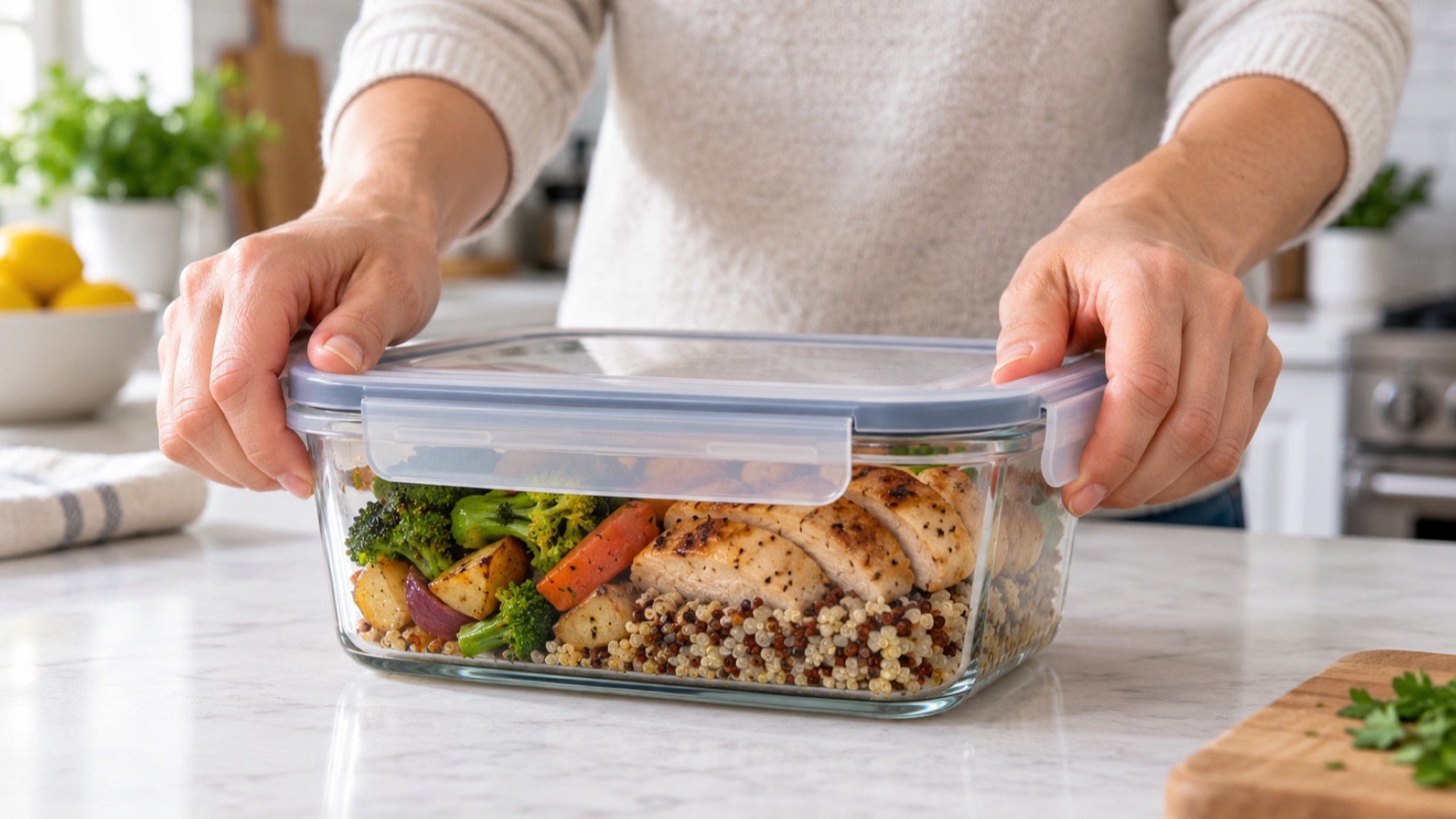
Cooling and reheating are where most homes drift off the rules. The two habits that carry the most weight: divide large batches into shallow containers so the center cools quickly, and reheat what you will eat — not the whole pot — to an internal 165°F, checking the thickest part rather than trusting steam or bubbling edges. Soups, stews, and gravies go back to a proper boil. Microwaves deserve their own caution, because they heat unevenly: cover the dish, stir midway, let it stand for a minute, and check more than one spot in anything dense.
| Food | Fridge life | The rule that matters most |
|---|---|---|
| 🥡 Cooked leftovers (meat, poultry, casseroles) | 3–4 days | Reheat to 165°F throughout — and reheat only the portion you will eat |
| 🍲 Soups and stews | 3–4 days | Cool in shallow containers; bring back to a boil when reheating |
| 🍕 Pizza and takeout | 3–4 days | Takeout gets no exemption — the two-hour clock applies from the moment it was served |
| 🥗 Deli-style salads (egg, tuna, chicken) | 3–4 days | Not reheated — kept cold until served, and tossed if it sat out |
| 🍚 Cooked rice | Keep it short | Cool fast and refrigerate promptly — the stricter rice rules are below |
Rice, Honestly
Cooked rice deserves its own section because it breaks the intuition that reheating fixes everything. Rice can carry Bacillus cereus spores that survive cooking; left warm, the spores grow into bacteria that produce a heat-stable toxin — one that reheating does not destroy, no matter how hot the pan or microwave gets.
The practical translation is about speed, not shelf-life arithmetic: cool leftover rice quickly, refrigerate it promptly, never let it stand at room temperature as a habit, and eat it sooner rather than later. When in any doubt about rice that spent a warm evening on the counter, the answer is the same as everywhere on this page — throw it out. It is a cheap meal to lose.
Cross-Contamination and Clean Hands
- 🔪 Separate raw from ready. Raw meat, poultry, and seafood get their own board, their own plate, and their own section of the fridge; juices must never drip onto food that will be eaten uncooked.
- 🧼 Hands are the most common vehicle. Wash them before cooking, after handling raw meat, and after the bin — the boring rule that quietly prevents the most illness.
- 🧽 Wipe fridge spills immediately. Federal guidance singles out thawing-meat drips, because Listeria can keep growing even at refrigerator temperatures.
- 🧊 Thaw and marinate cold. Defrosting on the counter parks meat in the danger zone for hours; the refrigerator does the same job safely overnight.
- 📅 Cover, date, and rotate. Covered containers, visible dates, and checking leftovers daily for spoilage keep the 3–4 day window from becoming a guess.
⚠️ When in doubt, throw it out
This is the FDA's own phrasing, and it is the entire decision rule for the gray zone — food of unknown history, a container with no date, an off smell or texture you cannot explain. No smell test or taste test is a safety test. If you are pregnant, immunocompromised, or cooking for young children or older adults, the safety rules matter more, not less: the cost of wasting food is always smaller than the cost it is insuring against.
Who Should Take This Most Seriously
For most healthy adults, a slip means a bad day. For some people, the same slip is a hospital visit. Pregnancy raises the stakes sharply — Listeria is a particular concern because it grows at refrigerator temperatures and can cross the placenta — and the same caution extends to anyone immunocompromised, adults in the oldest age brackets, and young children. In those households, the three numbers on this page tighten: refrigerate faster, keep less, reheat hotter and check it. Pregnancy also comes with a short avoid-list worth a dedicated conversation with a clinician — unpasteurized dairy and other high-risk foods chief among them.
If that is your situation, none of this is optional garnish — it is the page that matters. And if it is not, the rules still cost almost nothing to follow. That is what a "food-safety floor" means: the minimum below which the kitchen should never go, priced so low that no one benefits from cutting it.
Questions, Answered Briefly
- ⏱️ Food sat out three hours — is it ruined? The guidance is to discard perishable food that spent more than two hours warm (one hour above 90°F). Reheating kills bacteria but not everything they leave behind.
- 🌡️ My fridge has no thermometer — does it matter? It is the cheapest fix on this page. Appliance thermometers are inexpensive, and "40°F or below" is only a target if you can see the number.
- 🔥 Does reheating make old food safe again? It resets bacterial counts, not the history. The 3–4 day window did not restart, and heat-stable toxins (the rice case) do not care how hot the pan got.
- 🥶 Is frozen food safe forever? Safety-wise, continuous 0°F storage keeps food safe indefinitely; quality is the limiting factor, not pathogens. Freeze leftovers well before day 4 rather than after.
- 🚿 Should I rinse raw chicken? No — rinsing splashes bacteria around the sink and counter and removes nothing that cooking will not handle. Pat it dry with paper towel if you want a drier sear, then wash hands and surfaces.
- 🧊 Can thawed leftovers be refrozen? Refreezing is safe when the food was thawed in the refrigerator rather than on the counter; quality suffers more than safety does.
- 📉 Where does this rank against the rest of the series? First, on both size and certainty — the risk ledger makes exactly that argument in one chart.
The Bottom Line
- This is the decisive page. Two hours, 40°F to 140°F, 3–4 days, reheat to 165°F — published rules, not debates, and they are cheap to keep.
- Speed beats arithmetic. Cool fast in shallow containers, refrigerate promptly, reheat only what you will eat, and treat rice's heat-stable toxin with extra respect.
- Cross-contamination is the quiet failure. Separate boards, clean hands, wiped spills, and raw meat kept away from everything ready-to-eat.
- Some households cannot afford the gray zone. Pregnancy, immune compromise, oldest age, young children — refrigerate faster, keep less, and when in doubt, throw it out.
Related Topics
- U.S. Food and Drug Administration, "Refrigerator Thermometers — Cold Facts about Food Safety" — fda.gov
- Centers for Disease Control and Prevention, "Food Safety Basics" — cdc.gov
- Centers for Disease Control and Prevention, "Facts About Food Poisoning" — cdc.gov
- FoodSafety.gov (USDA/FDA/HHS), "Cold Food Storage Chart" — foodsafety.gov