Polyphenol Families
"Polyphenols" is one word standing in for thousands of compounds with wildly different chemistry, absorption, and evidence bases. This page runs the family-by-family audit: which of these plant chemicals have moved past the cell dish into credible human trials, which are stuck there, and what the honest shopping list looks like afterward.
What the evidence supports
- Food-level polyphenol intake is associated with lower cardiovascular risk across large cohorts.
- Cocoa flavanols moved vascular function in well-run trials, and COSMOS showed fewer cardiovascular deaths on flavanol supplements.
- Sulforaphane — technically an isothiocyanate, not a polyphenol — has the strongest mechanistic human data of the group.
What remains uncertain
- Resveratrol's human evidence is thin and its oral bioavailability is very poor; most claims rest on rodent and cell work.
- Curcumin's trial record is dominated by assay-interference artifacts and negative or tiny effects.
- Whether any single compound reproduces the benefit of the foods that contain it is largely unanswered.
Evidence last reviewed: August 15, 2026. Conclusions may change as new research is published.
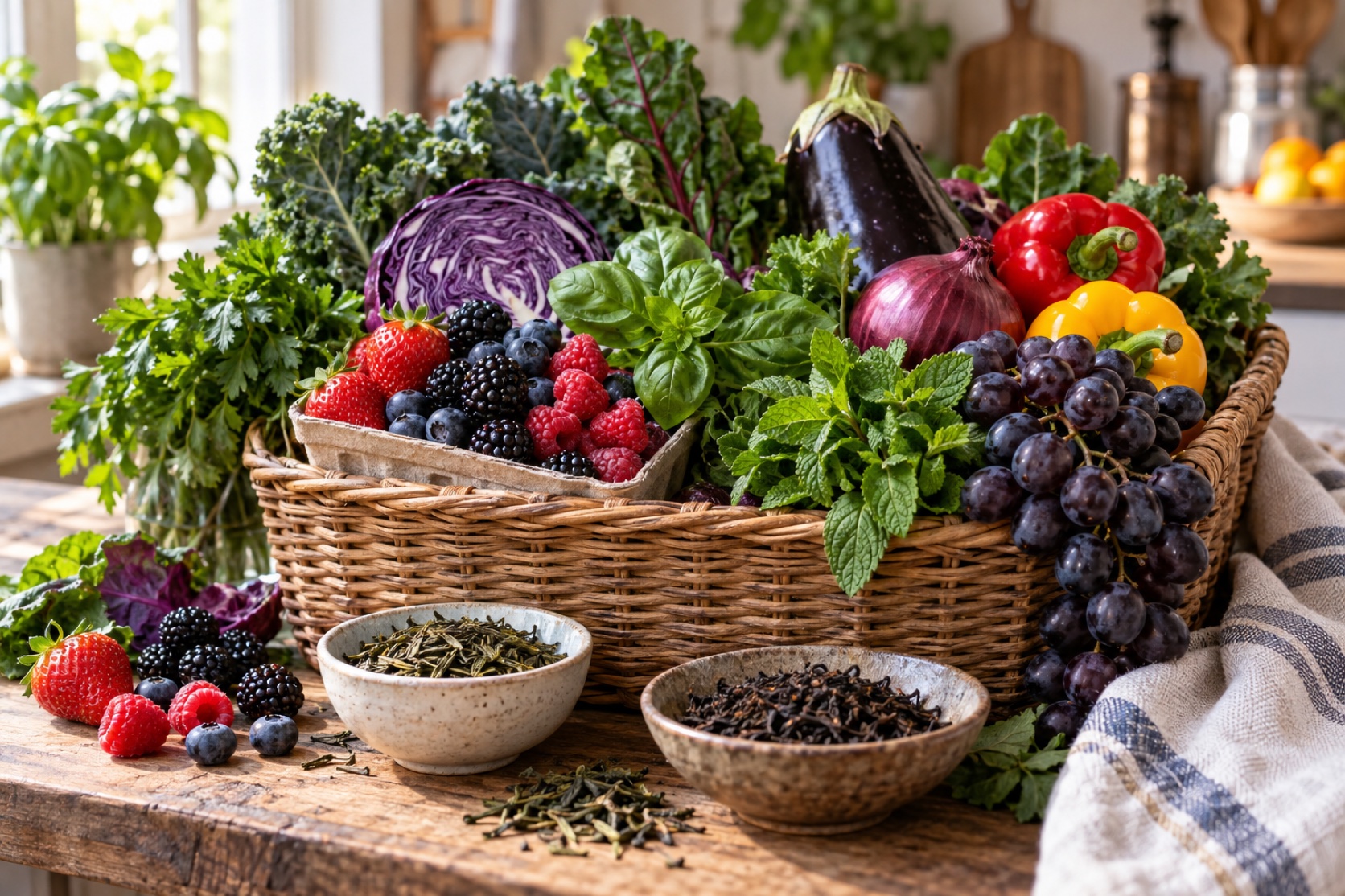
One Word, Thousands of Compounds
Polyphenols are a chemical class defined by structure — multiple phenol rings — and more than 8,000 members have been identified in plants. They fall into families with different chemistries and different fates in the human body: flavonoids (anthocyanins in berries, flavanols in cocoa and tea, flavanones in citrus), stilbenes (resveratrol), phenolic acids (coffee's chlorogenic acid), and lignans (flax, sesame). Two compounds usually filed under "polyphenols" in supplement marketing deserve a correction up front: sulforaphane is an isothiocyanate, not a polyphenol, and curcumin is a diarylheptanoid that merely shares some structural features. Grouping them all together is how a weak evidence base borrows credibility from a strong one — the central confusion this page exists to undo.
Product picks are generic categories, not brands. We may earn a commission on Amazon or iHerb purchases at no cost to you — this never changes our evidence conclusions. Full disclosure
Broccoli sprouting seeds
Makes it practical to grow broccoli sprouts where an article specifically teaches that food preparation method.
⚠️ Raw sprouts can carry foodborne-illness risk; pregnancy, immunocompromise, older age, and other higher-risk contexts require the article’s cooked alternative or individualized food-safety guidance.
Check price on Amazon →The Family Audit
| Family | Main food sources | What the human evidence actually shows | Verdict |
|---|---|---|---|
| 🥦 Glucosinolates → sulforaphane | Broccoli sprouts, crucifers | Controlled trials show Nrf2 activation, detoxification-marker shifts, and modest glucose effects | Strong |
| 🍫 Flavanols (cocoa) | Cocoa, dark chocolate, tea | Blood-pressure and endothelial-function effects in trials; COSMOS found fewer cardiovascular deaths (secondary endpoint) | Good |
| 🫐 Anthocyanins | Berries, cherries, red cabbage | Modest, fairly consistent blood-pressure and vascular-function effects in small trials | Moderate |
| 🍵 Catechins (EGCG) | Green tea, matcha | Mixed trial results; high-dose extracts carry liver-injury warnings | Mixed |
| 🍇 Resveratrol (stilbenes) | Grapes, red wine, peanuts | Very low oral bioavailability; human trials show little beyond modest metabolic effects | Weak |
| 🟡 Curcumin | Turmeric root | Assay-interference problems documented; no convincing human trial for any hard outcome | Weak |
The table's shape is the takeaway: evidence strength does not track supplement-shop popularity. The two weakest families — resveratrol and curcumin — are among the most marketed, while the strongest sits in produce nobody glamorizes. One structural fact explains part of the spread: flavonoids are by far the largest family and have absorbed the most research attention, which is why they also anchor the meta-analytic support — Hooper and colleagues (American Journal of Clinical Nutrition, 2008) found chocolate and tea flavonoid interventions modestly improved blood pressure and vascular function, the pattern that later large trials built on. Families with thin literatures are not guilty until proven innocent; they are simply unproven, and unproven is the honest default. The cruciferous case page develops the sulforaphane story in full, and the matcha topic owns the tea catechins.
Matcha powder
Makes an unsweetened matcha routine convenient for people who enjoy and tolerate caffeine.
⚠️ Caffeine can worsen insomnia, anxiety, palpitations, reflux, or medication-related concerns; timing and total intake matter.
Check price on Amazon →The Bioavailability Filter
Much of the variance in the audit comes down to one measurement question: does the compound actually reach your cells? The polyphenol bioavailability literature (Manach et al., American Journal of Clinical Nutrition, 2004) shows absorption varies from single-digit percentages to, at best, around a third of an ingested dose — and what is absorbed is heavily transformed. Most of the dose passes to the colon, where the gut microbiome converts parent compounds into smaller metabolites, some of which appear to be the actual active players. Ellagitannins from berries and pomegranate are the textbook case: whether you can make urolithins — the anti-inflammatory metabolites — depends on which microbes you carry, which is why the fiber and fermented foods topic matters to this story. Resveratrol shows the opposite pole: absorbed well but metabolized so fast that almost none circulates as resveratrol (Walle et al., Drug Metabolism and Disposition, 2004) — one reason its human trial record is so thin despite blockbuster mouse results.
Why the Whole Food Beats the Sum of Its Parts
A quiet finding runs through the strongest polyphenol evidence: the effects appear when the compounds arrive in food, and often shrink or vanish in extracts. The landmark PREDIMED trial made the point at diet scale — cardiovascular events fell in participants assigned extra-virgin olive oil or nuts within a Mediterranean pattern (Estruch et al., New England Journal of Medicine, 2013), a result that cannot be assigned to any single polyphenol because the intervention was the food matrix itself. Several mechanisms plausibly explain the gap: fiber slows transit and changes where compounds are metabolized, the microbiome converts families into active metabolites in tandem, and dozens of compounds at food-level doses may do together what megadoses of one do poorly. The practical consequence is that the Mediterranean diet topic and this page converge on the same instruction: eat the foods, not the molecules.
What "High in Antioxidants" Really Means
Nearly everything sold on the polyphenol story is labeled "high in antioxidants," a phrase that survives because it sounds testable while saying almost nothing. The in-vitro assays behind the claim — like ORAC, which the USDA withdrew from its own database in 2012 after concluding it had no demonstrated relevance to human biology — measure how fast a food neutralizes radicals in a test tube. They do not measure what happens in a person, they ignore absorption and metabolism entirely, and they reward exactly the compounds with the weakest human records. The research pivot described on the xenohormesis page — from antioxidant scavenging to stress-pathway signaling — is the reason the label stopped being taken taken seriously in the literature while persisting on packages. When a claim leans on ORAC-style numbers, the honest translation is "tested in a tube, not in you." A further irony is that the label usually appears on the products that need it least: the foods with the strongest human records — crucifers, berries, tea — were never marketed on antioxidant capacity, because their evidence arrived through trials instead. Meanwhile coffee and tea quietly supply a large share of most people's actual polyphenol intake, without a single antioxidant claim on the mug.
🎯 Judge families by human trials, not cell plates
The audit rule that sorts this table: prefer the family with credible human trials over the one with dramatic cell-culture or animal results. That single filter moves sulforaphane and cocoa flavanols to the top and resveratrol and curcumin to the bottom — the reverse of what supplement shelves suggest. Whole foods also deliver families in combination, with fiber and matrix effects no pill reproduces, which is why the big five supplements page keeps its list so short.
A Practical Ranking
Folded into a shopping pattern, the audit looks like this:
- 🥦 Daily tier — strongest evidence per serving: cruciferous vegetables (the sulforaphane source), berries, green and black tea, and plain cocoa-level flavanols.
- 🍊 Weekly tier — real but smaller effects: citrus and its flavanones, legumes and their lignans-plus-fiber package, pomegranate and other ellagitannin sources if your microbiome cooperates.
- 🍇 Food tier — enjoy, don't dose: grapes, red wine, and turmeric belong in meals for pleasure and habit; their isolated molecules do not justify capsules.
- 💊 Skip tier — the evidence does not clear the bar: resveratrol pills, curcumin extracts, and concentrated EGCG supplements, the last of which carries a liver-injury warning at high doses that the foods themselves do not.
Questions, Answered Briefly
- 🍇 Should I take resveratrol? The evidence does not support it. The famous mouse results did not reproduce convincingly in humans, and bioavailability is a fundamental problem. Red wine's benefit, such as it is, is not the resveratrol.
- 🟡 Is turmeric useless? As a food, no — it makes food taste like food, and the spices page covers what it can and cannot claim. As a concentrated extract, it has repeatedly failed to separate from placebo.
- 🍫 Does dark chocolate count? Modestly. Cocoa flavanols have real vascular effects, but chocolate brings sugar and calories — the COSMOS trial used a flavanol supplement, not a chocolate bar.
- 🫐 What should I actually eat? The families with evidence concentrate in simple foods: crucifers, berries, tea, cocoa-powder-level flavanols, citrus, legumes. Variety beats any single "super" source.
The Bottom Line
- "Polyphenols" is not one thing — the family spread from well-tested compounds like sulforaphane to barely-bioavailable ones like resveratrol.
- Human trials are the filter — sulforaphane and cocoa flavanols clear it; resveratrol and curcumin, largely, do not.
- Bioavailability explains much of the spread — absorption, metabolism, and your microbiome decide what a polyphenol actually does.
- Eat the families, skip the extracts — crucifers, berries, tea, and cocoa as foods; treat pill-grade claims with suspicion.
Related Topics
- Hooper et al., "Flavonoids, flavonoid-rich foods, and cardiovascular risk: a meta-analysis of randomized controlled trials," American Journal of Clinical Nutrition (2008)
- Sesso et al., "Effect of cocoa flavanol supplementation for the prevention of cardiovascular disease events: the COSMOS randomized clinical trial," American Journal of Clinical Nutrition (2022)
- Walle et al., "High absorption but very low bioavailability of oral resveratrol in humans," Drug Metabolism and Disposition (2004)
- Nelson et al., "The essential medicinal chemistry of curcumin," Journal of Medicinal Chemistry (2017)
- Manach et al., "Polyphenols: food sources and bioavailability," American Journal of Clinical Nutrition (2004)
- Estruch et al., "Primary prevention of cardiovascular disease with a Mediterranean diet supplemented with extra-virgin olive oil or nuts," New England Journal of Medicine (2013)