Fiber & Fermented Foods: Feeding Your Gut
Your microbiome eats what you eat. Two strategies feed it: fiber — the prebiotic fuel the colon's bacteria ferment — and fermented foods — the live cultures that arrive ready to work. This is the overview; the next two topics rank the specific foods and drinks.
What the evidence supports
- Higher fiber intake associates with lower all-cause and cardiovascular mortality in large cohorts.
- Fiber fermentation produces butyrate — the colon's fuel and a systemic anti-inflammatory signal.
- A landmark 2021 trial: 6 fermented-food servings/day measurably increased microbiome diversity and lowered inflammatory markers.
What remains uncertain
- Whether fermented foods' benefit comes from the microbes, the fermentation products, or both is unresolved.
- Individual responses to fiber vary substantially — no single dose fits all.
- Commercial "probiotic" foods vary enormously in live counts and strain content.
Evidence last reviewed: August 13, 2026. Conclusions may change as new research is published.
Product picks are generic categories, not brands. We may earn a commission on Amazon or iHerb purchases at no cost to you — this never changes our evidence conclusions. Full disclosure
Plain live-culture yogurt
A convenient fermented-food option where an article specifically teaches live cultures as part of a dietary pattern.
⚠️ Dairy intolerance and added sugar matter; choose plain products with live cultures when that is the article-specific instruction.
Grocery item — availability varies by region.
Check price on Amazon →Strategy One: Fiber
- 📊 The outcomes: high-fiber cohorts show lower all-cause mortality, cardiovascular disease, and colorectal cancer — among the most consistent findings in nutrition (the Nutrition pillar's fiber topic owns the detail).
- ⚗️ The chemistry: colon bacteria ferment fiber into short-chain fatty acids — especially butyrate, which feeds colon cells and dampens systemic inflammation.
- 🌱 The dose: most guidelines target 25–30 g/day; most people get about half. Increase gradually — the gut adapts over weeks.
- 🎯 The variety principle: different fibers feed different microbes — the diversity association argues for many fiber sources, not one supplement.
Strategy Two: Fermented Foods
The standout trial (Stanford, 2021): participants randomized to increase fermented foods (yogurt, kefir, kimchi, kombucha) for ten weeks showed increased microbiome diversity and reduced inflammatory markers — while the fiber-only group showed neither effect uniformly. The honest caveats: it was one trial, the fiber response varied enormously between individuals, and the fermented-food dose was generous (about six servings daily). But the finding reframed the field's advice: fermented foods may deliver microbial diversity that fiber alone doesn't guarantee — and the two strategies complement rather than compete.
The Practical Protocol
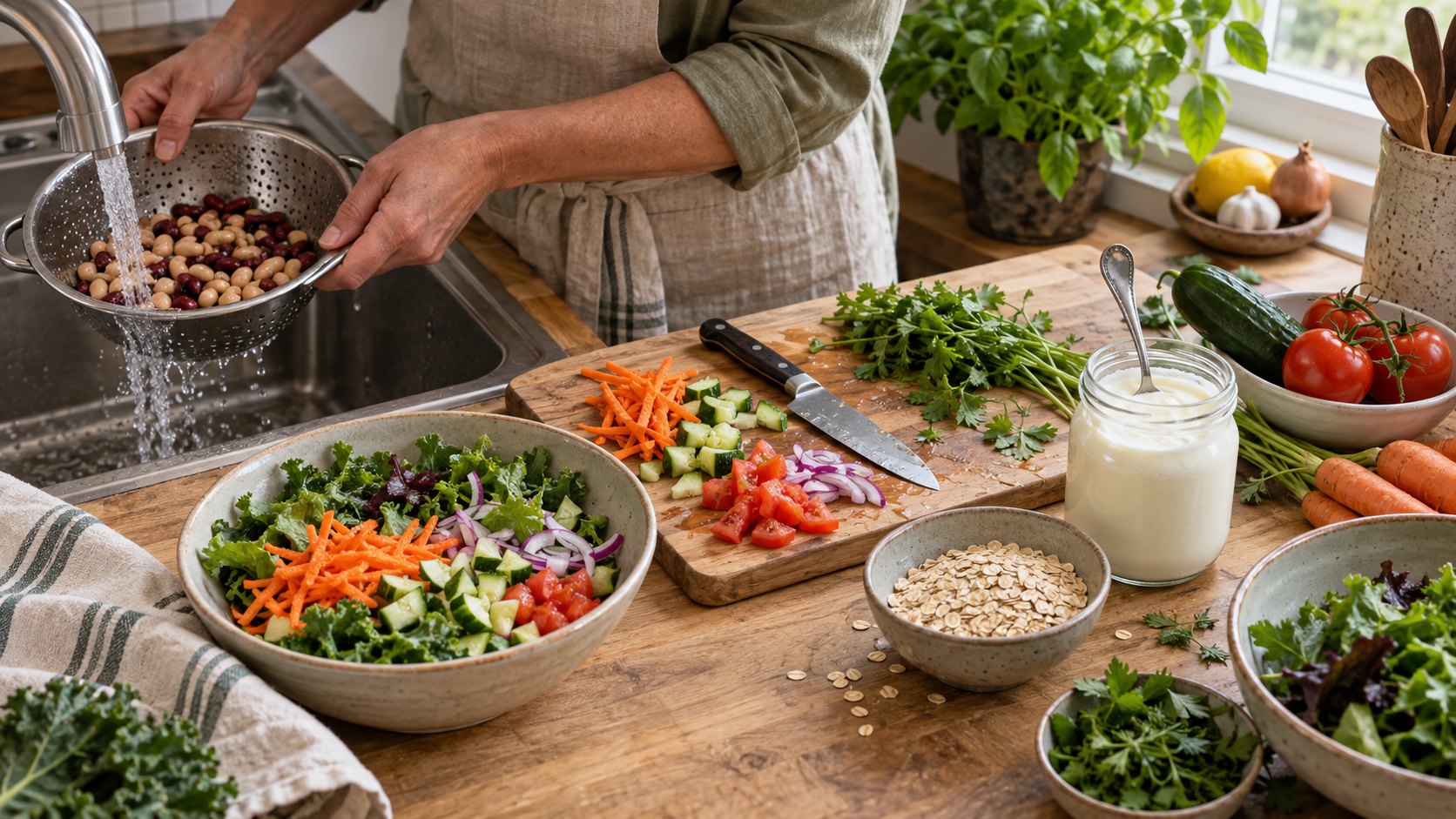
- 🌾 Daily fiber floor: 25–30 g from varied plants — the fiber topic's list (beans, oats, vegetables, fruit, seeds).
- 🫙 Daily ferment: one serving of a live fermented food — yogurt with live cultures, kefir, or unpasteurized kimchi/sauerkraut (the next topic ranks them).
- 📈 Titrate up: both fiber and ferments can cause temporary bloating as the ecosystem reshuffles — increase over 2–3 weeks.
- 💊 The pill question: food-first is the overview's honest position — the probiotics-vs-prebiotics topic covers when supplements earn their place.
🔗 The fiber-page handoff
This page is the overview; the deep-dives are elsewhere by design. The Nutrition pillar's fiber topic owns fiber the nutrient — intake targets, types, and health outcomes. This pillar's next two topics rank the specific foods and drinks by evidence. Read fiber for the "how much and why," the superfoods topic for the "which ones," and this page for the strategy that ties them together.
The Bottom Line
- Feed the gut two ways: fiber for fuel, fermented foods for live cultures.
- Fiber's outcome evidence is the strongest in nutrition — 25–30 g/day, varied sources.
- Fermented foods add diversity — the 2021 trial's signature finding.
- The stack beats either alone — both, daily, titrated up.
Go Deeper: Subtopics
- 🔎 The SCFA pipeline, in depth — fiber → butyrate → colon cells: the full mechanism chain (links Nutrition's Fiber topic). Read it →
- 🔎 Fermented foods, ranked — yogurt, kefir, kimchi, sauerkraut, miso: the live-culture evidence per food. Read it →
- 🔎 The Stanford fermented-foods trial — the famous 2021 study: what it showed about diversity and inflammation. Read it →
- 🔎 Pasteurization & the shelf-stable trap — why most commercial "fermented" products are dead on arrival. Read it →
- 🔎 The 30-plant-points challenge — the diversity-by-diet game: 30 different plants per week. Read it →
Related Topics
- Wastyk et al., "Gut-microbiota-targeted diets modulate human immune status," Cell (2021)
- Reynolds et al., "Carbohydrate quality and human health: a series of systematic reviews," The Lancet (2019)
- Koh et al., "From dietary fiber to host physiology: short-chain fatty acids as key bacterial metabolites," Cell (2016)
- Marco et al., "Health benefits of fermented foods: microbiota and beyond," Current Opinion in Biotechnology (2017)
- O'Keefe et al., "Fat, fibre and cancer risk in African Americans and rural Africans," Nature Communications (2015)