Fermented Foods, Ranked
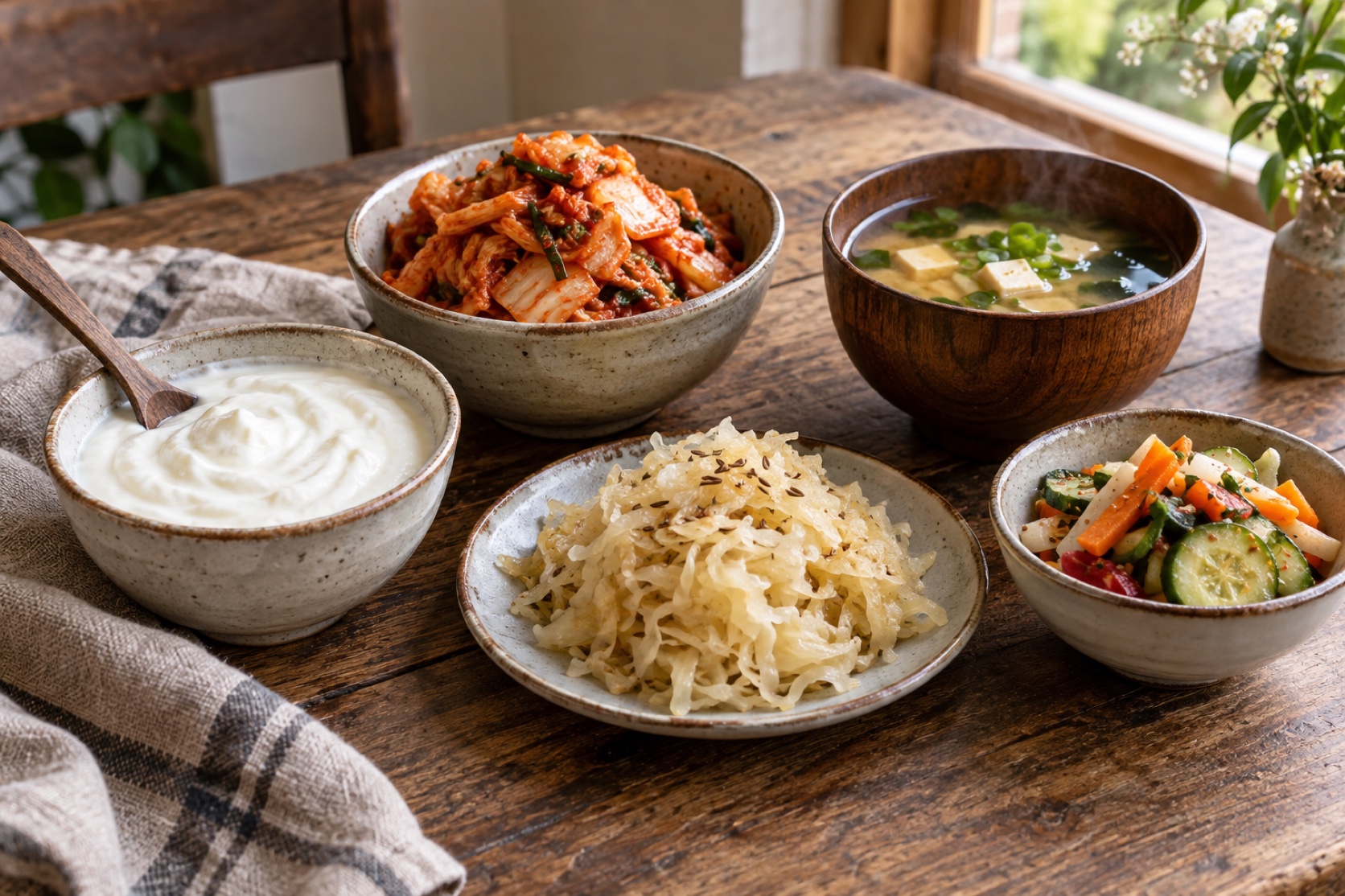
Yogurt, kefir, kimchi, sauerkraut, miso, kombucha — all fermented, all marketed for gut health, and nowhere near equal in what the research actually shows. Yogurt rests on decades of cohort and pooled data; kombucha has one small pilot trial. This page ranks the common ferments by the strength of their human evidence and adds the buying rules that keep the ranking honest.
What the evidence supports
- Yogurt intake associates with lower type 2 diabetes risk in pooled cohorts — the basis of the FDA's 2024 qualified health claim.
- The Stanford trial (Cell, 2021) showed a high-fermented-food diet raised microbiome diversity and reduced inflammatory markers.
- Kimchi and kefir carry small human trials with signals in the expected direction.
What remains uncertain
- Whether benefits come from live microbes, fermentation metabolites, or the base food is unresolved for most products.
- Sauerkraut, miso, and kombucha have thin human trial bases — tradition and pilot data, not settled evidence.
- Yogurt's cohort data are observational, and products differ in sugar, salt, and calories that also matter.
Evidence last reviewed: August 15, 2026. Conclusions may change as new research is published.
How the Ranking Works
Three tiers, judged on human evidence alone. Tier 1: pooled cohort data or meta-analyses linking the food to health outcomes. Tier 2: small randomized trials measuring markers rather than disease. Tier 3: pilot trials, mechanistic work, and tradition. The ranking asks one question — how much do we actually know about this food in humans — and it deliberately ignores price, trendiness, and marketing. Division of labor note: the superfoods topic ranks the fiber-bearing foods, the super-drinks topic covers the liquid aisle, and this page ranks the live-culture foods.
Product picks are generic categories, not brands. We may earn a commission on Amazon or iHerb purchases at no cost to you — this never changes our evidence conclusions. Full disclosure
Plain live kefir
A fermented dairy option for people who choose and tolerate it.
⚠️ Lactose intolerance, sugar content, and individual GI tolerance matter; select plain, live products when the article specifies them.
Grocery item — availability varies by region.
Check price on Amazon →Yogurt: The Cohort Champion
No other fermented food has outcome-level epidemiology behind it the way yogurt does. A 2014 meta-analysis of cohort studies estimated roughly 18 percent lower type 2 diabetes risk per 200 grams of yogurt a day (Chen et al., BMC Medicine, 2014) — a pooled finding stable enough that in March 2024 the FDA granted yogurt a qualified health claim: eating at least 2 cups (3 servings) a week "may reduce the risk of type 2 diabetes." The mechanism remains unresolved — the live cultures, the fermentation products, or the nutrient package could each be doing the work. Two buying caveats keep the claim honest. First, the evidence describes yogurt in general, but flavored products can carry substantial added sugar that no study endorsed. Second, only products that kept their cultures alive count — the pasteurization page shows how to check. Plain, live-culture yogurt is the version the evidence describes.
Kefir and Kimchi: Small Trials, Real Signals
Kefir is fermented milk carrying a more diverse microbial community than yogurt — bacteria plus yeasts. Human trials are small and short, with modest reported effects on blood lipids and glucose; the evidence is promising but far from settled. Kimchi has the more interesting trial record, because one Korean group ran the right experiment. In a 2013 study, 21 adults with prediabetes ate either fresh or fermented kimchi for eight weeks — the fermented version improved insulin sensitivity while the fresh version did not (An et al., Annals of Nutrition and Metabolism, 2013). An earlier trial in overweight adults reported body-fat reductions with fermented but not fresh kimchi (Kim et al., Nutrition Research, 2011). The sample sizes were tiny — roughly twenty people each — but the fresh-versus-fermented design isolates the fermentation itself, which is exactly the comparison that matters. The sodium caveat applies throughout: kimchi is salty, and anyone watching blood pressure should budget it like salt, not like salad.
Sauerkraut, Miso, and Natto: Traditional and Understudied
Raw sauerkraut carries some of the densest live communities of any food — on the order of ten million to a billion cells per gram — yet its human trial base is sparse: a handful of small studies, mostly on digestive symptoms, with mixed results. Miso, a fermented soybean paste, has Japanese cohort data suggesting its salt does not carry the usual blood-pressure penalty of table salt — the fermentation products may blunt it — but that finding is preliminary and contested. Natto, fermented soybeans rich in vitamin K2 (MK-7), has cohort associations with bone and cardiovascular markers; the enzyme claims attached to nattokinase are mostly mechanistic. The honest summary for the whole tier: tradition-rich, evidence-thin. These are reasonable foods, and they are not evidence-backed interventions — eat them because you like them, not because a study told you to. One clinical note: natto's vitamin K2 interacts with warfarin and similar anticoagulants, so anyone on those medications should check with their prescriber before making natto a habit.
Kombucha and the Drink Aisle
Kombucha's human record is one small pilot: twelve adults with type 2 diabetes drank either kombucha or a calorie-matched control drink for four weeks, and the kombucha group's fasting glucose fell from about 164 to 116 mg/dL (Mendelson et al., Frontiers in Nutrition, 2023). That is a striking effect size from a tiny sample — exactly the kind of result that needs replication before it means anything. A second caveat is product-level: most commercial kombucha is pasteurized or sterile-filtered to keep alcohol below the legal limit, which can remove the live microbes the label implies — the pasteurization page owns that story. The full drinks ranking, kombucha included, lives on the super-drinks topic.
Plain live-culture yogurt
A convenient fermented-food option where an article specifically teaches live cultures as part of a dietary pattern.
⚠️ Dairy intolerance and added sugar matter; choose plain products with live cultures when that is the article-specific instruction.
Grocery item — availability varies by region.
Check price on Amazon →The Cohort Numbers Behind the Ranking
The chart shows the pooled per-200-gram associations with type 2 diabetes from Chen et al. (2014): yogurt and low-fat dairy show meaningful inverse associations, while cheese and total dairy are essentially neutral. Read it as relative risk, not fate — these are observational estimates with wide confidence intervals, and they describe groups.
🛒 The label rule that keeps this ranking honest
A food only counts as fermented here if live cultures survived to the spoon. Yogurt without the live-cultures seal, shelf-stable sauerkraut, and pasteurized kombucha may still be fine foods — but they are not delivering the thing this ranking is about. The pasteurization page has the full checklist.
The Full Ranking
| Food | Live-culture status | Best human evidence | Verdict |
|---|---|---|---|
| 🥛 Yogurt | Live only if labeled; the seal verifies it | Pooled cohorts; 2024 FDA qualified health claim | Tier 1 |
| 🥤 Kefir | Refrigerated kefir usually live | Small RCTs (lipids, glucose) | Tier 2 |
| 🥬 Kimchi | Raw/refrigerated only | Two small RCTs (prediabetes, body fat) | Tier 2 |
| 🥣 Miso | Often live; paste varies | Cohorts; sodium questions open | Tier 2 |
| 🍶 Kombucha | Commercial versions often pasteurized | One pilot RCT (n = 12) | Tier 3 |
| 🥗 Sauerkraut | Raw/refrigerated only | Sparse small trials, mixed results | Tier 3 |
- 🧊 Shop the refrigerated section — live cultures need cold; shelf-stable means heat-treated.
- 🏷️ Favor explicit words — "raw," "unpasteurized," or a live-culture count on the label.
- 🥣 Buy plain — sweetened versions carry a sugar bill the evidence never tested.
- 🧂 Track the salt — kimchi and miso are sodium-dense; budget them like salt, not like free.
If the supplement aisle is more your question — whether a pill ever earns its place over a food — the probiotics-vs-prebiotics topic covers it directly. The microbial machinery these foods feed is the SCFA pipeline, and the trial that put the whole category on the map is the Stanford study.
Questions, Answered Briefly
- 🥛 Which yogurt counts? Plain, refrigerated, with the live-cultures seal. The cohort evidence describes yogurt in general, but sweetened versions add a sugar bill no study endorsed.
- 🥬 Is store-bought kimchi as good as homemade? Only if it is unpasteurized; many commercial jars are heat-treated. Homemade gives live cultures plus full salt control, at the cost of effort and hygiene care.
- 💊 Should I just take a probiotic instead? The foods on this page deliver whole communities, not a handful of strains. The supplement question is genuinely open, and the probiotics-vs-prebiotics topic covers it directly.
- 🧂 What about the salt in kimchi and miso? Budget them like salty condiments. The fermented-food evidence does not override sodium basics.
- 🍶 Is kombucha worth drinking? Enjoy it if you like it; don't lean on it. One small pilot trial is a reason for curiosity, not a protocol.
The Bottom Line
- Yogurt leads on evidence — plain, live-culture yogurt is the closest thing to a research-backed daily ferment.
- Kimchi and kefir are promising — small trials, real signals, and the fresh-versus-fermented designs are the right experiments.
- Sauerkraut, miso, natto, and kombucha rest on tradition and pilot data — fine to enjoy, weak to lean on.
- The label decides everything — a pasteurized "fermented" product delivers no live cultures at all.
Related Topics
- Chen et al., "Dairy products consumption and risk of type 2 diabetes: a systematic review and meta-analysis," BMC Medicine (2014)
- Wastyk et al., "Gut-microbiota-targeted diets modulate human immune status," Cell (2021)
- An et al., "Beneficial effects of fresh and fermented kimchi in prediabetic individuals," Annals of Nutrition and Metabolism (2013)
- Kim et al., "Fermented kimchi reduces body weight and improves metabolic parameters in overweight and obese patients," Nutrition Research (2011)
- Mendelson et al., "Kombucha tea as an anti-hyperglycemic agent in humans with diabetes — a randomized controlled pilot investigation," Frontiers in Nutrition (2023)
- Marco et al., "Health benefits of fermented foods: microbiota and beyond," Current Opinion in Biotechnology (2017)
- Kok & Hutkins, "Yogurt and other fermented foods as sources of health-promoting bacteria," Nutrition Reviews (2018)
- Rezac et al., "Fermented foods as a dietary source of live organisms," Frontiers in Microbiology (2018)
- U.S. Food and Drug Administration, "Qualified health claim: yogurt and reduced risk of type 2 diabetes" (2024)