The Fermented Tier: Where Kimchi Actually Ranks
Fermented foods sit in T2 on the gut-food list — real evidence, thinner than the bean tier's — and inside that tier the ranking is not what the grocery-store signage suggests. Yogurt leads, kefir sits beside it, and kimchi, for all its deserved fame, ranks below both. This page explains the tier's internal order, the one landmark trial that anchors it, and the serving sizes that actually matter.
What the evidence supports
- Increased fermented-food intake raised microbiome diversity and reduced inflammatory markers in a randomized diet trial.
- Live-culture yogurt has the longest evidence trail in the tier, including cohort associations with lower type-2 diabetes risk.
- Kimchi trials show modest metabolic effects — real, but smaller and fewer than the dairy-ferment literature.
What remains uncertain
- The landmark trial studied healthy adults for ten weeks; how the effect holds over years and in other populations is untested.
- Live-culture counts vary enormously by brand and batch, and density is not the same as benefit.
- Pasteurized, shelf-stable products retain none of the live-culture component the evidence is built on.
Evidence last reviewed: August 15, 2026. Conclusions may change as new research is published.
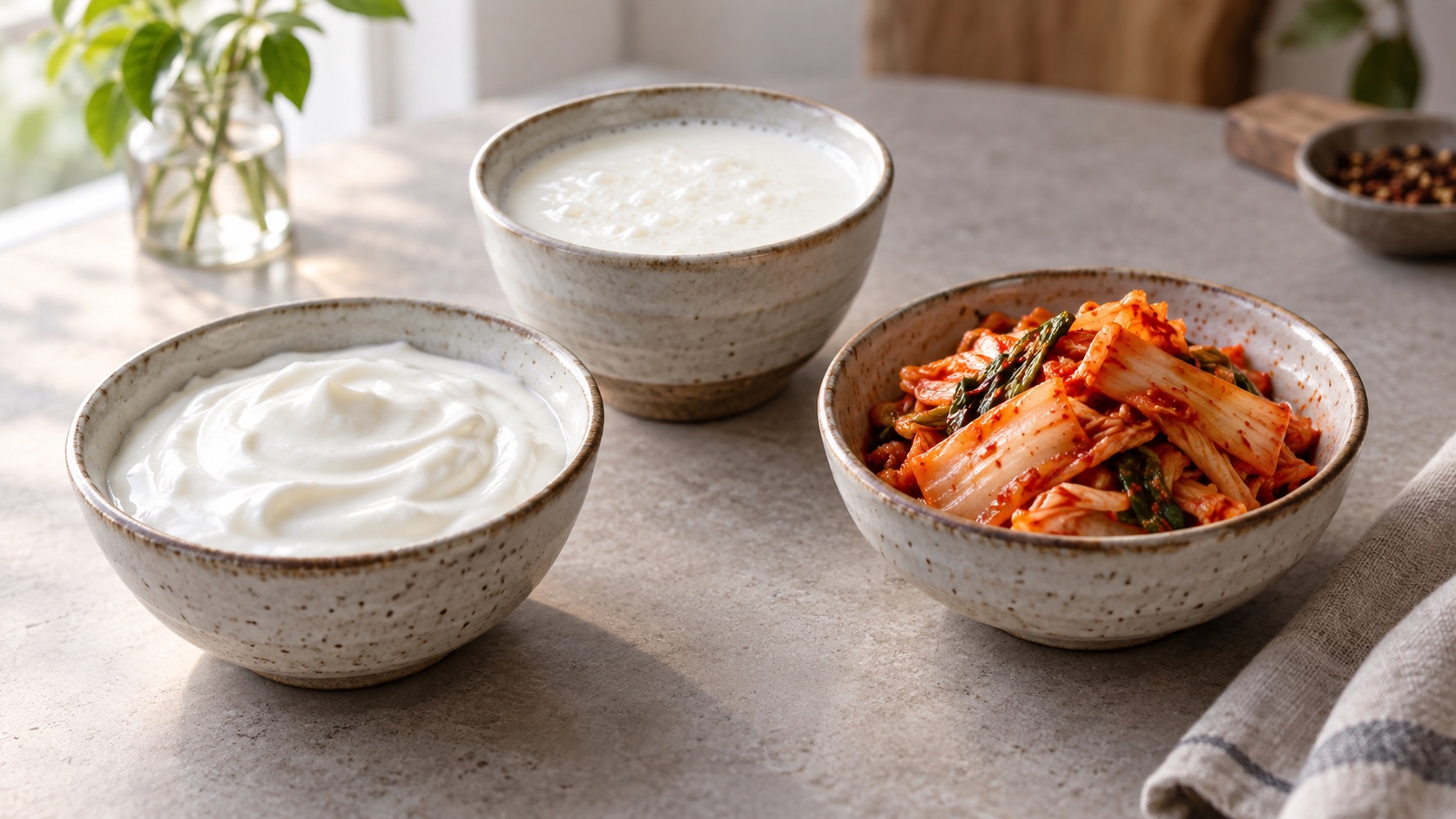
What Fermentation Actually Delivers
Fermentation is preservation by microbes, and the gut-health case rests on what the jar carries afterward: live lactic-acid bacteria, the prebiotic fiber of the vegetable or dairy base, and fermentation-created metabolites. The ISAPP consensus on fermented foods (Marco et al., Nature Reviews Gastroenterology & Hepatology, 2021) draws the line that matters for shoppers: a fermented food must contain live microbes at the time of consumption, or it is just pickled food with a story. That single definition explains most of the tier's internal ranking, because products differ enormously in how many live cells actually reach the shelf — and then your colon, through an acid bath that kills most of them en route. The probiotics vs prebiotics topic covers the survival question in detail.
One definitional subtlety that changes buying behavior: "fermented" on a label describes a process that happened in the past, not a property of the food in your hand. Vinegar-brined pickles, shelf-stable sauerkraut, and heat-treated kimchi all went through a fermentation at some point; none carries live cultures when you open it. The evidence in this tier was built on products that still contain the microbes, which is the single most common way shoppers accidentally buy out of the tier.
Product picks are generic categories, not brands. We may earn a commission on Amazon or iHerb purchases at no cost to you — this never changes our evidence conclusions. Full disclosure
Plain live-culture yogurt
A convenient fermented-food option where an article specifically teaches live cultures as part of a dietary pattern.
⚠️ Dairy intolerance and added sugar matter; choose plain products with live cultures when that is the article-specific instruction.
Grocery item — availability varies by region.
Check price on Amazon →The Anchor Trial: Ten Weeks, Thirty-Six People
The tier's foundation is a single randomized study from Stanford, published in Cell (Wastyk et al., 2021). Thirty-six healthy adults were assigned for ten weeks either to a high-fiber diet or to a diet that ramped up fermented foods toward roughly six servings a day — yogurt, kefir, kimchi, kombucha, and fermented vegetable brines. The fermented arm's microbiome diversity climbed in step with the dose, and the arm showed reductions across a panel of circulating inflammatory proteins. The fiber arm was instructive in the opposite way: responses split by starting microbiome, with some participants showing the hoped-for anti-inflammatory shift and others none. The honest read, which the parent page also takes: this is one small, short trial in healthy people — the tier rests on it plus a stack of smaller food-specific studies, not on it alone.
The anchor trial's design also tells you what the tier is not evidence for. The fermented arm ate several foods, not one, so the trial supports the category more than any single jar — exactly how this series grades tiers rather than heroes. And the trial tracked markers of immune status and diversity, not hard disease outcomes; the leap from "lower inflammatory markers over ten weeks" to "prevents disease over decades" is one the honest reader declines to make without better data.
Where Yogurt Ranks
Live-culture yogurt sits at the top of T2 on the strength of volume and vintage: decades of studies on lactose tolerance, live-culture survival, and metabolic endpoints, plus pooled observational analyses associating yogurt intake with roughly 15% lower risk of type 2 diabetes — with the usual cohort caveats that association is not causation (Salas-Salvadó et al., Journal of Nutrition, 2017). The trial doses are achievable: a small tub (150–200 g) daily, which is also the dose the landmark trial's fermented arm leaned on. Nothing on this page claims yogurt is medicinal; it is simply the food in this tier whose case is most thoroughly documented, which is what ranking means here.
Where Kimchi Actually Ranks
Kimchi is the tier's most charismatic member and its most over-positioned one. The evidence is real but modest: small Korean trials have fed participants on the order of a few hundred grams of kimchi daily for four to eight weeks and reported modest improvements in body weight, lipids, and inflammatory markers in overweight adults (Kim et al., Nutrition Research, 2011), and a trial contrasting fresh versus fermented kimchi found the fermented version shifted microbiota composition and metabolic markers more favorably (Han et al., Molecular Nutrition & Food Research, 2015). The reasons kimchi ranks below the dairy ferments are structural, not culinary: fewer trials, smaller samples, wider variation between batches, and a sodium load that its defenders rarely mention. A few hundred grams of traditional kimchi a day is a meaningful share of the day's sodium budget — fine as a condiment and delicious as one, but the trial dose and the prudent dose pull in different directions.
Live Counts vs. Evidence
The chart's lesson is the tier's lesson: raw density is one input among several. Kefir carries the highest typical counts, and it ranks near the top of the tier — but yogurt's trial record, not its count, is what puts it first. The super-drinks topic owns the kefir-versus-yogurt comparison in full; the takeaway here is simply that more cells does not automatically mean more evidence.
The Tier, Ranked, With Serving Sizes
| Food | Placement in tier | Serving that matters | Read |
|---|---|---|---|
| 🥛 Yogurt (live cultures) | T2 — top | 150–200 g daily in trials; 2+ servings/week in the cohorts | Strong |
| 🥤 Kefir | T2 — top | On the order of a glass (150–250 mL) daily in the small trials | Good |
| 🥬 Kimchi | T2 — middle | Trials used roughly 100–300 g daily; a prudent condiment dose is a few tablespoons | Good |
| 🥗 Sauerkraut (unpasteurized) | T2 — middle | No standardized trial dose; a few heaped tablespoons is the common suggestion | Moderate |
| 🍜 Miso & natto | T2 — lower | A daily bowl of miso soup (~15–20 g paste); evidence is largely from Japanese cohorts | Moderate |
The badges here match the parent page's list; the tier placements are this series' coarser grading. Note what the serving column does to the ranking in practice: yogurt's trial dose is something people actually eat; kimchi's trial dose is a daily side-dish commitment with a sodium bill attached. Dose feasibility is one of the five criteria, and it quietly shapes more placements than any headline does.
🧂 The sodium note nobody puts on the jar
Fermented vegetables are preserved in salt, and the trial doses carry a real sodium load — a few hundred milligrams per modest serving, and meaningfully more at the daily Korean-trial doses. None of this makes kimchi or sauerkraut bad foods; it makes them foods to budget, not to consume freely. If blood pressure is on your radar, the blood-pressure topic owns the sodium math, and the sensible placement is a few tablespoons of kimchi as a flavor engine rather than a bowl as a meal. For fermented dairy, the parallel caveat is sugar: flavored yogurts can carry more added sugar than some desserts, which is why the buying rules below start with the label.
The Buying Rules
- 🧊 Buy from the refrigerator. Shelf-stable sauerkraut, kimchi, and pickles are pasteurized; the live cultures the evidence is built on are gone. The refrigerated section is the tier's real storefront.
- 🏷️ Read for "live" or "active cultures" on dairy — and for "unpasteurized" or "raw" on vegetables. Labels that avoid those words are telling you something.
- 🍬 Check the sugar line on yogurt. Plain, unsweetened, and flavor it yourself; the cultures do not cancel the sugar.
- 🥄 Rotate, don't marry. Different ferments carry different strains; the diversity the landmark trial showed came from a rotation of several foods, not one perfect jar.
The Bottom Line
- The tier is anchored by one landmark trial — ten weeks of roughly six daily fermented servings raised microbiome diversity and lowered inflammatory markers in healthy adults.
- Yogurt leads on evidence, not charisma — the longest trial trail in the tier and the cohort data on diabetes risk; kefir sits beside it.
- Kimchi ranks below the dairy ferments honestly — real but modest trials, batch variation, and a sodium load that argues for condiment doses over trial doses.
- Buy refrigerated, live, and low-sugar — pasteurization deletes the live-culture point, and the label is where most products lose their case.
Related Topics
- Wastyk et al., "Gut-microbiota-targeted diets modulate human immune status," Cell (2021)
- Marco et al., "The International Scientific Association for Probiotics and Prebiotics (ISAPP) consensus statement on fermented foods," Nature Reviews Gastroenterology & Hepatology (2021)
- Kok & Hutkins, "Yogurt and other fermented foods as sources of health-promoting bacteria," Nutrition Reviews (2018)
- Dimidi et al., "Fermented foods: definitions and characteristics, impact on the gut microbiota and effects on gastrointestinal health and disease," Nutrients (2019)
- Salas-Salvadó et al., "Yogurt and diabetes: overview of recent observational studies," Journal of Nutrition (2017)
- Kim et al., "Fermented kimchi reduces body weight and improves metabolic parameters in overweight and obese patients," Nutrition Research (2011)
- Han et al., "Contrasting effects of fresh and fermented kimchi consumption on gut microbiota composition and gene expression related to metabolic syndrome in obese Korean women," Molecular Nutrition & Food Research (2015)