Beans & Legumes, the Undisputed Champions
Of every food on the gut-health list, beans and legumes are the ones whose case rests on pooled analyses of randomized trials rather than single studies or bench chemistry. This page walks the mechanism — resistant starch fermented into short-chain fatty acids — then the trial record, then the honest question everyone asks: what about the gas?
What the evidence supports
- Pulses measurably improve glycemic control in pooled randomized trials, including in people with diabetes.
- Legume intake is associated with lower LDL cholesterol and blood pressure across independent meta-analyses.
- Resistant starch and fiber from beans reliably feed butyrate-producing bacteria — a mechanism with direct human support.
What remains uncertain
- Effect sizes are real but modest; beans are a daily habit, not a one-dose intervention.
- Most trials run weeks to months — the multi-decade question is answered by cohorts, which carry the usual confounding caveats.
- Tolerance varies: a meaningful minority finds legumes genuinely uncomfortable, and that group needs a slower on-ramp.
Evidence last reviewed: August 15, 2026. Conclusions may change as new research is published.
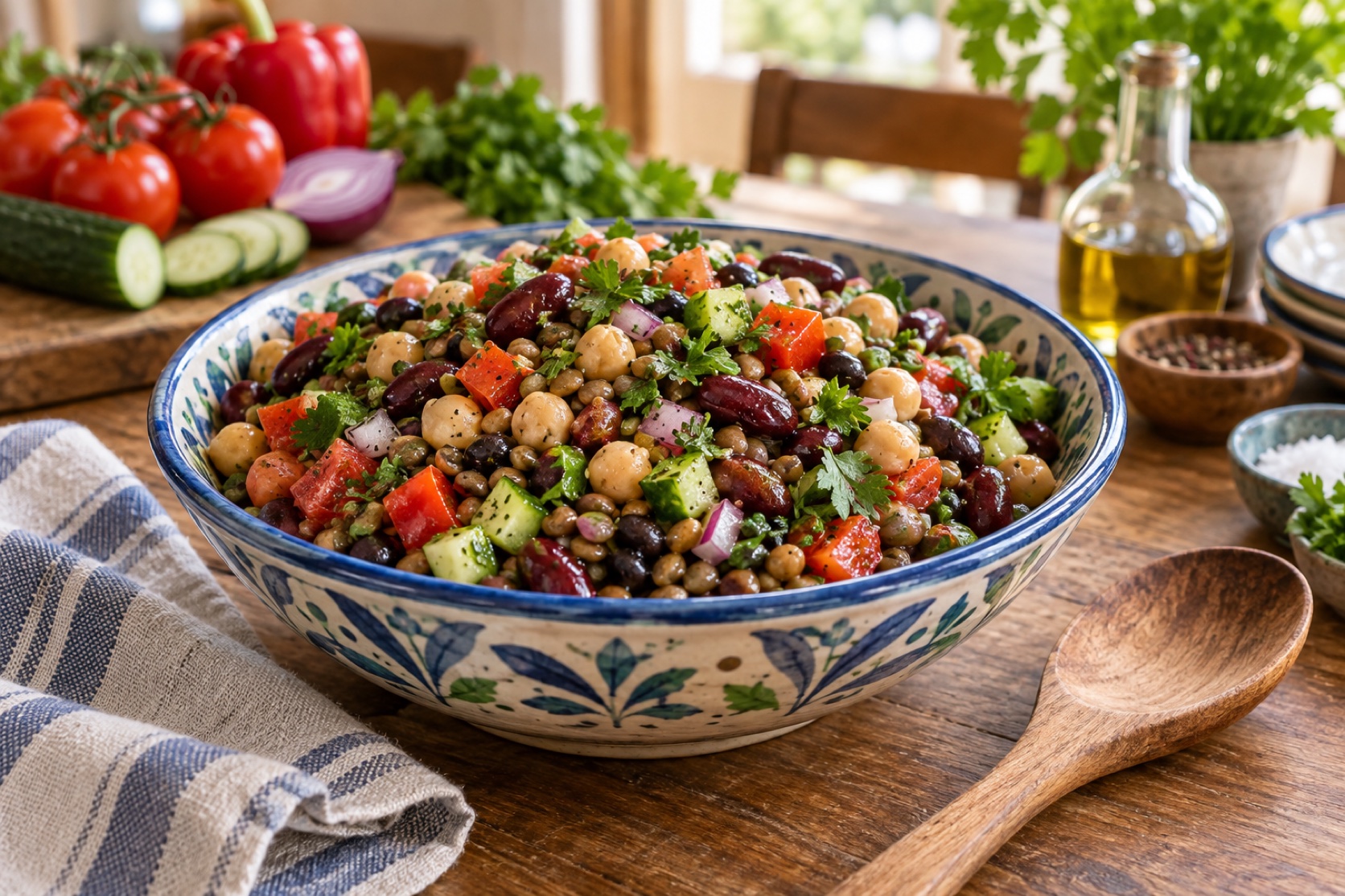
Why Beans Sit Alone in T1
The ranking methodology put one food category in T1, and it was not glamorous. Beans cleared the bar on every criterion at once: multiple independent pooled analyses of randomized trials, a mechanism that is documented from substrate to metabolite in humans, consistency across populations, a dose you can eat daily for decades, and a safety profile whose main side effect is social. No other food on the list does all five. The next sections show the work behind that sentence.
A framing note before the evidence, because it shapes how to read it: none of the effects below is dramatic on its own. What makes beans unusual is that the same food moves several outcomes in the same direction, repeatedly, across independent research groups — the pattern the methodology page scores as consistency. A food with one dramatic trial and nothing behind it earns less trust than a food with ten modest ones, and beans are the latter story told in full.
Product picks are generic categories, not brands. We may earn a commission on Amazon or iHerb purchases at no cost to you — this never changes our evidence conclusions. Full disclosure
Canned beans and lentils
A lower-friction way to use legumes where an article gives a concrete food-first practice.
⚠️ Increase gradually if gas is troublesome; people with IBS or a prescribed diet may need individualized guidance.
Check price on Amazon →The Resistant-Starch Pipeline
Beans carry two fiber fractions that work different jobs. Soluble fiber forms the gel that slows glucose absorption — the glycemic story. Resistant starch, the fraction that escapes small-intestine digestion entirely, reaches the colon intact, where bacteria ferment it. The fermentation products are short-chain fatty acids (SCFAs): acetate, propionate, and butyrate. Butyrate is the headline molecule — the colon's epithelial cells use it as their preferred fuel, and it feeds the anti-inflammatory signaling the fiber and ferments topic covers in depth. Koh et al.'s review in Cell (2016) remains the standard map of that pathway: fiber in, SCFAs out, barrier and metabolic signaling downstream.
One preparation detail matters more than the food label: cooking, then cooling, retrogrades part of the starch into its resistant form. A lentil salad eaten cold delivers more resistant starch than the same lentils eaten hot from the pot — a free upgrade that costs only patience. Reheating after cooling keeps most of the benefit.
What the SCFAs Do Downstream
- 🔋 Colon fuel. Butyrate is oxidized by colonocytes, supporting the barrier that keeps bacterial products where they belong — the mechanism the leaky-gut topic explains.
- 🩸 Appetite and glucose signaling. Propionate participates in intestinal gluconeogenesis, one proposed route by which fermented fiber influences glucose homeostasis (the sugar topic's territory).
- 🧫 Microbiome composition. Feeding fiber selectively favors fiber-fermenting taxa; in the landmark diet trial this site cites elsewhere, the fiber arm's responders were the people whose SCFA production actually rose.
- 🌊 Satiety. Pulses are among the more satiating foods per calorie in controlled trials — part mechanical (volume, protein), part metabolic.
The Trial Record: Glucose, Lipids, Pressure
The T1 placement rests on pooled analyses rather than hero studies. Sievenpiper and colleagues' meta-analysis in Diabetologia (2009) pooled randomized controlled trials of non-oil-seed pulses and found improved glycemic control — lower fasting glucose and insulin, and better HbA1c in trials that lasted long enough to move it. A 2014 meta-analysis in CMAJ (Ha et al.) found pulse-rich diets lowered LDL cholesterol, a modest but consistent effect in the range of a few percent. And a pooled analysis of controlled feeding trials reported lower blood pressure with pulse-rich diets (Jayalath et al., American Journal of Hypertension, 2014). None of these effect sizes will replace a statin or a training plan — and the site's other pillars own those levers — but for a whole food bought by the bag, the consistency across three independent metabolic outcomes is the reason T1 exists.
Fiber per Half-Cup, Cooked
For scale: a half-cup serving lands between a quarter and a third of the day's fiber target for most adults, from a single cheap ingredient. The fiber topic owns the quantity math; the point here is that beans are the densest food-based way to hit it that most people actually enjoy repeatedly.
The Longevity Cohorts
The cohort side of the case is older but memorable: in a seven-year study of older adults across several ethnic groups, legume intake emerged as the food pattern variable most consistently associated with survival (Darmadi-Blackberry et al., Asia Pacific Journal of Clinical Nutrition, 2004). The finding deserves the standard honest gloss — cohort data cannot prove causation, and legume eaters differ from non-eaters in many other ways — but the direction matches what the trials show, which is the consistency criterion the methodology page scores. Where beans fit into the Mediterranean pattern that has the strongest randomized-evidence track record of any diet, the Mediterranean topic has the detail.
The same pattern shows up in the longer-lived populations the longevity literature likes to quote: legumes are a staple in most of the geographically concentrated long-lived populations researchers have described — though the honest caveat travels with those observations, since those populations differ from the general public in countless other ways. The trial data, not the anecdotes, is what earned the tier; the anecdotes just happen to point the same direction.
⚠️ The gas problem, handled
Fermentation is the point, and gas is fermentation's audible proof. The bacteria adapt within a few weeks of regular intake — most people's discomfort peaks early and fades — but the on-ramp matters. Start at a quarter-cup daily, not a bowl; rinse canned beans well (it removes much of the oligosaccharide-rich liquid); and soak-and-discard when cooking from dry. People with IBS or diagnosed fructan sensitivity should treat beans as clinician territory — a low-FODMAP approach may conflict with a high-legume one, and that trade-off belongs in a consultation, not a blog comment.
The Bean-by-Bean Field Guide
| Legume | What it brings | Prep shortcut | Gut note |
|---|---|---|---|
| 🫘 Black beans | High fiber, dark-polyphenol pigments, budget staple | Canned, rinsed; or pressure-cook from dry | The default T1 starter bean |
| 🟤 Lentils | Fastest to cook, high protein per cup, no soak needed | Simmer 20–25 min from dry | Often the most tolerable for gas-sensitive eaters |
| ⚪ Chickpeas | Versatile (hummus, roasting, salads) | Canned for salads; dried for hummus | Cold preparations maximize resistant starch |
| 🟥 Kidney beans | High fiber, hearty texture | Must be boiled properly from dry — never slow-cook raw | Classic chili bean; watch the ramp-up dose |
| 🫛 Edamame & green peas | Softer fiber profile, high protein | Frozen, steamed in minutes | The gentlest entry point for skeptics |
One safety footnote, because it is a genuine one: dried kidney beans must be boiled — slow cookers can leave the raw lectin content intact, and that causes real food poisoning. Canned kidney beans are already cooked and safe. This is the rare bean fact that matters more than the rankings.
Practical Rules
- 🫘 Default serving: half a cup, most days. The dose the trials used and the dose that keeps the SCFA pipeline fed without dominating the plate.
- 🧊 Cook once, eat cold twice. Batch-cook, refrigerate, and let retrogradation raise the resistant-starch fraction for free.
- 🥫 Canned is not a compromise. Rinsed canned beans are nutritionally close to home-cooked and cut the barrier to zero.
- 🌱 Start gentle, ramp over three weeks. The microbiome adaptation is real; the discomfort curve usually is not permanent.
The Bottom Line
- Beans are T1 because the trial base is pooled and consistent — improved glycemic control, lower LDL, lower blood pressure across independent meta-analyses.
- The mechanism is documented end to end — resistant starch and fiber ferment into SCFAs, with butyrate feeding the colon's barrier.
- Preparation upgrades the chemistry — cooking then cooling raises resistant starch; rinsing canned beans tames the gas.
- The on-ramp matters more than the variety — start at a quarter-cup and climb; people with IBS should route the trade-off through a clinician.
Related Topics
- Sievenpiper et al., "Effect of non-oil-seed pulses on glycaemic control: a systematic review and meta-analysis of randomised controlled experimental trials in people with and without diabetes," Diabetologia (2009)
- Ha et al., "Effect of dietary pulse intake on established therapeutic lipid targets for cardiovascular risk reduction: a systematic review and meta-analysis of randomized controlled trials," CMAJ (2014)
- Jayalath et al., "Effect of dietary pulses on blood pressure: a systematic review and meta-analysis of controlled feeding trials," American Journal of Hypertension (2014)
- Koh et al., "From dietary fiber to host physiology: short-chain fatty acids as key bacterial metabolites," Cell (2016)
- Darmadi-Blackberry et al., "Legumes: the most important dietary predictor of survival in older people of different ethnicities," Asia Pacific Journal of Clinical Nutrition (2004)
- Maki et al., "Resistant starch from high-amylose maize increases insulin sensitivity in overweight and obese men," Journal of Nutrition (2012)
- U.S. Department of Agriculture, FoodData Central (2024)