The Allium Family: Garlic, Onion & Leeks
Garlic, onions, and leeks are the quiet workhorses of the gut-food list: a T2 placement built on prebiotic fructans that feed beneficial bacteria and on organosulfur compounds whose chemistry is genuinely unusual. This page explains what each compound does, the cooking tricks that decide whether it survives to your colon or your plate, and where the human evidence is thinner than the cookbook enthusiasm.
What the evidence supports
- Alliums are rich in inulin-type fructans, the prebiotic fiber class with the most consistent human fermentation data.
- Crushed garlic produces allicin, with documented cardiovascular effects in pooled trials — a neighboring but real benefit.
- Fructans survive cooking, so the prebiotic effect does not depend on eating alliums raw.
What remains uncertain
- Gut-specific human trials of alliums are small and short; much of the microbiome evidence is indirect.
- Allicin is unstable and degrades quickly — how much of the cardiovascular benefit survives everyday cooking is an open question.
- For people with fructan intolerance, the prebiotic that helps others is precisely what hurts — individual variation is wide.
Evidence last reviewed: August 15, 2026. Conclusions may change as new research is published.
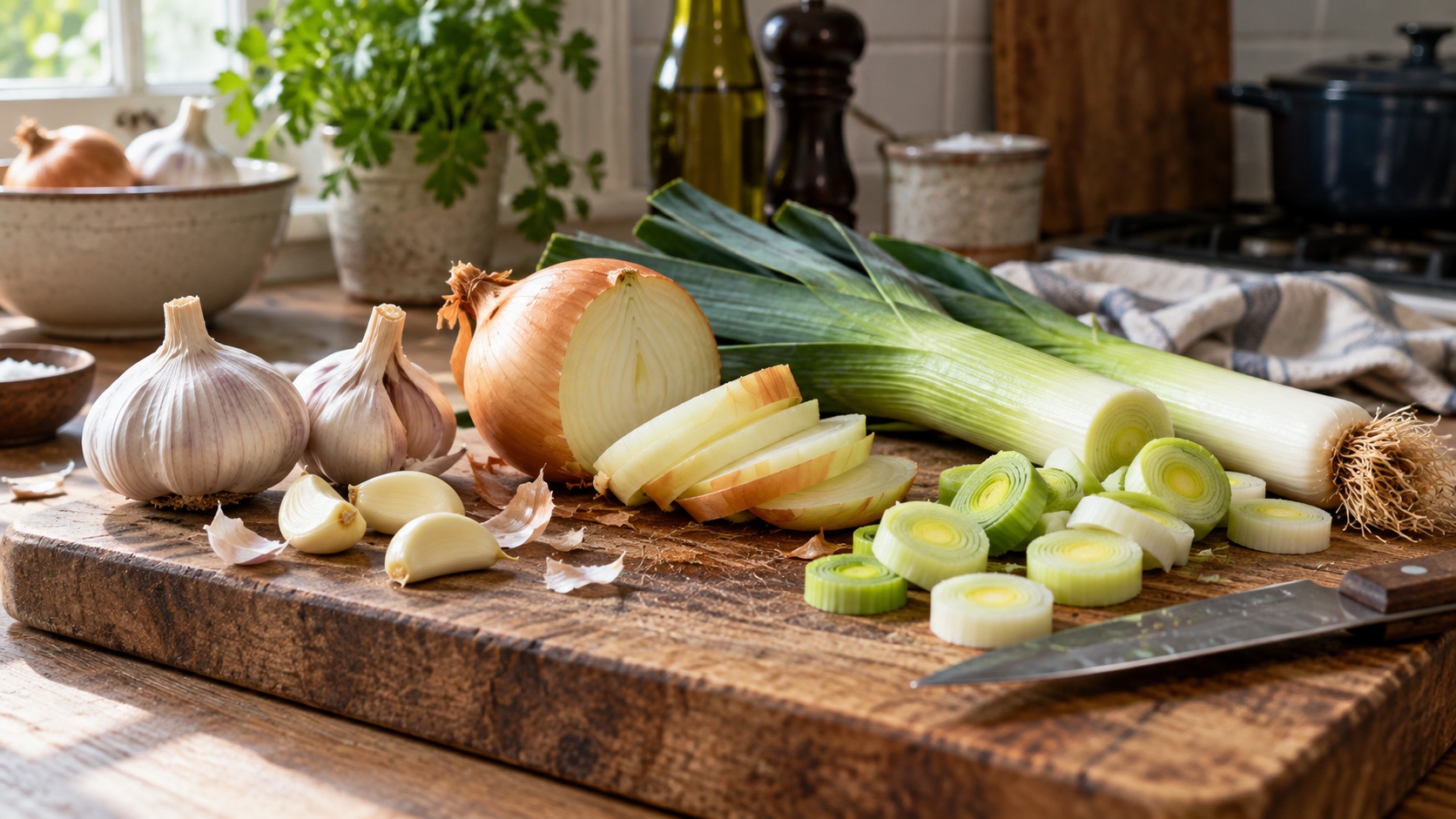
What Makes an Allium an Allium
Onions, garlic, shallots, leeks, scallions, and chives share a botanical family and two chemical signatures that matter for the gut. The first is inulin-type fructans — chains of fructose the human small intestine cannot break down, which therefore arrive in the colon intact and feed the bacteria that ferment them. The second is the organosulfur system: sulfur compounds stored separately from an enzyme, mixed only when the tissue is damaged — crushed, chopped, or chewed. That two-compartment design is the allium trick: the plant keeps its weapon inert until something tries to eat it. Both signatures matter here, but for different reasons, and cooking treats them very differently.
Product picks are generic categories, not brands. We may earn a commission on Amazon or iHerb purchases at no cost to you — this never changes our evidence conclusions. Full disclosure
Inulin-type prebiotic powder
May be a structured, optional way to increase inulin-type fructans when an article explicitly teaches a gradual, food-first trial.
⚠️ Can cause gas and bloating; avoid self-directed use with active gas-predominant IBS or a low-FODMAP elimination phase without professional guidance.
Check price on Amazon →The Fructan Chemistry
Inulin-type fructans are among the best-characterized prebiotics in nutrition science — the reference standard against which other candidate prebiotics are compared, per the ISAPP consensus definition (Gibson et al., Nature Reviews Gastroenterology & Hepatology, 2017). Prebiotic trials typically deliver these compounds as purified powders (inulin, oligofructose); alliums are the whole-food delivery vehicle, and the chart shows why the humble onion has company. Garlic is unusually concentrated for a culinary ingredient — close to Jerusalem artichoke — though nobody eats 100 g of garlic at a sitting, so the practical dose arrives through cumulative use across a day: an onion in a sauce, a couple of cloves in a stir-fry, leek greens in a soup. The fiber and ferments topic frames where this fits in the overall feeding strategy.
Fructan Content, Side by Side
The honest read: gram for gram, alliums are not the densest fructan source on earth, but they are the densest one that ordinary cooking uses every day. A diet that already cooks with onion and garlic gets prebiotic support without adding a single new behavior — which is why dose feasibility scored them well on the methodology page.
The Allicin Story
Crush a garlic clove and two compartments merge: the enzyme alliinase converts alliin into allicin, the compound responsible for garlic's bite and most of its studied cardiovascular effects. Allicin is short-lived and heat-sensitive; it degrades within hours at room temperature and faster in the pan. The practical rule, drawn from garlic pharmacology papers (Lawson & Gardner, Journal of Agricultural and Food Chemistry, 2005): crush or chop, then let the garlic stand for about ten minutes before heating, so the enzyme finishes its work while the product survives. Cooked garlic still delivers the fructans — heat barely touches those — but the allicin dimension depends on this small choreography.
The cardiovascular case is real and belongs to another pillar: pooled analyses find garlic preparations lower blood pressure in hypertensive adults and modestly improve lipids, with effects around the size of a small dietary intervention rather than a medication (Ried et al., reviews from 2008 through 2020). The gut link is adjacent — several reviews note garlic's capacity to shift microbiota composition in animal models, with human trials smaller and newer. The tier placement reflects that honest split: strong chemistry, promising but thin gut-specific human data.
The Cooking Tricks
- ⏱️ Crush, wait ten, then heat. The standing window maximizes allicin before cooking destroys the enzyme. Finer crushing makes more; whole cloves make little.
- 🍲 Fructans shrug off heat. The prebiotic benefit survives soups, roasts, and sauces — raw-garlic martyrdom is unnecessary unless you enjoy it.
- 🥬 Leek greens, not just whites. The fibrous green tops carry fiber that most recipes discard; sliced thin and sweated, they disappear into soups and stocks.
- 🫒 Infused oil keeps flavor, drops fructans. For fructan-sensitive eaters, cooking onion and garlic in oil then removing the solids leaves the aromatic sulfur compounds behind while discarding most of the fructan load — the standard low-FODMAP workaround.
- 🧄 Powder is not a substitute, but not useless. Dried preparations lose allicin but keep some fructan and most flavor; fresh wins on chemistry, powder wins on convenience.
What the Human Data Actually Show
The evidence table for alliums splits three ways. The fructan–microbiome pathway is established in human trials of purified inulin and oligofructose — reliable increases in bifidobacteria, the classic prebiotic signature. The cardiovascular effects of garlic preparations are pooled and consistent, if modest. What is genuinely scarce is the middle cell: randomized trials of whole alliums measuring gut endpoints in humans. That gap — not any negative finding — is why alliums sit in T2 beside the fermented foods rather than in T1 with the beans. The placement says the category is worth a permanent place in the kitchen; it does not say the case is closed.
The Allium Field Guide
| Allium | Signature strength | Best use | Gut note |
|---|---|---|---|
| 🧄 Garlic | Concentrated fructans plus the allicin system | Crushed into nearly any savory dish | The 10-minute rule applies; highest fructan density per gram |
| 🧅 Onion | Volume: the allium you actually eat in quantity | Bases, caramelized, pickled | Most of a day's culinary fructan usually comes from here |
| 🥬 Leek | Mild flavor, fiber-rich greens | Soups, braises, potato-leek anything | Easiest allium to eat in bulk without bite |
| 🌱 Scallion & chive | Fresh, raw-friendly, low-dose | Finishing garnish, salads, eggs | Small doses, minimal risk, steady habit value |
| 🟣 Shallot | Onion's refined cousin, milder sulfurs | Vinaigrettes, pan sauces | Swap-in when raw onion is too aggressive |
⚠️ Fructan sensitivity is real, not fussiness
For a meaningful minority — particularly people with IBS — fructans are the FODMAP component that triggers genuine symptoms, and alliums are among the highest culinary sources. That group faces a real trade-off: the prebiotic that feeds a healthy microbiome is the trigger that hurts them. The low-FODMAP approach to managing this is clinician territory, and the infused-oil trick above is the standard compromise. If alliums reliably cause pain or bloating, the prebiotic case does not outweigh your symptoms — swap them out and get fructans elsewhere, or work the reintroduction ladder with professional guidance.
Questions, Answered Briefly
- 😮💨 Does cooking destroy the gut benefit? No — the fructans are heat-stable. Cooking destroys allicin, not the prebiotic. The two benefits simply live on different clocks.
- 🧄 Is raw garlic better than cooked? For allicin, yes — but raw allicin doses that matter for cardiovascular endpoints are large and pungent, and the fructans work cooked. Eat alliums the way you'll keep eating them.
- 💊 Are garlic supplements equivalent? Not for this pillar's purpose: extracts target the allicin axis and skip most of the fructan story. The supplements topic owns the honest supplement verdicts.
- 🤢 Why do onions hurt my stomach when beans don't? Different fermentable fibers, different people. Fructan sensitivity and resistant-starch tolerance are independent; the pattern you describe is common and routes to the low-FODMAP conversation, not to "eating through it."
The Bottom Line
- Alliums earn T2 on two compounds — heat-stable prebiotic fructans and the crush-activated allicin system, each with different cooking rules.
- The prebiotic survives the pan — the fructan benefit needs no raw-garlic heroics; the allicin benefit needs the ten-minute standing window.
- The human data are honestly split — pooled cardiovascular trials for garlic, solid prebiotic trials for purified fructans, but few gut-specific whole-allium trials.
- Fructan sensitivity is the real boundary — for IBS-type guts, swap to infused oil and get fructans elsewhere; symptoms outrank the ranking.
Related Topics
- Moshfegh et al., "Presence of inulin and oligofructose in the diets of Americans," Journal of Nutrition (1999)
- Gibson et al., "Expert consensus document: the ISAPP consensus statement on the definition and scope of prebiotics," Nature Reviews Gastroenterology & Hepatology (2017)
- Lawson & Gardner, "Composition, stability, and bioavailability of garlic products used in a clinical trial," Journal of Agricultural and Food Chemistry (2005)
- Ried et al., "Effect of garlic on blood pressure: a systematic review and meta-analysis," BMC Cardiovascular Disorders (2008)
- Ried, "Garlic lowers blood pressure in hypertensive subjects, improves arterial stiffness and gut microbiota: a review and meta-analysis," Experimental and Therapeutic Medicine (2020)
- Vazquez-Prieto & Miatello, "Organosulfur compounds and cardiovascular disease," Molecular Aspects of Medicine (2010)