Resistance Training for Women Through Midlife
The menopause transition changes how the body responds to training — and it does not cancel the response. This page covers what the evidence actually says about strength, muscle, and bone for women in midlife, then hands you a working template: two sessions a week, heavy enough to matter, honest about symptoms, recovery, and the moments that belong to a clinician.
What the evidence supports
- Midlife and postmenopausal women gain relative strength at least as well as men in the first months of training; the training response holds through the transition.
- Twice-weekly, progressively loaded full-body training measurably improves strength, function, and muscle in this age group.
- Heavy resistance plus impact training can slow — and in trials, modestly reverse — bone-density loss in postmenopausal women (LIFTMOR RCT, 2018).
What remains uncertain
- Whether regular exercise relieves vasomotor symptoms is mixed: some trials report fewer hot flashes, others find no difference.
- The exact interaction between hormone therapy and training response is under-studied; existing trials are small and inconsistent.
- Individual symptom patterns, pelvic-floor responses, and bone status vary widely — group averages do not predict your experience.
Evidence last reviewed: August 20, 2026. Conclusions may change as new research is published.
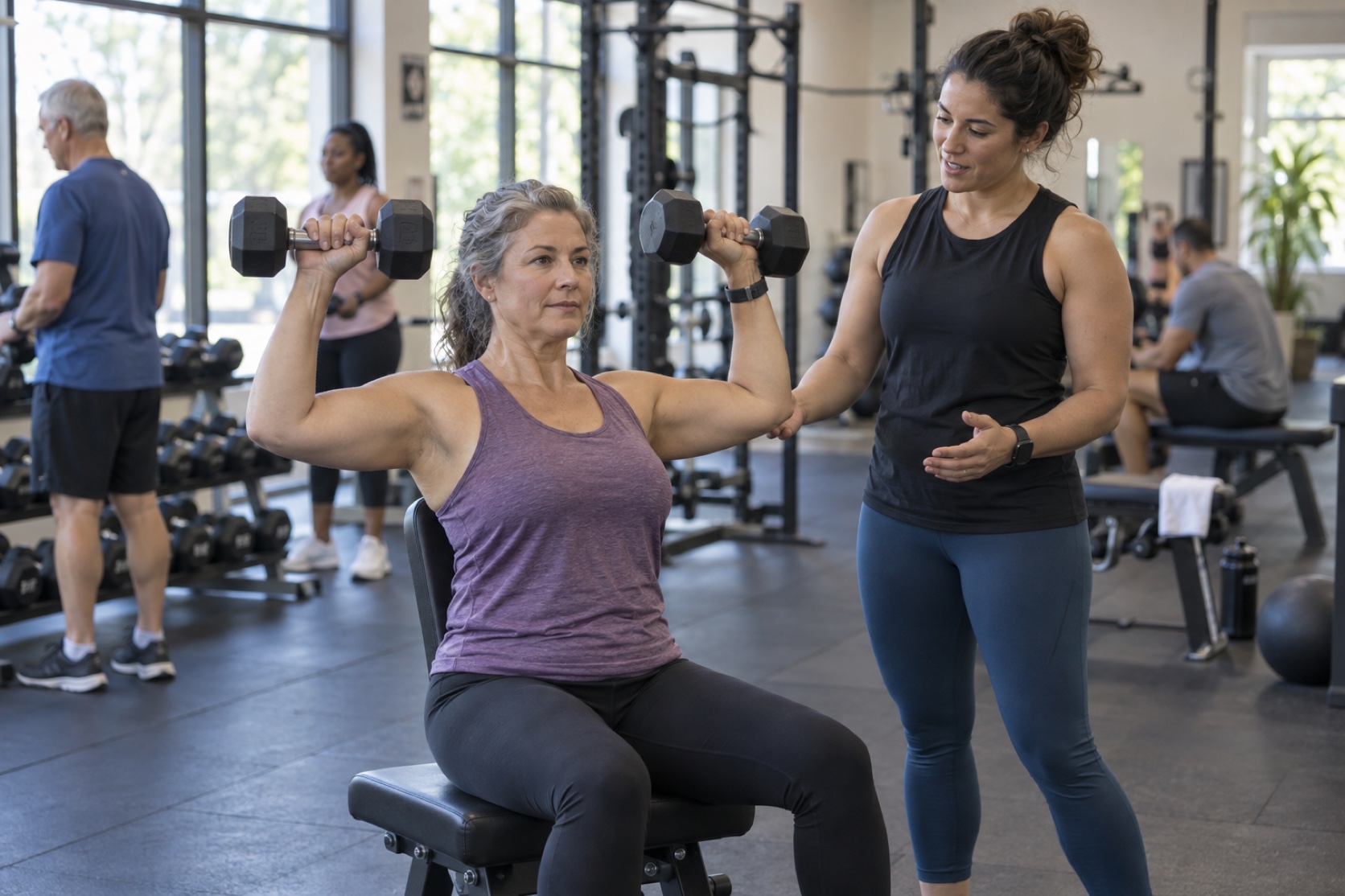
What Actually Changes at Midlife
The transition is a multi-year drift, not a switch. Hormone levels fall gradually through perimenopause, and the final menstrual period is a marker on that curve, not the start of it. The changes that matter for training are bone remodeling, muscle upkeep, and body composition — each on its own timetable.
- 🌸 Timing is individual — perimenopause commonly runs four to eight years, and symptoms, hormone levels, and body responses vary widely between women. Nothing on this page assumes your experience; that is a feature of the evidence, not a gap in it.
- 🦴 Bone loss accelerates — spine bone density begins dropping faster in the roughly two years around the final menstrual period, at about 1–2% per year, before the rate slows again in later postmenopause (Finkelstein et al., 2008). This window is the reason loading matters more now.
- 💪 Muscle and strength drift — muscle mass declines roughly 0.5–1% per year from the thirties onward, and strength loss steepens after fifty in untrained women. The drift is real, and it is modifiable — the training response below is the modification.
- ⚖️ Body composition shifts — fat tends to redistribute toward the trunk across the transition. Training changes the response to that biology; it does not erase the biology.
🌸 Symptoms are individual — so is the plan
Hot flashes, night sweats, sleep disruption, joint aches, mood: patterns exist, but the individual experience does not follow them. If symptoms are disrupting sleep or training, a clinician — ideally one who works with menopause regularly — is the right first stop, and a physiotherapist or pelvic-health specialist is the right second one for movement-specific questions.
Product picks are generic categories, not brands. We may earn a commission on Amazon or iHerb purchases at no cost to you — this never changes our evidence conclusions. Full disclosure
Adjustable dumbbells
Allows progressive loading at home across common strength movements.
⚠️ Poor technique or rapid load increases raise injury risk; not required to begin moving more.
Check price on Amazon →The Training Response Holds — and Often Surprises
The most common fear this page exists to answer: "my body doesn't respond anymore." The trial literature points the other way. When untrained women and men run the same progressive program, women's relative strength gains — the percentage improvement from their own starting point — match or exceed men's. Early gains are largely neural: the nervous system learns to recruit muscle that was already there, which is why the first weeks move fast for everyone.
- 💪 Relative gains, not absolute — in eight-to-twelve-week trials, midlife women typically add 20–40% to key lifts from baseline; men add more absolute weight but similar relative percentages. Your trend line is the honest comparison, not someone else's bar.
- 🧬 Muscle protein sensitivity — the muscle's response to protein and resistance exercise can be blunted in some postmenopausal women; regular training and adequate daily protein appear to support it. The protein page owns the dosing; this page just notes the interaction.
- 🔁 Twice a week is enough — two full-body sessions capture most of the strength and muscle benefit of higher frequencies in this age group; a third is a bonus, not a requirement.
- 📈 Progression rules are unchanged — double progression (fill the rep range, add the smallest load) works exactly as in Part 2 of this series. The transition changes the context, not the mechanism.
Bone: Why Loading Matters More Now
The transition is when bone-density loss accelerates, and mechanical loading is one of the few interventions with trial support for pushing back. The honest version: the effects are real but modest — on the order of 1–3% over six to twelve months — and the win compounds because strength also cuts the fall risk that turns low bone density into fractures.
- 🏋️ Heavy lifting moves bone — the LIFTMOR trial (Watson et al., 2018) put postmenopausal women with osteopenia or osteoporosis through eight months of supervised high-intensity resistance plus impact training: hip and spine density improved by a few percent while the control group declined. Heavy, supervised, and progressive — that combination is the pattern, not any single machine.
- 🦘 Impact counts — jumps, heel drops, and stomps add load at the hip that slow isometric work cannot. Start small, add gradually, and keep the landing soft.
- 🧭 A DXA number is not a verdict — fracture risk is a conversation between bone density, strength, falls, and history. Clinicians interpret scans; the muscle & bone context page walks through what the numbers mean.
- ⚠️ Known low bone density changes the prescription — heavy spinal loading may still be appropriate — LIFTMOR used it under supervision — but that decision belongs to a clinician or physiotherapist who has seen your scan, not to a website.
The Template: Two Sessions That Do the Work
The structure is the series lead's five-pattern template with three midlife-specific adjustments: the hinge and the carry earn a permanent slot (hip and spine loading), impact appears in small doses, and every set keeps the 1–3-rep reserve so sessions stay recoverable when sleep is short.
| Pattern | Movement | Sets × reps | Midlife note |
|---|---|---|---|
| 🪑 Squat | Goblet or split squat | 2–3 × 6–10 | Depth you control; the hip is the target, not the record |
| 🔗 Hinge | Dumbbell RDL or glute bridge | 2–3 × 6–10 | The bone-relevant lift — load it progressively |
| 🚪 Push | Dumbbell press or push-up | 2 × 6–12 | Neutral grip spares the wrist and elbow |
| 🪝 Pull | Row or lat pulldown | 2 × 6–12 | Balance the press; posture work pays double |
| 🎒 Carry + impact | Farmer's carry + light jumps | 2–3 carries, 10–20 jumps | Hip loading without gymnastics; soft landings |
Run the week as Monday and Thursday, or any two days with a recovery day between. Progression follows Part 2: add a rep per set until the range tops out, then add the smallest load and rebuild. The full prescription, set by set, lives on the training template page.
Kettlebell
A compact option for loaded carries, hinges, squats, and presses.
⚠️ Ballistic movements require skill; avoid using pain or instability as a training signal.
Check price on Amazon →Heavy Enough: Spine, Hips, and Wrists
- ⚖️ Load is a dose — bone responds to strain magnitude more than to rep count. The working sets should feel genuinely hard, with 1–3 reps in reserve — not comfortable, and not grinded to failure.
- 🦴 Hinge and carry, always — the hip hinge and the loaded carry put load exactly where the transition hits hardest: the hip and the spine. They are not optional extras in this template; they are the point.
- 🖐️ Wrists and elbows get a vote — pressing with dumbbells instead of a bar allows a neutral grip that spares sore wrists; grip strength itself is a health marker worth training, which the strength-after-40 topic covers.
- 🐢 Progress slowly on purpose — joints and tendons adapt more slowly than muscles. Smallest jumps (2.5 kg / 5 lb), fill the rep range first, and treat a twinge as information, not an obstacle to push through.
Symptoms, Sleep, and Recovery
The transition's most training-relevant symptom is the one that steals recovery: night sweats fragment sleep, and training adaptations are built between sessions, not during them. The honest summary of the exercise-and- symptoms literature is that it is mixed, so the practical system is to train around your own pattern.
- 🌡️ Hot flashes: mixed evidence — a Cochrane review of exercise for vasomotor symptoms (Daley et al., 2014) found inconsistent results: some women report fewer flashes with regular exercise, many trials show no difference. Worth trying for a month; judge by your pattern, not by averages.
- 😴 Sleep is the recovery currency — if night sweats are fragmenting sleep, training harder is the wrong lever; fixing the sleep is the right one. The sleep protocol has the basics, and a menopause-informed clinician owns the rest.
- 🔋 Train in your energy window — many midlife women report their best window is morning; find yours and protect it. On low-energy days, shorten the session rather than skip it — twenty good minutes keeps the trend line alive.
- 📉 A bad week is not a bad program — symptom flares will dent sessions. The months-long trend line is what counts; the symptoms, sleep & recovery page turns this into day-to-day rules.
Pelvic Floor and Core: Respect the Pressure
Lifting raises intra-abdominal pressure, and the pelvic floor responds to it. For most women that response is unremarkable; for some it shows up as leakage or a sense of heaviness. That is common — and it is not something to train through or ignore.
- 🌬️ Breathe, don't hold — exhale on the effort. A hard brace held with a breath spikes pressure more than the lift requires.
- 🧱 Core work is pelvic-floor work — the deep core system and the pelvic floor coordinate as one unit; the pelvic-floor & core page explains what training that actually looks like.
- 🚻 Leaking during training is a signal — urine leakage with jumps or heavy lifts is a pelvic-health question with strong treatment options. Pelvic-floor physiotherapists are the standard referral, and the evidence for their care is among the strongest in rehabilitation medicine.
- ⚠️ Heaviness or pressure changes everything — a history of prolapse, or new heaviness with loading, means the loading conversation belongs to a pelvic-health specialist. This page's template assumes a healthy pelvic floor; that assumption is the clinician's to confirm.
🧭 Leaking is common and treatable — not normal to ignore
One in three women experiences some pelvic-floor symptoms after childbirth or with age. The response is not to quit lifting — it is to train the system properly, which is exactly what pelvic-health physiotherapy is designed for. It is a referral, not a retirement.
The Clinician Handoff: When Training Isn't the First Move
This site educates; it does not prescribe. The situations below are the ones where the right first move is a professional — because menopause symptoms, pelvic-floor issues, injury, bone concerns, and medical history are individual, and no page can know yours.
- 🩻 Undiagnosed or known low bone density — or any history of fracture after forty. Get the scan and the clinical read before loading the spine heavily; the loading prescription follows the imaging.
- 🩺 New joint pain, chest symptoms, or unexplained fatigue — stop that movement and evaluate. Pain that persists past a week, or worsens with ordinary life, is a clinician question, not a loading question.
- 🌡️ Symptoms that disrupt life — sleep, work, or mood consistently derailed. Hormone therapy decisions interact with training and bone in ways the trials are still sorting out; that decision is clinical, and a menopause-informed clinician is the right person to make it with.
- 🧑⚕️ Pelvic-floor symptoms, injury, or complex history — physiotherapists and pelvic-health specialists own the movement-specific questions. The individualized care handoff page turns this list into a conversation script for your next appointment.
What the power-training trials actually measured is laid out in What the Trials Show.
The Bottom Line
- The response holds — women in midlife gain relative strength and muscle at least as well as anyone; the transition changes the context, not the capacity.
- Bone is the added reason — heavy, progressive loading plus modest impact is one of the few interventions with trial support for holding bone through the transition's 1–2%-per-year window.
- Two sessions, honestly recovered — the five-pattern template twice a week, hinge and carry permanent, 1–3 reps in reserve, smallest jumps on the way up.
- Individual, not uniform — symptoms, pelvic floor, bone, and history vary; clinicians, physiotherapists, and pelvic-health specialists own the decisions whenever anything is off.
Go Deeper: Resistance Training for Women Through Midlife
These five companion pages turn the topic into smaller, testable practices.
- 🔗 Midlife Muscle & Bone Context
- 🔗 The Training Template
- 🔗 Symptoms, Sleep & Recovery
- 🔗 Pelvic-Floor & Core Considerations
- 🔗 The Individualized Care Handoff
Related Topics
- Watson SL, et al. "High-Intensity Resistance and Impact Training Improves Bone Mineral Density and Physical Function in Postmenopausal Women With Osteopenia and Osteoporosis: The LIFTMOR Randomized Controlled Trial." Journal of Bone and Mineral Research (2018)
- Finkelstein JS, et al. "Bone mineral density changes during the menopause transition in a multiethnic cohort of women." Journal of Clinical Endocrinology & Metabolism (2008)
- Taaffe DR, et al. "Once-weekly resistance exercise improves muscle strength and neuromuscular performance in older adults." Journal of the American Geriatrics Society (1999)
- Schoenfeld BJ, et al. "Strength and hypertrophy adaptations between low- vs. high-load resistance training: a systematic review and meta-analysis." Journal of Strength and Conditioning Research (2017)
- Daley A, et al. "Exercise for vasomotor menopausal symptoms." Cochrane Database of Systematic Reviews (2014)
- World Health Organization. WHO guidelines on physical activity and sedentary behaviour (2020)