The Training Template
A midlife resistance plan does not need to be elaborate to be effective — it needs to be repeatable. This page assembles the frequency, pattern order, progression, and recovery decisions into one template built to survive symptoms, travel, and real life.
What the evidence supports
- Two to three sessions per week produce the largest strength effects in older adults (Borde 2015).
- Total weekly volume matters more than how it is split across days (Grgic 2018).
- Progressive overload — small, logged increases over time — is the mechanism behind most training gains (Ratamess 2009).
What remains uncertain
- Optimal set counts for midlife women specifically are not established; guidance is extrapolated from mixed-age and older-adult samples.
- How much recovery differs across the transition is individual — some women report slower recovery, others none (Fullagar 2015 covers the sleep side).
Evidence last reviewed: August 20, 2026. Conclusions may change as new research is published.
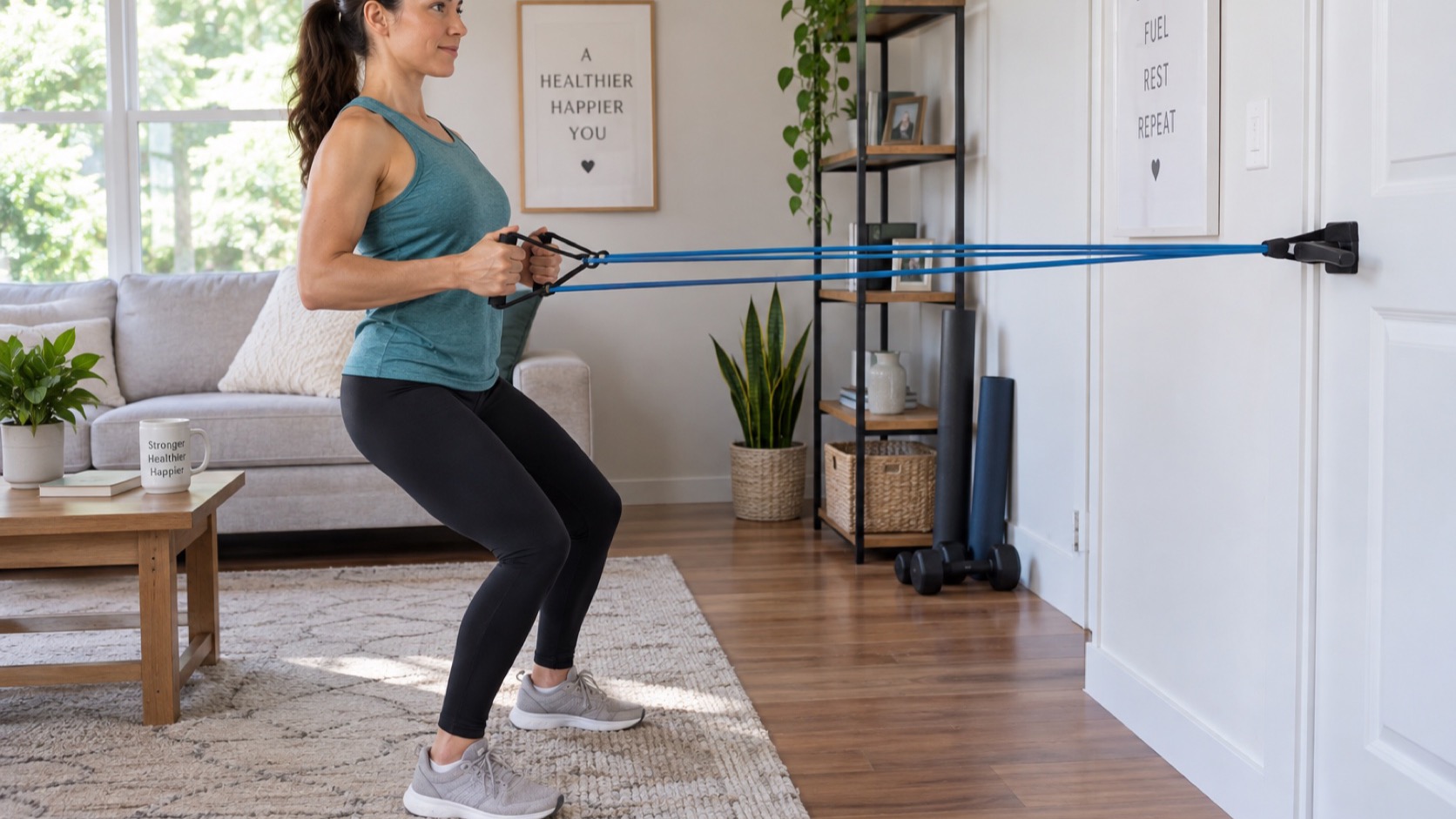
One Template, Three Jobs
The template below has three explicit jobs: build muscle and bone stimulus every week, keep sessions short enough to repeat, and leave room for symptom-aware adjustments. It is a framework, not a prescription — the resistance training series supplies the principles underneath it.
- 🧭 The load-bearing idea — a durable plan survives bad weeks, so the template's default is full-body sessions built from the five movement patterns rather than a body-part split that collapses when one session is missed.
- ⏱️ The time budget is the constraint — 45–60 minutes, three times a week, is enough to cover every pattern; anything longer tends to get skipped, and skipped sessions are the real enemy of progress.
- 🔄 The template bends instead of breaking — the same skeleton works at two or three days, with or without accessories, and across symptom-heavy weeks; the symptoms, sleep, and recovery page covers the adjustment rules.
- 📆 Habit is part of the dose — habit-formation data suggest it takes roughly two months of consistent repetition for a behavior to become automatic (Lally 2010), which is why the first phase of the ramp is about showing up, not loading up.
Product picks are generic categories, not brands. We may earn a commission on Amazon or iHerb purchases at no cost to you — this never changes our evidence conclusions. Full disclosure
Adjustable dumbbells
Allows progressive loading at home across common strength movements.
⚠️ Poor technique or rapid load increases raise injury risk; not required to begin moving more.
Check price on Amazon →Frequency: Two to Three Days
Frequency is the most-asked question and the least interesting one — the data consistently land on two to three sessions per week, with total weekly work doing most of the work.
- 📊 The dose-response data — a systematic review in healthy older adults found 2–3 weekly sessions with moderate-to-high intensity produced the largest strength effects; more sessions added little (Borde 2015).
- ⚖️ Splitting does not multiply — meta-analytic comparisons of training frequency find similar strength and size gains when weekly volume is matched (Grgic 2018); the reps, sets & weights topic frames volume the same way.
- 📉 Two days is a floor, not a ceiling — two well-structured full-body sessions per week beat three sessions that keep getting postponed; the parent topic's two-day argument applies here unchanged.
- 🗓️ The default schedule — Monday, Wednesday, Friday (or any even spacing) with at least one rest day between sessions, and the freedom to compress to two days during busy or symptomatic weeks.
The Five Patterns, in Order
Every session runs the same skeleton: squat, hinge, push, pull, and carry, in that order, with compounds first while the nervous system is fresh. The exercise selection topic owns the full pattern library; here the focus is the order and the load logic.
- 🏆 Big patterns while fresh — squat and hinge open the session; their skill demand and load both degrade under fatigue, so the schedule protects them.
- 🤸 Push, then pull, then carry — pressing, pulling, and loaded carries close out the patterns in that order, with carries doubling as the session's finishing grip-and-core stimulus.
- ➕ Accessories are optional by design — zero to two targeted isolation moves after the five patterns, aimed at a named weak point, cut first when time compresses.
- 🔄 Swaps keep the skeleton honest — a machine or dumbbell version of a pattern is still that pattern; the exercise selection parent documents the swap rules.
Progression That Lasts
The engine of the template is progressive overload — small, logged increases in load, reps, or sets over time. The rules below keep that engine running without turning every session into a max-out.
- 📈 Add weight in small, regular steps — the 2.5 kg (or smaller) increment rule from the progressive overload topic keeps progress legible and joints happy; machines with small plates make this easier than barbells.
- 🧮 Reps first, then weight — double progression: add reps within a target range before adding load; only when the top of the range is reached does the weight go up (Ratamess 2009).
- 🛑 Leave two to three reps in reserve — working near but not at failure on most sets produces similar gains with less recovery cost; true failure sets are the exception, not the default (Grgic 2022).
- 📋 Log the session, not the feeling — a simple record of exercises, weights, and reps turns vague "it felt harder" into a decision about next week; the reps, sets & weights topic has the tracking detail.
| Phase | Sessions/week | Sets per pattern | Focus | Verdict |
|---|---|---|---|---|
| 🗓️ Weeks 1–4 | 2 | 2 | Skill, habit, and honest starting loads | Start here |
| 📈 Weeks 5–8 | 2–3 | 2–3 | Load build via double progression | Gradual |
| 🔩 Weeks 9–12 | 3 | 3 | Full template, heavier working sets | Maintain |
| 🔄 Ongoing | 2–3 | 2–3 | Deload every 6–8 weeks; then repeat | The long game |
The Recovery Column
The template schedules work; it also schedules the absence of work. Recovery is where the stimulus becomes adaptation, and midlife recovery is individual enough that the plan has to bend around it.
- 😴 Sleep is the first recovery lever — short sleep raises perceived effort during training and appears to blunt the muscle-protein response to a session (Fullagar 2015; Lamon 2021); the sleep topic owns the mechanics.
- 📉 Deload weeks are scheduled, not emergency measures — every 6–8 weeks, cut volume or intensity by roughly half for a week; the training vs recovery topic documents why this preserves long-run progress.
- 🔄 Symptom weeks use the adjustment ladder — drop intensity, keep the patterns, split sessions if needed; the symptoms page has the full ladder.
- 🥗 Protein does not wait for training days — recovery runs on daily intake near 1.6–2.2 g/kg, not just on session days (Morton 2018); the protein topic has the per-meal breakdown.
📋 The template bends; it does not break
The failure mode this template is designed against is not "too light" — it is "stopped." A symptom-heavy week, a trip, or a busy stretch does not require a new plan; it requires the same skeleton at reduced intensity or reduced frequency. Two honest sessions beat three rescheduled ones, and a deloaded week beats a missed month. When symptoms, pain, or new medical findings arrive, the adjustment is a conversation with a clinician or physiotherapist — not a reason to abandon the template altogether.
Questions, Answered Briefly
- ❓ Can I train with heavy fatigue or poor sleep? — Yes, with the volume and intensity dialed down; the evidence shows short sleep degrades performance and recovery, not the value of showing up (Fullagar 2015).
- ❓ Is a 30-minute session worth anything? — It covers the squat and hinge patterns plus a carry; that is most of the stimulus for a fraction of the time, and it keeps the habit alive (Grgic 2018).
- ❓ What if one pattern hurts? — Swap to a machine or dumbbell version of the same pattern first; if pain persists beyond a couple of weeks, that is physiotherapist territory, not a reason to stop everything else.
- ❓ Do I need to train to failure? — No — most sets should leave two to three reps in reserve; the evidence for failure training's extra benefit is modest and the recovery cost is real (Grgic 2022).
- ❓ When do I deload? — Every 6–8 weeks, or sooner when sleep quality drops, motivation tanks, or weights that used to move easily feel heavy; the training vs recovery topic has the decision rules.
The Bottom Line
- The template is two to three full-body sessions a week, built from the five patterns in order, in 45–60 minutes (Borde 2015).
- Progression is small, logged, and regular — reps first, then weight, with two to three reps left in reserve (Ratamess 2009).
- Recovery is scheduled, not improvised — sleep, protein, and a deload every 6–8 weeks are part of the plan (Fullagar 2015; Morton 2018).
- The template bends around life instead of breaking — reduced-intensity and reduced-frequency weeks keep the habit alive when symptoms or schedules interfere.
Related Topics
- Borde et al., "Dose–response relationships of resistance training in healthy old adults: a systematic review and meta-analysis," Sports Medicine (2015)
- Grgic et al., "Effect of resistance training frequency on gains in muscular strength: a systematic review and meta-analysis," Sports Medicine (2018)
- Ratamess et al., "Progression models in resistance training for healthy adults," Medicine & Science in Sports & Exercise (2009)
- Kraemer & Ratamess, "Fundamentals of resistance training: progression and exercise prescription," Medicine & Science in Sports & Exercise (2004)
- Grgic et al., "Effects of resistance training performed to repetition failure or non-failure on muscular strength and hypertrophy: a systematic review and meta-analysis," Journal of Sport and Health Science (2022)
- Fullagar et al., "Sleep and athletic performance: the effects of sleep loss on exercise performance, and physiological and cognitive responses to exercise," Sports Medicine (2015)
- Lamon et al., "The effect of acute sleep deprivation on skeletal muscle protein synthesis and the hormonal environment," Physiological Reports (2021)
- Lally et al., "How are habits formed: modelling habit formation in the real world," European Journal of Social Psychology (2010)
- Morton et al., "A systematic review, meta-analysis and meta-regression of the effect of protein supplementation on resistance training-induced gains in muscle mass and strength in healthy adults," British Journal of Sports Medicine (2018)