Symptoms, Sleep & Recovery
Hot flashes, restless nights, and heavy fatigue are common in midlife — and none of them is a reason to abandon training. This page treats symptoms and sleep as information: what to adjust, what to track, and when a symptom pattern deserves a clinician's attention rather than a workout redesign.
What the evidence supports
- Sleep difficulty rises across the menopause transition — roughly 38% of midlife women in a large community survey reported it (Kravitz 2003).
- Short sleep raises perceived effort during training and appears to blunt the muscle-protein response afterward (Fullagar 2015; Lamon 2021).
- Cognitive behavioral therapy for insomnia produces durable sleep improvements in trials (Trauer 2015).
What remains uncertain
- Whether exercise reliably reduces hot flashes is not established — the Cochrane review found insufficient evidence (Daley 2014).
- How much of midlife sleep change is hormonal versus age- and stress-related is unresolved.
Evidence last reviewed: August 20, 2026. Conclusions may change as new research is published.
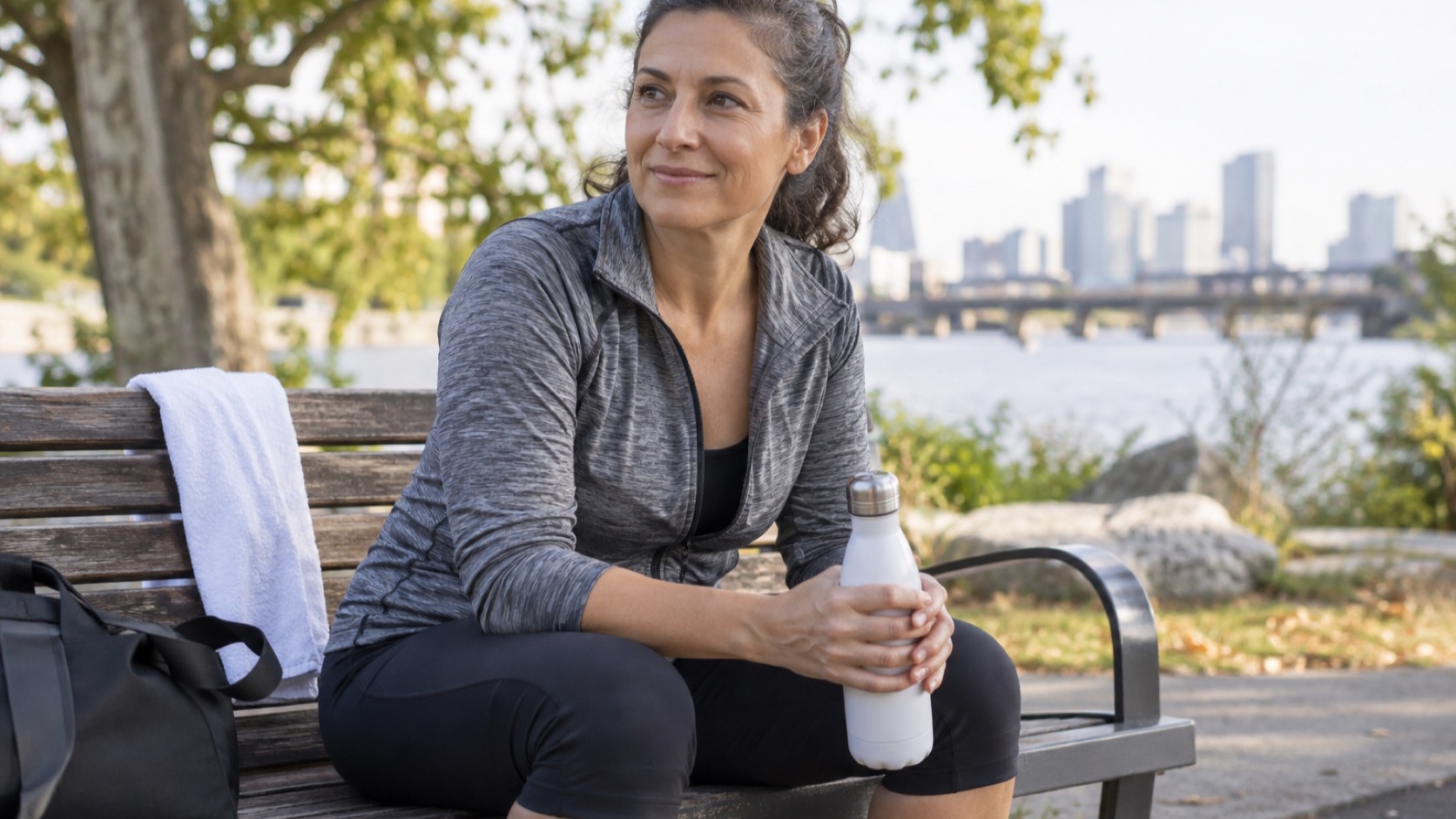
Symptoms as Information
The frame matters before any adjustment: symptoms are data about the current week, not a verdict on training itself. A hot-flash-heavy night changes how tomorrow's session should look; it does not change whether training is worth doing.
- 🌡️ Symptoms are individual by definition — timing, intensity, and burden vary so widely across women that any general rule ("train through it" or "rest through it") is wrong for someone; the muscle and bone context page makes the same point about averages.
- 📉 The cost of quitting is larger than the cost of adjusting — muscle and bone respond to consistent loading over years; a modified session preserves the habit that produces the response (Borde 2015).
- 🔍 Symptoms are also signals — a pattern that is new, severe, or worsening is worth a clinician conversation, not just a workout tweak; the care handoff covers when.
- 📋 Track the pattern, not the single bad day — one rough night is noise; a two-week trend of poor sleep or heavy fatigue is information that should change the plan and possibly prompt a check-in.
Product picks are generic categories, not brands. We may earn a commission on Amazon or iHerb purchases at no cost to you — this never changes our evidence conclusions. Full disclosure
Blackout shades or curtains
May reduce unwanted bedroom light and make a dark sleep setting easier to maintain.
⚠️ None expected from the product itself; install securely and preserve a safe route to exits.
Check price on Amazon →Hot Flashes and Training Sessions
The honest evidence here is thinner than most wellness content suggests: trials have not shown that exercise reliably reduces hot flashes, even though individual women often report feeling better after sessions.
- 🔎 The Cochrane verdict — a systematic review of exercise for vasomotor symptoms found insufficient evidence that exercise reduces hot flashes, while also finding no evidence of harm (Daley 2014).
- 🧪 The MsFLASH trials agree — a 12-week randomized trial found neither yoga nor aerobic exercise significantly reduced hot-flash frequency compared with usual activity, though exercise was associated with better sleep and quality-of-life scores (Sternfeld 2014).
- 🏃 Training around the heat — earlier or later sessions, cooler environments, layered clothing, and hydration are practical levers that cost nothing and help many women; a small aerobic trial found night sweats responded to training more than daytime flushes did (Luoto 2012).
- ⚖️ The real question is not "will it stop the flashes" — it is whether training's documented benefits for muscle, bone, and mood justify continuing; the resistance training series documents those benefits, and the symptom evidence does not undercut them.
The Sleep Numbers in Midlife
Sleep is the recovery variable most affected by the transition, and the cohort data make the scale of it plain: sleep difficulty is not a niche complaint at midlife.
- 📊 The SWAN survey numbers — in a community sample of more than 12,000 women aged 40–55, roughly 38% reported sleep difficulty, with rates rising across transition stages (Kravitz 2003).
- 🔥 The flash–wake connection is real but partial — night-time hot flashes are associated with more awakenings, yet many midlife sleep problems persist independent of flashes; the sleep and mood transition topic untangles the two.
- 😴 What actually helps is underused — cognitive behavioral therapy for insomnia (CBT-I) outperforms sleep medications in trials and is recommended as first-line treatment; the sleep topic and the sleep protocol own the implementation.
- 🧮 One night matters less than the pattern — recovery math runs on weekly sleep totals, not single nights; a bad night is a reason to lighten a session, not to cancel the week.
Short Sleep, Harder Training
For training specifically, the sleep cost is measurable and mostly mechanical: sleep loss makes the same session feel harder and appears to shrink the muscle-building response to it.
- 📈 Perceived effort goes up — systematic review data show sleep loss raises ratings of perceived exertion during exercise and degrades performance on longer efforts (Fullagar 2015).
- 🧬 The muscle response shrinks — a small crossover study found a single night of sleep deprivation lowered the muscle-protein synthetic response to a subsequent meal, a finding consistent with the broader sleep–recovery literature (Lamon 2021).
- ⚖️ Submaximal strength holds up better — the same reviews find that lighter, submaximal work is far less affected than maximal efforts, which is why the adjustment ladder below favors dropping intensity before dropping sessions (Fullagar 2015).
- 🛌 Sleep is trainable too — consistent timing, a cool dark room, and CBT-I where needed are all associated with better midlife sleep; the sleep protocol is the practical playbook.
The Adjustment Ladder
When symptoms or sleep are off, adjust in a defined order — intensity first, volume second, frequency third, and sessions last. The ladder keeps the stimulus alive while respecting the current week.
- 🪜 Rung one: lower the intensity — keep the same exercises and sets, take two to three reps off the working weight; submaximal work is the least affected by fatigue and sleep loss (Fullagar 2015).
- 📉 Rung two: cut volume — drop from three sets per pattern to two, or drop the accessories; the five patterns stay intact.
- 📅 Rung three: compress frequency — a two-day week still meets the evidence-based minimum; the training template shows how the skeleton compresses.
- 🕐 Rung four: move the session — train earlier or later in the day; for women whose flashes cluster at certain times, session timing is a free lever (Luoto 2012).
- 🚩 The ladder's bottom rung is a handoff, not a stop — persistent heavy fatigue, new pain, or a worsening symptom pattern is clinician territory (see the care handoff), while the habit itself is preserved.
| Symptom | First adjustment | When to hand off | Verdict |
|---|---|---|---|
| 🔥 Hot flashes | Cooler sessions, layered clothing, timing shift | Severe or worsening burden — clinician conversation | Adjust at home |
| 😴 Poor sleep | Drop intensity, keep patterns | Chronic insomnia lasting weeks — CBT-I or clinician input | Adjust at home |
| 🦵 Heavy fatigue | Cut volume, add a rest day | Fatigue with other symptoms or lasting beyond two weeks | Check with clinician |
| 🩺 New joint or muscle pain | Reduce load, avoid aggravating movements | Pain persisting past two weeks — physiotherapist assessment | Physio input |
😴 Sleep is a signal, not a stop sign
A poor night's sleep is the most common reason midlife training plans quietly die — not because the body cannot train, but because the session feels miserable at full intensity. The evidence-backed response is to keep the session and lower the bar: submaximal work is least affected by sleep loss, the habit survives, and the recovery column of the template gets its due. If poor sleep becomes the pattern rather than the exception, that is a conversation for a clinician — CBT-I has the strongest evidence base of any insomnia treatment, and it is underused.
Questions, Answered Briefly
- ❓ Should I skip training when I am exhausted? — Skip the intensity, not the session; the evidence shows submaximal work is far less affected by fatigue, and the habit is the asset (Fullagar 2015).
- ❓ Will training eventually reduce my hot flashes? — Maybe for some women, but the trials have not demonstrated it; the honest position is to train for muscle, bone, and mood, and treat flash relief as a possible bonus (Daley 2014; Sternfeld 2014).
- ❓ Is a hot flash during a set dangerous? — No evidence suggests it; the practical response is cooling and pacing, not alarm.
- ❓ What counts as "chronic insomnia" worth treating? — Difficulty falling or staying asleep at least three nights a week for three months or more is the conventional threshold; CBT-I is the evidence-backed first step (Trauer 2015).
- ❓ Do I need more rest days in midlife? — Individual, not automatic; the template's two to three sessions with a deload every 6–8 weeks covers most women, and the symptom ladder handles the rest.
The Bottom Line
- Symptoms and sleep are context, not verdicts — they inform the week's adjustments, not the worth of training itself.
- Exercise has not been shown to reliably reduce hot flashes, yet its muscle, bone, and mood benefits stand on separate evidence (Daley 2014).
- Sleep loss makes sessions harder and shrinks the muscle response — drop intensity before dropping sessions (Fullagar 2015; Lamon 2021).
- The adjustment ladder is intensity, volume, frequency, timing, then handoff — and a persistent symptom pattern is a clinician conversation, not a workout redesign.
Related Topics
- Daley et al., "Exercise for vasomotor menopausal symptoms," Cochrane Database of Systematic Reviews (2014)
- Sternfeld et al., "Efficacy of exercise for menopausal symptoms: a randomized controlled trial," Menopause (2014)
- Luoto et al., "Effect of aerobic training on hot flushes and quality of life in postmenopausal women: a randomized controlled trial," Annals of Medicine (2012)
- Kravitz et al., "Sleep difficulty in women at midlife: a community survey of sleep and the menopausal transition," Menopause (2003)
- Trauer et al., "Cognitive behavioral therapy for chronic insomnia: a systematic review and meta-analysis," Annals of Internal Medicine (2015)
- Fullagar et al., "Sleep and athletic performance: the effects of sleep loss on exercise performance, and physiological and cognitive responses to exercise," Sports Medicine (2015)
- Lamon et al., "The effect of acute sleep deprivation on skeletal muscle protein synthesis and the hormonal environment," Physiological Reports (2021)
- Borde et al., "Dose–response relationships of resistance training in healthy old adults: a systematic review and meta-analysis," Sports Medicine (2015)