Cardio for Joint-Limited Bodies
Joint pain is one of the most common reasons people stop training — and one of the most fixable. The cardio plan that serves a healthy knee can inflame an arthritic one, but the fix is usually a change of vehicle, not a change of goal. This page is the joint-first version of the cardio protocol: keep the volume, keep the heart gains, and let the joints decide the mode.
What the evidence supports
- Low-impact aerobic training — cycling and swimming — improves function and reduces pain in people with knee osteoarthritis (RCT evidence, including Alkatan 2016 and the Cochrane review of exercise for knee OA).
- Recreational running is not clearly associated with higher knee-osteoarthritis risk than a sedentary lifestyle; the elevated risk concentrates at elite, high-volume running (Timmins 2017).
- Exercise is the reference first-line management for hip and knee osteoarthritis in rheumatology guidelines (EULAR 2018).
- Cardiorespiratory gains are largely independent of mode — zone 2 and interval stimulus transfer from bike to pool to rower.
What remains uncertain
- Where the individual line sits between "joint-friendly" and "joint-stressing" — no test predicts which mode will flare which joint.
- Whether low-impact modes deliver an identical metabolic stimulus — swimming's horizontal body position and heat loss change the response.
- Long-term cartilage outcomes of high-volume training in people with existing osteoarthritis — the trials run for months, not decades.
Evidence last reviewed: August 20, 2026. Conclusions may change as new research is published.
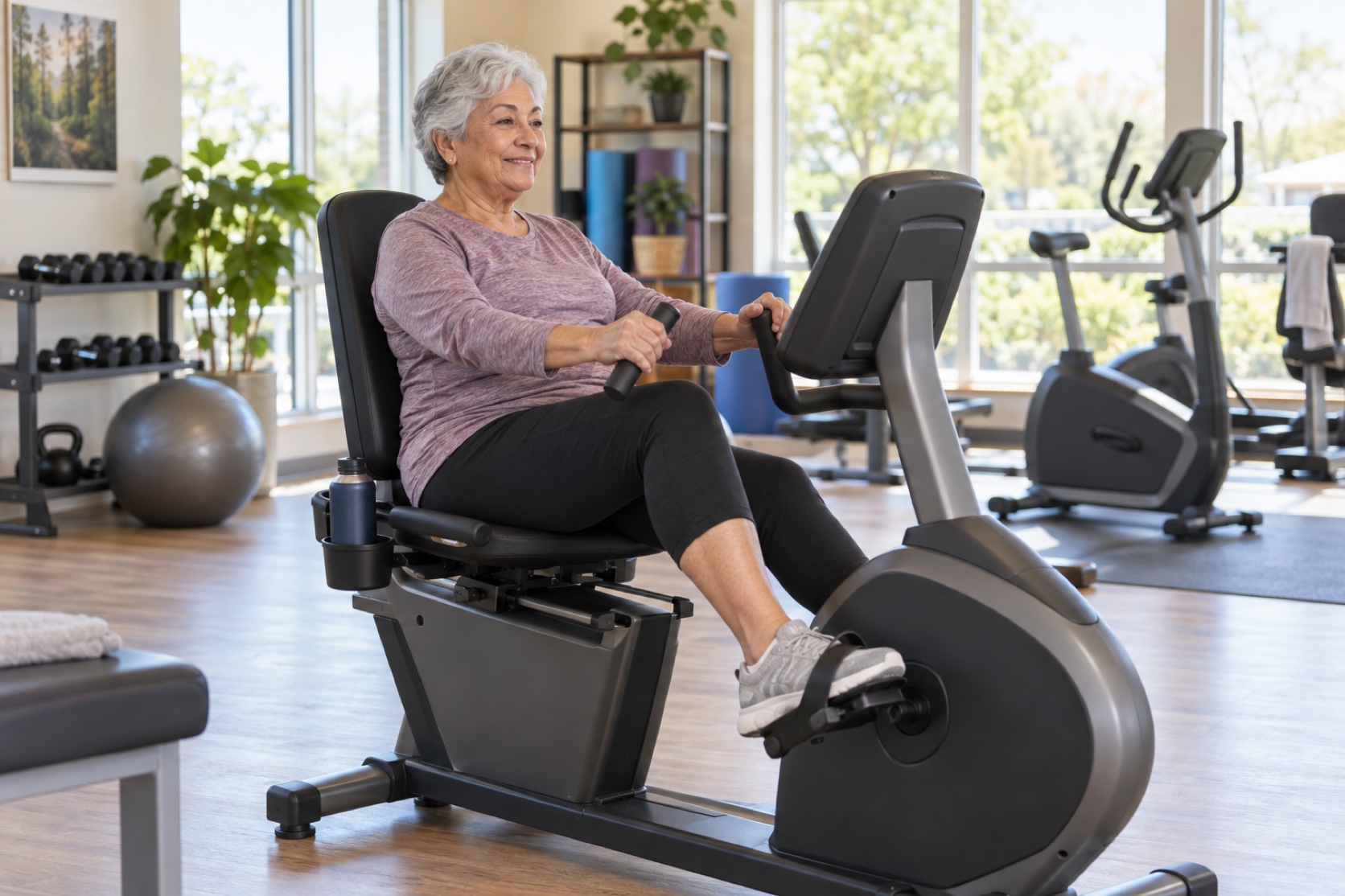
The Joint Question, Framed Honestly
The joints are not delicate — they are load-adapted organs with a slower remodeling clock than muscle. What changes with age, injury, or arthritis is tolerance: the same step that strengthens one knee can flare another. The honest frame is that load is not automatically damage; it becomes a problem only when it exceeds what a joint can currently absorb and recover from.
- 🦴 Cartilage feels nothing itself — articular cartilage has no pain fibers; the ache you feel comes from the tissues around it — bone, synovium, capsule — signaling strain (Dye 2005). Pain is a tolerance signal, not a damage report.
- ⚖️ Load is relative — recreational runners show no higher knee-osteoarthritis rates than sedentary people in meta-analyses; the same load is protective for one joint and excessive for another (Timmins 2017).
- 📉 The tolerance gap — after injury or with arthritis, joint tolerance drops while the aerobic goal stays the same. The mode bends; the goal does not have to.
- 🧭 What this page is not — it does not diagnose. It maps how to keep cardio when joints limit it, and where the limits stop being adjustable.
- 🔗 The parent protocol — the Cardio Conditioning Protocol owns the zones, the talk test, and the weekly schedule this page adapts.
Product picks are generic categories, not brands. We may earn a commission on Amazon or iHerb purchases at no cost to you — this never changes our evidence conclusions. Full disclosure
Smart band or smartwatch
Can make activity, exercise, and routine patterns easier to notice over time.
⚠️ Step, heart-rate, and sleep estimates can be inaccurate and may encourage unhelpful over-monitoring; consumer readings are not medical diagnoses.
Check price on Amazon →The Impact Ladder
Every mode delivers the same currency — heart-rate minutes — but the joint pays a different toll per unit. The ladder below shows approximate peak knee loads; it is a map of options, not a verdict on any of them.
- 🏃 Running — roughly 2.5–3× body weight through the knee per step; the reference high-load mode, and the one most people picture when they picture cardio.
- 🚶 Walking — about 1.2–1.3× body weight; the default joint-friendly floor that also fills the daily-movement bucket.
- 🚴 Cycling — roughly 1× with the saddle carrying the load; seated position also spares the lower back.
- 🏊 Swimming — near-zero impact; buoyancy supports the joints and the horizontal position changes circulation and heat handling.
- ⚖️ Load is not the verdict — a high bar on this chart is not a warning against running for everyone; it is a warning about running for a joint whose tolerance is already spent.
Choosing a Low-Impact Mode
Match the mode to the joint that complains, not to the mode that sounds most athletic. The table is a starting point; the Choosing a Low-Impact Mode companion page runs the full comparison.
| Mode | What it spares | The catch | Impact |
|---|---|---|---|
| 🚴 Cycling | Knees, hips, feet — the saddle takes the load | A too-low saddle shifts load to the front of the knee; set height and spin lightly | Low |
| 🏊 Swimming | Nearly everything — buoyancy unloads all joints | Freestyle form can strain shoulders and neck; pool access is the practical limit | Low |
| 🚣 Rowing | Knees and feet — the glide spares impact | Collapsed form loads the lower back; the leg push is where the power lives | Low |
| 🦵 Elliptical | Knees and feet — the motion is guided and smooth | Some find the stride awkward; foot position and resistance need attention | Low |
| 🚶 Walking | Feet, hips, and knees at moderate pace | Pace-limited — raising heart rate means hills, speed, or a weighted pack | Moderate |
| 🏃 Running | Nothing extra — the highest per-step load on the ladder | Fine for tolerant joints; a poor default while a joint is actively flaring | High |
The honest rule: pick the mode your joints tolerate, then make the heart work inside it.
- 🎯 Match the complaint — ankle or foot trouble points to cycling, rowing, and swimming; knee trouble points to swimming and upright cycling; back trouble points to swimming and the recumbent bike.
- 🔄 Rotate, don't fixate — a two- or three-mode rotation spreads load across patterns and keeps any one joint from taking every session.
- 💓 The heart doesn't read the machine — the zone 2 topic owns the intensity math; it applies identically on a bike, a rower, or in a pool.
- 🧪 Test-drive before committing — two easy sessions in a new mode, a day apart, tell you more than any equipment review: did the joint feel settled the next morning?
Stationary bicycle
Offers an indoor, lower-impact way to accumulate aerobic activity.
⚠️ Fit, intensity, and medical context matter; chest pain, fainting, or concerning exertional symptoms require medical evaluation.
Check price on Amazon →The Pain-Response Rule
Symptom response can guide conservative adjustment — that is the whole of the rule. What matters is what the pain does during and after movement, and whether the joint settles. The decision tree below is the working version; the Pain-Response Rule companion page owns the detailed cases.
| Signal | What it usually means | Response |
|---|---|---|
| 🟢 Mild ache that eases through the warm-up | The joint is loading within tolerance | Continue |
| 🟡 Sharp or catching pain during the movement | That movement, at that load, is past tolerance | Adjust |
| 🔴 Soreness or swelling that follows sessions | The dose exceeded what the joint recovered from | Reduce |
| ⚫ Night pain, instability, or pain after a fall or twist | Outside the conservative-adjustment lane | Assess |
- ⏰ The 24-hour test — a session should not make the joint worse the next morning. If it does, the dose was too big — cut volume, not the habit.
- 🔄 Adjust, don't push through — sharp pain during movement is a stop signal for that movement, not a challenge to overcome; switch mode and keep the heart-rate minutes.
- 📉 The conservative lever — when a joint flares, drop volume 30–50% for a week while keeping easy movement; most flare-ups settle and the volume returns.
- 🚫 What the rule never does — it never overrides the assessment lane: persistent swelling, instability, night pain, traumatic onset, or steady worsening get professional eyes, not another adjustment.
Building Volume Without Impact
Joints tolerate added time better than added force, so the joint-limited build leans on the volume dial — slowly. The Building Volume Without Impact companion page carries the full ramp.
- 📈 The 10% rule — add no more than about 10% per week to total session time. It is a coaching heuristic, not a law, but it is the single most reliable protection against the flare-up that kills the habit.
- 🚴 Cadence over force — on a bike, spin 80–90 rpm with light resistance instead of grinding a big gear; the joints see fewer peak loads per minute.
- 🏊 Effort over yardage — heart rate and the talk test govern the session; distance is a side effect, not the target.
- 🔄 The cross-training week — alternate modes so the same joint never carries every session; variety is a load-management tool, not a boredom fix.
- 💓 Intensity still counts — joint-friendly modes still raise VO2 max; the Zone 2 Mastery and 4×4 intervals sessions transfer directly to bike, rower, and pool.
- 📊 Volume, tracked — the Cardio Conditioning Protocol sets the weekly structure; the joint-limited version keeps the structure and swaps the vehicles.
Mobility and Strength as Cardio Supports
The strongest predictor of whether a limited joint can keep training is usually not the cardio itself — it is the strength and range around the joint. Muscle is the shock absorber; mobility keeps the movement clean. The Mobility & Strength as Cardio Supports companion page owns the routine.
- 💪 Muscle spares cartilage — stronger legs take load off the joint surface; quadriceps strength is among the most consistent predictors of knee-pain improvement in osteoarthritis cohorts.
- 🧘 Range keeps the pattern honest — a stiff ankle changes knee mechanics on every single step; a few minutes of mobility before sessions buys cleaner movement.
- 🏋️ The lifting half — the Strength Training After 40 topic and the Resistance Training Protocol own the program; for joint-limited bodies, quads, glutes, and core come first.
- ⏱️ Five and five — five minutes of mobility before, five minutes of targeted strength after; small enough to keep, large enough to matter.
When Symptoms Need Assessment
Conservative adjustment has a ceiling, and the ceiling is lower than most people assume. The items below are not training problems — they are assessment triggers, and the timing is "soon," not "after one more week." The When Symptoms Need Assessment companion page walks the full list.
- 🚨 Persistent swelling — a joint that swells after every session and stays swollen between them, rather than settling overnight.
- 🚨 Instability — buckling, giving way, or the sense that the joint will not hold under load.
- 🚨 Night pain — pain that wakes you, or hurts at rest when the joint is unloaded.
- 🚨 Traumatic onset — pain that began with a fall, twist, or impact, especially with immediate swelling.
- 🚨 Worsening despite adjustment — steady decline week over week even after volume and mode changes; the adjustments have stopped working, which is information.
⚠️ The line between adjusting and assessing
Nothing on this page diagnoses. Symptom response can guide conservative adjustment — but persistent swelling, instability, night pain, traumatic onset, or worsening symptoms need professional assessment. When a joint crosses that line, the right next step is a clinician's evaluation, not a modified workout.
The Joint-Limited Week, Assembled
A workable week keeps the cardio conditioning structure — two zone-2 sessions, easy movement daily, strength supporting the joints — with every high-load vehicle swapped out. Progression stays at the 10% rule, and every fourth week is easy.
| Day | Session | Notes |
|---|---|---|
| 📅 Mon | 30 min zone 2 cycling | Light resistance, 80–90 rpm; the talk test governs |
| 📅 Tue | 40 min strength | Quads, glutes, core — the joint-support muscles |
| 📅 Wed | 25 min easy swimming + 5 min mobility | Buoyant day; shoulders get the form check |
| 📅 Thu | 40 min brisk walk or 20 min elliptical | Fill the daily-movement bucket |
| 📅 Fri | 40 min strength | Same support pattern; add range work |
| 📅 Sat | 45 min zone 2 cycling | The longer easy session; joints tolerate time |
| 📅 Sun | Easy walk or rest | Joint check-in: any swelling, night pain, or instability is an assessment trigger, not a modification |
- 🚶 The walking floor — the Walking & Rucking topic owns the daily-movement layer that fills the gaps between sessions.
- 📈 The ramp — add roughly 10% per week, never to two dials at once: volume one week, intensity the next.
- 🔄 The swap rule — any session can be swapped for another low-impact mode of similar duration; the heart does not know the difference.
Questions, Answered Briefly
- ❓ Does running destroy knees? — The meta-analyses say no for recreational runners; the elevated osteoarthritis risk concentrates at elite, high-volume running. For a joint that already flares, running is a tolerance question, not a moral one.
- ❓ I find swimming boring — will it really keep my heart fit? — Yes. VO2 max gains do not care about the vehicle; the talk test and heart-rate zones do the work, and Zone 2 Mastery applies unchanged.
- ❓ I have knee pain — should I stop cardio? — Usually you change the vehicle, not the habit. If pain is sharp during movement, swelling follows sessions, or it wakes you at night, that moves into assessment territory.
- ❓ Can I still do intervals? — Yes, in a low-impact mode — bike, rower, or elliptical. Hard efforts load the heart, not the joint; the 4×4 intervals page gives the session.
The Bottom Line
- Mode, not mileage, is the lever — the heart does not know whether its VO2 came from a bike, a pool, or a rower.
- Load is relative to tolerance — the same step is fine for one knee and too much for another; the pain-response rule sorts out which is which.
- Adjust conservatively, assess decisively — symptom response guides week-to-week choices; persistent swelling, instability, night pain, traumatic onset, or worsening get professional eyes.
- Strength and mobility are cardio support — muscle and range keep the joints able to do the sessions that keep the heart young.
Go Deeper: Cardio for Joint-Limited Bodies
These five companion pages turn the topic into smaller, testable practices.
- 🔗 Choosing a Low-Impact Mode
- 🔗 The Pain-Response Rule
- 🔗 Building Volume Without Impact
- 🔗 Mobility & Strength as Cardio Supports
- 🔗 When Symptoms Need Assessment
Related Topics
- Steinmetz et al. (GBD 2021 Osteoarthritis Collaborators), "Global, Regional, and National Burden of Osteoarthritis, 1990–2020 and Projections to 2050," The Lancet Rheumatology (2023)
- World Health Organization, WHO Guidelines on Physical Activity and Sedentary Behaviour (2020)
- Timmins et al., "Running and Knee Osteoarthritis: A Systematic Review and Meta-analysis," The American Journal of Sports Medicine (2017)
- Alkatan et al., "Improved Function and Reduced Pain After Swimming and Cycling Training in Patients With Osteoarthritis," The Journal of Rheumatology (2016)
- Fransen et al., "Exercise for Osteoarthritis of the Knee: A Cochrane Systematic Review," British Journal of Sports Medicine (2015)
- Rausch Osthoff et al., "2019 EULAR Recommendations for the Non-pharmacological Core Management of Hip and Knee Osteoarthritis," Annals of the Rheumatic Diseases (2018)
- Dye, "The Pathophysiology of Patellofemoral Pain: A Tissue Homeostasis Perspective," Clinical Orthopaedics and Related Research (2005)