Choosing a Low-Impact Mode
When joints are the constraint, the question is not whether to train but which machine or movement will let you train often. This page lays out the low-impact menu — cycling, rowing, pool exercise, elliptical work, and walking — and the trade-offs each carries for comfort, effort ceiling, and everyday access, so the choice is made on evidence and fit rather than on habit or hearsay.
What the evidence supports
- Ground-reaction force is far lower in cycling, rowing, and aquatic exercise than in weight-bearing gait — the biomechanics are textbook.
- Aquatic exercise relieves osteoarthritis pain about as much as land-based exercise in pooled trials.
- Exercise of any tolerable form is associated with the broader cardiorespiratory and mortality benefits the series covers.
What remains uncertain
- Which single mode is best for a given joint complaint has almost no direct trial evidence.
- Whether "low impact" translates to long-term joint protection is inferred from mechanics, not measured directly.
- Individual comfort varies so widely that population averages say little about your specific knee, hip, or ankle.
Evidence last reviewed: August 20, 2026. Conclusions may change as new research is published.
What "Low Impact" Actually Means
"Low impact" describes the load an activity places on the joints with each stride, stroke, or pedal turn — it says nothing about how hard the session feels. That distinction matters, because it is the source of most of the confusion in this topic: a flat-out pool interval can be genuinely exhausting while a slow walk is gentle, and both are "low impact."
- 🦴 Impact is about ground reaction, not effort. Walking lands with roughly one times your body weight per step; running lands with about two to three times. Cycling, rowing, and swimming support the body weight, so the joints see a small fraction of that load.
- 💪 Low impact is not low intensity. The heart does not know what the machine is called. A steep seated climb or a hard aqua-jog interval can push heart rate as high as a jog — the joint load drops while the training stimulus holds.
- 🎯 The mode that gets repeated is the mode that works. Every benefit in the Cardio Conditioning Protocol assumes accumulated sessions; a mode that flares a joint in week two will not be accumulated.
Product picks are generic categories, not brands. We may earn a commission on Amazon or iHerb purchases at no cost to you — this never changes our evidence conclusions. Full disclosure
Stationary bicycle
Offers an indoor, lower-impact way to accumulate aerobic activity.
⚠️ Fit, intensity, and medical context matter; chest pain, fainting, or concerning exertional symptoms require medical evaluation.
Check price on Amazon →The Mode Menu, Compared
Five modes cover nearly every joint-limited situation, and each has a different profile on the three axes that decide whether you will still be doing it in month three: joint demand, how hard you can push, and what it takes to access the mode at all.
| Mode | Joint demand | Effort ceiling | Access notes | Read |
|---|---|---|---|---|
| 🚴 Cycling | Near-zero impact; saddle and fit decide the rest | High — intervals fully available seated or standing | Cheap to start; works indoors in any weather | Strong fit |
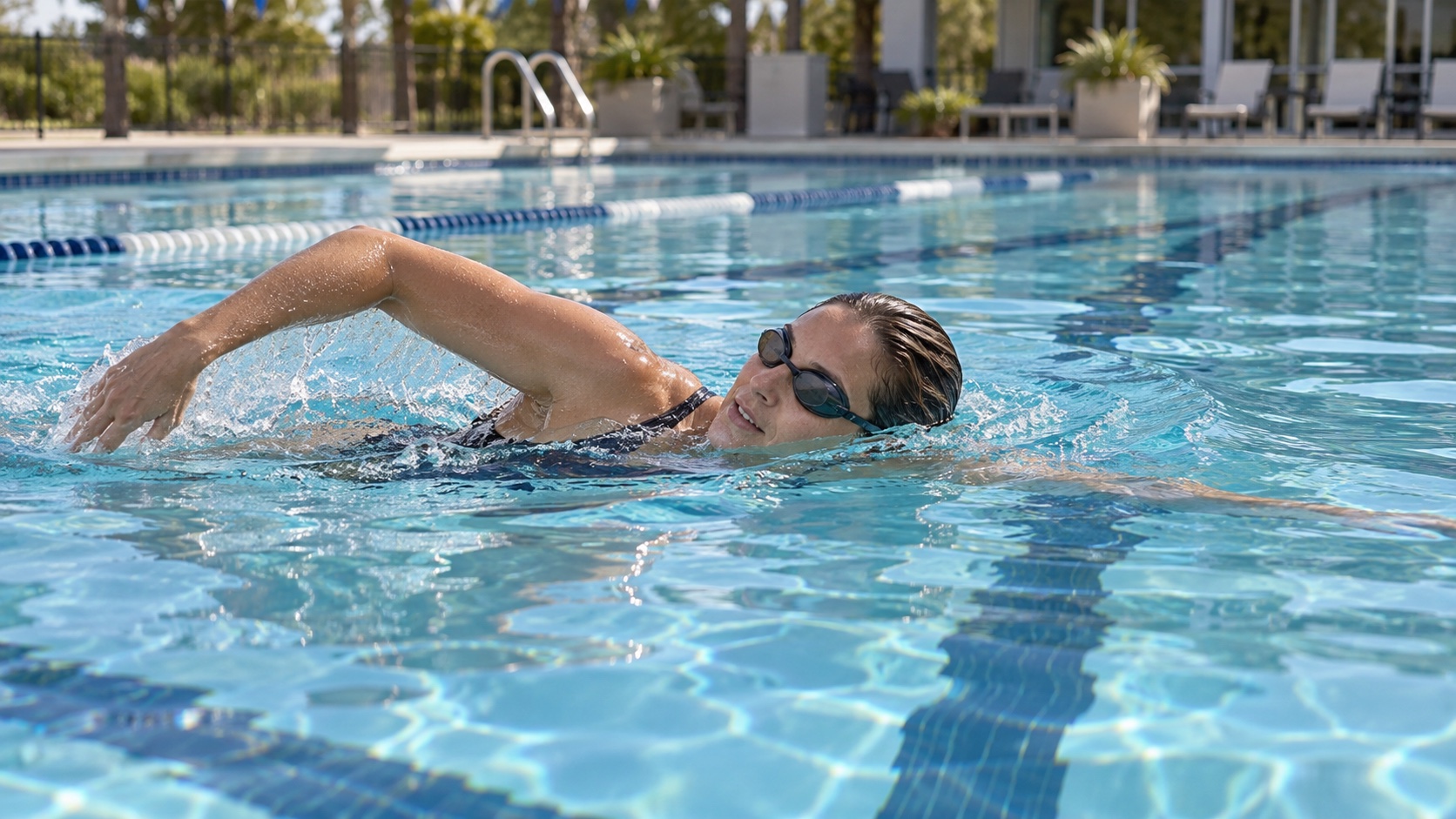
| 🏊 Pool exercise | Near-zero impact; buoyancy offloads the joints | Moderate-high — water adds drag and limits pace | Needs a pool; water temperature changes comfort | Strong fit |
| 🚣 Rowing | Near-zero impact; spine and shoulders carry the load | High — full-body and heart-rate friendly | Machine or boat; technique has a learning curve | Strong fit |
| 🌀 Elliptical work | Below walking, though not zero; some report foot or hip niggles | Moderate-high — stride length sets the ceiling | Common in gyms; forgiving on knees | Mostly |
| 🚶 Walking | Mild repetitive load at about body weight | Moderate — hard to push past brisk | Nothing to buy; works anywhere, anytime | Mostly |
The "Read" column is a verdict on typical fit, not a ranking of merit — a person with shoulder trouble may find rowing a poor fit and walking excellent, and that swap is the correct answer for them. Fit matters more than the label on the machine.
How Much Load Each Mode Carries
The chart below ranks the five modes by the joint load a typical session produces. The walking row is the reference: roughly body weight per step. The exact multiples for the other modes are illustrative, because per-mode comparisons are far less standardized than the ground-reaction measurements that anchor the walking and running numbers.
Matching the Mode to Your Constraints
- 🏠 Access is the first filter. A pool that takes forty minutes to reach will lose to a bike in the basement on a cold Tuesday. The mode you can do twice a week beats the one you can do occasionally.
- 🪑 Fit changes load more than the mode label does. A saddle set too low increases knee flexion and load; handlebar reach changes the back. A poorly fitted bike can bother a knee more than walking ever would.
- 🌡️ Pool variables shift the experience. Water temperature, depth, and whether you swim, aqua-jog, or use a deep-water belt change both comfort and how hard the session can be.
- 🦵 Judge a mode across the session and the next morning. The post-meal walk page shows how gently even the most accessible mode can be dosed; the same short-and-easy logic applies to every row of the menu.
🚴 Comfort is a feature, not a concession
Every mode on this page can deliver a genuine training stimulus, which means the differentiator is repeatability — and repeatability runs on comfort and access, not on which machine has the best reputation. A mode you can do without dread, twice a week, for a year, outperforms the theoretical ideal you quit in March.
The Case for Mixing Modes
Nothing in the evidence requires committing to a single mode forever, and most joint-limited plans benefit from a menu of two or three. The case for variety is practical as much as physiological.
- 🔄 Variety spreads the load across tissues. Cycling spares the knee's compression while rowing recruits the upper body; alternating modes changes which joints and muscles carry the week's stress.
- 🧠 Novelty protects adherence. The boredom that kills exercise plans is real; a two- or three-mode rotation keeps sessions from becoming a grind.
- 🎚️ Mode is a dial, not an identity. The Mode Selection page makes the same argument for the general build: pick for the long run, and re-pick when your joints or your schedule change.
What the Evidence Does and Does Not Say
The honest summary is that the evidence supports the category rather than any single champion. Exercise in a tolerable low-impact form is associated with the cardiorespiratory, quality-of-life, and mortality benefits mapped across the Zone 2 Training pillar. Mode-specific comparisons are thinner: aquatic exercise for knee and hip osteoarthritis relieves pain about as much as land-based exercise in pooled trials (Bartels et al., Cochrane Database of Systematic Reviews, 2016), and supervised exercise of any flavor in knee osteoarthritis produces a moderate pooled pain reduction (Fransen et al., Cochrane Database of Systematic Reviews, 2015). What no trial has done is crown one mode for everyone — and none should, because comfort is individual and no mode is universally best.
- ❓ Head-to-head mode trials are rare. Studies typically compare one mode against no exercise or against another treatment, not against a sibling mode.
- ❓ Low impact is not a comfort guarantee. Some people report foot or hip niggles on the elliptical, and cold pool water can bother cold-sensitive joints.
- ❓ Adherence advantages are partly psychological. The mode you enjoy genuinely wins, but the win includes motivation — which counts, even if it is not physiology.
Practical Rules for This Week
- 🎯 Trial one mode for two weeks before judging it. The first session is not the verdict; the second week's sessions are, once novelty and nerves have worn off.
- ⏱️ Start short and easy in any mode. Twenty gentle minutes tells you more about fit than forty hard ones, and it leaves room to adjust.
- 🛠️ Adjust the equipment before the load. Saddle height, handlebar reach, and water temperature come first; resistance and pace come second.
- 📋 Keep a two-line log. Mode, minutes, and how the joints felt the next morning — three columns that answer most fit questions faster than any review.
- 🩺 Flag repeats. If the same joint flares in the same way twice, the mode's fit or the plan itself needs a change — and the pain-response rule is where that change starts.
Questions, Answered Briefly
- 🚴 Is cycling bad for knees? For most people with knee complaints, seated cycling is among the best-tolerated options — provided the saddle is high enough that the knee does not over-flex at the bottom of the stroke and the resistance stays conversational.
- 🏊 Is the pool "second-class" training? No. Aquatic exercise produced pain relief comparable to land-based exercise in osteoarthritis trials (Bartels et al., 2016), and water adds its own resistance that a bike cannot.
- 🌀 Elliptical or walking for a grumbling knee? That is an individual answer: try each at an easy effort for two weeks and let the next-morning response decide. Both sit well below running in joint load.
- 🚣 Is rowing risky for the back? Rowing's low impact is genuine, but the spine and shoulders carry the load, so technique and a short ramp matter more than they do on a bike. Start with low stroke rate and short sessions.
- 🤔 What if every mode bothers something? That is a signal worth taking to a clinician — the assessment page in this series covers when symptoms stop being an adjustment problem and become a handoff one.
The Bottom Line
- Low impact is about joint load, not effort — walking lands at about body weight per step while cycling, rowing, and pool work approach zero, and all of them can still train the heart.
- No mode is universally best — access, fit, and comfort decide which one you will repeat, and repeatability beats theoretical superiority.
- The evidence supports the category, not a champion — aquatic and land exercise relieve osteoarthritis pain similarly (Bartels 2016; Fransen 2015), and head-to-head mode trials barely exist.
- Trial a mode for two weeks with short, easy sessions — adjust the equipment before the load, and let the next-morning response be the judge.
Related Topics
- Bartels et al., "Aquatic exercise for the treatment of knee and hip osteoarthritis," Cochrane Database of Systematic Reviews (2016)
- Fransen et al., "Exercise for osteoarthritis of the knee," Cochrane Database of Systematic Reviews (2015)
- Arem et al., "Leisure time physical activity and mortality: a detailed pooled analysis of the dose-response relationship," JAMA Internal Medicine (2015)
- Garber et al., "Quantity and quality of exercise for developing and maintaining cardiorespiratory, musculoskeletal, and neuromotor fitness in apparently healthy adults," Medicine & Science in Sports & Exercise (2011)