Mobility and Strength as Cardio Supports
A joint-limited cardio plan does not run on cardio alone. The muscles that steady the knee, the range the hip still owns, and the trunk that braces every pedal stroke are the supporting cast — and a small amount of targeted strength and movement preparation changes how much cardio a joint can tolerate. This page covers what the support work adds, how little of it is needed, and where its evidence stops.
What the evidence supports
- Strength training is associated with fewer sports injuries and roughly halved overuse injuries in pooled trials (Lauersen et al., 2014).
- Exercise — including strength-flavored exercise — produces moderate pain reduction in knee osteoarthritis (Fransen et al., 2015).
- Balance and functional training consistently reduce falls in older adults (Sherrington et al., 2019).
What remains uncertain
- Whether support work directly improves cardio tolerance is inferred, not measured head-to-head.
- The minimal effective dose of support work for joint protection is not established.
- Warm-up studies are surprisingly sparse, and their results are mixed.
Evidence last reviewed: August 20, 2026. Conclusions may change as new research is published.
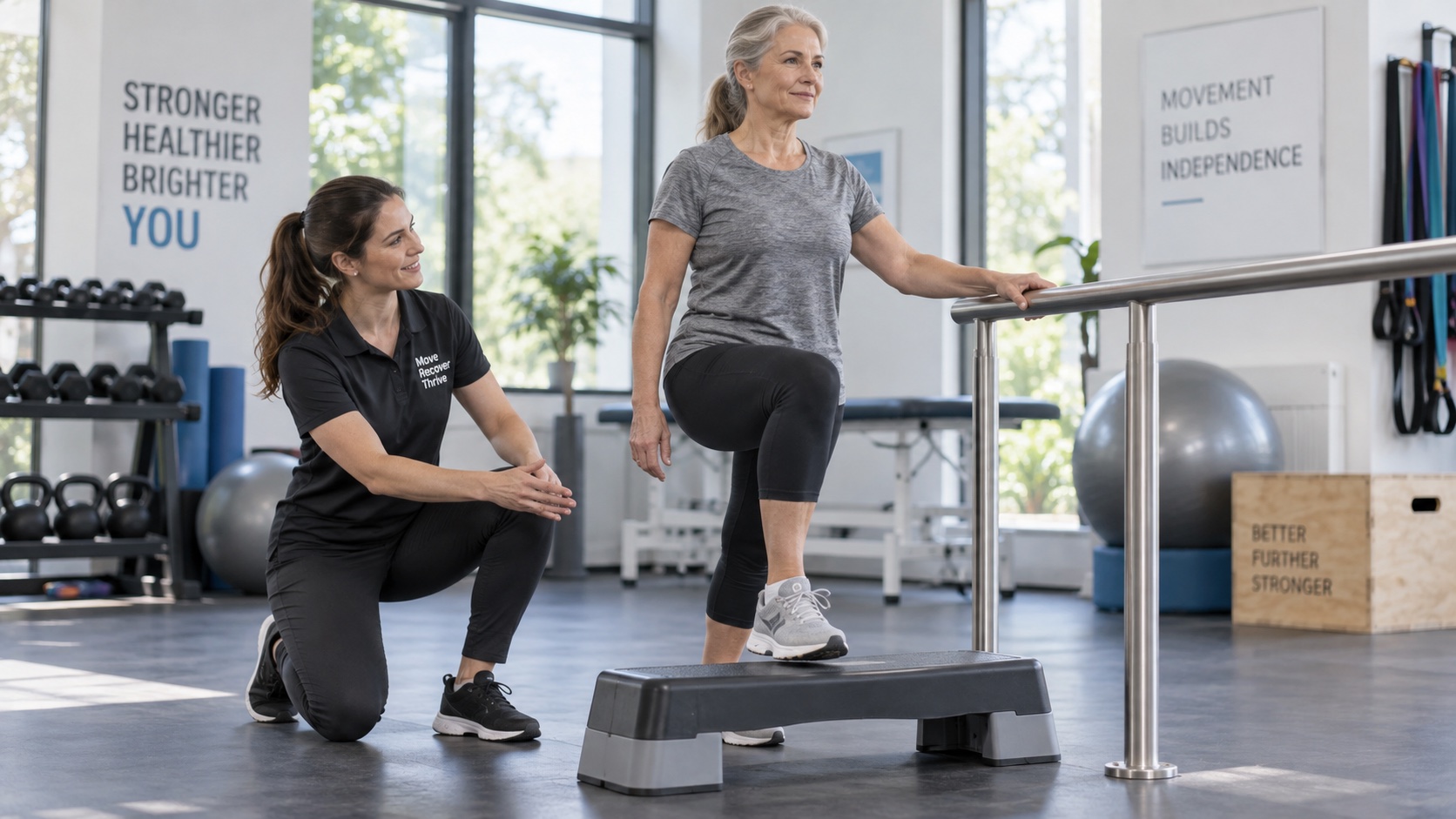
Why the Support Work Exists
Every pedal stroke, stroke, and stride is anchored by muscles that are not doing the cardio at all. The quadriceps steady the knee through the pedal circle; the hip extensors power the push; the trunk holds the spine in a stable column; the calf and foot manage the transfer. When those supports are weak or stiff, the joint itself absorbs load that the muscle was meant to carry — and that is the mechanism the support work targets.
- 🛡️ Strength is the joint's shock absorber. Stronger muscles around a joint reduce the force the joint structures must manage, and the injury literature backs the concept: strength training is associated with fewer than one-third the sports injuries of no strength training, with overuse injuries roughly halved (Lauersen et al., British Journal of Sports Medicine, 2014).
- 🧘 Range is the joint's permission slip. A hip or ankle that moves through its comfortable range makes every cardio movement smoother; a stiff joint borrows range from wherever it can, and the neighbors pay.
- 🏋️ Strength is a complement, not a competitor. The support work is not a second training program — it is a small, targeted addition that makes the cardio more sustainable.
Product picks are generic categories, not brands. We may earn a commission on Amazon or iHerb purchases at no cost to you — this never changes our evidence conclusions. Full disclosure
Resistance bands
A low-space way to begin or supplement resistance training.
⚠️ Bands can snap and unstable anchoring can cause injury; stop movements that provoke pain.
Check price on Amazon →What Strength Adds
The strength that matters for a joint-limited cardio plan is not gym maximalism; it is targeted capacity in the muscles the cardio loads. Knee extension strength, hip control, and single-leg stability are the practical currencies — the things that decide whether a knee gives way stepping off the bike or whether a hip handles the pedal circle without complaint.
- 🦵 Single-leg strength is the joint-level unit. Step-ups, split squats, and single-leg presses build the knee and hip control that cycling and walking lean on, at loads the joints can accept.
- 🍑 Hip work carries the cardio chain. The glutes and hip extensors power the pedal stroke and the stride; when they are weak, the knee and low back compensate.
- 💪 The trunk braces every movement. A stable core gives the arms and legs something to push against, on a rower as much as on a bike.
- 📚 The evidence is dose-agnostic but real. The Resistance Training protocol owns the broader strength science; this page borrows only the joint-protection slice of it.
Movement Prep Before the Cardio
Movement preparation is the five-to-ten minutes that separate "training on a cold joint" from "training on a prepared one." Its purpose is modest — raise tissue temperature, walk the joints through their range, and remind the nervous system what the session will ask — and the evidence for warm-ups is thinner than their ubiquity would suggest. The warm-up requirement page in the intervals series covers the debate honestly; the joint-limited version of the conclusion is simple: prep costs little, may help, and cold joints are a poor place to test the question.
- 🦶 Start with the joints the session will load. Ankles, knees, hips, and the low back — a few slow, pain-free circles and holds each, not a stretch marathon.
- 🚶 Graduate into the movement. Five easy minutes of the actual mode — gentle pedaling, slow rowing, a short walk — is the best warm-up for that mode.
- 📏 Use prep as a daily symptom check. If a joint objects during prep, the session's plan changes before the hard part starts — the prep is the cheapest diagnostic on this page.
What the Support Work Buys
The chart below ranks what the support work is associated with, from the strongest evidence to the thinnest. It is a qualitative ordering of the pooled literature, not a set of measured effect sizes — and it explains why the support work earns its place even when individual studies wobble.
The Minimal Support Stack
The support work does not need to be elaborate. The minimal stack below covers the three jobs — strength, range, and trunk — in two short sessions a week plus a few minutes of prep before each cardio session. Each row names the exercise family, why it supports the cardio, and a sensible starting dose; the Resistance Training protocol owns the finer progression.
| Support | Why it supports the cardio | Starting dose | Fit |
|---|---|---|---|
| 🦵 Single-leg strength (step-ups, split squats) | Builds the knee and hip control every stride and pedal stroke uses | 2–3 sets of 8–12, twice a week | Strong fit |
| 🧘 Hip and ankle range (slow circles, holds) | Keeps the joints the cardio loads moving through their range | 5–10 minutes before sessions | Daily prep |
| 🏋️ Low-load squat pattern | Reinforces the movement the bike and the stairs share | 2 sets of 10–15, twice a week | Modest |
| 💪 Trunk holds (plank, side plank) | Gives the arms and legs a stable column to push against | 2–3 holds of 20–40 seconds, twice a week | Modest |
🧘 Two short sessions a week beat one long one
The support work competes with nothing because it is tiny: twenty to thirty minutes twice a week covers the whole stack. Spreading it across two days keeps the joints in frequent contact with the movements that protect them — a single marathon session on Sunday cannot do what two brief ones across the week do.
Budgeting the Time
The support work's entire time budget is about thirty to sixty minutes a week — roughly a quarter of what the cardio itself takes. That ratio is the point: the support work is an investment in the cardio's sustainability, and it should never grow into a second program that crowds the sessions it exists to protect.
- 📅 Attach the strength to existing habits. The two sessions can ride along with cardio days — strength first, then the cardio — or sit on their own; the anchor that sticks is the one you keep.
- ⏱️ Prep counts as warm-up time, not extra time. The five to ten minutes of movement prep are the first part of the cardio session, not an addition to it.
- 📈 Progress the strength slowly, like the cardio. The same one-lever-at-a-time discipline applies: more reps before more load, and the pain-response rule reads the verdict.
Where Support Work Stops
The support work is exactly as valuable as its name says: it supports. It does not replace the cardio stimulus, it does not reverse a joint's structural condition, and it cannot make a joint that needs assessment safe to train on. The strength and mobility pages are full of claims that a single movement pattern will repair a joint; the honest version is that targeted work can improve tolerance and capacity, and that persistent swelling, instability, night pain, or a specific traumatic onset still belongs with a professional.
- 🚫 Support work is not treatment. A movement can be part of a care plan; it is not the diagnosis.
- 🩺 Sharp pain during support work is the same signal it is during cardio. The pain-response rule applies to the step-up and the plank exactly as it does to the bike.
- 🧭 The assessment signals page is the boundary. When symptoms cross into handoff territory, the support work pauses with the cardio while a professional takes the question.
Questions, Answered Briefly
- 🏋️ Do I need gym equipment for the support work? No. Step-ups on a stair, bodyweight split squats, and plank holds cover the stack; load can be added with a backpack or household objects when the bodyweight version stops challenging.
- 🧘 Should the mobility work hurt or stretch hard? Neither. The prep moves joints through pain-free range; a sharp stretch or a painful hold is a signal, not a goal.
- 🔄 Can the support work replace a cardio session when a joint flares? Temporarily, yes — a flare that rules out cardio can still tolerate gentle strength and prep, which keeps the week from becoming a full stop. The flare's own signals still decide when assessment is needed.
- 📉 How long until the support work shows up in the cardio? Strength changes are measurable within weeks in trials, but the practical answer is individual: most people notice steadier joints and easier sessions within a month or two.
- 🩺 Anyone who should skip the strength work? Anyone with known cardiovascular disease should clear the strength component with a clinician, since even moderate resistance work raises blood pressure transiently; the cardio-only entry point is the conservative default.
The Bottom Line
- The support work is a complement, not a second program — thirty to sixty minutes a week of targeted strength, range, and trunk work protects the joints the cardio loads.
- Strength is the best-evidenced support — associated with fewer than one-third the injuries of no strength training, with overuse injuries roughly halved (Lauersen et al., 2014).
- Movement prep is cheap and worth keeping — the evidence is thinner than its ubiquity suggests, but five to ten pain-free minutes before each session costs little and doubles as a daily symptom check.
- Support work is not treatment — it improves tolerance and capacity, and persistent swelling, instability, night pain, or traumatic onset still belongs with a professional.
Related Topics
- Lauersen et al., "The effectiveness of exercise interventions to prevent sports injuries: a systematic review and meta-analysis of randomised controlled trials," British Journal of Sports Medicine (2014)
- Fransen et al., "Exercise for osteoarthritis of the knee," Cochrane Database of Systematic Reviews (2015)
- Sherrington et al., "Exercise for preventing falls in older people living in the community," Cochrane Database of Systematic Reviews (2019)
- Martyn-St James & Carroll, "Progressive high-intensity resistance training and bone mineral density in postmenopausal women," British Journal of Sports Medicine (2009)