The volume-eating playbook
The simplest way to cut calories is often the least painful: eat the same weight of food, just in a less energy-dense form. When water and fiber take up space on the plate, fullness can stay constant while the calorie count falls — and the feeding studies bear this out. This page gives you the density math, the satiety-per-calorie list, and the exact plate construction, plus the honest places where volume eating stops working.
What the evidence supports
- People eat a fairly consistent daily weight of food, so cutting energy density tends to cut intake without a fight.
- Controlled feeding studies show 100–200 kcal less consumed per meal on lower-density diets, with fullness ratings that hold or improve.
- Higher-diet-energy-density is consistently associated with higher body weight in large population datasets.
What remains uncertain
- Whether the effect survives months of free-living use, where people drift back toward dense foods and restaurant portions.
- How much of the benefit is the lower density itself versus the higher fiber and water content that ride along with it.
- The exact per-person calorie saving — it varies with the individual's baseline diet more than any recipe predicts.
Evidence last reviewed: August 15, 2026. Conclusions may change as new research is published.
What Energy Density Actually Measures
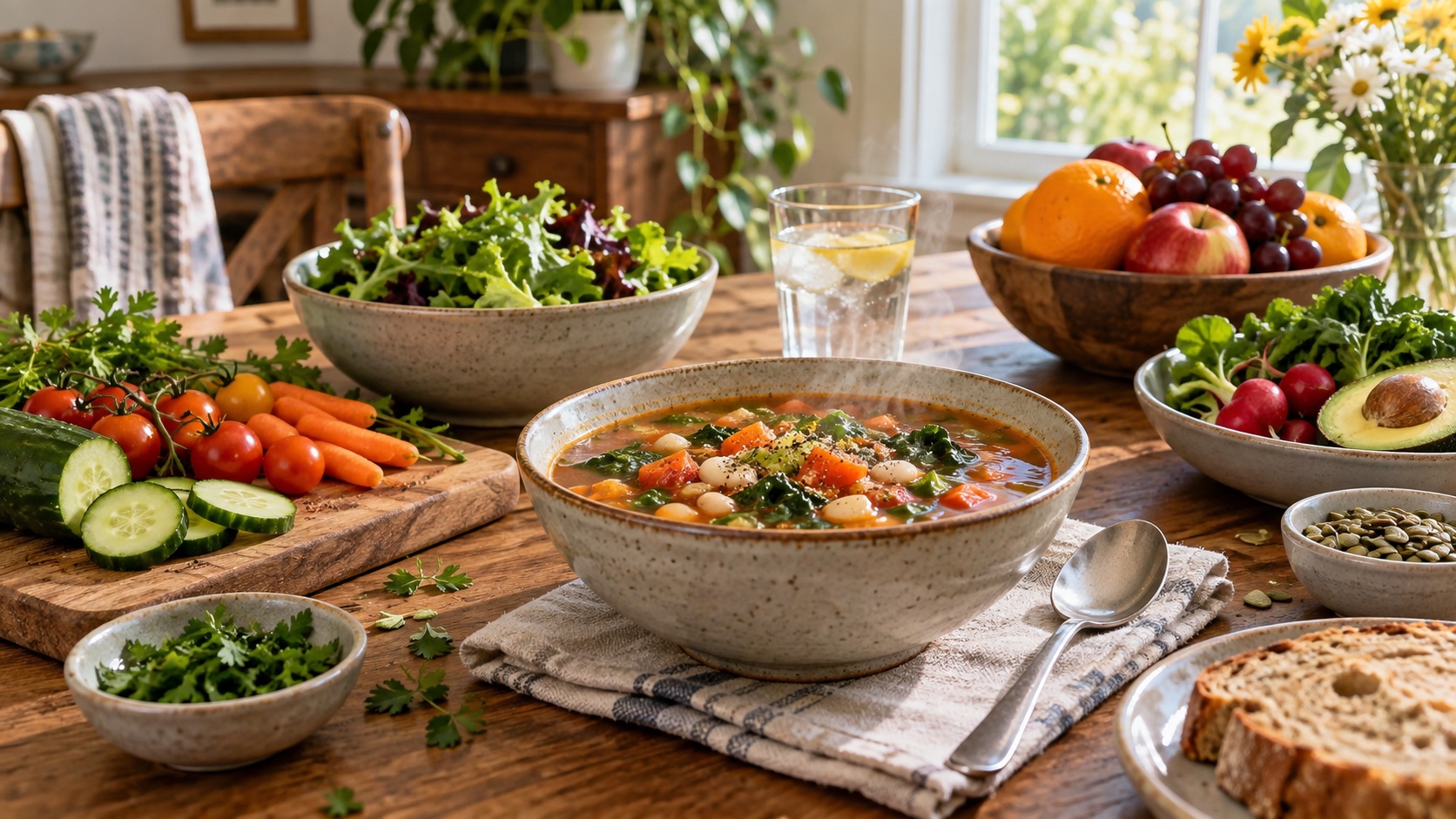
Energy density is just calories per gram of food — a number that ranges from near zero for water-rich vegetables to around nine for pure fat. Water and fiber are the two cheap diluents that push a food toward the low end: they add weight, volume, and chewing without adding much energy. Fat is the opposite — the most calorie-dense nutrient on the plate, and the reason fried versions of anything roughly double in density while the food looks the same. Cooked vegetables hover around 0.3–0.5 kcal per gram; cooked rice around 1.3; cheese around 4; oils and dressings around 9. The practical claim of the volume approach is that you can eat the same amount — the same bowl, the same plate, the same satisfying stretch — while the total at the bottom of the day falls, because a larger share of the plate came from the low-density end.
The Consistent-Weight Phenomenon
The mechanism behind volume eating is a quirk of appetite called the consistent-weight effect, and it is one of the better-replicated findings in appetite research: left to themselves, people eat a fairly steady weight or volume of food each day, rather than a steady number of calories. Decades of controlled feeding work by Barbara Rolls and colleagues at Penn State showed that when the same foods are prepared in lower-density versions — more water, more air, more vegetables — people eat the same weight of food and therefore consume fewer calories, without reporting more hunger (Rolls, Physiology & Behavior, 2009). In one series of experiments, a single low-density starter reduced total meal intake by roughly 100–200 kcal while fullness ratings stayed flat or climbed. The caveat worth stating: the effect is strongest in controlled research kitchens; free-living people are better at quietly adding a more dense snack later. The lesson isn't that density alone runs your diet — it is that density is the lever with the largest psychological headroom, because it trades calories for volume rather than for misery. The Fiber topic owns the satiety mechanics that ride along with this effect.
The Satiety-per-Calorie List
The list below ranks foods the one way that matters for volume eating: how much fullness you get per calorie. Top of the list buys you a full plate for almost nothing; the bottom buys small portions at a high price.
| Food family | Approx. kcal per 100 g | What it buys you | Verdict |
|---|---|---|---|
| 🥦 Non-starchy vegetables | 20–50 | Maximal volume, fiber, and chewing for minimal energy | Best |
| 🍲 Broth-based soups | 30–80 | Water carried in the food itself, which registers as fullness | Strong |
| 🍎 Whole fruit | 40–80 | Sweetness plus water and fiber; far better than the juice | Good |
| 🥔 Cooked starches (rice, potato) | 80–130 | Affordable bulk; goes dense fast if fried or buttered | Mixed |
| 🥩 Lean protein (chicken, fish, eggs) | 100–170 | The strongest satiety per calorie of any family — see the protein-first page | Strong |
| 🧀 Cheese, nuts, oils | 350–900 | Dense; tiny portions, easy to overshoot | Dense |
Two readings of this table. First, density and satiety are not the same axis — lean protein is mid-density yet top-shelf on fullness, which is why the volume approach pairs with, rather than replaces, the protein-first rule on the next page. Second, the "good" foods earn their place by displacing dense foods, not by being eaten on top of them. Volume eating is a substitution strategy; treat it that way and the arithmetic works.
A Volume Plate, Built
The playbook compresses into one plate-construction rule — build from the highest-volume layers down. In practice, in order:
- 🥦 Fill half the plate with non-starchy vegetables — at 20–50 kcal per 100 g, this is where volume is manufactured. Aim for two different colors and don't drown them in oil; a steam, roast, or broth treatment keeps them low-density.
- 🍲 Lead with soup or salad about half the time — a broth-based starter 15 minutes before the meal is the version of the trick with direct trial support, shaving calories from the meal that follows.
- 🍗 Put the protein on next, then the starch — protein first keeps the satiety signal high, starch portion stays honest and modest. Sequencing detail lives on the protein-first page.
- 🫒 Treat fat as a seasoning, not a cooking medium — a measured teaspoon or two on the plate beats a pan that lubricates everything; this is the single density trap that silently re-densifies a volume meal.
- 🍎 End with fruit for the sweet tooth — whole fruit delivers the dessert signal at 40–80 kcal per 100 g instead of the 450–500 of a pastry slice.
The whole construction takes about ten extra seconds per plate and requires no logging — the density does the calorie accounting for you. The Habit Formation protocol is the layer that turns a constructed plate into a default one.
What the Density Advantage Is Worth
To be honest about scale: volume eating is not a dramatic intervention. A reasonably faithful version produces roughly 100–200 kcal less per meal in the feeding studies — enough, if it shows up once or twice a day, to fund a real deficit of the kind the Deficit, Measured page describes, without a single plate looking smaller. The chart below ranks common foods by density so you can see the size of the spread you're trading against.
Where Volume Stops Working
The honest limits deserve equal billing, because mistaking the margins is how the trick fails. First, liquid calories beat the strategy almost entirely: a smoothie or juice removes the water-and-fiber advantage by grinding it into a drink, and calories in liquid register weakly as fullness — the Sugar & Insulin topic documents how fast that gap closes. Second, restaurant portions overrule plate construction: a volume plate at home quietly becomes a dense plate out, because the kitchen — not the eater — decides density. Third, dense toppings undo the arithmetic: a "healthy salad" carrying four tablespoons of oil-dressing can reach the calorie load of a burger, which is precisely the trap the kitchen-reset page addresses by changing what's in reach. Fourth, plain volume can bore: if the plate is technically full but texturally uniform, the fullness signal fades and people snack later. Plant variety, crunch, and seasoning aren't garnish — they're part of the mechanism.
🥗 Substitution is the point, not subtraction
Volume eating works because it swaps density for bulk — the plate looks the same or better, and the calorie column quietly drops. The moment it turns into "eat less of everything" it loses the mechanism that makes it sustainable. If the plate looks smaller, you're doing it wrong.
Common Pitfalls and How to Overcome Them
Volume eating fails in recognizable patterns, every one with a built-in countermove.
| Pitfall | Why it happens | The countermove |
|---|---|---|
| 🥗 The "healthy" salad that isn't | Dressing and toppings re-densify the bowl silently | Dressing on the side, measured by the spoon; the plate stays volume-grade |
| 🥤 Volume by smoothie | Blending removes the water-and-fiber fullness advantage | Eat fruit whole or in a bowl; reserve smoothies for planned exceptions |
| 🍲 Same soup, same salad, every day | Boredom blunts the fullness signal and invites late snacking | Rotate the volume layer — different vegetables, proteins, and seasonings weekly |
| 🫒 "Light" cooking that isn't | Oil in the pan lubricates everything and never appears on the plate | Measure the pan oil like an ingredient; steam, broth, or roast instead |
| 🍽️ Dense restaurant portions | The kitchen, not you, decides density when eating out | Lead with a broth soup or side salad and box half before the plate arrives |
| 📈 Scale stalls anyway | Volume protects the deficit but doesn't create it | Re-verify the calorie line for two weeks with the Deficit, Measured arithmetic |
The Bottom Line
- Energy density is the master lever — people eat a steady weight of food, so dilute density and intake falls 100–200 kcal per meal with fullness intact.
- Vegetables and broth soups are the volume engines — half the plate from the low-density end, fat treated as a seasoning.
- Substitution, not subtraction — the plate should look the same or bigger; the moment it shrinks, the mechanism is gone.
- Know the failure modes — smoothies, dressings, restaurant kitchens, and boredom nullify the advantage; each has a specific countermove.
Related Topics
- Rolls, "The relationship between dietary energy density and energy intake," Physiology & Behavior (2009)
- Drewnowski, "Energy density, palatability, and satiety: implications for weight control," Nutrition Reviews (1998)
- Ledikwe et al., "Dietary energy density is associated with energy intake and weight status in US adults," American Journal of Clinical Nutrition (2006)
- Slavin, "Dietary fiber and body weight," Nutrition (2005)