The kitchen environment reset
Willpower is the weakest link in any diet, so the strongest designs don't ask for it. A kitchen that keeps the dense snacks visible, at hand, and open wins most evenings before you've made any decision at all. This page walks the visibility-and-convenience science, the thirty-minute counter reset that re-engineers your kitchen's defaults, and the specific friction moves that make grazing cost more than it's worth.
What the evidence supports
- Moving a food out of sight and out of reach sharply cuts how much of it people eat, independent of hunger.
- Convenient placement of healthy foods — fruit on the counter — nudges their selection upward.
- Hungry shopping measurably shifts what ends up in the cart, making the grocery trip part of the food environment.
What remains uncertain
- Whether a single kitchen reset produces lasting change or quietly degrades as habits reassert themselves.
- How big the effect is outside the lab, where other people in the household control what comes into the house.
- Whether the visibility effect applies equally to people with strong habitual snacking patterns.
Evidence last reviewed: August 15, 2026. Conclusions may change as new research is published.
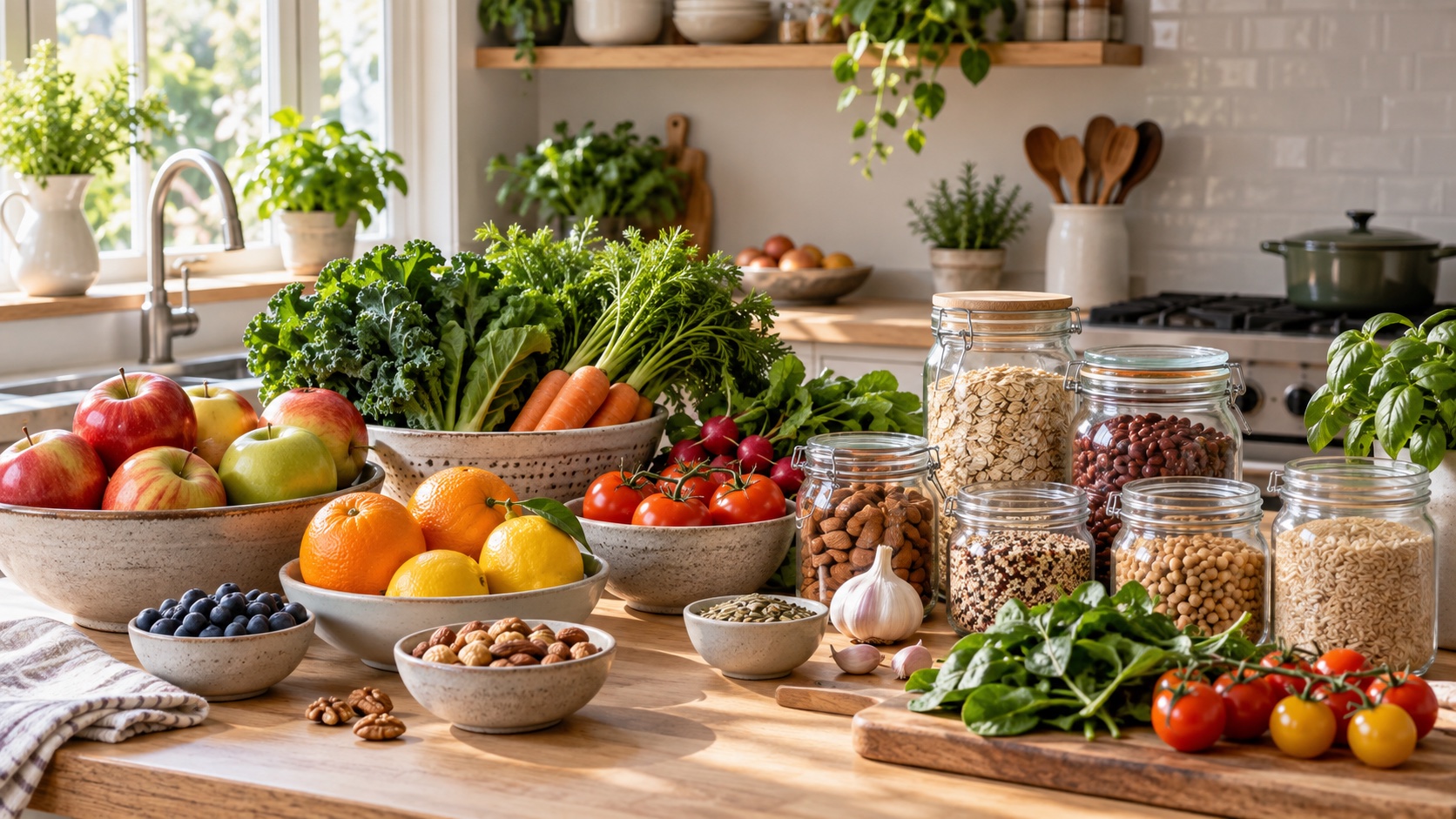
The Kitchen Decides Before You Do
Behavioural research on the food environment makes one point that should change how you stock a cupboard: eating decisions track what is visible and convenient far more than they track stated intentions. The most cited demonstration is the desk-candy experiment at a university office, where a bowl of chocolates placed on the desk was eaten roughly half again as often as the same chocolates tucked into a desk drawer, and several times more than the identical bowl moved six feet away (Painter, Wansink & Hieggelke, Appetite, 2002). Nobody's preferences changed — only the geometry between the food and the hand. That is the entire thesis of the reset: you are not fixing your discipline, you are fixing the map of your kitchen so that the defaults run in your favor. The rest of this the page that runs the larger environment-design logic at the level of habit is the Habit Formation protocol, which owns the general science of designing choices rather than resisting them.
Product picks are generic categories, not brands. We may earn a commission on Amazon or iHerb purchases at no cost to you — this never changes our evidence conclusions. Full disclosure
Simple visual timer
Can reduce friction for short breathing, mobility, or meditation breaks.
⚠️ None expected; it does not treat anxiety, panic, depression, or trauma-related symptoms.
Check price on Amazon →Visibility and Convenience: The Mechanism
Two levers do most of the work, and they stack. Visibility is about what your eyes land on — the fruit bowl on the counter versus the cookie tin in the back of the pantry. The eye leads the hand, and a food glimpsed a dozen times a day wins more reach-for moments than the food you have to remember exists. Convenience is about the number of steps between the urge and the food: opening a wrapper, finding a chair, walking to another room. Every step of friction is a moment where the urge has to keep paying a cost, and most urges don't. Together they explain why the same household can have a "healthy" pantry and still fail: the healthy food is buried behind the counter, unwashed, in the back; the dense snack sits at eye level beside the kettle. The reset's whole job is to swap those two addresses.
Two everyday examples make the mechanism concrete. The household that keeps its chips in the cupboard and its carrots washed on the counter is not healthier by discipline — it is healthier by geography, because every reach-for moment lands on a vegetable instead of a bag. And the reverse is just as often the reason a relaxed weekend turns into a snack marathon: the good food was easy on weekdays, while the dense food sat at eye level the whole time, waiting for the weekend guard to drop. The environment doesn't care about your intentions, which is precisely why changing it works.
The Friction Audit
Walk your kitchen with an auditor's eye and classify everything by where it sits and how easy it is to reach. The audit below is a serviceable starting grid — adjust the items to your actual household.
| Item | Current risk | The move |
|---|---|---|
| 🍪 Snacks at eye level in the pantry | High | To the back, top shelf, or an opaque container; out of the line of sight |
| 🥜 The candy jar or nut bowl on the counter | High | Closed cupboard or another room; bare counter reads as "off limits" |
| 🍎 Fruit tucked in the fridge drawer | Medium | Washed, in a visible bowl on the counter — the swap that moves selections |
| 🥤 Sweet drinks at the front of the fridge | Medium | Behind a water carafe at the front; sparkling water at eye level |
| 🫒 The oil bottle and dressing at the counter's edge | Medium | Back in the cupboard, measured at use — the density trap from the volume page |
| 🥦 Vegetables prepped and ready | Low | Keep them there — the good-food convenience is the entire point |
The Counter Reset, in Thirty Minutes
The reset is a single clocked session, not a lifestyle program. Set a timer and run these in order:
- 🧹 Clear the counters — everything but the kettle, the chopping board, and one bowl of ready fruit comes off. A bare counter is a decision-free surface.
- 🏷️ Move the dense foods — snacks, sweets, and baking ingredients to the back of the top shelf or an opaque bin; out of the sightline at chest level.
- 🥕 Prepare the good foods — wash the fruit, cut the vegetables, portion the yogurt — so the healthy options are the ones that are ready to eat.
- 🚰 Front-load the water — a carafe and clean glasses at the front of the fridge, sweet drinks pushed behind it.
- 📵 Add a clock rule — pair the layout with the parent protocol's kitchen-closed time; the environment handles the distance, the clock handles the hour.
The countermove logic applies to the rest of the house — the desk drawer, the car, the office — wherever the grazing actually happens. The same friction that hides a cookie hides a second helping of a volume-friendly meal; use it in both directions. Re-run the audit once a month — a single twenty-minute pass of the same five steps keeps the layout honest long after the enthusiasm of the first reset fades.
Shopping Is Part of the Environment
A reset that stops at the front door is unfinished, because the food environment begins at the supermarket. The well-named "fattening fasting" studies found that hungry shoppers buy more calorie-dense food, not more food overall — the cart changes composition before the kitchen ever sees it (Tal & Wansink, JAMA Internal Medicine, 2013). Three moves capture the lesson for free: shop after a meal, never on an empty tank; carry a written list and treat it as binding, so the cart is decided before the aisles vote; and take the perimeter route — whole produce, protein, dairy — with a rule that anything packaged in the middle aisles has to justify itself. The environment you build at the checkout determines the environment you have to defend at home, and the Fiber topic and the volume playbook both assume the right raw materials actually made it into the house.
🏠 Design the defaults, then let them run
Every minute spent arranging the kitchen is downtime from negotiating with yourself later. A bowl of ready fruit where the chip bag used to be doesn't make you want fruit — it makes the decision already over, which is the entire game.
Common Pitfalls and How to Overcome Them
The reset backslides in recognizable ways — each with a standard fix.
| Pitfall | Why it happens | The countermove |
|---|---|---|
| 🎪 The reset creeps back in two weeks | New groceries land where the old ones did, one trip at a time | Tie the repair to the weekly shop: restock the good-food bowl and re-hide the dense items on the same trip |
| 👻 Someone else shops for the house | The household's cravings, not yours, stock the pantry | One shared list, one same-trip rule; the visible bowls only hold what the household agrees to |
| 🌫️ Hidden foods get found with perfect recall | You know exactly where the tin is — hiding is a nudge, not amnesia | Pair hiding with the ten-minute delay and the kitchen-closed hour; distance plus time defeats recall |
| 🥕 The good-food bowl rots unwatched | Prepared fruit and vegetables go uneaten and then abandoned | Buy less, prep in small batches, and put the bowl where you actually linger |
| 🍷 The office and the car are unguarded | Grazing moved outside the kitchen's boundaries | Run the same audit in the desk and the car — bare surfaces, good options forward |
| 📉 The kitchen is fixed but the week is still over | Environment handles grazing, not the whole deficit | The environment is one leg; the parent protocol's other tricks carry the plate |
The Bottom Line
- Eating tracks visibility and convenience, not intentions — the desk-candy experiments show distance alone cutting consumption by two-thirds.
- Do the thirty-minute reset — clear the counters, hide the dense foods, and prep the good ones so the defaults run your way.
- Shopping is upstream of the kitchen — shop fed, on a list, on the perimeter, and the house gets harder to defend less often.
- The environment is a leg, not the whole system — it controls grazing; the deficit and the plate still carry the outcome.
Related Topics
- Painter, Wansink & Hieggelke, "How visibility and convenience influence candy consumption," Appetite (2002)
- Tal & Wansink, "Fattening fasting: hungry grocery shoppers buy more calories, not more food," JAMA Internal Medicine (2013)
- Story et al., "Creating healthy food and eating environments: policy and environmental approaches," Annual Review of Public Health (2008)