Protein timing in a deficit
Total daily protein wins every argument — but how you spread it changes how much of that total your body actually uses, and in a deficit the margin for error shrinks. This page covers the per-meal dose that reliably triggers muscle-protein synthesis, the leucine switch behind that trigger, and the honest verdict on the post-workout window: worth having, not worth worshipping.
What the evidence supports
- An even spread of 3–4 protein doses across the day produces higher 24-hour muscle-protein synthesis than a skewed or bolus pattern.
- A per-meal dose of roughly 30–40 g reliably triggers synthesis; larger single doses add little.
- Leucine is the switch — a meal low in it will not stimulate synthesis even if total protein is adequate.
What remains uncertain
- Whether any specific timing scheme preserves meaningfully more lean mass in a real deficit than a simple even spread does.
- The exact leucine threshold per meal across ages, body sizes, and training states.
- How strictly the spread matters for people eating at the top of the protein range, where the totals may already cover the shortfalls.
Evidence last reviewed: August 15, 2026. Conclusions may change as new research is published.
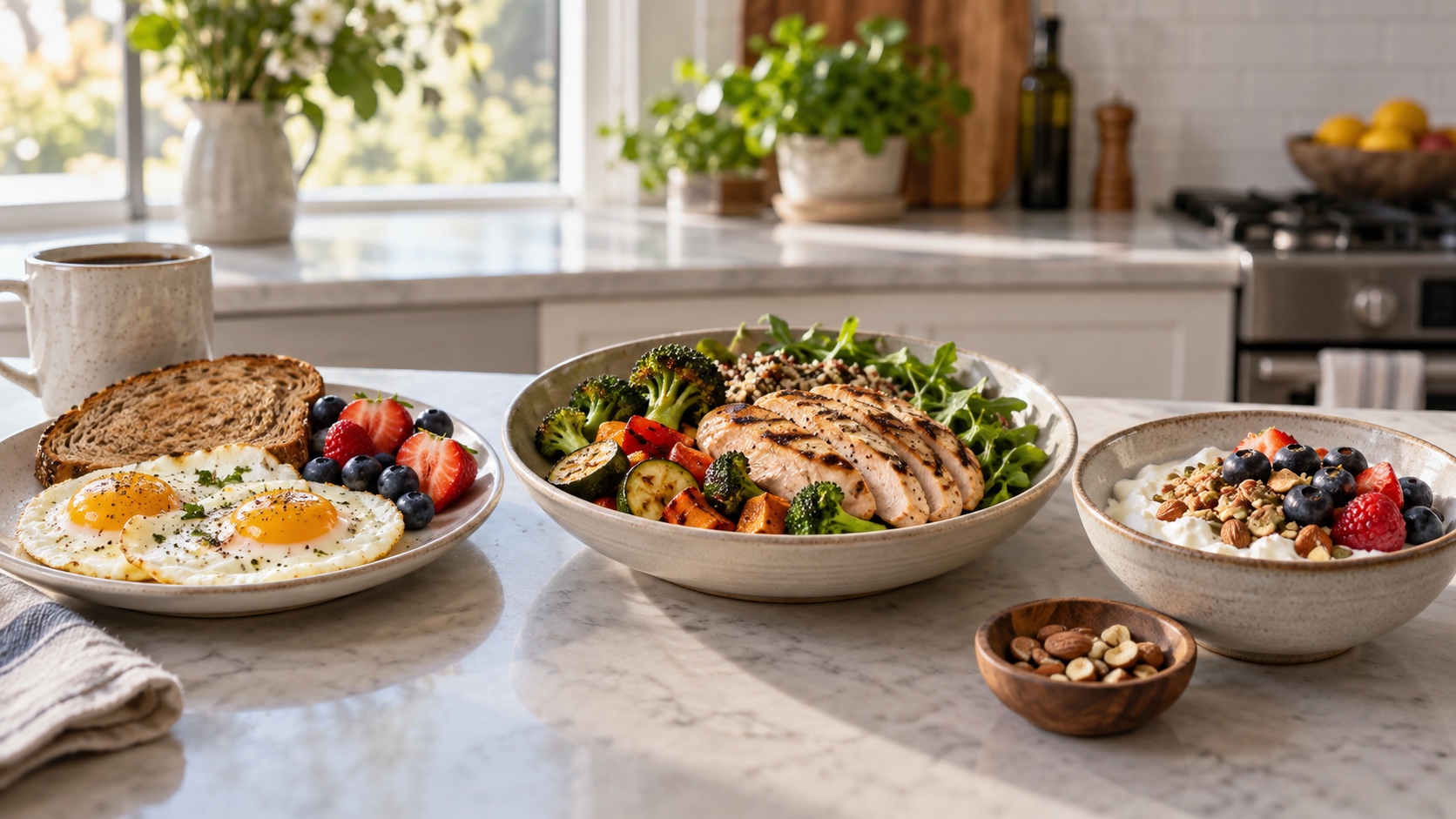
The Timing Question, Sharpened
Ask most gym-goers about protein timing and they will tell you about the post-workout window — the claim that a shake within a narrow span after training is the difference that matters. The evidence says something more interesting. A meta-analysis of the timing literature found no significant overall benefit of any particular timing scheme over another for muscle strength or size — the total consumed across the day swamped the timing of each dose (Schoenfeld, Aragon & Krieger, Journal of the International Society of Sports Nutrition, 2013). That is the honest headline. But the meta-analysis mostly examined people maintaining or building; the sharper question for this page is how the same body behaves when the total is fixed and the deficit is pressing. That is where distribution, not window, earns its keep.
Product picks are generic categories, not brands. We may earn a commission on Amazon or iHerb purchases at no cost to you — this never changes our evidence conclusions. Full disclosure
Protein powder
A convenient way to add dietary protein when food intake is insufficient or impractical.
⚠️ May cause digestive symptoms; formulation matters for allergies and intolerances. It does not replace a varied diet.
Check price on Amazon →The Per-Meal Dose That Works
Muscle-protein synthesis behaves like a switch with a floor. Give a muscle a small dose of protein and nothing much happens; cross a threshold and synthesis jumps; push far above the threshold and the response plateaus. In young men the near-maximal response arrives at roughly 20–25 g per meal (about 0.24 g/kg) after training, and older adults need measurably more per dose (Moore et al., 2009; Katsanos et al., 2006). Across studies the practical floor lands around 30–40 g per meal for a cut — high enough to cross the threshold comfortably with room for the deficit's blunting effect, and low enough that you can pay it four times without blowing your calorie budget. Doses far above that, like a single 80 g dinner, produce no extra synthesis — the response is capped, and in a deficit the cap means the day's other hours run unprotected.
| Feeding pattern | What it does to 24-hour synthesis | Verdict |
|---|---|---|
| ⏰ Even spread — 3–4 meals of 30–40 g | Keeps the synthetic signal topped up all day; highest 24-hour response in the acute studies | The pattern |
| 🌙 Skewed — a light day and a big dinner | One strong pulse, long window of low signal; total can still be adequate but the response is lumpy | Workable |
| 🍽️ Once-a-day bolus — most protein in one meal | One capped response; most of the day runs below the threshold, and that is the deficit's favorite condition | Not in a cut |
| 🥄 Grazing — many tiny doses | Each dose stays below the threshold that trips the switch; total is fine but the signal barely fires | Inefficient |
The Leucine Switch
Why does a 30 g meal work where a 10 g snack does not? The controlling amino acid is leucine. Leucine is the trigger that tells the synthetic machinery to run; if a meal does not carry enough of it, even adequate total protein will not switch the machinery on. Supplementing leucine into a protein-poor meal restores the response, and older adults appear to need a higher leucine dose per meal than younger ones (Katsanos et al., 2006). The practical translation is nearly free: choose protein sources that carry leucine reliably — whey, dairy, eggs, meat, fish, and the leucine-richer plant options like soy — and it becomes hard to miss the roughly 2–3 g of leucine per meal that the threshold implies. It is one more reason the even-spread pattern works: each dose has to cross the switch on its own.
Why Spread Beats the Bolus in a Deficit
The controlled feeding data make the distribution point directly. When healthy adults ate the same daily protein split evenly across several meals, 24-hour muscle-protein synthesis was meaningfully higher than when the same total was skewed toward one part of the day (Mamerow et al., 2014). And when the same total protein was delivered in different patterns after resistance exercise, the pattern of repeated 20 g doses sustained the highest myofibrillar response over recovery, compared with two 80 g boluses or a trickle of tiny doses (Areta et al., 2013). Those studies were not run in a deficit — but that is precisely the point. The deficit raises the bar for protection; running the pattern that is already the better one under neutral conditions is the free margin you want when the conditions harden.
The one catch in the chart is worth naming: the 20 g bar looks tiny next to the 80 g bar because the bars show per-dose size, not effect. The finding is exactly the opposite of the visual weight — the small repeated doses won. That is the lesson of the page, and it is why the parent plan's structure of roughly 30–40 g at four touchpoints is a preservation machine: each dose individually clears the switch, and none of them wastes the capped response that a giant dinner wastes.
The Training Window, Honest
The post-workout window deserves a fair trial rather than a dismissal. The evidence for a narrow, make-or-break window is weak — the timing meta-analysis found no significant advantage to chasing it — but a protein dose in the hours around training does two useful things during a deficit: it supports the recovery of the tissue you are actively defending, and it rides the elevated synthetic sensitivity that exercise creates. The honest framing: the window is a convenience, not a commandment. Land a dose near training when it fits the day, as the parent meal plan does with its evening shake, and treat every other meal as the main event. The resistance-training protocol owns the training half of this interaction; this page's contribution is that the two belong together, not that the window is the tie that binds.
🥚 Spread the day; don't worship the window
If you take one rule from this page, make it the spread: three to four meals of 30–40 g of leucine-rich protein, every day of the deficit. The window is a rounding error next to that. And if a day goes skewed — a travel lunch, a skipped breakfast — the fix is not guilt and it is not a double dinner; it is the next dose crossing its threshold on time. The pattern is resilient because it is repeated, not because it is perfect.
The Five Timing Rules
- 🌅 Rule one, the breakfast dose. The overnight fast is the longest unprotected stretch of the day; the first dose of 30–40 g is what interrupts it. If you skip breakfast, the floor simply moves to meal one — but the day starts behind.
- ⚖️ Rule two, the even spread. Aim for three or four touchpoints, not two and not eight. The 30 g floor and the once-a-day trap are the two endpoints to avoid.
- 🏋️ Rule three, the training dose. Land one dose in the hours around your session when it fits — it supports recovery and plays the window honestly, without making it the centerpiece.
- 🌙 Rule four, the evening insurance dose. A slow protein before bed — dairy works — blunts the overnight fast for people who train late or sleep long. It is the cheapest margin in the plan.
- 📉 Rule five, don't chase perfection. The pattern is resilient; a missed meal is corrected by the next one, not by doubling the one after. Total across the day and the spread across the week beat any single perfect day — the maintenance series treats the same logic at the year scale.
The Bottom Line
- Total protein wins; the spread makes it usable — even distribution across 3–4 meals sustains 24-hour synthesis where a single bolus caps it.
- The per-meal floor is real — roughly 30–40 g per dose clears the synthetic switch; doses far above add nothing, doses far below barely fire.
- Leucine is the mechanism — pick leucine-rich sources and the threshold mostly takes care of itself; 2–3 g per meal is the working target.
- The window is honest, modest, and optional — land a dose near training when convenient, and let the spread carry the protection.
Related Topics
- Schoenfeld, Aragon, & Krieger, "The effect of protein timing on muscle strength and hypertrophy: a meta-analysis," Journal of the International Society of Sports Nutrition (2013)
- Areta et al., "Timing and distribution of protein ingestion during prolonged recovery from resistance exercise alters myofibrillar protein synthesis," The Journal of Physiology (2013)
- Mamerow et al., "Dietary protein distribution positively influences 24-h muscle protein synthesis in healthy adults," The Journal of Nutrition (2014)
- Moore et al., "Ingested protein dose response of muscle and albumin protein synthesis after resistance exercise in young men," American Journal of Clinical Nutrition (2009)
- Katsanos et al., "Leucine supplementation of an inadequate protein meal improves muscle protein accretion after exercise in older adults," American Journal of Physiology: Endocrinology and Metabolism (2006)