Tracking without obsession
Precise food tracking is a tool, not a lifestyle — and for some people it stops being helpful and starts being a problem. This page covers the honest psychology of logging, the warning signs that tracking has crossed into obsession, and the deliberate taper: how to step from weighing every gram down to durable, low-burden habits while keeping the progress you've made.
What the evidence supports
- Self-monitoring — weighing and logging — is consistently associated with better weight-loss outcomes while it continues.
- Adherence to logging typically fades over time, and it fades gracefully: habits formed during tracking persist without the daily ledger.
- Rigid, guilt-driven tracking is associated with worse disordered-eating symptoms in vulnerable individuals — the same tool, used differently, cuts both ways.
What remains uncertain
- Whether there is an optimal duration for tracking before tapering — the research points to "keep going while it helps," not a settled schedule.
- How well habit-based eating maintains weight in the long term without any measurement at all.
- Where the line between diligent tracking and clinical obsession sits varies enormously between people; no single checklist is decisive.
Evidence last reviewed: August 15, 2026. Conclusions may change as new research is published.
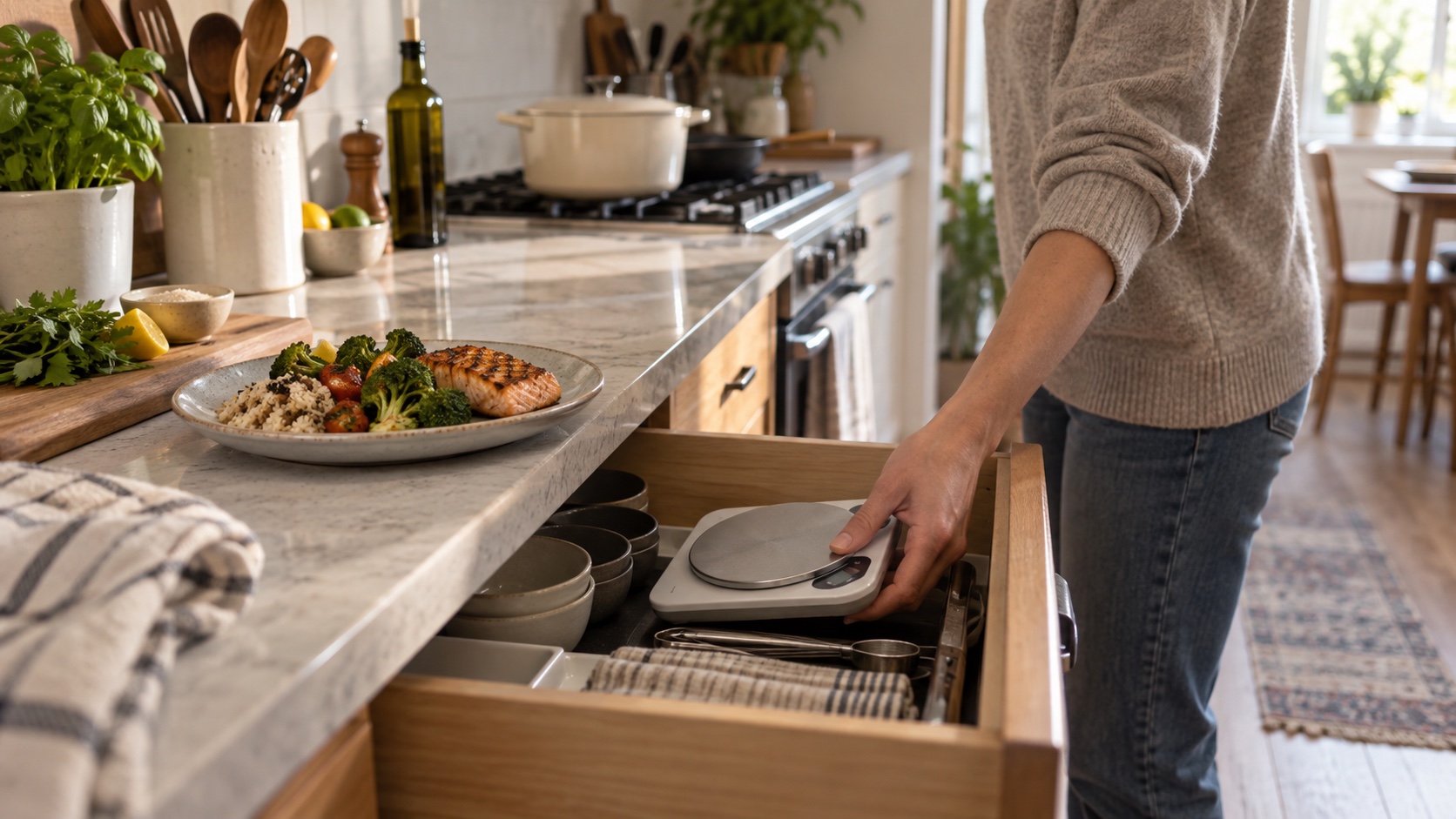
The Honest Psychology of Logging
Tracking works, and part of why it works is that it is a mildly uncomfortable act of honesty. Weighing the oil and logging the bite forces you to look at choices you'd rather blur. That friction is the mechanism — but it is also the reason tracking can curdle. For most people, logging is a calibrated effort: effort in, results out, and when the results arrive, the effort naturally relaxes. For a smaller group, the ledger stops being a mirror and becomes a judge: guilt over an imperfect day, anxiety before the weekly weigh-in, food eaten to get the number "right" rather than to nourish. When the tool you adopted to reduce stress starts generating it, the tool is the problem — not your willpower.
Six Warning Signs to Take Seriously
These are not diagnoses; they are flags worth noticing. If several of them describe you, the right move is the taper at the bottom of this page — and for anyone with a history of disordered eating, talking through tracking habits with a qualified professional is worth more than any self-help protocol.
- 😰 The weekly weigh-in makes you anxious. Dread before a routine measurement is the emotional tell that the scale stopped being information.
- 🔥 You're adjusting meals to make the number look good. Skipping the bite or the meal so the daily log stays low is a sign the tool is steering you, not measuring you.
- 🕰️ Logging eats unreasonable time. More than ten focused minutes a day, or trade-offs against family and work, is a heavy tax for a measurement.
- 🥶 You eat foods you don't want to hit a number. Choosing the "safe" food over the food you'd enjoy, or over- or under-eating to satisfy the app, is the tail wagging the dog.
- 📵 You can't enjoy an occasion without logging it. The holiday dinner ruined by "I'll have to log this later" is a cost no tool should charge.
- 🔁 Guilt spirals over one high day. A single mismatch with your plan triggering self-punishment — not a note and a return — is the pattern that matters most.
The Taper: From Grams to Habits
The exit from strict tracking is not an abrupt stop — that's how skills and progress evaporate. It is a deliberate, staged taper that hands responsibility from the app to your trained eye, one step at a time. The sequence below assumes you've done the calibration work on the tracking-calibrated page: your eye knows portions, your pantry is measured, and your weekly trend has been stable.
- 📓 Stage one — keep logging everything (weeks 1–2 of taper). Nothing changes yet; you're confirming the trend is stable before loosening anything. This is the control condition for the whole experiment.
- 🍳 Stage two — stop weighing the knowns (weeks 3–4). Your measured bowls, plates, and daily staples are now "calibrated set-pieces." Keep logging their numbers, but from memory of the weigh-in you did once.
- 🥄 Stage three — weigh only the dense and the novel (weeks 5–6). Oil, nuts, restaurant meals, and anything new still hit the scale; routine produce and prepared-at-home staples go by eye.
- 🕊️ Stage four — drop to weekly spot-checks (weeks 7–8). Log a full day once a week to keep calibration honest, and keep the weekly scale average.
- 📊 Maintenance — the lightweight default (week 9+). One weighed day and one weekly average, plus the monthly trend. The habit carries the load; the data just checks in on it.
- 🔁 The re-calibration button. Any time the trend drifts for two to three weeks, step back up to stage two for one week and re-learn what your portions actually look like now. The taper is a dial, not a one-way door.
⚠️ When to step back from tracking entirely
If the warning signs above are present — especially anxiety around the scale, guilt spirals, or eating to satisfy the log — the honest move is to stop daily tracking now, not to build a slower taper. Keep the lightweight elements that feel neutral (a monthly weigh-in, a waist measurement) and drop the rest. This preference toward stopping is a clinical-territory judgment for anyone with a history of disordered eating: if that describes you, involve a qualified healthcare professional before deciding how much tracking, if any, is right. Nothing on this site prescribes a particular relationship with the scale.
Do / Avoid: The Exit Table
| Situation | Do | Avoid |
|---|---|---|
| 📉 Trend stable for 4+ weeks | Begin the taper; hand responsibility to your trained eye | Logging forever out of fear the progress will vanish |
| 😰 Weigh-ins cause dread | Drop to monthly weigh-ins; keep waist measurement if neutral | Powering through with more logging because you "should" |
| 🍽️ Special occasions | Enjoy them unlogged; note the day, return the next | Ruining the moment to keep the streak alive |
| 📈 Trend drifts 2–3 weeks | Step the taper back one stage for a re-calibration week | Abandoning the whole system in frustration |
| 🩺 History of disordered eating | Discuss tracking habits and the taper with a professional | Deciding on your own that obsessive patterns are "fine" |
Habits That Outlast the Ledger
The taper works because you are not removing structure — you are moving it from the app into habit. The habits worth banking during the track-heavy weeks are the ones that keep the trend honest without any logging at all: a plate built mostly from protein and vegetables, a fixed cooking-fat budget you set once in the kitchen, restaurant ordering that already defaults to the high-protein option, and a standing weekly weigh-in that you keep even after the daily log retires. These are the same moves the weight-loss protocol runs on, and the habit-formation protocol explains why anchoring them to the same time and place makes them stick. The gap between "tracking" and "not tracking" is not a cliff; it is a smooth gradient, and you are walking it one calibrated stage at a time.
Questions, Answered Briefly
- 📏 How do I know it's time to taper? When the trend has been stable or appropriately downward for several weeks, when portion sizes feel automatic, and when logging no longer changes what you choose. Time to hand over to habit.
- 😨 What if I stop tracking and regain weight? That's precisely what the taper's re-calibration rule is for: drift for two to three weeks, step back up one stage, re-learn the portions, and the trend corrects long before the regain runs away.
- 📉 Do I need to track forever to keep the weight off? No — the maintenance evidence points to keeping some form of regular self-monitoring (a weekly scale check, a monthly weighed day), not daily logging, as the durable pattern.
- 🩺 I have a history of eating disorders — should I track at all? This is genuinely clinician territory. For many people in recovery, daily food logging and frequent weigh-ins are counterproductive or harmful. Bring the taper and tracking plans to your care team before starting; nothing here is a substitute for that conversation.
- 🧭 Will I lose my gains if I stop? The gains that matter — portion perception, food habit, the weekly weigh-in — live in you, not in the app. The data was scaffolding; the habits are the building. The taper exists to prove it to you.
The Bottom Line
- Logging is a tool, not a lifestyle — it works while it helps, and its job is to train the eye and hands that replace it.
- Watch for the warning signs — dread, guilt, and eating-to-the-number mean tracking has crossed from measurement into obsession, and the right response is to step back.
- Taper, don't crash-stop — move from weighing everything to weighing only the dense and novel, to a weekly check, keeping the weekly average alive.
- Keep the re-calibration button — drift for two to three weeks means stepping the taper back one stage, and for anyone with disordered-eating history, every stage of this conversation belongs with a qualified professional.
Related Topics
- Burke et al., "Self-monitoring in weight loss: a systematic review of the literature," Journal of the American Dietetic Association (2011)
- Schoeller, "How accurate is self-reported dietary energy intake?" Nutrition Reviews (1990)
- Wing & Phelan, "Long-term weight loss maintenance," American Journal of Clinical Nutrition (2005)