Food tracking, calibrated
Every piece of this protocol is only as good as your intake numbers, and human beings are quietly terrible at estimating what they eat. Research using doubly labeled water — a technique that measures true energy expenditure — consistently finds that people under-report their eating by a meaningful margin. This page looks at how big that error is, why a kitchen scale outperforms eyeballing and measuring cups, and the two-week weighing protocol that recalibrates your portions for good.
What the evidence supports
- Self-reported dietary intake under-counts actual intake substantially — a finding repeatedly confirmed when energy expenditure is measured with doubly labeled water rather than self-report.
- Weighed portions are reliably more accurate than eyeballed portions or measuring-cup estimates, especially for energy-dense foods.
- People who weigh and log food during weight-loss efforts lose more weight on average than those who don't — measurement itself is associated with adherence.
What remains uncertain
- How long a weighing habit must persist before portion estimates stay calibrated; skills decay without practice.
- The bias in popular tracking-app databases, whose entries carry their own errors of unknown direction and size.
- Whether the accuracy benefit outweighs the burden for everyone — some people do better with looser approaches (see the final page of this series).
Evidence last reviewed: August 15, 2026. Conclusions may change as new research is published.
Product picks are generic categories, not brands. We may earn a commission on Amazon or iHerb purchases at no cost to you — this never changes our evidence conclusions. Full disclosure
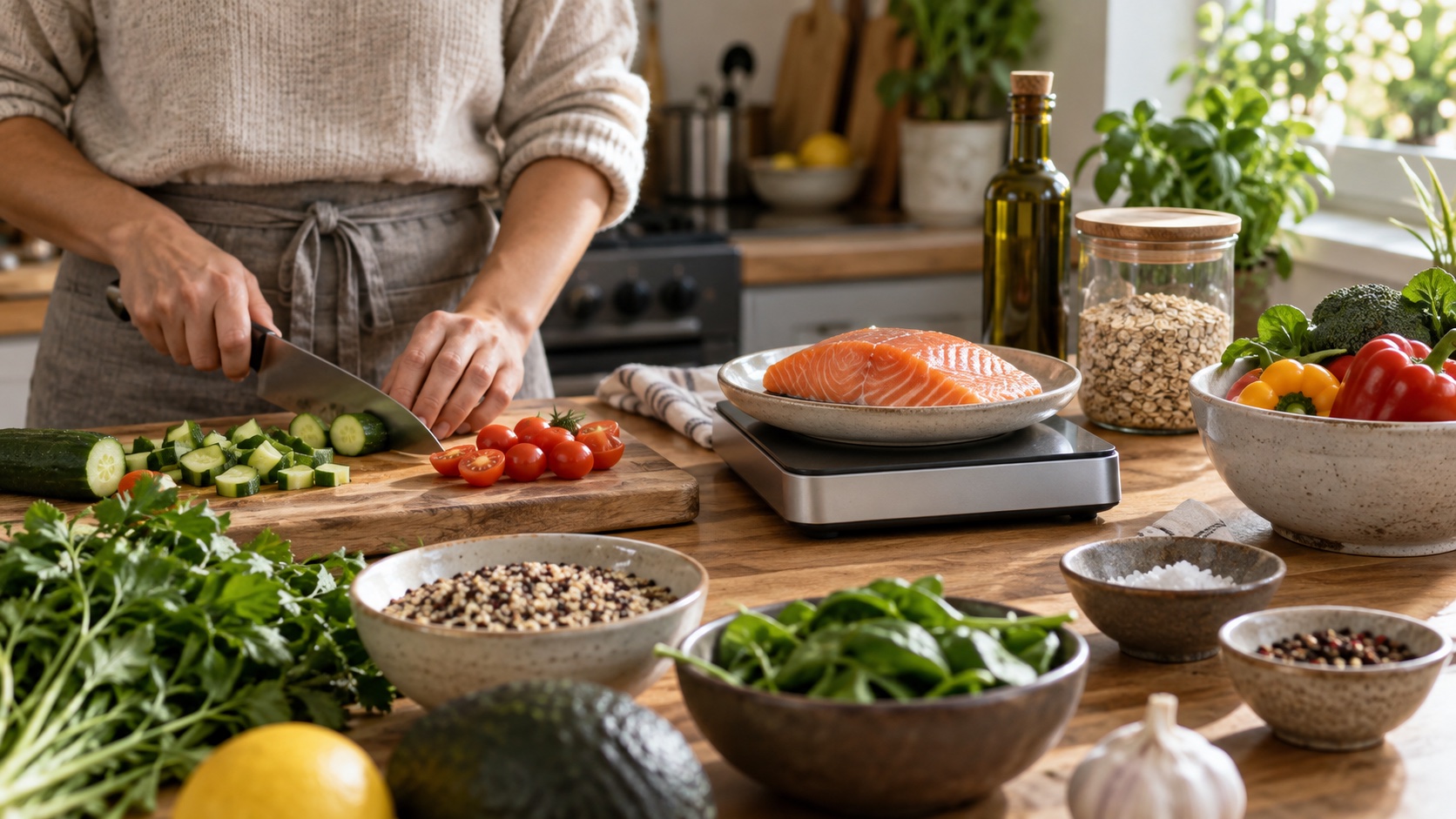
Digital kitchen scale
Can help with recipe consistency and portion awareness when a person finds that useful.
⚠️ Detailed food tracking can be unhelpful for people with a current or past eating disorder; it is not necessary for healthy eating.
Check price on Amazon →How Big Is the Under-Reporting Problem?
The cleanest way to test whether people's reported food matches their actual eating is to compare it against a direct measurement of energy expenditure — the doubly labeled water technique, which tracks a special isotope as it leaves the body and yields a true energy-expenditure number. When researchers do this, self-reported intake consistently comes up short. Landmark studies found average under-reporting in the range of a few hundred calories a day, and the shortfall grows among people with a history of dieting and in those who are heavier (Schoeller, Nutrition Reviews, 1990; Subar et al., American Journal of Clinical Nutrition, 2003 — the OPEN study).
This is not moral failure; it is measurement failure. The error comes from three mechanical sources: portions are bigger than we think, "small bites" and cooking oils are never counted, and restaurant portions in particular are wildly under-estimated. In a 300–500 kcal deficit, a few hundred unrecorded calories of oil and bites can quietly erase the entire deficit — which is precisely why this page is not optional garnish for the protocol but one of its load-bearing walls.
Eyeball vs Cup vs Scale
The three common portion methods are not equal. Eyeballing is astonishingly unreliable — research on portion estimation finds people routinely guess wrong by large margins, and the errors do not cancel out across a day. Measuring cups are better for liquids and things that pour, but hopeless for things you can pack tight (a "cup" of grated cheese or rice depends entirely on how hard you push). The kitchen scale is the reference: weight is weight, independent of shape, packing, or the size of your palm.
The reason dense foods matter: a tablespoon of oil is roughly 120 kcal, a handful of nuts two or three hundred, a "generous" pour of dressing can double a salad's calories. Eyeballing an 80-calorie vegetable is harmless; eyeballing oils, nut butters, cheese, and rice is where plans silently die. If you weigh only one category, weigh the energy-dense one.
The Two-Week Calibration Protocol
You do not need to weigh everything forever. You need to weigh things long enough that your eye and your hand learn what the portions actually are — and that learning happens fastest in two focused weeks. This is the same timing logic as the TDEE page's maintenance test: a short, precise investment that pays off for months.
- ⚖️ Weigh everything that goes in your mouth for two weeks. Solids on the scale, liquids in a cup on the scale with the weight mode set. Yes, including the oil, the sauce, and the "taste" bites.
- 🥣 Weigh in grams, in the unit the app uses. A gram is a gram; convert from ounces if needed. Weigh raw or cooked consistently and pick the matching database entry — mixing them doubles the error.
- 📓 Log once, immediately. The number goes in the app the moment the food is weighed, while it is in front of you. "I'll log it later" is the beginning of every missing entry.
- 📸 Calibrate your eye with a photographic record. Photograph your weighed plate alongside the gram total for the first few days; the images train your perception faster than abstract numbers.
- 🔁 Re-verify one day a week afterward. After the two weeks, keep weighing one whole day per week to catch drift — portion memory decays, and one disciplined day keeps it honest.
- 🧮 When you eat out, weigh "by analogy." Plate it at home later the same week and weigh a guess-sized portion; you will be surprised at how different restaurant portions look on a scale.
🥄 The biggest fix is the cheapest: weight the ingredients before cooking
Oil, butter, and sauces added during cooking vanish into the dish and are the single most common silent calorie source. Weigh the bottle or the spoon before it goes in and log it as part of the meal — a detected tablespoon of oil added to the recipe beats a guessed "it's probably fine" added to nothing. This one habit fixes more tracking error than any app feature.
The App Database Problem
Tracking apps make weighing easy but introduce a second, quieter error source: the database itself. Entries vary wildly between "raw chicken breast" and "roasted chicken breast," between generic "rice, cooked" and specific brands. Studies of food-composition databases find large discrepancies between entries for the same food, so the accuracy you earn by weighing can be thrown away by picking the wrong row. The discipline: always choose entries that match how the food was actually prepared, favor entries with a brand and a gram weight, and prefer foods you weighed yourself over "verified" crowd entries you can't inspect. When in doubt, round the serving to the higher common value.
Do / Avoid: The Calibration Table
| Situation | Do | Avoid |
|---|---|---|
| 🥄 Cooking at home | Weigh oil, butter, sauces as ingredients — before they go in | Logging the plate but not the pan |
| 🏪 Restaurant meals | Estimate high, by analogy with weighed home portions, or weigh a remake later | Choosing the app's lowest "restaurant" estimate to feel better |
| 🧈 Energy-dense foods | Always weigh nuts, oils, nut butters, cheese, rice, granola | Trusting your eye on anything a tablespoon could be hiding |
| 🥦 Low-density foods | Weigh once, then reuse the number for the same bowl/plate | Weighing every single lettuce leaf — low error payoff, high burden |
| 📓 The logging moment | Log immediately, in grams, from the scale | "I'll add it tonight" — the origin of most missing entries |
Questions, Answered Briefly
- 🧮 Do I have to weigh food for the rest of my life? No — the two-week calibration is the investment, and one re-verification day per week keeps your eye honest afterward. The exit strategy page maps the full taper from weighing to habits.
- 🥣 My app has two entries for the same chicken — which is right? Likely neither exactly, but one is closer than the other. Match the description to how you prepared it, prefer brand entries, and stay consistent — consistency matters more than perfect database accuracy.
- 🍞 Is raw or cooked weight the right one? Pick one and be consistent; rice and pasta roughly triple in weight when cooked, meat shrinks. The common mistake is entering raw food as cooked weight — an instant 2–3x calorie error.
- 😅 I forget to log and it feels hopeless. The forgetting is usually a signal that logging is too heavy a load — which is what the final page exists to solve. Until then, weight the calories you can see and don't punish yourself for the rest.
- 📉 Will weighing really speed up the weight loss? In the research, people who weighed and logged their food lost more on average than those who did not — measurement is associated with better adherence. It is not magic; it is error correction on the thing the whole protocol depends on.
The Bottom Line
- Self-report under-counts — doubly-labeled-water studies routinely find reported intake falls short by 30–40%, mostly from unmeasured oil, bites, and portion size.
- The kitchen scale is the reference method — weight removes the packing and eyeballing error; dense foods are the ones where it pays off most.
- Two weeks of full weighing recalibrates your eye — a short, precise investment, maintained by one re-verification day a week.
- The app is a second error source — match entries to how food was prepared, prefer verified gram entries, and round servings slightly up rather than down.
Related Topics
- Schoeller, "How accurate is self-reported dietary energy intake?" Nutrition Reviews (1990)
- Subar et al., "Using intake biomarkers to evaluate the extent of dietary misreporting in a large sample of adults: the OPEN study," American Journal of Clinical Nutrition (2003)
- Burke et al., "Self-monitoring in weight loss: a systematic review of the literature," Journal of the American Dietetic Association (2011)