The Humidity Band
Relative humidity can affect allergen and dampness concerns, but a specific target for improving sleep has not been established. The cited evidence supports keeping indoor humidity below about 50% as one dust-mite control measure; it does not establish a lower bound. How dryness affects comfort varies from person to person.
What the evidence supports
- Holding mean daily relative humidity under 50% restricts dust-mite population growth, even with brief daily excursions above it (Arlian et al., 1999).
- In a 17-month field study, homes held under 51% RH cut live mites per gram of dust from roughly 400 to about 8, with allergens more than ten times below humid homes (Arlian et al., 2001).
- Damp or mouldy buildings are linked to more respiratory symptoms and asthma exacerbations across many countries — enough for WHO to recommend remediation (WHO, 2009).
- Active dust mites cannot hold out long in dry air: at or below 50% RH they survive only about 6–11 days (Arlian, 1992).
What remains uncertain
- Controlled evidence that bedroom humidification improves sleep itself is scarce — most humidity research measures symptoms or mite populations, not sleep quality.
- No lower humidity threshold has been established for sleep; how much dryness bothers a person varies.
- How much one bedroom's humidity, versus bedding, dust load and building quality, drives a person's symptoms is hard to disentangle.
Evidence last reviewed: October 5, 2026. Conclusions may change as new research is published.
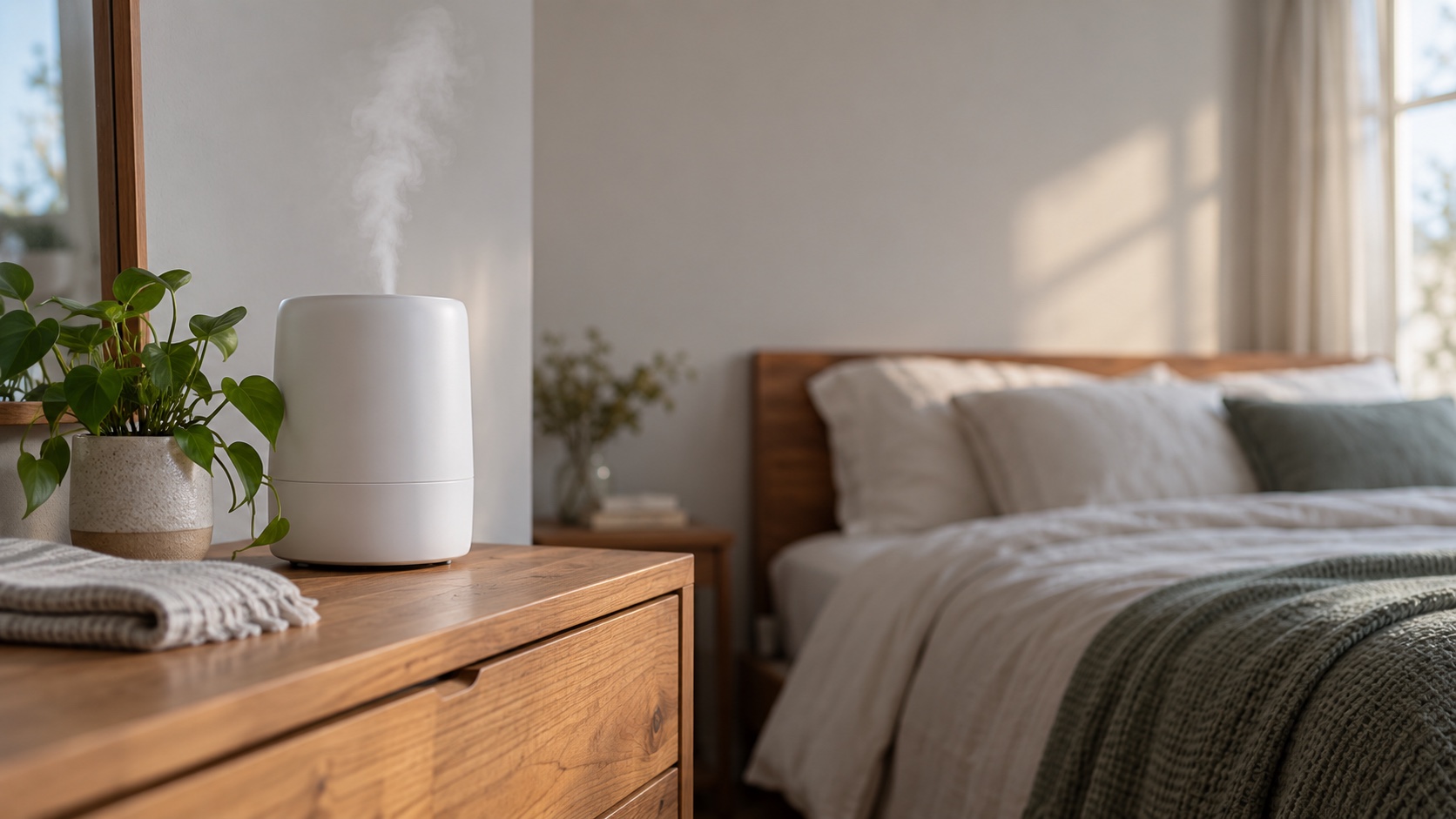
Humidity and Dust-Mite Control
Relative humidity is how full the air is — the moisture it carries versus the most it could carry at its current temperature. Warm air holds more water, so a heated room reads drier, and a winter bedroom can sit thirty points from a summer one. The working dust-mite evidence supports keeping indoor humidity below about 50%; it does not validate a lower bound or sleep target. US EPA moisture guidance lands in the same place — below 60% to reduce dampness; it does not establish a sleep-specific humidity range.
- 🧭 Different questions — dry-air discomfort, dust-mite control and building dampness are distinct concerns, not a validated sleep-humidity range.
- 🌡️ The number moves on its own — heating dries indoor air, air conditioning dries it as a side effect, and wet weather pushes the other way.
- 🛏️ One variable among several — temperature, light and noise have their own evidence base on the Bedroom Engineering page.
A meter can help describe the room, but its reading is not a diagnosis or a sleep target:
| RH zone | What is happening | What to do |
|---|---|---|
| 🌵 Dry air — if personally uncomfortable | Dry nose, throat, eyes and skin; static and dry-mouth wake-ups. | If dryness is uncomfortable, cautious humidification may help comfort; no lower target or sleep benefit is established. |
| 💧 Below about 50% as one mite-control measure | This can limit dust-mite growth; individual comfort varies. | Consider it as part of allergen control, not as a sleep prescription. |
| 🦠 Higher humidity or persistent dampness | Sustained humidity may favor mites; condensation and dampness can contribute to mould. | Investigate persistent dampness; use ventilation or dehumidification only when suitable. |
Dry Air and Comfort
When air feels uncomfortably dry, people may notice symptoms in the nose, throat, eyes or skin. Humidity is only one possible contributor. The sleep-specific evidence is thinner: humidification trials with objective sleep outcomes are few and small, and much dry-air research comes from aircraft cabins and offices rather than bedrooms.
- 👃 Who notices most — mouth breathers, chronically congested noses, and anyone sleeping in a heated winter room.
- 🛌 A comfort check — a dry nose or throat can prompt a cautious humidifier trial; a meter reading alone cannot identify the cause.
- 🫁 When humidity is not the story — persistent blockage, snoring and breathing pauses belong to the Sleep Apnea page, and to a clinician.
Mites and Dampness
For dust mites, sustained humidity can matter: holding the daily mean below about 50% limited population growth in the cited research. This is an allergen-control measure, not a sleep target. The broader example is dampness — the WHO's 2009 guidelines found sufficient evidence, across countries, that occupants of damp or mouldy buildings have more respiratory symptoms and asthma exacerbations, and recommended fixing the source. Note the altitude: population-level, and mostly about buildings rather than your bedroom's dial last Tuesday.
- 🦠 The mite line — a mean daily relative humidity under 50% restricts population growth, even with brief daily spikes above it (Arlian et al., 1999).
- 🏚️ The dampness line — WHO 2009: damp or mouldy homes show more respiratory symptoms and asthma trouble.
The Dust-Mite Finding, Precisely
Dust mites live in mattress seams, pillows and soft furnishings — and cannot drink; their water comes from the air as vapour. Active mites do not survive longer than about 6–11 days at or below 50% relative humidity (Arlian, 1992), and populations held under a daily mean of 50% stop growing. The desiccation-resistant juvenile stage can wait out dry spells for months, though, so consistency beats one-off drying campaigns.
- 🛏️ The bed is the colony — mattress, pillows and duvet first, then carpet and upholstered furniture.
- 🩺 Who it matters most for — people sensitized to mite allergen; the encasing trials are mixed, and allergy or asthma care is clinician territory. Humidity is one lever in a bundle.
💧 Mite control is not a sleep setting
A reading below about 50% may help limit dust-mite growth; the cited evidence does not establish a lower limit, a preferred point within a range, or a sleep target. A reading such as 45% is not proof that the room is optimized. If dry air causes discomfort, do not keep lowering humidity to chase mite control. Address persistent dampness or visible mould as a building issue.
Running a Humidifier Well
A humidifier is a heating-season tool, and the difference between good and bad is mostly water quality, cleaning and restraint.
- 💧 Distilled water, or a demineralization cartridge — ultrasonic humidifiers aerosolize whatever the water carries, and tap-water minerals land as fine white dust.
- 🧽 Clean weekly — a warm, wet tank grows biofilm; skip the cleaning and you can spray mould spores along with the mist.
- 🧪 Keep the claim narrow — evidence supports below about 50% as one dust-mite control measure; it does not establish a sleep target or prove that lower settings are better.
- 📍 Place it with clearance — away from the bed, electronics and the breathing zone, so mist disperses rather than landing on the sleeper.
- 🛑 Wrong tool for damp — a room that smells damp wants the next section, not a humidifier.
Running a Dehumidifier Well
A dehumidifier is the summer, basement and damp-climate tool; its failure modes are over-drying and fighting an open window.
- 🧪 Do not chase a lower number — the cited evidence does not establish a lower humidity bound or an added benefit from further drying for sleep.
- 🪟 Close the room — with windows open, it tries to dry the neighbourhood; shut external doors and windows while it runs.
- 🔇 Mind the noise — compressor hum is its own sleep disruptor; run it earlier in the day, or keep it in the damp space it is fixing.
- 🧱 When it is really a building problem — if the tank fills daily and the walls still sweat, the answers are drainage, leaks and insulation; visible mould calls for remediation.
Air exchange is a different lever with its own page in this series — and the two machines side by side:
| Device | When it earns its place | Set it to | Cautions |
|---|---|---|---|
| 💧 Humidifier | The room feels uncomfortably dry, such as waking with a dry nose or throat. | Follow general indoor-moisture guidance; do not humidify to a target for sleep, and avoid excess moisture. | Use distilled water, clean the tank weekly and avoid excess moisture that creates dampness. |
| 🌬️ Dehumidifier | Persistent dampness needs attention, or below-about-50% humidity is being considered for dust-mite control. | Use only as needed to address dampness; avoid excess dryness. | Close windows while it runs; keep compressor noise off the pillow; if the tank fills daily and walls still sweat, the fix is the building. |
Measuring Humidity
A meter helps describe a room, but it is only one input; comfort, allergens and persistent dampness are different questions.
- 📟 An inexpensive hygrometer is fine — consumer sensors sit within a few points and drift; the trend matters, not the decimal.
- 📍 Put it at the pillow, and log temperature with it — away from the mist path, radiators, vents and windows; the same moisture reads differently as the room warms or cools.
- 📅 Check when seasons turn — heating and damp weather can shift readings; monitor comfort or building dampness rather than chasing a fixed sleep target.
- 🧪 Sanity-check the sensor — compare it with a second meter occasionally; a drifting sensor can steer months of decisions wrong.
Questions, Answered Briefly
- ❓ Is 30–50% a validated sleep target? No. The cited below-about-50% evidence concerns dust-mite control, not sleep improvement; indoor moisture and comfort vary by building and person.
- ❓ Will a humidifier fix my dry throat at night? It may relieve dryness for some people; evidence for sleep improvement is limited. If you try one, track comfort, clean it regularly and stop if dampness develops.
- ❓ My room reads 55–60% in summer — should I intervene? A reading alone does not establish a need to act. When mite allergen is a concern, below about 50% may be one control measure; do not pursue lower humidity if it causes discomfort.
- ❓ Does humidity matter if I have asthma or allergies? Dampness and mite allergen are asthma-relevant at population level; personal management is clinician territory. Treat humidity as a supportive lever, not a treatment.
The Bottom Line
- For dust-mite control, below about 50% may limit growth — this is not a proven sleep target; avoid uncomfortable dryness.
- The 50% line is the mite threshold — a mean daily RH under 50% keeps populations from growing, and damp buildings show more respiratory symptoms.
- The sleep-specific evidence is thin — the literature mostly measures symptoms and mite counts, not sleep quality; plan accordingly.
- Use equipment cautiously — clean humidifiers weekly, avoid excess moisture, and use a meter as context rather than a sleep target.
Related Topics
- Arlian LG, et al., "Reducing relative humidity to control the house dust mite Dermatophagoides farinae," Journal of Allergy and Clinical Immunology (1999)
- Arlian LG, "Water balance and humidity requirements of house dust mites," Experimental and Applied Acarology (1992)
- Arlian LG, et al., "Reducing relative humidity is a practical way to control dust mites and their allergens in homes in temperate climates," Journal of Allergy and Clinical Immunology (2001)
- World Health Organization, "WHO Guidelines for Indoor Air Quality: Dampness and Mould" (2009)
- Terreehorst I, et al., "Evaluation of impermeable covers for bedding in patients with allergic rhinitis," New England Journal of Medicine (2003)
- Tsurikisawa N, et al., "Encasing bedding in covers made of microfine fibers reduces exposure to house mite allergens and improves disease management in adult atopic asthmatics," Allergy, Asthma & Clinical Immunology (2013)
- US EPA, "A Brief Guide to Mold, Moisture and Your Home"