The Clean-Air Aisle
The clean-air aisle is the most confident shelf in the store: purifiers promising better sleep, devices claiming to kill everything airborne, candles selling calm, covers selling protection. The science underneath is narrower than the marketing. This page grades it against the evidence: where filters help, why ozone generators are a documented hazard, what combustion and fragrance add, and what covers do and do not change.
What the evidence supports
- HEPA filtration reliably lowers indoor particles; 8 pooled trials found small symptom gains in allergic rhinitis.
- In smoke, field studies show large indoor PM2.5 reductions — with wide real-world variation.
- Regulators are united: emitted ozone is a lung irritant with no place in occupied rooms.
What remains uncertain
- Whether cleaner air changes sleep itself — signals are modest and mixed.
- How big the real-world benefit is for any one household — device, room, and habits move it.
- Whether covers help clinically alone — the largest trial found allergen down, symptoms unchanged.
Evidence last reviewed: October 5, 2026. Conclusions may change as new research is published.
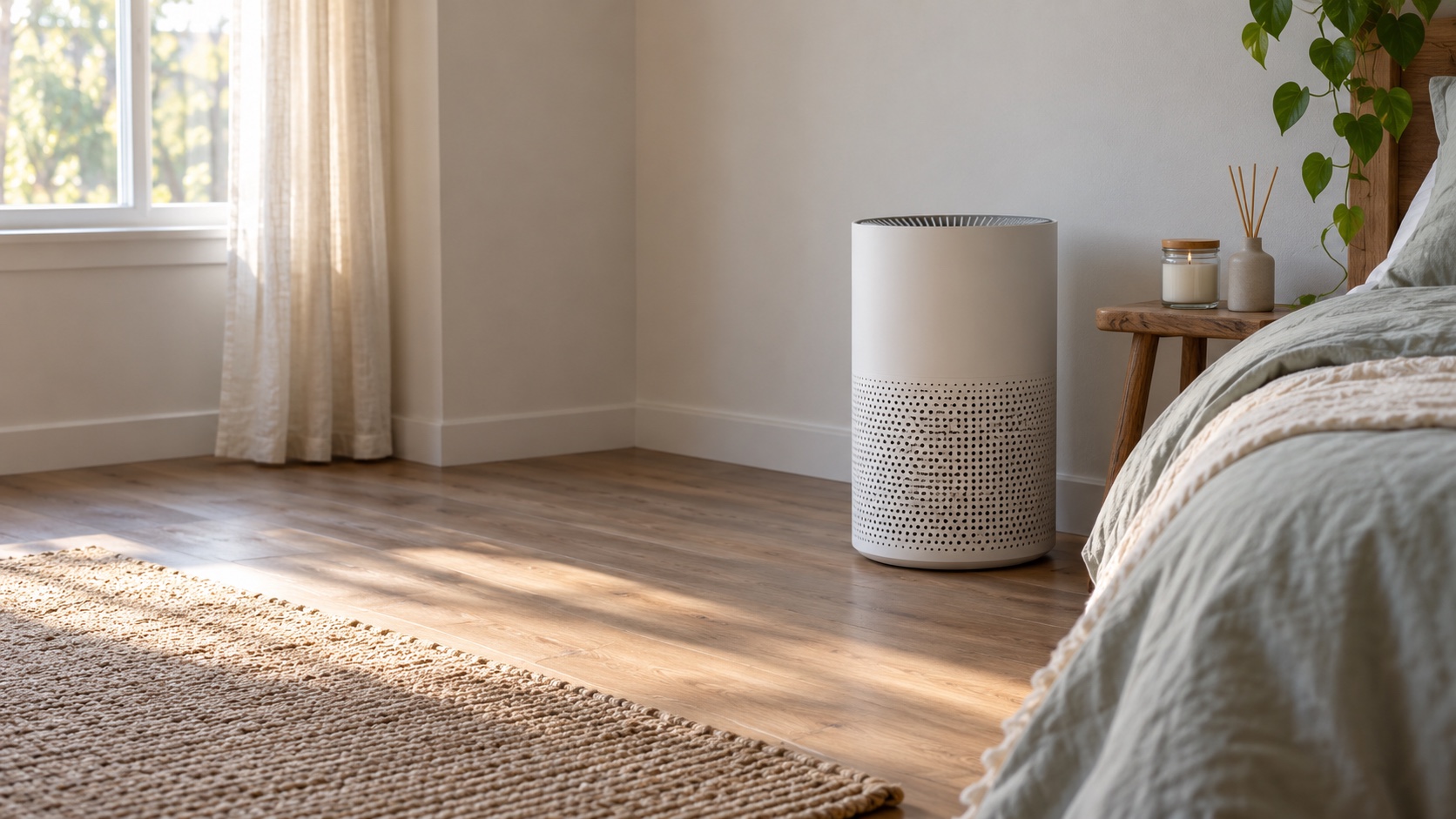
What the Aisle Promises
Three claims repeat up and down the aisle.
- 😴 "You will sleep better" — the thinnest support here. Filters remove irritants; whether your sleep improves depends on whether irritants were your problem.
- 🫁 "The air will be cleaner" — the defensible core: particle counts fall when filters run. Symptom payoffs are smaller.
- ☠️ "It kills everything" — the overreach. No consumer device sterilizes a room, and the technology leaning hardest on this claim — intentionally emitted ozone — is the category regulators say not to run around people.
| Product | Claim | Evidence | Verdict |
|---|---|---|---|
| 🌫️ HEPA purifier | "Sleep better; breathe cleaner air" | Cuts indoor particles; small symptom gains in allergic rhinitis; large cuts in smoke | Helps |
| ⚡ Ozone generator | "Purifies air; kills mold, odors, germs" | Intentionally emits ozone, a lung irritant; never approved for occupied spaces | Avoid |
| 🕯️ Candles & incense | "Calm, clean air" | Combustion source of PM2.5 and aldehydes; spikes particles while burning | Minimize |
| 🛏️ Allergen covers | "Ends mite allergy" | Reduce bedding allergen; no clinical benefit alone (NEJM); better within a plan | Conditional |
| 💧 Diffusers & sprays | "Spa-fresh air" | Emit VOCs; terpenes can form formaldehyde with indoor ozone | Skip or limit |
Filters and Purifiers: Where It Helps
The strongest evidence here is plain particle filtration: a 2024 meta-analysis in Indoor Air pooled 8 randomized trials in allergic rhinitis: nighttime symptom scores improved with filtration (standardized mean difference −0.21), daytime by −0.16 — small but real, with no peak-flow change.
Asthma's picture is mixed. A double-blind trial gave 50 adults with mild-to-moderate asthma active or dummy HEPA purifiers for 78 weeks: PM2.5 fell with active filters, and post-hoc analyses showed better getting-to-sleep and less night-waking — while the trial's own sleep comparison found no significant difference (Kadalayil et al., Clin Exp Allergy, 2024).
Two boundaries matter. A purifier catches particles; CO₂ — a gas — sails through, so stuffy air belongs to the ventilation pages (Stuffy Air, Measured, The Ventilation Trials). In smoke, the numbers split: 48–78% indoor PM2.5 cuts in Seattle homes during a wildfire (Xiang et al., 2021), versus about 15% during the Eaton Fire (Chen et al., npj Clean Air, 2026).
Ozone Generators: A Documented Hazard
Some devices intentionally produce ozone — the main component of smog — and market it as "activated oxygen." The EPA's position: no federal agency has approved ozone generators for occupied spaces; intentionally emitted ozone can damage the lungs, causing chest pain, coughing, shortness of breath, and throat irritation at relatively low amounts, and may worsen asthma.
California's Air Resources Board goes further: ineffective at cleaning air at safe levels, advised against any occupied-space use, with a public list of hazardous models (absence is not endorsement). Its chemistry footnote: ozone reacts indoors to form formaldehyde and ultrafine particles — adding pollution while claiming to remove it. Ionizers produce ozone indirectly and typically less, but by the same pathway; EPA is cautious on both.
🚨 Ozone generators are not a grey area
EPA and CARB agree: these devices intentionally add a lung irritant to occupied air, and exposure can cause chest pain, coughing, shortness of breath, and asthma flare-ups. There is no bedroom use case — if one is in your room, unplug it.
Candles, Incense and Diffusers
Incense is the best-documented burner: one stick in an experimental house pushed indoor PM2.5 to about 200 µg/m³ — 13 times the WHO 24-hour guideline (Ji et al., Indoor Air, 2010) — and home tests measured 7–31 mg per gram burned (Ofodile et al., 2024).
Scented candles are the same physics in a jar: a chamber study found BTEX compounds, aldehydes including formaldehyde, and PAHs, varying widely by product (Derudi et al., 2012).
Diffusers skip the flame but not the chemistry: fragranced products emit VOC mixtures — 156 compounds across 37 products, terpenes like limonene dominating (Steinemann, 2015) — and those terpenes can react with indoor ozone to form formaldehyde.
- 🔥 Burn early, ventilate — hours before sleep, window cracked.
- 📏 Keep flames and smoke away from bedding and anything soft.
- 🚫 Never near oxygen or medication — an open flame is a fire risk.
Bedding Covers and the Mite Question
You spend a third of your life against the home's densest allergen reservoir: the mattress. Zipped encasings around mattress, pillow, and duvet cut that reservoir, and the largest randomized test of benefit came back negative: 279 adults with mite-sensitized rhinitis used impermeable or control covers for a year; mattress allergen fell significantly, symptoms did not improve (Terreehorst et al., N Engl J Med, 2003).
That verdict is about covers alone, not covers as a tool: a smaller randomized trial in adult atopic asthmatics found microfine-fiber encasings plus cleaning counseling lowered mite allergen and improved asthma symptom scores and peak flow (Tsurikisawa et al., 2013). Single measures underperform; multi-component plans do more.
- 🛏️ As a single move: allergen down, symptoms flat — covers earn their place inside a bundle.
- 💧 Humidity sets the mite ceiling — the humidity band has its own page.
Pillows, Mattresses and Pets
Synthetic pillow fillings carry several-fold more mite and pet allergen than feather ones — the weave, not the feathers, is the barrier (Custovic et al., Pediatric Allergy & Immunology, 2000).
Washing is the highest-yield move. Mites die at 55°C or above; a cold cycle leaves live mites but still removes over 90% of mite allergen, and dry cleaning kills mites without reducing allergen (McDonald & Tovey, J Allergy Clin Immunol, 1992). Wash bedding weekly; go hot when fabric allows.
Pets split into sleep and exposure: sleep efficiency held with a dog in the room but dropped with the dog on the bed (Patel et al., Mayo Clin Proc, 2017); a national survey linked pet co-sleeping to poorer perceived sleep, more insomnia (Scientific Reports, 2024). The data are correlational and thin; for dander-sensitized sleepers, the bed is the last place to share with the source.
What to Buy, What to Skip
Ranked from worth-it to walk-away:
- Buy first: filter the particles — a HEPA unit sized to the room, run overnight.
- Then the bedding program — weekly washing; encasings within a bundle.
- Minimize combustion and fragrance — burn earlier, in moving air; diffusers are scent, not filtration.
- Skip ozone — no occupied-space use, whatever "activated oxygen" claims.
The rest of the room still beats the aisle — the bedroom engineering playbook owns that territory.
When Air Is a Clinician Conversation
This page improves a room, not a disease. Some symptoms belong to a clinician:
- 👃 Nocturnal nasal obstruction or persistent congestion — allergic rhinitis is treatable, and a randomized crossover trial found intranasal budesonide reduced congestion-related sleep disturbance and daytime sleepiness (Gurevich et al., 2005).
- 🫁 Asthma symptoms at night — waking with cough, wheeze, or chest tightness needs review, not another purifier.
- 😮💨 Possible sleep apnea — snoring with pauses, gasping, morning headaches — belongs to a sleep evaluation; see Sleep Apnea.
Filtration supports the plan; it should never delay one.
Questions, Answered Briefly
- ❓ Do I need a purifier to sleep well? No — the case is decent if you are allergic or live with smoke; otherwise thin.
- ❓ Will a purifier fix a stuffy bedroom? No — CO₂ is a gas; filters catch particles. Start with moving air without freezing the room.
- ❓ Are ionizers the same as ozone generators? Not identical — typically less ozone, same irritant, and EPA is cautious on both.
- ❓ Is one candle before bed a problem? One ventilated candle is not nightly incense at the pillow — but minimize combustion where you sleep, never near oxygen or medication.
- ❓ Do allergen covers work? Yes for allergen; for symptoms alone, the largest trial says no.
The Bottom Line
- Filter the particles, ventilate the gas — CO₂ needs air exchange, not HEPA.
- Ozone generators are a hazard, not a premium feature — never in an occupied room, whatever the label calls the ozone.
- Combustion and fragrance are additions you manage — burn rarely and ventilated, away from bed.
- Everything else earns its keep at the margin — allergen control is real where allergen concentrates; sleep is not a product here.
Related Topics
- US EPA, "Ozone Generators that are Sold as Air Cleaners"
- California Air Resources Board, "Hazardous Ozone-Generating Air Purifiers"
- Shih et al., "Effectiveness of Air Filters in Allergic Rhinitis: A Systematic Review and Meta-Analysis," Indoor Air (2024)
- Kadalayil L, et al., "Effects of air purifiers on rhinitis quality of life ... in people with asthma," Clin Exp Allergy (2024)
- Xiang J, et al., "Field measurements of PM2.5 infiltration factor and portable air cleaner effectiveness during wildfire episodes in US residences," Sci Total Environ (2021)
- Chen R, et al., "Fine particulate matter levels and HEPA filtration in Los Angeles homes during a wildland-urban-interface fire," npj Clean Air (2026)
- Ji X, et al., "Characterization of particles emitted by incense burning in an experimental house," Indoor Air (2010)
- Ofodile J, et al., "Characterizing PM2.5 Emissions ... from Incense Burning in a California Residence," Environ Sci Technol (2024)
- Derudi M, et al., "Emissions of air pollutants from scented candles burning in a test chamber," Atmos Environ (2012)
- Steinemann A, "Volatile emissions from common consumer products," Air Qual Atmos Health (2015)
- Terreehorst I, et al., "Evaluation of impermeable covers for bedding in patients with allergic rhinitis," N Engl J Med (2003)
- Tsurikisawa N, et al., "Encasing bedding in covers made of microfine fibers ... improves disease management in adult atopic asthmatics," Allergy Asthma Clin Immunol (2013)
- McDonald LG, Tovey E, "The role of water temperature and laundry procedures in reducing house dust mite populations and allergen content of bedding," J Allergy Clin Immunol (1992)
- Custovic A, et al., "Synthetic pillows contain higher levels of cat and dog allergen than feather pillows," Pediatr Allergy Immunol (2000)
- Patel SI, et al., "The Effect of Dogs on Human Sleep in the Home Sleep Environment," Mayo Clin Proc (2017)
- "Co-sleeping with pets, stress, and sleep in a nationally-representative sample of United States adults," Scientific Reports (2024)
- Gurevich F, et al., "The effect of intranasal steroid budesonide on the congestion-related sleep disturbance ... in patients with perennial allergic rhinitis," Allergy Asthma Proc (2005)