The Programming Rules
Power is the fast half of strength — force expressed quickly, the quality behind a brisk stand from a chair. It is trained differently from the rest of the gym: light-to-moderate loads moved with intent to accelerate, short sets, full recovery. This page lays out the working rules — load, reps, rest, session placement, and an exercise menu from a chair to throws.
What the evidence supports
- Position stands place power work at light-to-moderate loads moved fast: the ACSM stand describes 0–60% of 1RM for the lower body and 30–60% for the upper body at fast velocity (Ratamess 2009); the NSCA older-adult statement uses 40–60% (Fragala 2019).
- Explosive intent is a distinct training signal: rate of force development improves with explosive-type training, largely through faster early-phase muscle activation (Maffiuletti 2016).
- Supervised, progressive plyometric programs show low reported injury rates in older adults (Vetrovsky 2019) — though evidence is scarce, and jumping is not required to train power.
What remains uncertain
- The best load inside that range is not settled: a 2023 meta-analysis of three trials in older adults found similar power gains from low-to-moderate and high intensities (Bandeira-Guimarães 2023).
- Exact rep counts, stop rules and rest lengths are coaching convention built on that physiology — the position stands describe the neighborhood, not a test-verified single dose.
- Long-term comparisons of intent-focused light-load work against heavier fast lifting in older adults are still thin.
Evidence last reviewed: October 5, 2026. Conclusions may change as new research is published.
The One Idea
Power is force multiplied by velocity, so there are two ways to build it: add force, or add speed. Strength work pulls the first lever with heavy, controlled reps; power work pulls the second. Move a manageable load as fast as you safely can, and the nervous system learns to fire quickly — same muscles, different instruction: intent to accelerate.
- ⚡ Speed is the point, not strain — a rep that ends in a grind has left the power zone; the signal is how fast the load moves.
- 🏃 Intent counts even when the load moves slowly — on heavier fast reps, maximal intent still drives the adaptation even as the bar slows.
- 🪑 The humble version is real — a fast sit-to-stand is legitimate power training; everything fancier is a variation on that theme.
The Load Question
The commonly quoted shorthand is 30–60% of one-rep maximum (1RM), moved with maximal velocity intent — position-stand guidance rather than one decisive trial. The ACSM stand describes light loads (0–60% of 1RM lower body, 30–60% upper body) at fast contraction velocity (Ratamess 2009); the NSCA's older-adult statement uses 40–60%, high velocity in the lifting phase (Fragala 2019).
- ⚖️ Light loads let velocity express itself — force and velocity trade off, so the middle range keeps enough resistance to matter while still allowing genuine speed.
- 🧪 The range is not proven optimal — three trials pooled in a 2023 review found similar power gains from low-to-moderate and high intensities (Bandeira-Guimarães 2023); treat it as a starting neighborhood, not a law.
- 🏋️ Heavier fast singles are for trained lifters — with a strength base and solid technique you can cycle heavier speed work; beginners do better with lighter loads moved faster (convention).
- 📏 You do not need a 1RM test — pick a load you can move crisply and stop cleanly; if reps slow early, it is too heavy. The loading rules cover the arithmetic.
Sets, Reps, Rest
A power set is short: three to six fast reps (convention), ending the moment speed visibly drops — grinding extra reps trains the wrong thing (Orssatto 2019 notes velocity falls as fatigue accumulates). Then rest for real. The ACSM description of power progression uses 3–5 minutes between sets (Ratamess 2009); older-adult studies often manage with less, and a longer rest simply buys better recovery (Orssatto 2019).
| 🧩 Piece | 📋 The dose | 🧾 Where it comes from |
|---|---|---|
| ⚖️ Load | 30–60% of 1RM, moved fast | Position-stand guidance (ACSM 2009; NSCA 2019) |
| 🔁 Reps | 3–6 fast reps per set | Coaching convention |
| ⛔ Stop rule | End the set when the reps visibly slow | Convention, grounded in fatigue physiology |
| 🧮 Sets | 2–5 short sets per exercise | ACSM describes 3–5; common practice runs lower |
| ⏱️ Rest | 3–5 min between hard sets | Position-stand description (ACSM 2009); shorter rests are practice |
| 📅 Frequency | 2–3 sessions per week | Position statement (NSCA 2019) |
Notice how little this resembles hypertrophy work: no burn to chase, no failure to reach. A power set that ends in a grind has left the zone; metabolite-chasing belongs to the growth pages.
🏃 Speed intent is the training signal
Snap out of the bottom, float the load up, keep the lowering under control. The moment you are muscling a rep just to finish it, the set is over. Fast, clean reps — then a real rest — beat long, heavy grinds.
Where It Sits in a Session
Power is the most fatigue-sensitive quality on the menu, so it goes where you are freshest: after the warm-up, before the heavy work — never bolted onto the end of a long session, where tired, slow reps teach slowness.
- 🥇 First, after warming up — ten minutes of fast work opens a strength day; bodyweight speed can even open a walk.
- 🚫 Not at the end — saving power work for a spent body is practicing fatigue, which speed cannot tolerate.
- 📅 Two or three exposures a week — the NSCA statement puts the whole program at 2–3 sessions weekly (Fragala 2019); two short power blocks fit inside that (convention).
- 🧊 Fully recovered between sets — speed runs on a refilled tank; if the next set is slow from rep one, rest longer.
The Exercise Menu
The menu runs from the floor to ballistics: start with what you can do, add load before complexity, leave jumping to those who built up to it.
| 🏋️ Exercise | 🎯 What it trains | 🧰 Equipment | 👤 Who it suits |
|---|---|---|---|
| 🪑 Fast sit-to-stands | Lower-body speed — hips and knees at pace | A firm chair | Most adults — the starting rung |
| 🪜 Speed step-ups | Single-leg drive and balance at pace | A low step or stair; something to hold | Beginners who are steady on their feet |
| 🧎 Hip-hinge speed reps | Posterior-chain speed — fast hips | A light dumbbell or kettlebell (or none) | Anyone with an honest hinge |
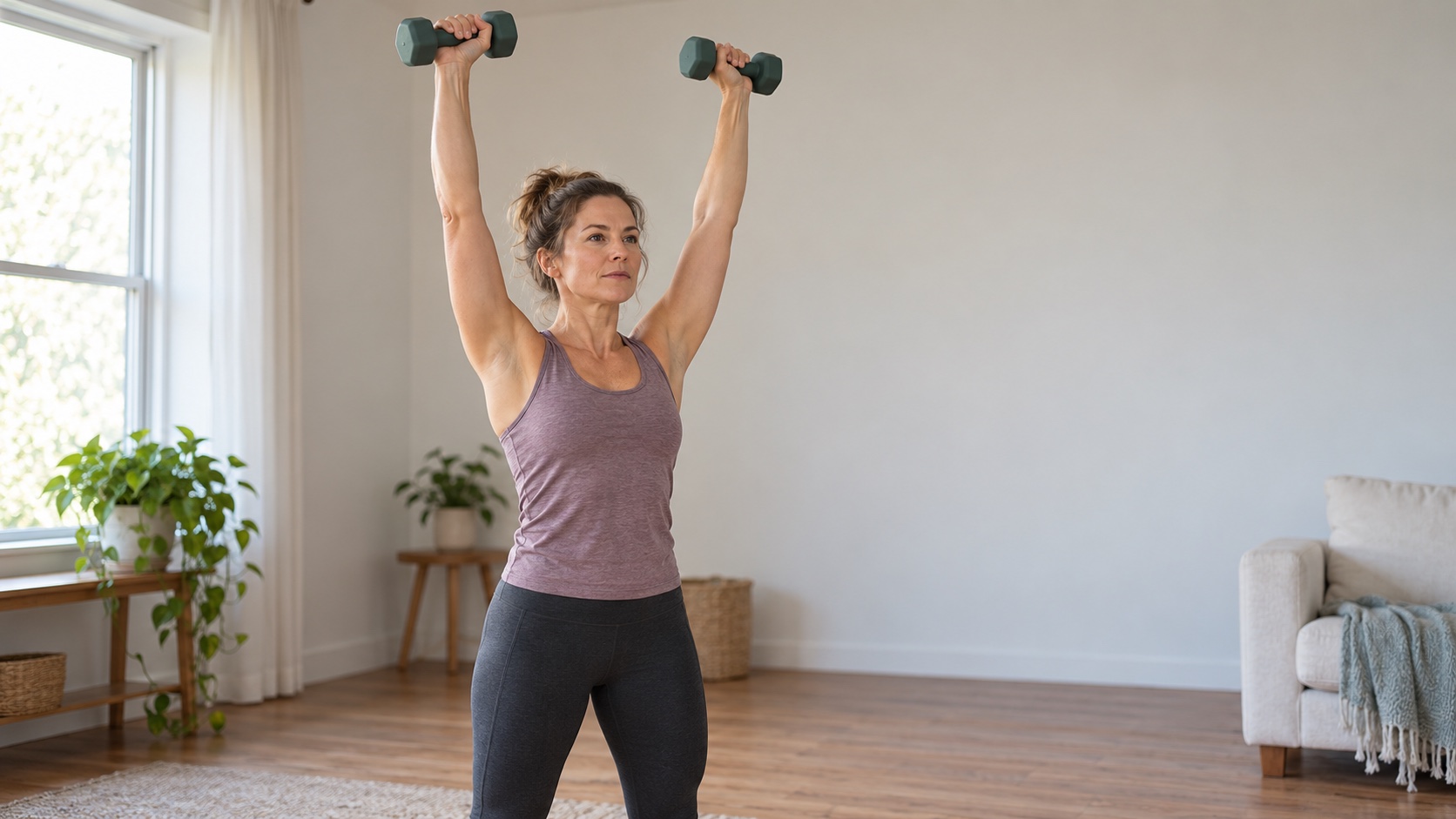
| 🙌 Fast overhead press | Upper-body pressing speed | Light dumbbells — lighter than you think | Healthy shoulders; start almost too light |
| 🏐 Medicine-ball throws | Upper-body throwing power; trunk | A light ball and a solid wall (or a partner) | Most adults with clear space |
| 🦘 Jump squats and low hops | Whole-body ballistic power; stretch-shortening | None at first — load comes later, or never | Trained, joint-healthy adults only — see Landing Safely for the progression |
Pick the lowest row that fits and climb a rung when it stays crisp. Throws are the quiet star up top — full speed without the catch-and-brake of a thrown weight.
Progression: Intent First, Then Load
Progress power the way you built it: intent first, load second, complexity last. Progressive Overload governs the mechanics — a little more stimulus over time, banked patiently.
- 🎯 Chase crispness before numbers — when every set hits its reps without slowing, nudge the load about five percent or add a rep (convention).
- 🐢 When speed fades, back up — a grinding set means the dose was too big; cut load or reps and keep quality.
- 🏗️ Complexity comes last — climb from stands to step-ups to jumps only when the current rung is boringly crisp.
- 📆 A small dose, repeated — two short exposures weekly beat one heroic session; the fast system adapts to frequency, not misery.
The loading ranges themselves live in Reps, Sets & Weights; speed is this page's brief.
What You Do Not Need
- 🪑 No gym — a chair, a wall and a patch of floor cover the bottom rungs.
- 🏐 Almost no equipment — a light dumbbell or medicine ball is the whole kit; bands stand in fine.
- 🛰️ No velocity tracker — devices exist, but eyes are enough: reps that visibly slow end the set.
- 🚑 No jumping required — if your joints say no to impact, the floor exercises and throws still train speed; jumping is the top rung, not a requirement.
- 🏠 If strength is the bottleneck — build the base with the Home Strength Plan first; power rides on strength.
Questions, Answered Briefly
- ❓ Can I train power with no equipment? — Yes. Fast sit-to-stands and hip-hinge speed reps are bodyweight power work; add weight once they stay crisp.
- ❓ Should power work come before or after my heavy sets? — Before. Speed falls to fatigue first, which is why fast work opens the session and grinding closes it.
- ❓ Is fast lifting safe as I get older? — With clearance and a gradual build, yes: supervised plyometrics in older adults show low reported injury rates (Vetrovsky 2019). With joint pain, a recent injury or a cardiac history, seek professional guidance before adding speed or impact.
- ❓ Do I need to jump? — No. The menu trains power from a chair upward; jumping is the top rung for trained, joint-healthy people.
- ❓ How fast is fast, and when is a set done? — As fast as you can move the load while staying in control — and the moment the reps visibly slow, the set is over.
The Bottom Line
- Power means moving light-to-moderate loads with maximal speed intent — speed, not strain, is the signal.
- Position-stand guidance puts loads around 30–60% of 1RM at a fast contraction velocity, in short sets with full recovery (Ratamess 2009; Fragala 2019).
- Put power work first in a session, two or three brief exposures a week, and end a set when the reps visibly slow.
- Build from fast sit-to-stands and throws; add load before complexity, and leave jumping to trained, joint-healthy lifters.
Subtopic three of five inside the Building Power topic: pair it with Why Power Declines First, What the Trials Show, Landing Safely and Testing Power at Home — then read on via Reps, Sets & Weights and Progressive Overload.
Related Topics
- Ratamess et al., "American College of Sports Medicine position stand: progression models in resistance training for healthy adults," Medicine & Science in Sports & Exercise (2009)
- Fragala et al., "Resistance training for older adults: position statement from the National Strength and Conditioning Association," Journal of Strength and Conditioning Research (2019)
- Orssatto, Cadore, Andersen & Diefenthaeler, "Why fast velocity resistance training should be prioritized for elderly people," Strength & Conditioning Journal (2019)
- Vetrovsky, Steffl, Stastny & Tufano, "The efficacy and safety of lower-limb plyometric training in older adults: a systematic review," Sports Medicine (2019)
- Maffiuletti, Aagaard, Blazevich, Folland, Tillin & Duchateau, "Rate of force development: physiological and methodological considerations," European Journal of Applied Physiology (2016)
- Bandeira-Guimarães et al., "Chronic effects of different intensities of power training on neuromuscular parameters in older people: a systematic review with meta-analysis," Sports Medicine - Open (2023)