Isometric Training: The Wall-Squat Data
Isometric exercise — holding a position rather than moving a load — has produced some of the larger blood-pressure reductions in recent meta-analyses, and the wall squat is the version that gets the attention. This page walks the hold literature with the skepticism it deserves: what the trials actually did, what the pooled numbers show, and where the evidence is thinner than the headlines.
What the evidence supports
- Isometric protocols — wall squats and handgrip holds — appear in meta-analyses with reductions at least as large as aerobic training's.
- Two-minute holds with short rests, repeated three to five times, are the recurring trial pattern.
- The effect shows up in trials of people with elevated readings and in some trials of normal-pressure adults.
What remains uncertain
- Most isometric trials are small, short, and run by a handful of research groups.
- The mechanism — what the hold does to the vasculature — is still an open question.
- Whether the wall squat specifically outperforms handgrip holds, or whether any consistent hold does the job, is not settled.
Evidence last reviewed: August 20, 2026. Conclusions may change as new research is published.
What Isometric Training Actually Is
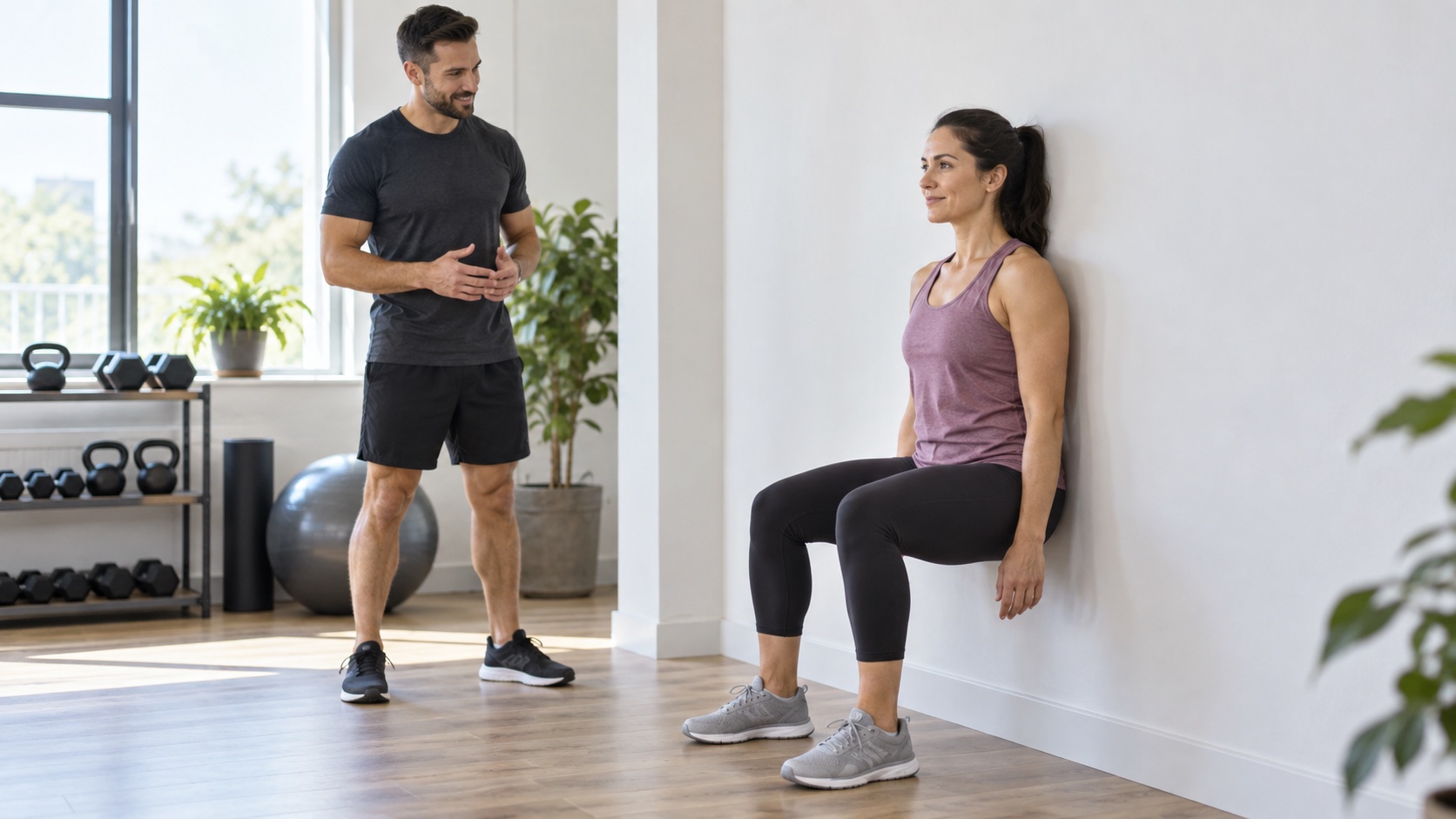
Isometric exercise is a muscle contraction that changes the tension in the muscle without changing its length — a hold instead of a lift. The two forms that dominate the blood-pressure literature are the wall squat (back against a wall, thighs roughly parallel to the floor, held still) and the handgrip squeeze (a firm grip held at a fraction of your maximum). The wall squat got the recent attention because it is a whole-leg effort with no equipment, but the handgrip version has the longer trial history.
- 🧱 Wall squat — back flat against a wall, feet shoulder-width, slide down until the knees sit near a right angle, hold.
- ✊ Handgrip hold — squeeze a grip trainer at roughly 30% of maximum effort and hold, the format of the older trials.
- ⏱️ Two-minute holds recur — the trials cluster around two-minute contractions with one to two minutes of rest between.
- 🗓️ Three times a week — most protocols run three sessions weekly, often on non-consecutive days.
Product picks are generic categories, not brands. We may earn a commission on Amazon or iHerb purchases at no cost to you — this never changes our evidence conclusions. Full disclosure
Hand-grip dynamometer
Can track grip-strength performance over time when measured consistently.
⚠️ Readings can be affected by pain, arthritis, technique, and device variation; a result is not a diagnosis.
Check price on Amazon →The Meta-Analytic Signal
Two meta-analyses frame the field. The first, by Carlson and colleagues in Mayo Clinic Proceedings (2014), pooled isometric handgrip and wall-squat trials and reported systolic reductions larger than those typical of aerobic training. The second, a network meta-analysis in the British Journal of Sports Medicine (Edwards et al., 2023) that compared all exercise modes head-to-head, ranked isometric training first for resting systolic pressure, with an estimated reduction of roughly 8 mmHg.
- 🏆 Ranked first, cautiously — the 2023 network meta-analysis ranked isometric holds top among modes, but ranking is not the same as certainty.
- 📏 Effect sizes vary by trial — the pooled estimate hides trials reporting anywhere from a couple of mmHg to double digits.
- 🔬 Small-study caution — the isometric evidence base is dominated by modest trials from a few groups, which can inflate pooled estimates.
Read the Numbers Carefully
The honest summary of the isometric literature has two sentences. First: the pooled signal is real and, on paper, larger than aerobic training's. Second: that signal rests on a thinner foundation — fewer trials, smaller samples, shorter durations — and every meta-analysis in this area carries the usual caveats about heterogeneity. The numbers deserve to be in the plan, not to be over-read as settled science.
- 🧪 Trial sizes are small — many isometric trials enroll dozens, not hundreds, of participants.
- 🕰️ Follow-ups are short — the hold protocols run for weeks, and durability beyond a few months is largely untested.
- 🧲 Publication bias is possible — small fields with positive results warrant a skeptical glance at the funnel plots.
- 👥 Who was studied — many trials recruited healthy or mildly elevated adults; severe hypertension is rarely represented.
⚠️ The hold raises pressure while you hold it
Isometric exercise is not a passive rest — blood pressure rises during the contraction itself, which is why the wall squat belongs in a structured session with breathing cues, not in an all-out grind. Anyone with known cardiovascular disease or very high readings should clear the wall squat with a clinician before adding it, and no one should hold through pain, dizziness, or chest discomfort.
Simple visual timer
Can reduce friction for short breathing, mobility, or meditation breaks.
⚠️ None expected; it does not treat anxiety, panic, depression, or trauma-related symptoms.
Check price on Amazon →The Wall-Squat Protocol in Practice
The recurring trial pattern is simple enough to reproduce at home: hold the wall squat for two minutes, rest for one to two minutes, and repeat for a total of three to five holds, three days a week. The knees sit at a manageable angle — most people start well above parallel — and the hands stay free so breathing stays audible. If two minutes is out of reach, shorter holds still count; the trials that reported the largest effects used consistent, repeated effort rather than maximal depth.
- 🦶 Feet shoulder-width, back flat — slide down the wall until the thighs are at a challenging-but-holdable angle.
- ⏱️ Two minutes on, two off — the trial pattern is roughly two-minute holds with a full rest between.
- 🔁 Three to five holds — three solid rounds beat five sloppy ones; consistency is the variable that matters.
- 🗓️ Three days a week — non-consecutive days keep the legs fresh and match the published protocols.
- 🫁 Breathe the whole time — exhale audibly, never hold your breath; the breath-holding caution from the safety rules applies fully here.
| Common hold mistake | What it costs | The fix |
|---|---|---|
| 🫁 Holding your breath | Spikes pressure mid-hold | Stop Exhale audibly throughout |
| 🦵 Going too deep too fast | Turns the hold into a strain | Moderate Start well above parallel |
| ⏱️ Watching the clock | Breaks the breathing rhythm | Moderate Set a timer, then breathe |
| 🏃 Adding daily sessions | Fatigue without extra signal | Good Three days a week is the dose |
A Worked Hold Session
Here is what one isometric session looks like in real time, including the bookends — the whole thing fits in about fifteen minutes and follows the safety rules from the session-safety page.
- 🕐 Minutes 0–3 — easy leg swings and a light wall squat to warm the thighs before the holds.
- 🕐 Minutes 3–10 — three two-minute wall-squat holds with two-minute rests between, breathing audibly through every one.
- 🕐 Minutes 10–12 — standing shake-out and slow breathing as the cool-down begins.
- 🕐 Minutes 12–15 — easy walk and a hamstring stretch, then log the session in the home-measurement record.
Handgrip as the Alternative
The handgrip hold predates the wall squat in the literature and is easier on the knees: a grip trainer squeezed at about 30% of maximum and held for two minutes, four holds per session, three times a week. The meta-analytic signal for handgrip is in the same neighborhood as the wall squat's, and it has the advantage of being usable at a desk. The trade-off is equipment and the temptation to squeeze harder than the protocol intends.
- ✊ 30% of max effort — firm but conversational; the hold should never be an all-out crush.
- ⏱️ Two minutes, four holds — the classic handgrip protocol from the older trials.
- 🔄 Alternate hands — most protocols train both arms, alternating holds across the session.
Where the Wall Squat Fits the Week
The isometric work earns a slot in the weekly plan precisely because it is short and portable — fifteen minutes three times a week is the whole investment. It does not replace the aerobic backbone or the strength sessions; the network meta-analysis's own comparison treats the modes as complements, and the physiology of a hold is different from the physiology of a walk or a lift. The weekly plan places the holds on their own days so each mode gets a clean shot at the numbers.
Questions, Answered Briefly
- ❓ Is the wall squat really better than walking for blood pressure? — the network meta-analysis ranked it first, but the aerobic evidence base is far larger; both belong in the plan.
- ❓ My knees complain at depth. What do I do? — start with a higher angle — barely a bend — and let the hold time carry the work; depth is not the point.
- ❓ Can I hold my breath to last longer? — no; breath-holding is exactly what the safety rules warn against, and it spikes pressure during the hold.
- ❓ Do I need the wall squat if I already lift weights? — the strength lever and the isometric lever are separate entries in the meta-analysis; they are complements, not substitutes.
- ❓ How long until the numbers move? — the published protocols run several weeks, and the trial averages reflect that timeframe.
- ❓ I have high readings. Should I start with holds? — check with a clinician first; anyone with known cardiovascular disease or very high readings needs clearance before adding isometric work.
The Bottom Line
- The signal is promising, not proven. Isometric holds rank first in the 2023 network meta-analysis, but the underlying trials are small and few.
- Two minutes on, two off, three times a week. That pattern — wall squat or handgrip — is the recurring trial protocol.
- Breathe throughout the hold. The contraction raises pressure while it lasts, which is why breath-holding is off the table.
- Treat it as a complement. The holds add a signal the aerobic and strength levers do not, and they cost fifteen minutes a session.
Related Topics
- Edwards JJ, et al. "Exercise training and resting blood pressure: a large-scale pairwise and network meta-analysis of randomised controlled trials," British Journal of Sports Medicine (2023)
- Carlson DJ, et al. "Isometric exercise training for blood pressure management: a systematic review and meta-analysis," Mayo Clinic Proceedings (2014)
- Inder JD, et al. "Isometric exercise training for blood pressure management: a systematic review and meta-analysis to optimize benefit," Hypertension Research (2016)
- Millar PJ, et al. "Isometric handgrip training lowers blood pressure and increases baroreflex sensitivity in individuals with normal blood pressure or prehypertension," Journal of Hypertension (2013)
- McGowan CL, et al. "Isometric handgrip training improves local flow-mediated dilation in medicated hypertensives," European Journal of Applied Physiology (2007)