AGEs Explained
Every time glucose lingers in your blood, a small fraction of it reacts with the proteins around it — slow, spontaneous chemistry that stiffens tissue over decades. The products of that reaction, advanced glycation end products, are one of the clearest mechanistic links between chronically high blood sugar and accelerated aging. Here is the chemistry, what it damages, and — the part most articles get wrong — how much of your AGE exposure is actually on your plate.
What the evidence supports
- The chemistry is textbook-solid: sugars bind proteins irreversibly, forming cross-links — and HbA1c, the standard diabetes marker, is itself a glycated protein.
- Chronically elevated glucose multiplies the body's own AGE formation; the diabetes pathway is the main engine of the damage.
- Cooking method measurably changes dietary AGE content: dry-heat methods (grilling, frying, roasting) produce far more than moist methods (boiling, steaming).
What remains uncertain
- Whether AGEs drive aging in people without diabetes — or mostly mark it — has no long-term human trial behind it.
- How much dietary AGEs matter on top of the body's own production is still debated; absorption is partial and varies.
- Skin AGE readers sold to consumers measure something real, but their clinical value in metabolically healthy people is unproven.
Evidence last reviewed: August 15, 2026. Conclusions may change as new research is published.
The Chemistry in One Paragraph
Sugar molecules — glucose above all, but fructose even more aggressively — bind spontaneously to the amino acids in proteins. The first attachment is reversible; then it rearranges, then it cross-links, until the protein is permanently welded to its neighbors and can no longer flex, fold, or be recycled the way it should. The whole sequence runs faster when glucose concentrations are higher and when it has more time — which is exactly why diabetes, a disease of chronically elevated glucose, accelerates every tissue-damage clock at once. The famous biomarker HbA1c is this same chemistry caught at an early stage: hemoglobin in red blood cells, glycated in proportion to the average glucose around it for the previous few months. It is the same reaction that browns a steak and turns toast golden — the Maillard reaction — running slowly, all your life, inside you. The parent topic owns the big-picture sugar story; this page goes into the chemistry and what it actually does to tissue.
Product picks are generic categories, not brands. We may earn a commission on Amazon or iHerb purchases at no cost to you — this never changes our evidence conclusions. Full disclosure
Rolled oats
A soluble-fiber food option where an article specifically teaches oats as part of a gradual fiber increase.
⚠️ Increase fiber gradually; GI symptoms vary and gluten cross-contact matters for people who require certified gluten-free products.
Check price on Amazon →What AGEs Actually Damage
Long-lived proteins are the ones that accumulate AGEs, because the damage is slow and the turnover never comes. That list reads like an inventory of the tissues that age most visibly.
| Where | What glycation does | Evidence |
|---|---|---|
| 🧵 Collagen (skin, tendons, joints) | Cross-links make collagen stiff and resistant to turnover — wrinkles, reduced elasticity | Mechanistic |
| 🫀 Blood vessel walls | Stiffened wall proteins and damaged endothelial function — groundwork for vascular disease | Strong in diabetes |
| 👁️ Eye lens & retina | Lens opacity (cataract) and retinal microvascular damage — classic diabetes complications | Good in diabetes |
| 🧠 Neurons & myelin | Protein aggregates and impaired repair — a candidate contributor to cognitive decline | Early |
| 🫘 Kidneys | Damage to the glomerular filter — the pathway of diabetic nephropathy | Good in diabetes |
Two Sources: Made Inside You, or Eaten
Your AGE pool has two taps. The endogenous tap runs inside you, scaled by your average blood glucose — time multiplied by concentration, which is why HbA1c doubles as a glycation meter. The dietary tap is the pre-formed AGEs in food, and here the honest number matters: in the classic absorption study, roughly a tenth of ingested AGEs crossed the gut wall, and a large share of what crossed was retained in tissues rather than excreted (Koschinsky et al., PNAS, 1997). So food contributes — but partially, and only part of the story. Which tap dominates? When average glucose is chronically high, the endogenous tap floods the pool; in metabolically healthy people, both taps are modest and the question of which one matters more is genuinely unsettled. Most commentary skips this split and treats AGEs as a food problem. The physiology says the opposite: the biggest lever is your glucose, and the food-side lever is smaller — but it is the one you can turn tonight, in the kitchen.
Cooking Is the Variable You Control
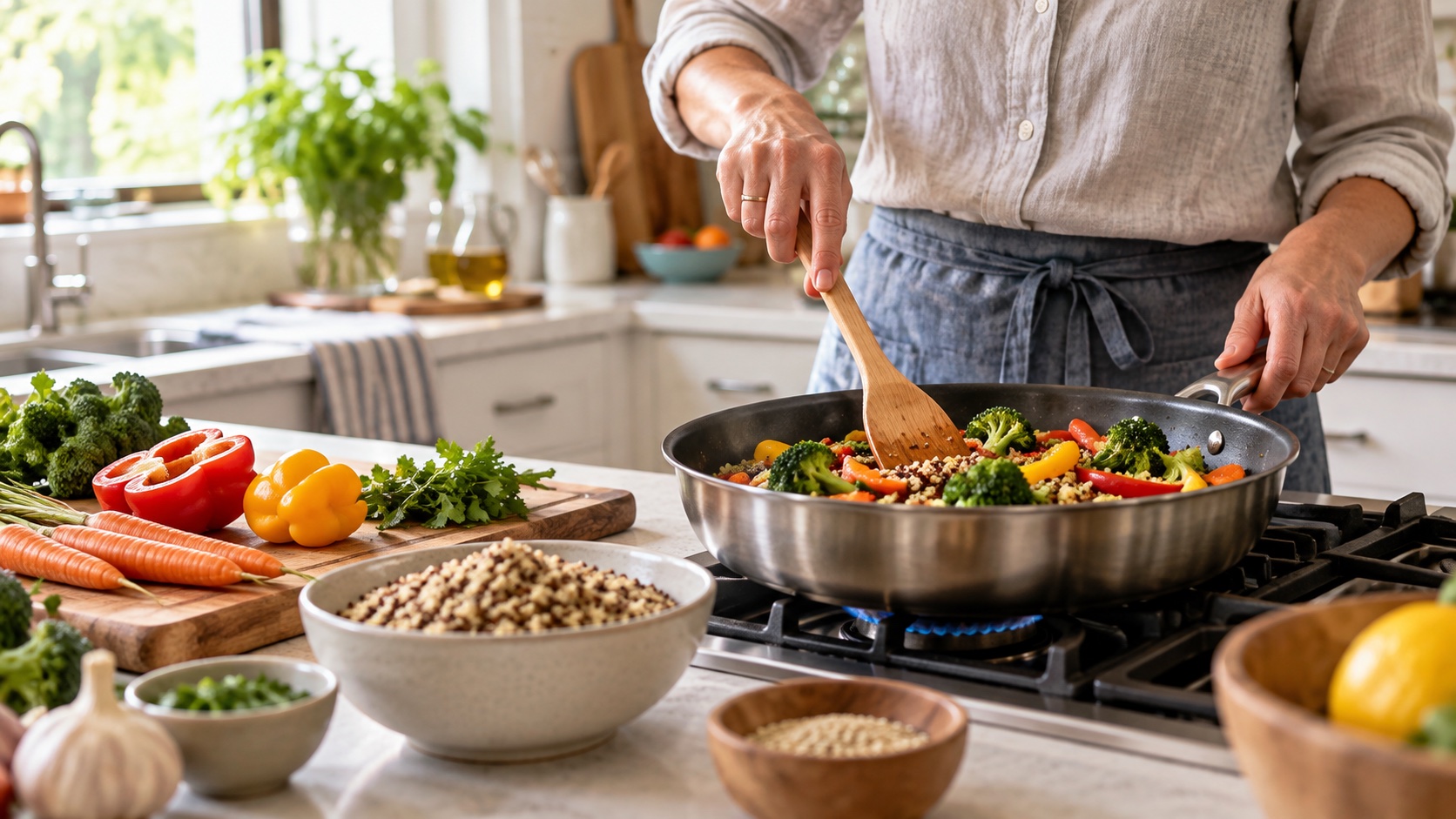
The same ingredients, cooked differently, carry wildly different AGE loads. The reference database assembled by Uribarri's group (J Am Diet Assoc, 2010) measured thousands of foods and found differences of up to a hundredfold between gentle and harsh preparations of the same item. The pattern is simple enough to internalize: dry heat, high temperature, and long cooking multiply AGEs; moisture, lower heat, and acid do the opposite.
The practical translation: prefer boiling, steaming, and poaching for everyday cooking; keep the sear as a treat rather than the default; and don't chase the perfect char. A second honest note belongs here — cooking-method habits track overall diet quality, so part of what these food studies measure is simply that people who boil vegetables also do other sensible things. Don't rank this above glucose control; it sits comfortably in second place.
What the Human Evidence Shows
- 🕸️ Tissue AGEs track the aging phenotype. Reviews of skin and tissue measurements find AGE accumulation rises with age and climbs faster in metabolic disease — association-level evidence, but consistent (Semba et al., J Gerontol A, 2010).
- 💓 In diabetes, skin AGEs predict outcomes. A Dutch study found skin autofluorescence — a noninvasive AGE proxy — was a strong predictor of cardiac mortality in people with diabetes (Meerwaldt et al., Diabetes Care, 2007). Note the context: the finding is about diabetes, not healthy aging.
- 🍳 One controlled trial moved the marker. A small trial in people with type 2 diabetes found a low-AGE diet improved insulin sensitivity relative to a standard diet matched for calories and nutrients (Uribarri et al., Diabetes Care, 2011).
- ❓ The missing experiment. No long-term trial has tested whether lowering AGEs in metabolically healthy people changes any hard outcome — and low-AGE diets change more than AGEs, so even positive trials can't isolate the mechanism.
The Honest Ledger for Longevity
- 🩸 Average glucose is the main lever. Endogenous formation scales with time × concentration; the glucose topic and the insulin-resistance topic own that machinery.
- 🍳 Cooking method is the real, smaller second lever. Moist heat, shorter times, acid marinades.
- 🧾 Don't buy AGE anxiety. The actionable test is HbA1c, not a skin reader — consumer AGE devices are research instruments in consumer clothing.
- 🔗 AGEs matter most where they were discovered: as a mechanism of diabetes complications. If your glucose is fine, this page is background knowledge, not an action item.
⚠️ If your HbA1c is elevated, this page is a footnote
The clinical story of AGEs is diabetic complications. Managing elevated glucose — with a clinician if needed — swamps every cooking rule on this page in importance. Skin autofluorescence devices marketed for "biological age" are not validated clinical tools for healthy people; treat their readings as entertainment until the evidence says otherwise.
A Week of Cooking, Worked
Take one salmon fillet and one potato. Poached, they sit near the bottom of the AGE tables. The same salmon pan-seared to a deep crust, the same potato roasted to golden-brown, carry many times the load — the crust you're admiring is glycation, made visible. A week of the gentler defaults looks like this: steel-cut oats instead of toasted granola; chicken marinated in lemon and yogurt before it meets the grill rather than charred plain; a Sunday stew instead of a Sunday roast; steamed greens with olive oil added after, rather than roasted in it. None of this requires abandoning the sear entirely — it means the sear becomes the occasion and the steam becomes the default. Run that default for a decade and the arithmetic compounds: modest per-meal differences, multiplied across thousands of meals, are how the food-side lever actually moves.
Questions, Answered Briefly
- 🔥 Does browned food age me? In a measurable chemical sense, a little — absorbed dietary AGEs add to your tissue pool. The effect size is small next to your average glucose. Don't burn everything; don't fear toast.
- 🩸 Is HbA1c an AGE? It's an early-stage glycation product — the same chemistry, caught before the irreversible cross-links form. That's why it reflects recent glucose rather than accumulated tissue damage.
- 🥩 Which cooking methods are worst? Dry, hot, and long: grilling, frying, and deep roasting. Boiling, steaming, poaching, and acid marinades keep AGE content low.
- 🧹 Can I "detox" AGEs? No mechanism with evidence does that. What clears the pool is forming fewer of them: lower average glucose and gentler cooking.
- 🩺 Should I get my AGEs measured? Some clinics offer skin-autofluorescence readings. For a metabolically healthy person the reading adds little beyond what HbA1c already tells you — the measurement is meaningful, but the decision it would change usually isn't.
The Bottom Line
- Glycation is real, well-mapped chemistry — sugar binds proteins irreversibly, and HbA1c is the same reaction caught early.
- Your own glucose is the main engine of AGE formation; diet contributes a smaller, partial share.
- Cooking method is the food lever you control — moist heat and acid marinades over dry heat and char.
- The actionable test is HbA1c, not an AGE gadget. If average glucose is high, that's the story; if it's fine, AGEs are background knowledge.
Related Topics
- Uribarri et al., "Dietary advanced glycation end products and their role in health and disease," Advances in Nutrition (2015)
- Uribarri et al., "Advanced glycation end products in foods and a practical guide to their reduction in the diet," Journal of the American Dietetic Association (2010)
- Uribarri et al., "Restriction of advanced glycation end products improves insulin resistance in human type 2 diabetes," Diabetes Care (2011)
- Koschinsky et al., "Orally absorbed reactive glycation products (glycotoxins): an environmental risk factor in diabetic nephropathy," PNAS (1997)
- Semba et al., "Does accumulation of advanced glycation end products contribute to the aging phenotype?" Journals of Gerontology Series A (2010)
- Meerwaldt et al., "Skin autofluorescence is a strong predictor of cardiac mortality in diabetes," Diabetes Care (2007)
- Monnier, "Nonenzymatic glycosylation, the Maillard reaction and the aging process," Journal of Gerontology (1990)