Sweeteners: The Honest Ledger
Non-caloric sweeteners sit at the center of one of nutrition's loudest arguments — and the loudest claims on both sides outrun the evidence. Aspartame, sucralose, stevia, and the rest are best understood not as health foods and not as poisons but as harm reduction: the honest question is what happens when they replace sugar. Here is the ledger, item by item.
What the evidence supports
- Randomized trials find that swapping sugar for sweeteners modestly reduces energy intake and body weight (Toews et al., BMJ, 2019).
- Safety assessments at typical intakes are reassuring: aspartame's acceptable daily intake sits far above real-world consumption, even after the 2023 review.
- The IARC classification of aspartame as "possibly carcinogenic" reflects limited evidence — the same category as radiofrequency fields and pickled vegetables.
What remains uncertain
- Long-term effects on weight, diabetes, and cardiovascular risk — cohort associations point both ways and cannot be read causally.
- Whether sweeteners change the microbiome in ways that matter metabolically — one striking 2022 study has not been replicated at scale.
- Whether they help or hinder long-term sugar reduction — plausibly both, depending on how they're used.
Evidence last reviewed: August 15, 2026. Conclusions may change as new research is published.
The Right Way to Frame This
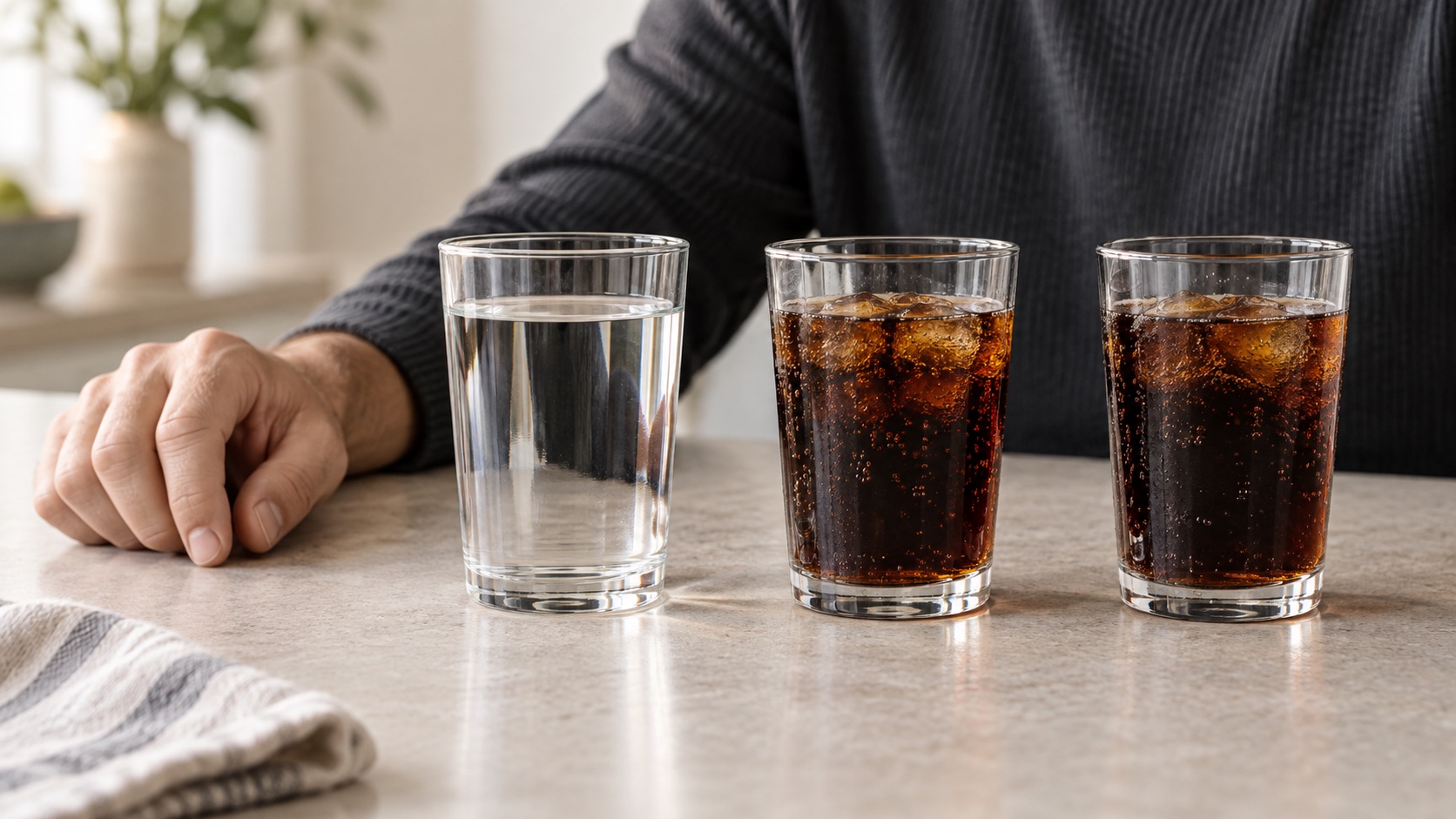
Sweeteners are not vitamins, and framing them as a health intervention is the original sin of this debate. The sensible frame is comparative: every verdict below is a verdict about a swap. Compared with sugar-sweetened drinks, sweetened drinks remove glucose spikes and calories, and the trial evidence says people who make that swap lose a little weight. Compared with water, they add nothing except the continued expectation of sweetness. Both comparisons are true at once, and most of the shouting online comes from people holding only one of them. The ledger below scores each molecule on the same three questions: what does the safety file say, what do trials measure, and what remains open.
The Ledger
| Sweetener | Sweetness vs sugar | Status & open questions | Verdict |
|---|---|---|---|
| 🍬 Aspartame | ~200× | ADI 40 mg/kg upheld by JECFA in 2023; IARC "possibly carcinogenic" (Group 2B) on limited evidence | Moderate |
| 🧂 Sucralose | ~600× | ADI 5 mg/kg (FDA); one 2022 study reported glucose-response changes in a subset of users — unreplicated | Moderate |
| 💊 Saccharin | ~300× | The oldest of the set; the 1970s rat bladder-cancer scare never translated to humans | Moderate |
| 🌿 Stevia (steviol glycosides) | ~200–300× | Plant-derived; glucose- and insulin-neutral in most trials; ADI 4 mg/kg steviol equivalents | Good |
| 🍯 Allulose | ~70% of sugar | Rare sugar, ~0.2–0.4 kcal/g, mostly unabsorbed; small trials show blunted post-meal glucose when it replaces sugar | Good |
| ❄️ Erythritol | ~70% of sugar | A 2023 study linked blood levels to cardiovascular events — heavily debated, since the body makes erythritol itself | Moderate |
Read the verdict column carefully: "Good" here means a quiet safety file at typical doses, not a recommendation to consume more. None of these molecules has long-term trial data on hard outcomes, and none of them is needed for health.
Aspartame's 2023 Moment
In July 2023 the International Agency for Research on Cancer classified aspartame as "possibly carcinogenic to humans" — Group 2B — while the joint FAO/WHO expert committee simultaneously reaffirmed the acceptable daily intake of 40 mg per kilogram of body weight (Riboli et al., Lancet Oncology, 2023). The two conclusions are not contradictory, and understanding both is the whole exercise. Group 2B means limited evidence in humans and less-than-convincing evidence in animals — a flag for more research, not a verdict. It is the category occupied by radiofrequency electromagnetic fields and pickled vegetables. Meanwhile the ADI math is the practical number: a 70kg adult's limit is 2,800 mg, a can of diet soda delivers roughly 180–200 mg, and typical consumers land at a tenth of the ADI or less. The reasonable summary: if aspartame carries a cancer risk at all, it is small, and it lives at doses almost nobody reaches — which is why most regulatory bodies changed nothing.
What the Trials Actually Show
The randomized evidence is boring in the best way. An umbrella review of trials and cohort studies found that in randomized settings, replacing sugar with sweeteners led to modestly lower energy intake and body weight, while the observational side showed the opposite associations — higher weight and diabetes risk among sweetener users (Toews et al., BMJ, 2019). The likely reconciliation is reverse causation: people who gain weight switch to diet drinks, which makes sweetener use look harmful in cohorts even when the trials say the swap itself helps. The trial literature on appetite agrees: low-energy sweeteners versus sugar reduce energy intake and weight rather than driving compensatory eating (Rogers et al., Int J Obesity, 2016), and a large European trial consortium has reported that a one-year switch from sugar to sweeteners produced greater weight loss in adults with overweight — the direction the short trials already pointed. One more trial detail worth knowing: in people who had already lost weight and habitually drank sweetened beverages, sweetened drinks outperformed water for keeping weight off over a year (Peters et al., Obesity, 2016) — evidence that the swap works best exactly where the habit is strongest.
The Two Worries That Deserve Respect
- 🦠 The microbiome question is open. A 2022 study gave healthy adults saccharin or sucralose for two weeks and found impaired glucose responses in a subset — and the effect transferred to mice via gut microbes (Suez et al., Cell, 2022). It was small, short, and has not been replicated at scale, but it upgraded the gut axis from theoretical to investigable.
- ❤️ The erythritol question is open too. A 2023 study found blood erythritol levels associated with cardiovascular events (Witkowski et al., Nature Medicine, 2023). The catch: humans synthesize erythritol endogenously, so high blood levels may reflect the body's own metabolism rather than intake — and later cohorts found much weaker links. Treat as an unresolved signal, not a verdict.
What the WHO Actually Said
The 2023 WHO guideline recommended against using non-sugar sweeteners for weight control or long-term disease-risk reduction — a conditional recommendation, which in guideline language means the certainty is low and reasonable people can reasonably differ. It was based on a commissioned review that found small short-term benefits in trials, no long-term benefit in cohorts, and no clear safety problem at typical intakes (Rios-Leyvraz & Montez, 2022). The guideline is frequently misquoted as "sweeteners are unsafe." What it says is closer to: don't expect them to fix your weight on their own, and don't treat them as a health intervention. That is also this page's conclusion — with one addition the WHO didn't emphasize: for the specific job of getting off sugar-sweetened drinks, a bridge is a bridge. The habit page covers how to use one without moving in permanently.
A Practical Policy
- 🥤 Bridge, don't migrate. Sweeteners earn their keep in the swap — sugary drink to sweetened drink, then eventually to water. The bridge should have an end, and the habit page has the exit plan.
- 💧 Water stays the null. Every sweetened drink is a choice, not a default — nobody needs sweeteners, which is the framing that keeps the ledger honest.
- 🧒 Kids' palates are still being set. Sweetness exposure shapes preference for life; less is more, and sweetened drinks have no place in a child's daily rotation.
- 🔄 Rotate molecules. Variety keeps any single-file risk — known or still unknown — small. The dose makes the poison, and rotation keeps every dose modest.
⚠️ Clinician territory
If sweeteners are part of how you manage diabetes, prediabetes, or weight, the WHO guideline is exactly the kind of judgment call to make with a clinician or dietitian rather than alone. Individual responses vary — the microbiome findings suggest some people may respond differently — and nothing on this page is medical advice.
Questions, Answered Briefly
- 🎗️ Does aspartame cause cancer? Current evidence shows a possible weak signal, not an established link; at typical intakes — a tenth of the ADI or less — regulatory bodies saw no reason to change the limit.
- 📈 Do sweeteners spike insulin? Most trials find glucose and insulin stay flat after sweetener intake; a few small studies report excursions. The question is unresolved, not settled either way.
- 🦠 Are they bad for the microbiome? One well-designed small study suggests individual responses exist; the field has not replicated it broadly. Honest status: open question.
- 🤔 Which should I pick? Rotate rather than megadose any single molecule; stevia and allulose currently have the quietest safety files. The dose makes the poison everywhere on this list.
- 🍧 What about "zero sugar" desserts? They swap the sugar but keep the ritual — fine occasionally, but they won't teach your palate that dessert is a treat rather than a right.
The Bottom Line
- Sweeteners are harm reduction, not health food — the right comparison is the sugar they replace, not water.
- Trials show the swap works modestly: lower energy intake, small weight benefits, no compensatory overeating.
- Safety at typical intakes looks reassuring — even aspartame's "possibly carcinogenic" label reflects limited evidence at doses almost nobody reaches.
- Two questions stay open: microbiome effects and long-term health — use sweeteners as a bridge, not a destination.
Related Topics
- Riboli et al., "Carcinogenicity of aspartame, methyleugenol, and isoeugenol," Lancet Oncology (2023)
- World Health Organization, "Use of non-sugar sweeteners: WHO guideline" (2023)
- Rios-Leyvraz & Montez, "Health effects of the use of non-sugar sweeteners: a systematic review and meta-analysis," WHO (2022)
- Toews et al., "Association between intake of non-sugar sweeteners and health outcomes: systematic review and meta-analyses of randomised and non-randomised controlled trials and observational studies," BMJ (2019)
- Suez et al., "Personalized microbiome-driven effects of non-nutritive sweeteners on human glucose tolerance," Cell (2022)
- Witkowski et al., "The artificial sweetener erythritol and cardiovascular event risk," Nature Medicine (2023)
- Rogers et al., "Does low-energy sweetener consumption affect energy intake and body weight? A systematic review, including meta-analyses, of the evidence from human and animal studies," International Journal of Obesity (2016)
- Peters et al., "The effects of water and non-nutritive sweetened beverages on weight loss and weight maintenance: a randomized clinical trial," Obesity (2016)