Fructose's Special Case
Fructose carries the same calories as glucose, tastes sweeter, and takes a completely different route through your body: it is metabolized almost entirely in the liver, a bit like a miniature dose of alcohol. That routing — not some toxin argument — is why concentrated fructose in soda, juice, and agave behaves differently from the sugar in whole fruit. Here is the biology, and what the controlled feeding studies actually measured.
What the evidence supports
- Tracer studies show fructose is nearly all cleared by the liver on first pass, while glucose is distributed to the whole body.
- Controlled feeding trials find that large fructose doses, at equal calories, raise triglycerides and liver fat more than glucose does.
- In whole fruit, fiber and the food matrix slow absorption and cap the dose — fruit intake associates with better metabolic health, not worse.
What remains uncertain
- Whether fructose at the modest doses inside a calorie-balanced mixed diet harms at all — most trials used 25% of calories.
- How much of the measured harm is the molecule itself versus simply the extra calories it delivers.
- Whether high-fructose corn syrup differs from table sugar in real diets — both are roughly half fructose.
Evidence last reviewed: August 15, 2026. Conclusions may change as new research is published.
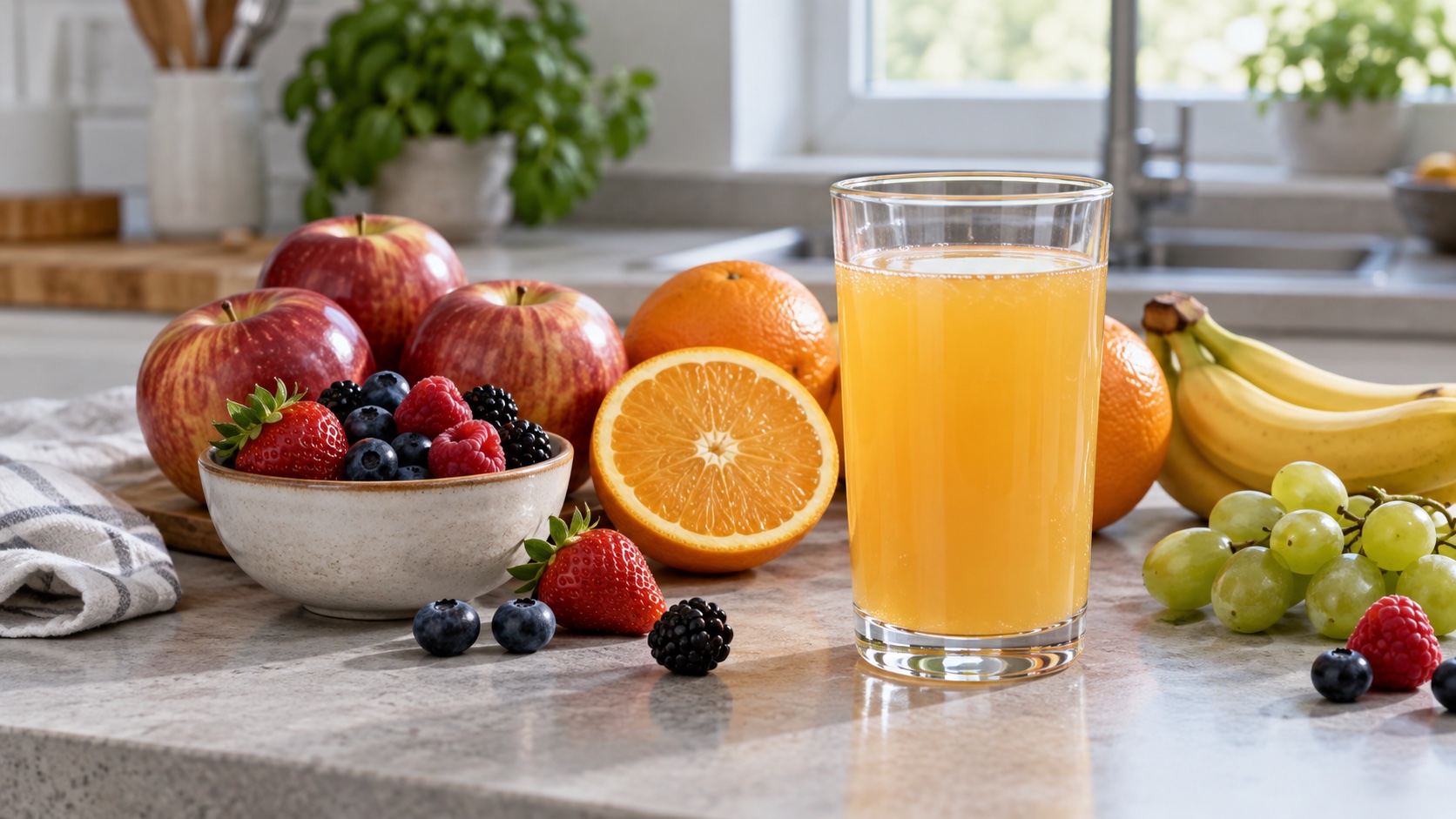
Same Atoms, Completely Different Routing
Glucose and fructose are isomers — the same six carbons arranged differently — and the body treats them like different substances. Glucose is a general-purpose fuel: nearly every cell can burn it, and insulin gates its entry into tissues, which is the system the glucose topic walks through in detail. Fructose takes a private road: the intestine absorbs it, and the liver extracts almost all of it on the first pass, before it ever reaches the general circulation in meaningful amounts. No insulin is needed for its metabolism, which sounds like an advantage until you notice what it means — there is no brake. The dose arrives at one organ, all at once, and the organ takes what it can and processes the rest on the spot. Glucose, by contrast, is diluted across a hundred trillion cells. That single routing difference explains most of what follows on this page.
The Assembly Line Has No Brake
- ⚡ The first step is unregulated. Fructokinase phosphorylates fructose as fast as it arrives, burning ATP with no feedback control — unlike glucose, whose entry into liver metabolism is throttled.
- 🧪 The byproduct is uric acid. Rapid ATP consumption degrades into uric acid, which rises measurably after a big fructose dose.
- 🏭 The overflow becomes fat. When the liver's storage pathways fill, excess fructose feeds de novo lipogenesis — new fat made in the liver, shipped out as triglycerides or parked in the liver itself.
- 🥃 The alcohol analogy is real, not rhetorical. Alcohol is also metabolized almost entirely in the liver with the same overflow-to-fat endpoint — a comparison the physiology literature itself makes (Johnson et al., Am J Clin Nutr, 2007). The difference is dose and speed: nobody sips soda at spirit concentrations.
What the Feeding Studies Show
The flagship experiment is the Davis group's ten-week trial: healthy overweight adults drank 25% of their calories as either fructose- or glucose-sweetened beverages, with matched diets and stable weight (Stanhope et al., J Clin Invest, 2009). Same calories, same weight, different molecule — and different outcomes. The fructose arm developed more visceral fat, higher fasting and post-meal triglycerides, and worse insulin sensitivity; the glucose arm did not show the same visceral-fat accumulation. A shorter study pushed the liver point further: nine days of a 25%-fructose weight-maintaining diet produced a sharp rise in liver fat in healthy young men (Schwarz et al., J Clin Endocrinol Metab, 2015). Both findings come with the same honest footnote: 25% of calories from any single sugar is far above how real people eat — roughly five times typical added-fructose intake. The trials prove the routing matters when the dose is abusive; they don't tell you what a moderate dose does.
Dose and Form Decide Everything
The fructose literature divides cleanly by dose. Reviews that survey feeding studies at realistic intakes conclude that moderate fructose, inside mixed meals, is handled without measurable harm — the liver's capacity covers it (Tappy & Lê, Physiol Rev, 2010). The damage appears when the dose outruns the capacity, which is what soda-sized doses do by design. Form then becomes the practical question. A medium apple delivers roughly 10 grams of fructose wrapped in fiber, water, and chewing time — a slow trickle the liver handles easily, and an amount nobody binges on. A 500ml soda delivers roughly 25 grams of fructose in the time it takes to finish the bottle. The fiber topic owns the absorption-slowing mechanism; the parent topic has the liquid-versus-solid framing. The one-sentence version: fructose is not the problem, concentrated fructose is — and the concentration is almost always in liquid form.
The Uric Acid Connection
One underrated consequence of fructose's unregulated first step is uric acid. The ATP burned during phosphorylation degrades to uric acid, so a large fructose dose raises blood urate within an hour — a metabolic side effect glucose doesn't share to the same degree. The clinical endpoint that made this famous is gout. In a prospective cohort of men, two or more sugary drinks a day was associated with roughly 85% higher risk of gout compared with less than one a month (Choi & Curhan, BMJ, 2008). Gout is the well-established piece; the broader claim — that fructose-driven uric acid also contributes to hypertension and kidney strain — is a serious hypothesis with mechanistic support but a contested evidence base, and the gout finding itself is about sugary drinks, not fruit. As ever, the clinical translation is narrow: people with gout get told to cut sugary drinks, and everyone else inherits the same advice at no extra cost.
The Practical Translation
| Form | Typical fructose dose | What the routing means | Verdict |
|---|---|---|---|
| 🍎 Whole fruit | ~5–15g per piece | Fiber and chewing slow absorption; the liver handles the trickle | Good |
| 🍯 Honey | ~8g per tablespoon | Roughly half fructose — sugar with a story, not a health food | Moderate |
| 🧃 Fruit juice | ~20g+ per glass | Concentrated fructose minus the fiber brake — soda with vitamins | Avoid |
| 🥤 Soda & sweetened drinks | ~25g+ per bottle | The exact dose range the feeding trials measured harm at | Avoid |
| 🌵 Agave syrup | ~10g per tablespoon, mostly fructose | One of the highest-fructose sweeteners sold — not a "natural" loophole | Avoid |
| 🍬 HFCS in processed foods | Variable, often large | Roughly half fructose, like table sugar — the label isn't the problem, the dose is | Moderate |
A Day of Fructose, Worked
Three people, one molecule, three livers. Person one eats an apple and a bowl of berries across the day — roughly 15 grams of fructose, delivered as a slow trickle wrapped in fiber and chewing time; the liver clears it without drama. Person two drinks a 250ml glass of orange juice at breakfast — about 20 grams of fructose in a single swallow-sized bolus, and the liver sees the whole dose at once. Person three drinks two bottles of soda across the afternoon — 50 grams or more, in repeated floods. The point of the exercise is that none of this is about fructose being a different molecule from one plate to the next; it's the same molecule at three different speeds. The literature's harm signals come from person three's day, repeated for years. Person one's day has no harm signal in the evidence at all. Form sets the dose, and the dose sets the story.
🍎 The fruit exception is real, not a loophole
Every time this topic comes up, someone asks whether fruit "counts." It doesn't — not because fruit sugar is different (it isn't) but because the dose and the delivery are. Nobody's fructose problem ever came from apples. If you had to pick one rule: liquids are the risk, solids are the food.
Questions, Answered Briefly
- 🌵 Is agave healthier than sugar? No. Agave syrup is among the highest-fructose sweeteners sold — at equal doses it stresses the same pathway more, not less.
- 🌽 Is high-fructose corn syrup worse than table sugar? Not meaningfully. HFCS-55 and sucrose are both roughly half fructose; the damage tracks total sugar, not the label.
- 🍯 Does honey count? Yes — roughly half fructose by weight, and its trace antioxidants don't change the routing. It's sugar with a story.
- 🧃 What about fruit juice? Concentrated fructose without the fiber brake. Treat it like soda with vitamins, not like fruit.
- 🍇 What about dried fruit? Raisins and dates concentrate fruit sugar several-fold and shed the water that makes fresh fruit filling — treat them as sweets with fiber, not as fruit.
The Bottom Line
- Fructose is metabolized almost entirely in the liver — no insulin gate, no brake, and overflow becomes fat.
- The feeding trials are real but high-dose — 25% of calories raised triglycerides and liver fat versus glucose at equal calories.
- Dose and form decide everything: whole fruit is a trickle the liver handles; soda and juice are the concentrated dose the trials harmed with.
- Agave is not a loophole, HFCS is not a special villain — both are roughly half fructose, and the risk tracks the dose, not the marketing.
Related Topics
- Tappy & Lê, "Metabolic effects of fructose and the worldwide increase in obesity," Physiological Reviews (2010)
- Stanhope et al., "Consuming fructose-sweetened, not glucose-sweetened, beverages increases visceral adiposity and lipids and decreases insulin sensitivity in overweight/obese humans," Journal of Clinical Investigation (2009)
- Schwarz et al., "Effect of a high-fructose weight-maintaining diet on lipogenesis and liver fat," Journal of Clinical Endocrinology & Metabolism (2015)
- Johnson et al., "Potential role of sugar (fructose) in the epidemic of hypertension, obesity and the metabolic syndrome, diabetes, kidney disease, and cardiovascular disease," American Journal of Clinical Nutrition (2007)
- Choi & Curhan, "Soft drinks, fructose consumption, and the risk of gout in men: prospective cohort study," BMJ (2008)