The Strength Standards
Every gym has a numbers table pinned somewhere: bench, squat, deadlift, with "untrained," "novice," "intermediate," "advanced" columns and a man reading them like a verdict. This page separates the standards that have real data behind them from the ones that do not, gives you reference values you can actually compare yourself against, and explains what "strong at 60" means — and does not mean.
What the evidence supports
- Grip strength has well-characterized reference values by age and sex from pooled dynamometer norms, and published cutoffs that flag low strength.
- Functional thresholds — chair-rise time and gait speed — predict falls, disability, and mortality in older cohorts, which is why clinicians measure them.
- Masters athletes who train continuously carry lean mass decades younger than their age-matched peers.
What remains uncertain
- Published tables for bench, squat, and deadlift by age come from self-selected gym populations — they describe who lifts, not what health requires.
- There is no evidence that hitting any barbell tier produces outcomes beyond what continuous training already produces.
- Percentile shifts from your own history matter more than any cross-sectional table, and the research cannot tell you your personal ceiling.
Evidence last reviewed: August 15, 2026. Conclusions may change as new research is published.
Product picks are generic categories, not brands. We may earn a commission on Amazon or iHerb purchases at no cost to you — this never changes our evidence conclusions. Full disclosure
Hand-grip dynamometer
Can track grip-strength performance over time when measured consistently.
⚠️ Readings can be affected by pain, arthritis, technique, and device variation; a result is not a diagnosis.
Check price on Amazon →Why Standards, and Why They Are Fuzzy
The honest thing about strength standards, said up front: the tables that circulate for bench, squat, and deadlift by age are not research findings. They are compilations built from gym-level records and self-reported training data — samples of men who lift, not of men in general. A "novice" squat of 1.0 times bodyweight describes what lifting novices typically manage after some months of training; it says nothing about what a man of sixty should be able to do, because the "should" population — everyone else his age — never appears in the data. This is not a reason to ignore standards; it is a reason to read them as orientation, not as a scoreboard. The standards that do carry research weight are the simple, equipment-light ones — grip, chair rise, gait — because large cohorts have been measured on them for decades, and because they predict real outcomes. The Exercise pillar calls them hidden vital signs, and that page owns their mortality story.
Grip: The Standard With Data
Grip strength is the single most measured human strength metric in existence, and its age-and-sex reference values are well mapped. The decade-to-decade pattern is consistent across cohorts: grip peaks in the thirties, drifts down through midlife, and declines more steeply after seventy — the same shape as the muscle curve traced on the sarcopenia page, but visible on a twenty-dollar instrument.
Two numbers anchor the chart. The mean values are approximate, pooled from published dynamometer reference data across North American and European cohorts (Bohannon et al., 2007, and the broader normative literature); different devices and populations shift them by a few kilograms. The cutoff is firmer: the revised European consensus on sarcopenia flags grip below 27 kilograms in men as low strength (Cruz-Jentoft et al., 2019). Falling below your decade's mean is normal variance; falling below 27 kg — or trending down year over year — is a signal worth acting on, and it is exactly the kind of trend the quarterly audit exists to catch.
The Big Three at Fifty-Plus
For barbell lifts, the reference values below are an editorial synthesis of the commonly published standards tables, expressed as multiples of bodyweight rather than absolute weight so they scale to the man. Treat them as coordinates, not grades: they describe the terrain of what continuous training produces at each level, and they are most honest when compared against your own history — your current multiple versus your multiple a year ago — rather than against another man.
| Lift | Recreational (1–2 years of consistent training) | Trained (several consistent years) | Advanced (long, deliberate training) |
|---|---|---|---|
| 🏋️ Squat | ≈ 1.0 × bodyweight | ≈ 1.25–1.5 × bodyweight | ≈ 1.75 × bodyweight and above |
| 🏋️ Bench press | ≈ 0.75 × bodyweight | ≈ 1.0–1.25 × bodyweight | ≈ 1.5 × bodyweight and above |
| 🏋️ Deadlift | ≈ 1.25 × bodyweight | ≈ 1.5–1.75 × bodyweight | ≈ 2.0 × bodyweight and above |
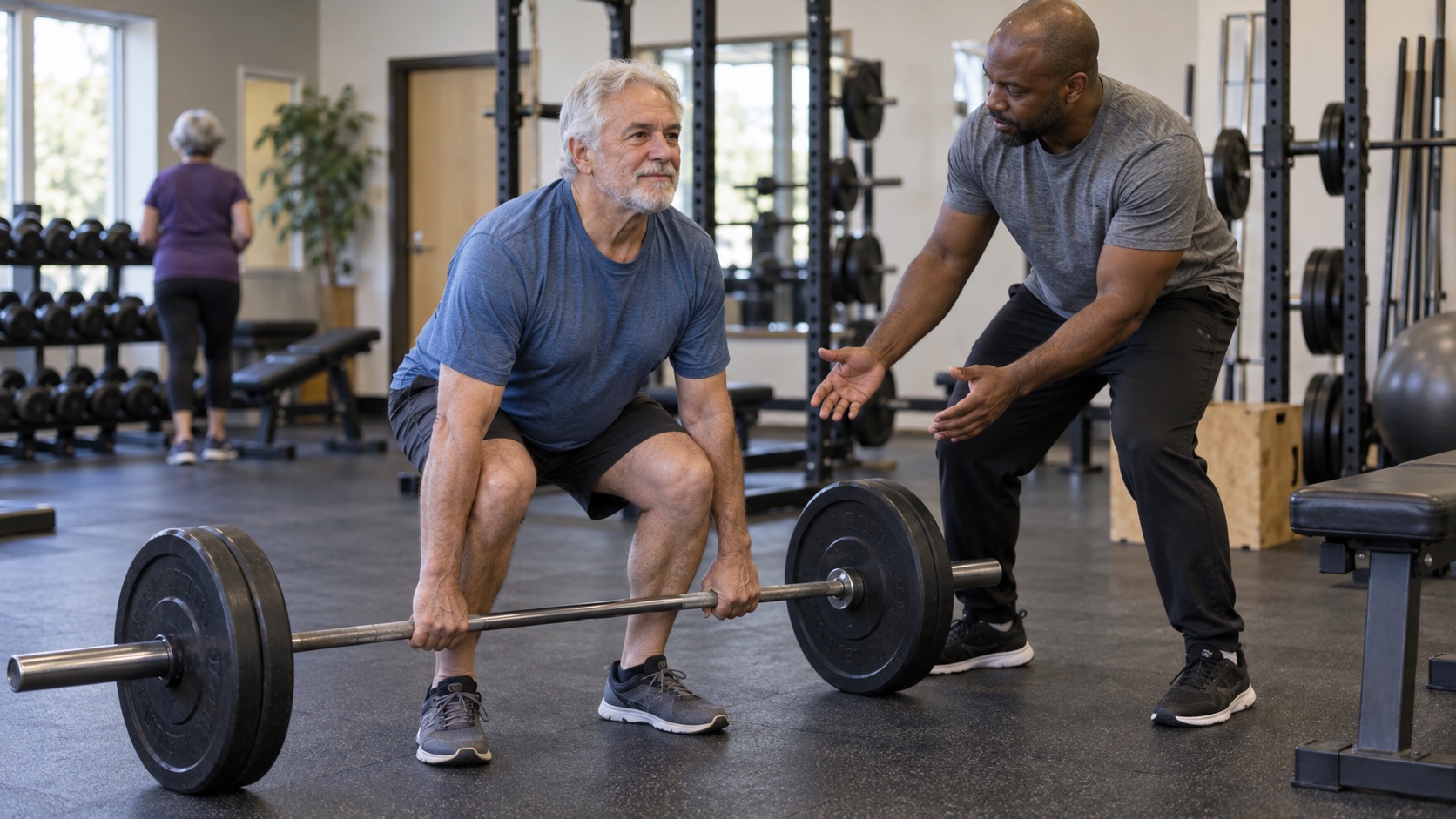
For an 80-kilogram man, that puts a recreational squat at roughly 80 kg and a trained one at 100–120 kg — numbers that are reachable, with patience, at any age this site covers. The honest caveats, in order: the tiers blur into one another, a man's training history matters more than his age in determining where he lands, and no study shows that crossing from "trained" into "advanced" buys longevity outcomes that continuous recreational lifting did not already buy. The resistance training protocol owns the how-to; this table only answers "where do I sit."
Reading a Standards Table Correctly
- 📊 Percentiles beat tiers. "Advanced" is a label; a percentile is a position. Most published tables map tiers to rough percentile bands — knowing you are in the top quarter of sixty-year-old lifters is more actionable than knowing a label.
- 🔁 Your own history is the reference standard. The most meaningful comparison is your current multiple against your multiple twelve months ago, because it measures the slope the sarcopenia page is about — and the slope is the thing you control.
- 🧭 Age-adjust honestly. A sixty-year-old at the recreational tier of a table built on young lifters is outperforming nearly all of his peers. Standards should be age-matched or they quietly shame people for being their age.
- ⚖️ Strength is not the sole output. The functional tests — grip, chair rise, gait — predict health outcomes in ways maximal lifts have not been shown to. Track both; they answer different questions.
- 🚫 One lift never tells the story. A big deadlift with a missing squat pattern is a hole in the plan, not a badge. The point of the big three is coverage, not a podium.
Strong at 60, Defined Functionally
If the site had to compress "strong at 60" into a single sentence, it would use the functional battery, because that is the definition with outcome data attached. A sixty-year-old man who can grip above 27 kg, rise from a chair five times in under 15 seconds without using his hands, and walk at more than 0.8 meters per second is, by the consensus criteria, not in the low-strength category that predicts disability and falls (Cruz-Jentoft et al., 2019). Notice what that definition leaves out: body fat percentage, bench press, visible muscle. Those are fine to care about, but they are aesthetics and ambition; the functional battery is the health-relevant floor. The stability pillar's Stability & Mobility topic adds the balance piece that turns this floor into fall protection.
⚠️ A low number is information, not a verdict
Reading a standards table and finding yourself below the band for your age is not a diagnosis — it is a description of your training history. Strength responds at every age this site covers, and the starting point only sets the slope of the first six months. If a number keeps falling across a year despite training, or grip drops sharply without explanation, that is a different conversation — one for a clinician, because unexplained strength loss can flag things that have nothing to do with the gym.
Questions, Answered Briefly
- 🏋️ I'm 62 and just starting. Which standard applies to me? None yet — a beginner is a beginner at any age. Run the functional battery as your baseline, then let the recreational tier be your twelve-month ambition, not your week-one expectation.
- 📏 Should I test one-rep maxes at 60? Most men over fifty are better served by estimated maxes from solid 3–5 rep sets — lower injury cost, same information for standards purposes. The injury-proofing page under the Exercise pillar explains the trade.
- ✊ My grip is below 27 kg. How worried should I be? It is a flag, not a sentence. Confirm it on a proper dynamometer with good technique, re-test in a few weeks, and add grip work — carries and hangs are enough. If it stays low, raise it with a clinician.
- 📉 My squat multiple is dropping even though I train. Why? First check the obvious: recovery, sleep, and consistency — the recovery math page covers the budget. If those are sound and the trend persists, a clinician conversation is warranted.
- 🏆 Is "advanced" a worthwhile goal at 60? As motivation, sure. As a health target, it is optional — the outcome data attach to continuous training and the functional floor, not to the top tier of a gym table.
The Bottom Line
- Standards come in two kinds — the functional ones (grip, chair rise, gait) carry research weight and outcome data; barbell tables are editorial orientation, not science.
- Strong at 60 has a measurable definition — above the 27 kg grip, 15-second chair-rise, and 0.8 m/s gait thresholds that flag low strength.
- The big three are coordinates, not grades — bodyweight multiples scale to the man, and your own year-over-year slope beats any cross-sectional table.
- Use tables as motivation, never as self-judgment — a low starting number describes training history, and strength responds at every age this site covers.
Related Topics
- Cruz-Jentoft AJ et al., "Sarcopenia: revised European consensus on definition and diagnosis" (EWGSOP2), Age and Ageing (2019)
- Bohannon RW et al., "Average grip strength: a meta-analysis of data obtained with a Jamar dynamometer from individuals 75 years or more," Journal of Geriatric Physical Therapy (2007)
- Wroblewski AP et al., "Chronic exercise preserves lean muscle mass in masters athletes," The Physician and Sportsmedicine (2011)
- Goodpaster BH et al., "The loss of skeletal muscle strength, mass, and quality in older adults: the health, aging and body composition study," Journals of Gerontology Series A (2006)
- Fiatarone MA et al., "High-intensity strength training in nonagenarians: effects on skeletal muscle," JAMA (1990)
- Srikanthan P, Karlamangla AS, "Muscle mass index as a predictor of longevity in older adults," The American Journal of Medicine (2014)