Muscle & Strength in Aging Men
Muscle is not a vanity metric — it is your glucose sink, your fall protection, and your reserve tank during illness. The honest trajectory of age-related muscle loss, the honest testosterone link, the training and protein numbers that interrupt the decline, and a starting plan for men over fifty.
What the evidence supports
- Muscle mass declines roughly three to eight percent per decade after thirty, with the slope steepening after sixty; strength and power fall faster than mass.
- Resistance training produces meaningful strength and mass gains even in the eighth and ninth decade — controlled trials in nonagenarians exist.
- Protein intake of roughly 1.6–2.2 g/kg/day maximizes lean-mass gains during training, per meta-analysis.
What remains uncertain
- Optimal protein distribution and timing beyond total daily intake.
- How much of sarcopenia's mortality signal is causal versus a marker of overall aging.
- Whether testosterone replacement alone builds meaningful muscle in men with normal testosterone — mostly, it does not.
Evidence last reviewed: August 13, 2026. Conclusions may change as new research is published.
Sarcopenia: The Quiet Unbuilding
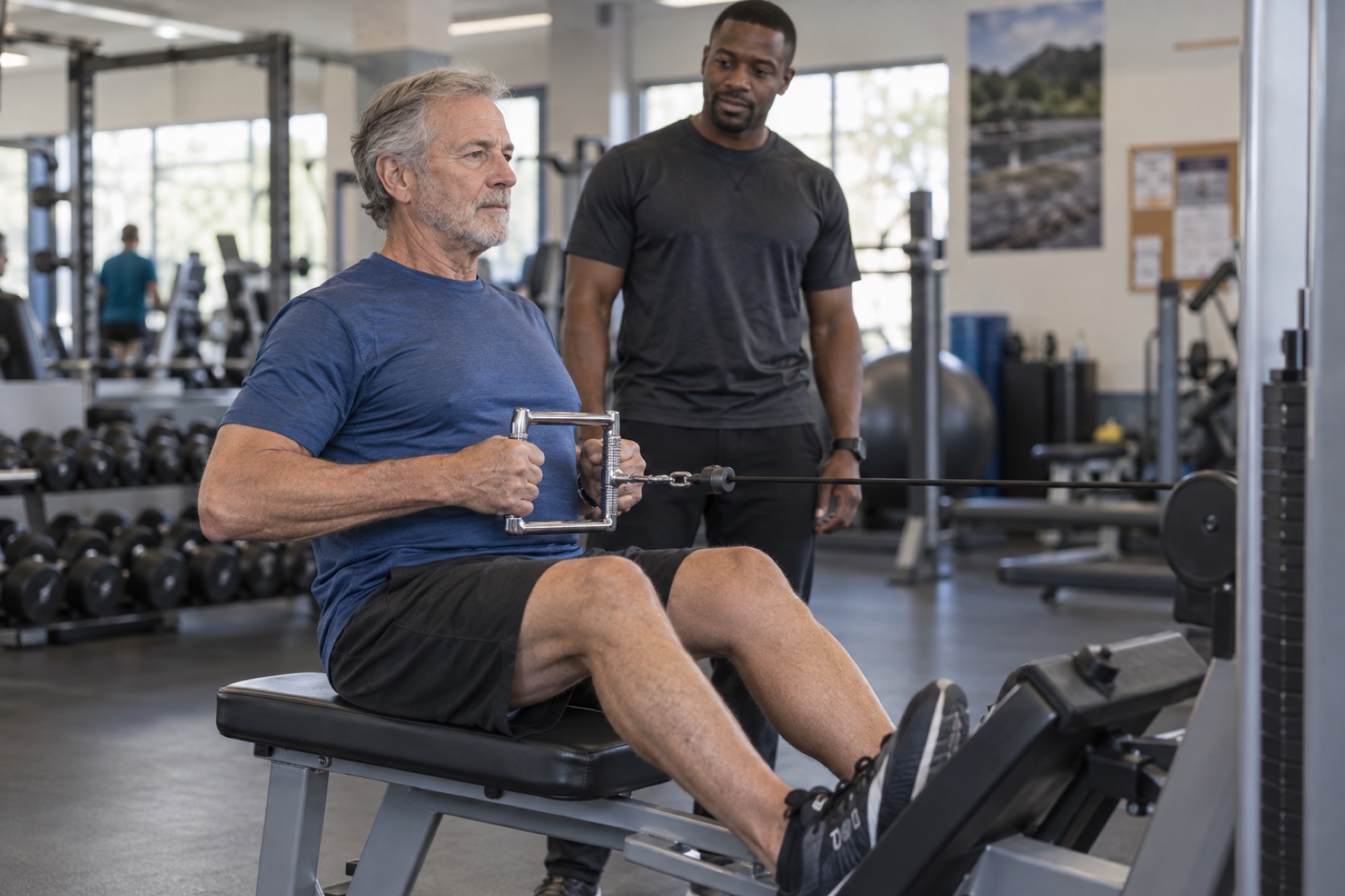
Skeletal muscle is the most plastic tissue you own — it is being dismantled or reinforced every day, and the balance shifts with age. After roughly thirty, the body starts losing three to eight percent of muscle mass per decade, and the slope steepens after sixty. Strength falls faster than mass, and power — force times speed — falls fastest of all, because the fast-twitch fibers that generate it are lost first. That ordering explains the signature of aging muscle: a man can look roughly the same and quietly lose his ability to catch a stumble or climb stairs two at a time.
The clinical name is sarcopenia — low muscle mass plus low strength and/or physical function, per the European consensus definition. But the label undersells what muscle is: simultaneously your glucose sink (the largest insulin-independent consumer of blood sugar in the body), your fall protection, and your reserve tank during illness. The average curve also hides enormous variance: some men lose almost none for decades, others lose steeply. That variance is the good news — it means the slope is modifiable.
Product picks are generic categories, not brands. We may earn a commission on Amazon or iHerb purchases at no cost to you — this never changes our evidence conclusions. Full disclosure
Hand-grip dynamometer
Can track grip-strength performance over time when measured consistently.
⚠️ Readings can be affected by pain, arthritis, technique, and device variation; a result is not a diagnosis.
Check price on Amazon →The Honest Testosterone–Muscle Link
Testosterone genuinely builds muscle — it drives muscle protein synthesis, and men who are clinically hypogonadal gain a few kilograms of lean mass on replacement therapy. Supraphysiologic doses build a lot more, which is exactly why they are pharmacology, not medicine. But the honest version of the TRT conversation belongs in the muscle chapter too: within physiologic replacement, gains without training are modest and slow — controlled trials measure kilograms over many months, not the physique changes some marketing implies. And in men with normal testosterone, TRT's muscle benefit is small to negligible. The lever that moves muscle at any testosterone level is mechanical loading. TRT may help you recover better and respond better to training; it will not lift the bar for you. The full accounting — numbers, risks, and who actually qualifies — lives in the Testosterone Decline & TRT topic.
The Resistance Protocol Handoff
The complete how-to lives in two places on this site, and this chapter defers to them: the resistance training protocol and the strength training after forty topic. The version this page stands behind, in one breath: two to three sessions per week, compound movements (a squat pattern, a hinge, a push, a pull, a carry), and progressive overload — adding a little load or a few reps whenever the current level stops being hard. Everything else in the fitness industry is decoration. For men over fifty, two additions matter more than any supplement: form over load (tendons and joints adapt slower than muscle), and recovery taken seriously (sleep is when the adaptation actually happens). Two more notes from the trial literature: gains arrive faster in the first months of training than at any point after, so the opening quarter is the highest-return investment available; and consistency beats intensity every time — men who train moderately for years build more than men who train "optimally" for eight weeks and quit.
The Protein Numbers
Training is the signal; protein is the material. The meta-analytic sweet spot for building muscle while training is roughly 1.6–2.2 grams of protein per kilogram of body weight per day — for an 80 kg man, that is about 130–175 grams daily. The Protein pillar topic has the full math and the food list. Aging adds a wrinkle: older muscle is anabolically resistant — it responds less to a given dose — which is why the higher end of the range, and spreading protein across three to four meals (roughly 25–40 grams each), matters more after fifty than it did at twenty-five. The blunt version: protein without training does very little for muscle, and training without adequate protein leaves gains on the table. They are one intervention with two halves.
The Functional Stakes
The stakes of muscle are not aesthetic. Grip strength — measured with a twenty-dollar dynamometer — is one of the strongest single predictors of all-cause mortality in aging cohorts, out-predicting blood pressure in some analyses, which is why the Exercise pillar treats it as a hidden vital sign. Then comes the fall chain: lost power means a slower catch step, which means a stumble becomes a fall, and a fall at seventy becomes a hip fracture, and a hip fracture is where independence goes to die — the strongest men in any cohort are the ones who get back up. And during illness, muscle is the reserve: hospitalized older adults draw down amino acids from muscle for weeks; those who arrive with more have more to spend. This is why sarcopenia is not a bodybuilding concern dressed up as geriatrics — it is the physical margin between a bad week and a bad year.
Measuring your own margin takes about ninety seconds, with tools cheaper than a month of gym membership:
- ✊ Grip: a hand dynamometer, one maximal squeeze per hand. Published norms by age and sex tell you exactly where you sit — falling below your age band is the classic early-warning sign.
- 🪑 Chair rises: time five full sit-to-stands from a chair without using your hands. Slowing across a year is a power signal, and power is the first thing aging takes.
- 🚶 Gait speed: time a comfortable four-meter walk. Speed below roughly a meter per second flags rising fall risk in older cohorts.
Any of the three trending down year over year is a reason to add training — not a reason to shrug and call it age.
🏋️ Can you actually build muscle at seventy? Eighty? Ninety?
Yes — the landmark evidence is from 1990 and has never been overturned. In a controlled trial of nursing-home residents aged eighty-six to ninety-six, ten weeks of high-intensity leg training roughly doubled leg strength, increased thigh muscle cross-sectional area, and improved walking speed. The adaptation machinery still works in the ninth decade; the ceiling is lower and the slope is still positive. The worst time to start is later than today.
The Over-50 Starting Plan
Deliberately boring, because boring works:
| Phase | Prescription | The point |
|---|---|---|
| Build the habit (first four to six weeks) | Full-body twice a week, machines or bodyweight, one to two sets of six to ten reps at a genuinely comfortable effort | Consistency and form before load — the habit is the intervention |
| Add load (months two to six) | Two to three sessions weekly; when the top of the rep range feels easy, add a small amount of weight | Progressive overload is the entire engine of adaptation |
| Keep it for decades (ongoing) | Keep lifting; add balance and fast movement — quick sit-to-stands, light power work — and protect recovery | Strength and power that still matter at eighty |
Two honest footnotes. First, if you have cardiovascular disease, uncontrolled blood pressure, or troublesome joints, clear the plan with a clinician — training is safe for nearly everyone, and the clearance conversation is how it stays that way. Second, start lighter than your ego suggests: the men who quit by week three are the ones who walked into week one hard. The men still training in year three are the ones who walked in easy.
The Bottom Line
- The trajectory is real but not destiny — muscle declines after your thirties and steeply later, and training interrupts it at any age.
- Lifting does the heavy lifting — testosterone helps at the margins; mechanical loading is the main lever.
- Eat for the work — protein toward the higher end of the evidence-backed range, spread across meals.
- Grip, gait, and rising from a chair are vital signs — track them like you track blood pressure.
Go Deeper: Subtopics
- 🔎 The male sarcopenia curve — testosterone's decline and the muscle loss timeline. Read it →
- 🔎 The strength standards — bench, squat, deadlift reference values by age: what "strong at 60" means. Read it →
- 🔎 The testosterone-training interaction — why lifting raises T modestly but meaningfully (links Testosterone topic). Read it →
- 🔎 The over-40 recovery math — volume, frequency, and the recovery budget shift. Read it →
- 🔎 Injury patterns in aging men — shoulders, lower back, and the prehab that prevents them (links Stability topic). Read it →
Related Topics
- Cruz-Jentoft AJ et al., "Sarcopenia: revised European consensus on definition and diagnosis" (EWGSOP2), Age and Ageing (2019)
- Mitchell WK et al., "Sarcopenia, dynapenia, and the impact of advancing age on human skeletal muscle size and strength," Frontiers in Physiology (2012)
- Goodpaster BH et al., "The loss of skeletal muscle strength, mass, and quality in older adults: the Health, Aging and Body Composition study," Journals of Gerontology A (2006)
- Fiatarone MA et al., "High-intensity strength training in nonagenarians: effects on skeletal muscle," JAMA (1990)
- Morton RW et al., "A systematic review, meta-analysis and meta-regression of the effect of protein supplementation on resistance training-induced gains in muscle mass and strength," British Journal of Sports Medicine (2018)
- Bohannon RW, "Grip strength: an indispensable biomarker for older adults," Clinical Interventions in Aging (2019)