The Testosterone-Training Interaction
A heavy squat session does raise testosterone — briefly, and more so in a twenty-five-year-old than in a sixty-year-old. This page measures that interaction from both directions: what training does to testosterone, and what testosterone does to training. The honest summary of a well-researched corner of exercise endocrinology: the lift is real, the spike is transient, and loading — not the hormone — is still the main lever.
What the evidence supports
- A heavy multi-joint lifting session raises testosterone acutely — on the order of twenty to thirty percent in young men — with levels back to baseline within roughly an hour.
- The acute response fades with age: the same session produces little or no rise in men in their sixties and beyond.
- Suppressing testosterone blunts the response to strength training, and adding testosterone to training in older men with low-normal levels adds little or nothing — loading does the work, hormones set the environment.
What remains uncertain
- Whether the transient post-workout spike meaningfully contributes to muscle growth, or is merely an echo of the training stimulus — the trials cannot cleanly separate the two.
- Whether long-term training raises resting testosterone at all — the studies point in both directions, and the effect is small either way.
- How much of the age-related blunting of the spike is hormonal aging versus the training history that usually travels with age.
Evidence last reviewed: August 15, 2026. Conclusions may change as new research is published.
The Acute Spike: Real, Brief, and Age-Dependent
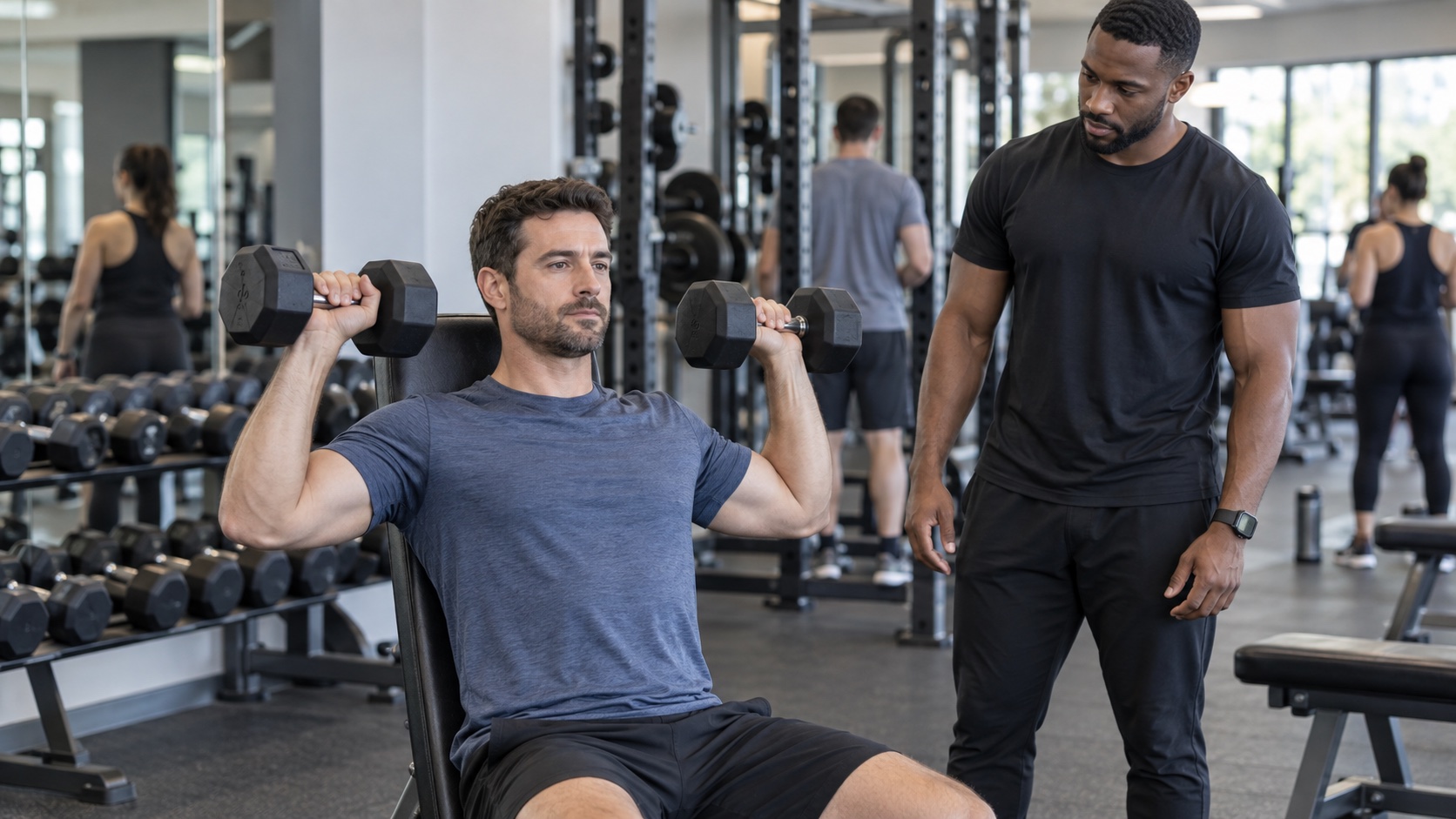
The acute effect is not in dispute. A session built from heavy, multi-joint movements — squats, deadlifts, presses — with large muscle mass, high loads, and short rests produces a measurable rise in circulating testosterone, peaking shortly after the session and returning to baseline within about an hour. The early controlled work put numbers on it: young men showed a clear post-session rise while elderly subjects did not (Craig et al., 1989), and the follow-up literature showed the same gradient in detail — large responses in the twenties, smaller in middle age, and small or absent responses in men in their sixties (Häkkinen & Pakarinen, 1995). The chart below is the pattern those studies describe; the numbers are approximate magnitudes, and the ordering is the finding.
The design features that drive the spike are worth knowing because they double as a description of effective training: heavy compound movements, high effort, moderate volume, short rest. The spike tracks the stimulus — a biceps-curl circuit does almost nothing to testosterone, while a hard squat session does, which is one more reason the compound-movement prescription on the Strength Training After 40 topic looks the way it does.
The Resting Question: Does Training Raise T?
The chronic question — does a year of lifting raise your resting testosterone — has a less satisfying answer. Across the training literature, resting testosterone after weeks or months of resistance training is mostly unchanged, with some studies in previously sedentary men showing modest rises and others showing nothing (Vingren et al., 2010). The honest read: if training moves resting testosterone at all, it moves it by single-digit percentages, small enough to be lost in the hour-to-hour and day-to-day noise that testosterone measurements carry. One well-established confounder complicates the story further: losing body fat raises testosterone, so a man who starts lifting, loses five kilograms, and sees his T rise has mostly experienced a fat-loss effect — real, welcome, and not what a "training raises T" headline would imply.
The Spike's Meaning: Probably Less Than It Sounds
The difficult question is whether the transient spike does anything for muscle. The spikes look impressive on a graph — a twenty-five percent surge — and the intuitive story writes itself: the hormone floods the muscle and drives growth. The evidence will not confirm that story. The spike is brief, its magnitude does not cleanly track long-term gains across studies, and the trials that suppressed testosterone during training (described below) blunted but did not eliminate the training response — suggesting the spike modulates the process rather than driving it. The mainstream reading in the field, summarized by the review literature (Vingren et al., 2010), treats the acute response as one of several signals in a coordinated anabolic environment, with muscle tension itself remaining the dominant input. This is exactly the kind of claim the sarcopenia page leans on when it says testosterone greases the slope but does not drive it.
The Reverse Direction: T Sets the Ceiling, Loading Sets the Floor
The more useful experiments run the causal arrow the other way. In young men given a drug that suppressed their endogenous testosterone, the same strength-training program produced smaller gains than in the placebo group — the hormone was permissive; remove it and loading works less well (Kvorning et al., 2006). Then the direct test in older men: sixty-one men aged sixty to seventy-eight with low-normal testosterone did twenty-four weeks of supervised strength training, half with testosterone gel and half with placebo. The training worked — and the added testosterone produced no meaningful extra strength or lean mass beyond the training alone (Kvorning et al., 2013). For contrast, the dose-response work in young men shows what testosterone can do when it is treated as a drug: at a 600 milligram weekly dose — many times replacement range — young men gained roughly eight kilograms of lean mass in twenty weeks without lifting a weight (Bhasin et al., 2001). That is pharmacology, not endocrinology.
| Layer of the interaction | What happens | Evidence read |
|---|---|---|
| Acute response, young men | Testosterone rises roughly 20–30% for about an hour after heavy multi-joint lifting | Consistent |
| Acute response, men in their 60s | The same session produces a small or absent rise | Consistent |
| Resting T after months of training | Small, inconsistent changes; some null studies, some modest rises in sedentary men | Mixed |
| Suppressed T during training (young men) | Strength gains continue but are blunted — T is permissive, not the driver | Single trial |
| Testosterone added to training, low-normal older men | No meaningful extra strength or mass beyond training alone | Single trial |
The synthesis that survives all three experiment types: within the physiologic range, loading does the work and testosterone sets the environment; only at pharmacologic doses does the hormone do the work on its own. Which is why the replacement-therapy conversation belongs exactly where the Testosterone Decline & TRT topic puts it — in a clinician's office, for men with symptoms and measured low levels — and not in a supplement store.
What This Means for Men Over 40
- 🏋️ Choose movements that produce the response. The sessions that spike testosterone — heavy squats, deadlifts, presses — are the same sessions that build the most muscle. The physiology and the prescription agree.
- 🧪 Do not chase T on a lab report as a training metric. A single testosterone reading is noisy, time-of-day dependent, and a poor judge of program quality. Judge the program on the bar and the logbook.
- 📉 Expect the spike to fade with age — and keep training anyway. The blunted acute response is normal endocrine aging, not a failure signal. The muscle-building response to loading survives it, as the older-lifter trials on the parent topic show.
- 😴 Protect the environment, not just the signal. Sleep, body fat, and protein are the support crew — the recovery math page and the Protein topic own those levers.
- ⚕️ Symptoms beat numbers. Persistent fatigue, lost libido, or mood changes with low measured testosterone are a clinician conversation — nothing on this page substitutes for it.
⚠️ Your T level is not a training scoreboard
Testosterone fluctuates hour to hour and day to day; one reading describes a moment, not a trajectory. Using it to grade your training — or self-treating a low number — is a category error. The evidence-based path: train hard, sleep, eat, retest on a clinician's schedule, and let symptoms rather than laboratory vanity drive any treatment conversation. Nothing on this site prescribes; the Testosterone Decline & TRT topic carries the clinical accounting.
Questions, Answered Briefly
- 📈 Does lifting raise my testosterone? Acutely, yes — transiently, for about an hour, and less so with age. Chronically, the resting change is small and inconsistent. If your T rises after a year of training, fat loss is often the main engine.
- 🧪 Should I test T before and after a workout? No — the exercise spike is a research measurement, not a health metric. For clinical purposes, testosterone is measured in the morning on a clinician's schedule, not around workouts.
- 💪 Does higher resting T mean more gains? Within the physiologic range, the training response does not scale cleanly with resting testosterone. The trials show training works across the range; the ceiling effect only appears at pharmacologic doses.
- 💊 Will TRT make my training work better? In genuinely hypogonadal men, restoration may support recovery and response; in men with normal-range levels, the muscle add-on is small to nil. That decision is clinician territory, end to end.
- 🔬 Why was my 25-year-old spike bigger? The gonadotropic response to exercise blunts with age — same session, smaller surge. It is normal endocrine aging, and it does not prevent muscle from responding to the training itself.
The Bottom Line
- Lifting raises testosterone modestly and briefly — a twenty-to-thirty percent spike for about an hour in young men, fading to near zero by the sixties.
- The resting effect is small and inconsistent — training is not a reliable way to raise your testosterone, and fat loss is the likelier explanation when it does rise.
- The causal arrow matters more the other way — testosterone is permissive: suppressing it blunts training gains, and adding it on top of training in low-normal older men adds little.
- Loading is the lever — the sessions that spike testosterone are the sessions that build muscle, and they work at any testosterone level in the physiologic range.
Related Topics
- Craig BW, Brown R, Everhart J, "Effects of progressive resistance training on growth hormone and testosterone levels in young and elderly subjects," Mechanisms of Ageing and Development (1989)
- Häkkinen K, Pakarinen A, "Acute hormonal responses to heavy resistance exercise in men and women at different ages," International Journal of Sports Medicine (1995)
- Kvorning T et al., "Suppression of endogenous testosterone production attenuates the response to strength training," American Journal of Physiology – Endocrinology and Metabolism (2006)
- Kvorning T et al., "Mechanical muscle function and lean body mass during supervised strength training and testosterone treatment in aging men with low-normal testosterone levels," Journal of the American Geriatrics Society (2013)
- Bhasin S et al., "Testosterone dose-response relationships in healthy young men," American Journal of Physiology – Endocrinology and Metabolism (2001)
- Vingren JL et al., "Testosterone physiology in resistance exercise and training: the up-stream regulatory elements," Sports Medicine (2010)