Kombucha's Real Contents
Kombucha is the drink most likely to have a halo and least likely to have a trial behind it. This page opens the bottle: what the fermentation actually leaves in there — live cultures, organic acids, polyphenols, trace alcohol, and usually more sugar than the label wants you to notice — and then sizes the human evidence honestly.
What the evidence supports
- The live culture is real: acetic acid bacteria and yeasts in a documented symbiosis (Jayabalan et al., Compr Rev Food Sci Food Saf, 2014).
- Tea polyphenols and organic acids survive the fermentation — the contents are genuine, not invented.
- One small randomized pilot in 12 adults with type 2 diabetes reported lower fasting glucose after four weeks of kombucha (Mendelson et al., Front Nutr, 2023).
What remains uncertain
- A systematic review found essentially no controlled human evidence for any kombucha health claim (Kapp & Sumner, Ann Epidemiol, 2019).
- Sugar content varies wildly between brands, and per-100-mL labeling hides the per-bottle total.
- Pasteurized, shelf-stable versions may contain no live cultures at all.
Evidence last reviewed: August 15, 2026. Conclusions may change as new research is published.
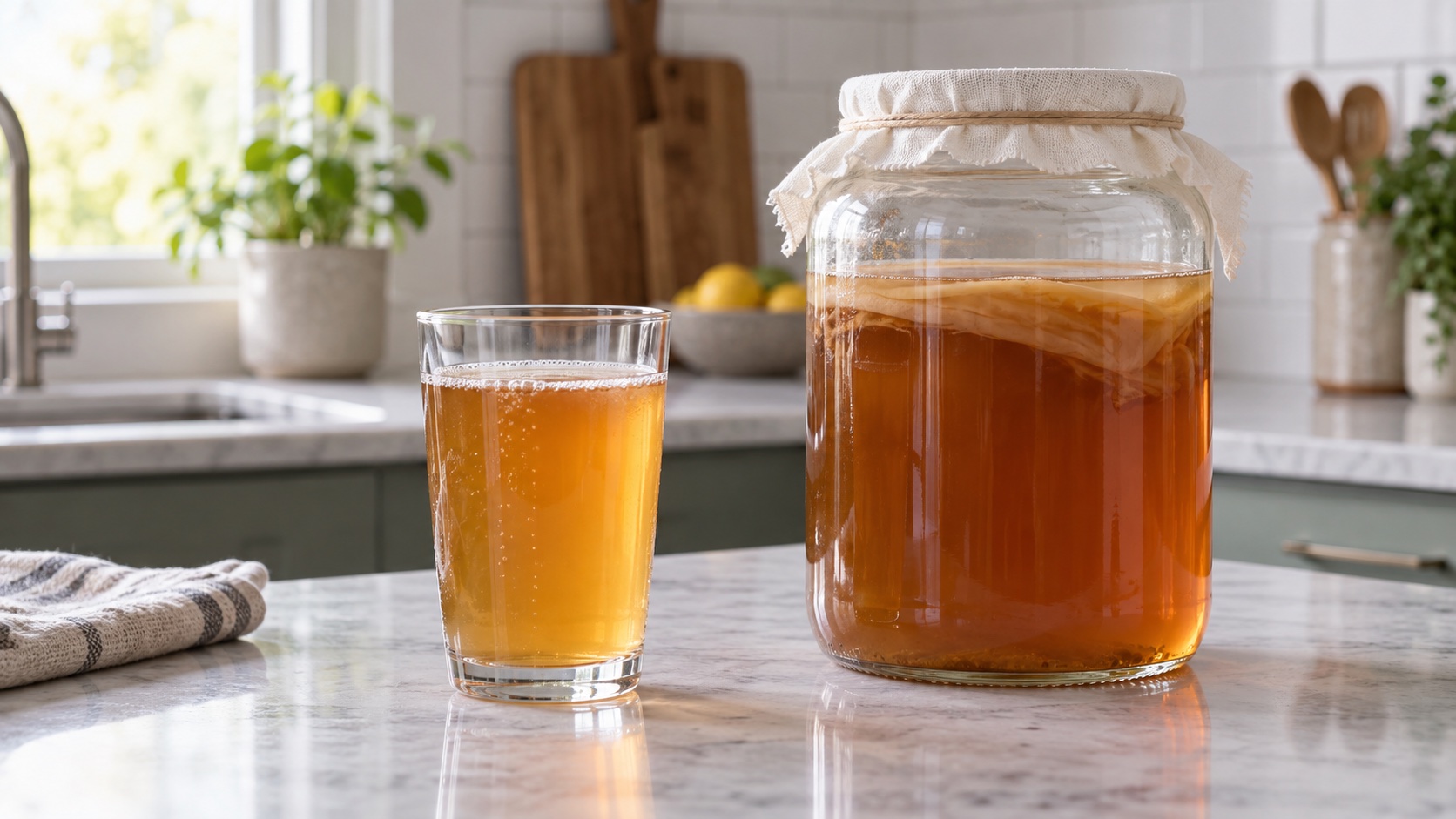
What Fermentation Leaves in the Bottle
Kombucha starts as sweetened tea — black or green — seeded with a SCOBY, the "symbiotic culture of bacteria and yeast." The yeasts split sucrose into glucose and fructose and ferment both into alcohol; the bacteria oxidize the alcohol into acetic acid. After a week or two you have a mildly alcoholic, mildly acidic, still-sweet tea with a living culture floating in it. The microbiology is well documented: acetic acid bacteria of the genera Komagataeibacter and Acetobacter, and yeasts including Brettanomyces, Saccharomyces, and Zygosaccharomyces species (Jayabalan et al., 2014). Here is the honest inventory of a cup.
| Component | Typical content | The honest read |
|---|---|---|
| 🦠 Live cultures | Acetic acid bacteria and yeasts — if unpasteurized | Real |
| 🍋 Organic acids | Acetic and gluconic acids, small amounts of others | Real |
| 🍃 Tea polyphenols | Catechins partly survive fermentation | Real |
| 🍬 Residual sugar | Depends on the batch; commercial brands often re-sweeten | Varies |
| 🍺 Trace alcohol | Typically 0.5% or more by volume | Watch |
Two of those rows carry the page's whole lesson. The cultures and polyphenols are genuine — kombucha is not a scam product. But "real ingredients" is a description of a food, not a demonstration of a health effect, and the sugar and alcohol rows are where the marketing quietly looks away.
Product picks are generic categories, not brands. We may earn a commission on Amazon or iHerb purchases at no cost to you — this never changes our evidence conclusions. Full disclosure
Refrigerated live fermented vegetables or kombucha
Can support a food-based fermented-food practice when the article specifically calls for a live refrigerated product.
⚠️ Kimchi and sauerkraut can be sodium-dense; raw kombucha can contain alcohol and added sugar can be substantial.
Grocery item — availability varies by region.
Check price on Amazon →The Human Evidence, Sized Honestly
The most useful paper ever written about kombucha is the one that found almost nothing. Kapp and Sumner ran a systematic review of the empirical evidence for human health benefits and concluded, in the Annals of Epidemiology (2019), that there was essentially no controlled human research to support any of the popular claims. Decades of lab studies — antioxidant activity, antimicrobial effects in cell culture, rat experiments — and nearly no humans. That asymmetry is the kombucha story in one sentence.
Since then, one pilot has nudged the file forward. Mendelson and colleagues randomized 12 adults with type 2 diabetes to four weeks of kombucha or a control drink and reported lower fasting blood glucose in the kombucha group (Frontiers in Nutrition, 2023). It is a real, preregistered finding — and it is 12 people for one month. The appropriate reaction is mild interest, not a changed shopping list. For the metabolic side of that question, the insulin-resistance topic owns the evidence that actually matters.
The Sugar Problem in One Cup
Here is the part the bottle hopes you skip. The SCOBY eats sucrose, but a standard fermentation does not run dry: the starter tea begins near 50 g of sugar per liter, and a typical week-long brew still holds a meaningful share of it. Commercial brands then complicate the picture, because tart kombucha is a hard sell — many re-sweeten after fermentation with fruit juice or sugar, and the label typically reports sugar per 100 mL, which makes a 450 mL bottle look like a thimble. The parent topic's ranking flags the same trap: plenty of kombuchas carry 10 g or more per bottle, soda-adjacent territory wearing a health halo. The sugar audit page works the label math in full.
The Sugar Clock
Trace Alcohol and the Refrigeration Rule
- 🍺 It is mildly alcoholic by nature. Fermentation produces alcohol before the bacteria convert it to acid; most kombuchas land near 0.5%, some batches higher. Above that line it is legally an alcoholic beverage — and a few brands are.
- 🧊 Refrigeration is the live-culture signal. A kombucha that sits warm on a shelf has been pasteurized to stop fermentation — the microbes are gone unless the label says cultures were added back.
- 🏠 Home brewing deserves respect. A badly managed home SCOBY can grow mold or unwanted microbes; if you brew your own, follow a tested recipe and discard anything fuzzy.
- 🦷 It is acidic. Acetic acid is the point of the drink, but sipping it all day bathes enamel in acid — a glass with a meal is friendlier than a constant drip.
How to Read a Kombucha Label
- 🧊 Unpasteurized is the point. If it is shelf-stable at room temperature, the culture has been killed — "raw" and refrigerated are the live signals.
- 🍬 Multiply the sugar line. Take the grams per serving and multiply by servings per bottle before deciding — the sugar audit is the whole toolkit for this row.
- 🍺 Check the alcohol fine print. Above 0.5% it is legally an alcoholic beverage; if that matters to you, the label tells you — small print, but it is there.
- 🍃 Tea early in the ingredients means a real tea base. If juice concentrates and flavorings crowd out the tea, you are buying a dressed-up soft drink.
- 🍋 Shorter, tart batches are lower in sugar. Longer fermentation eats more sucrose, which is why the driest kombuchas taste most like vinegar — the taste is the tell.
Questions, Answered Briefly
- 🦠 Does kombucha have more probiotics than kefir? Different microbes, not more: acetic-acid bacteria and yeasts versus dairy lactic-acid cultures. Kefir holds the trial record; kombucha holds the hype.
- 🫧 Does the fizz matter? Only as a pleasure. Carbonation is a byproduct of the fermentation, not a measure of anything healthful.
- 🍬 Can kombucha help bloating? There is no controlled evidence for symptom claims of any kind — which is precisely what the systematic review concluded.
- 👶 Is it fine for kids? Check the sugar and the trace alcohol first; many brands sit above a soft drink's sugar and at beer-adjacent alcohol lines. It is not a children's health drink by default.
- 🏠 Is homebrew safe? With a tested recipe and clean vessels, yes — and keeping the brew below pH 4.2 is the standard safety line. Anything moldy or fuzzy gets discarded, no exceptions.
- 🍵 Which tea base is best? Green and black bases both work and differ in polyphenol profile; the studies do not crown one. Pick the taste you will actually drink.
Where Kombucha Fits
The honest verdict, in one paragraph: kombucha is a legitimate fermented food with a real culture and real polyphenols, sitting inside a category whose health claims outrun its trials by a wide margin. If you like it, an unsweetened, refrigerated bottle is a reasonable upgrade over soda — the live culture is a small genuine difference, and the fiber and fermented foods topic puts it in the wider food context. What it is not is a treatment for anything, and no amount of "probiotic" branding changes the sugar row in the table above.
🫧 Tea vinegar with better branding
Strip the label and you are drinking dilute acetic acid, tea polyphenols, and the sugar the culture did not finish — a pleasant, slightly vinegary soda. That is not nothing: it is a real food with a live culture. It is also not medicine, and the difference is the entire honest verdict on this bottle.
The Bottom Line
- The contents are real — live acetic-acid bacteria and yeasts, tea polyphenols, and organic acids — but "real ingredients" describes a food, not a health effect.
- The human evidence is nearly empty: a systematic review found essentially no controlled trials, and the one pilot since enrolled 12 people.
- The sugar row is the trap: per-100-mL labels hide 10 g or more per bottle, and re-sweetened commercial batches are common.
- Buy it for taste, not therapy — unsweetened, refrigerated kombucha is a fine soda upgrade; pasteurized or sugared, it is just a soft drink.
Related Topics
- Jayabalan et al., "A Review on Kombucha Tea — Microbiology, Composition, Fermentation, Beneficial Effects, Toxicity, and Tea Fungus," Comprehensive Reviews in Food Science and Food Safety (2014)
- Kapp & Sumner, "Kombucha: a systematic review of the empirical evidence of human health benefit," Annals of Epidemiology (2019)
- Mendelson et al., "Kombucha tea as an anti-hyperglycemic agent in humans with diabetes — a randomized controlled pilot investigation," Frontiers in Nutrition (2023)
- Gaggìa et al., "Kombucha Beverage from Green, Black and Rooibos Teas: A Comparative Study Looking at Microbiology, Chemistry and Antioxidant Activity," Nutrients (2019)
- Dimidi et al., "Fermented Foods: Definitions and Characteristics, Impact on the Gut Microbiota and Effects on Gastrointestinal Health and Disease," Nutrients (2019)