Green Tea & Coffee as Prebiotics
Coffee and green tea are usually filed under antioxidants. The more interesting gut story is what happens after you swallow: most of their polyphenols sail through the small intestine untouched and become dinner for colon bacteria. This page walks the fermentation evidence for both drinks — including the trial that found nothing — and why your daily cup helps your microbiome without being its main course.
What the evidence supports
- Roughly 90–95% of dietary polyphenols reach the colon unabsorbed, where gut bacteria convert them (Manach et al., Am J Clin Nutr, 2004).
- Coffee raised Bifidobacterium counts in a controlled human study of three cups a day (Jaquet et al., Int J Food Microbiol, 2009).
- Green tea liquid shifted the oral and gut microbiome in a small controlled trial (Yuan et al., Mol Nutr Food Res, 2018).
What remains uncertain
- A 12-week trial of green tea catechins in capsules found no significant microbiome change (Janssens et al., PLoS One, 2016) — dose and form matter.
- The shifts are small and their clinical meaning is unclear; a Bifidobacterium bump is not a health outcome.
- Observational links between coffee intake and microbial composition cannot separate the drink from the drinker.
Evidence last reviewed: August 15, 2026. Conclusions may change as new research is published.
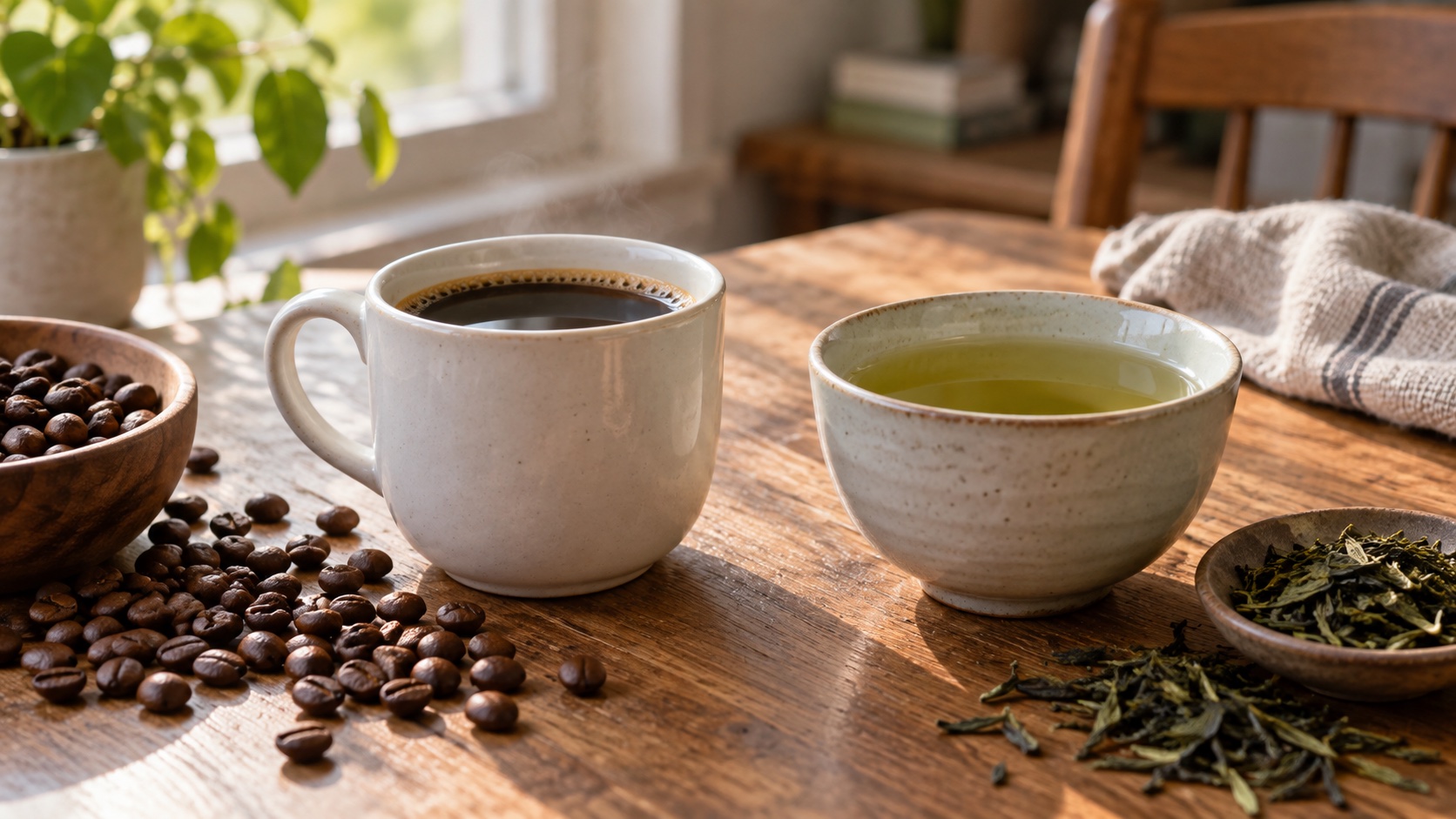
Polyphenols Are Food for Bacteria
The prebiotic story of tea and coffee starts with a number that surprises most people: only a small share of the polyphenols you drink are absorbed in the small intestine. The classic bioavailability review by Manach and colleagues (American Journal of Clinical Nutrition, 2004) puts it at 90–95% reaching the colon, where the resident bacteria get to work — stripping sugars, opening rings, and converting large polyphenols into smaller phenolic acids and short-chain fatty acids. Catechins become valerolactones and hydroxyphenylacetic acids; chlorogenic acid becomes caffeic acid. Those metabolites, not the parent compounds, are what then circulates in the body. That is prebiotic activity in the technical sense: a food component that feeds beneficial microbes and yields metabolites the host can use. The matcha topic owns the polyphenol dose data in detail; this page is about what those compounds do after they leave your stomach.
Product picks are generic categories, not brands. We may earn a commission on Amazon or iHerb purchases at no cost to you — this never changes our evidence conclusions. Full disclosure
Matcha powder
Makes an unsweetened matcha routine convenient for people who enjoy and tolerate caffeine.
⚠️ Caffeine can worsen insomnia, anxiety, palpitations, reflux, or medication-related concerns; timing and total intake matter.
Check price on Amazon →Green Tea: A Mixed Trial Record
The positive result: Yuan and colleagues gave healthy volunteers green tea liquid daily and sequenced their microbiomes, reporting shifts in gut and oral communities including higher Bifidobacterium abundance (Molecular Nutrition & Food Research, 2018). The negative result matters just as much: Janssens and colleagues ran a 12-week randomized trial of green tea catechins delivered as capsules — a cleaner, more standardized dose than any cup — and found no significant change in gut microbiota versus placebo (PLoS One, 2016).
Read the two together and the lesson is useful. The food form, with its full polyphenol profile and fermentation context, may matter more than the isolated compound; and the effects, when they appear, are modest. Green tea is a gentle, daily nudge to the microbiome, not a renovation. If you want the renovation, the fiber and fermented foods topic is where the evidence actually lives.
Coffee: The Chlorogenic-Acid Machine
Coffee's polyphenol load is dominated by chlorogenic acids — anywhere from 70 to 350 mg per cup depending on bean and roast (Clifford, J Sci Food Agric, 1999). They arrive in the colon largely intact, where gut bacteria convert them into caffeic acid and other metabolites, a pathway demonstrated with human fecal samples in the lab (Gniechwitz et al., J Agric Food Chem, 2007). The human data follow the mechanism: in a controlled study, three cups of coffee a day for three weeks raised Bifidobacterium counts in healthy volunteers (Jaquet et al., Int J Food Microbiol, 2009), and a Spanish cohort study found coffee intake associated with measurable differences in fecal microbial composition (González et al., Nutrients, 2020). Decaf carries most of the same chlorogenic acids, so this is not purely a caffeine effect — though caffeine brings its own dose rules from the hormetic drinks topic.
The Human Evidence at a Glance
| Study | Design | Finding | Verdict |
|---|---|---|---|
| 🍵 Yuan et al., 2018 | Green tea liquid, small controlled trial | Shifted gut and oral communities; Bifidobacterium rose | Positive |
| 🍵 Janssens et al., 2016 | 12-week catechin capsules, randomized | No significant microbiome change | No change |
| ☕ Jaquet et al., 2009 | 3 cups coffee daily, 3 weeks, controlled | Bifidobacterium counts rose | Positive |
| ☕ González et al., 2020 | Observational cohort | Coffee intake associated with fecal composition differences | Observational |
The pattern across the table is the honest verdict: direction consistent, magnitude small, mechanism plausible. Nobody should expect a cup of green tea to do the work of a bowl of lentils — the superfoods topic shows where the large, reproducible microbiome effects actually come from.
Plain brewed green tea
A beverage option for people who enjoy tea and tolerate caffeine.
⚠️ Caffeine timing and tolerance matter; avoid conflating brewed tea with concentrated green-tea extracts, which have different safety considerations.
Check price on Amazon →What Each Cup Delivers
Also on the Menu: Black Tea and Cocoa
The same fermentation logic extends to the rest of the polyphenol family. Black tea's theaflavins and thearubigins — formed when the leaves oxidize — reach the colon and meet the same microbial conversion machinery, and cocoa flavanols are among the more-studied polyphenols in human microbiome work. The direct microbiome evidence for these is thinner than for green tea and coffee, but the direction is consistent: the darker and more polyphenol-dense the cup, the more material lands in the colon for the resident bacteria to work with. None of this changes the page's main point — these are supporting actors, and the fiber story is the lead.
Modest, Real, and Secondary to Fiber
Sizing this evidence correctly requires one sentence of discipline: tea and coffee are a supporting act for the gut microbiome, not the headline. The Bifidobacterium bumps in the human studies are real but small, the negative capsule trial is a standing reminder that the effect is fragile, and nothing in this literature approaches the scale of what dietary fiber does — the fiber topic documents that gap in detail. The right mental model is a drip, not a flood: small daily doses of polyphenols converted by your resident bacteria, day after day, for years. In a diet that already carries fiber and fermented foods, your morning cup is a free supplement to that system — and in a diet without them, no amount of green tea closes the gap.
Steeping Rules That Preserve the Goods
- 🍬 Sugar undoes the framing. A sweetened bottled tea is a different beverage; the polyphenols survive, but the sugar audit math applies. Unsweetened is the operative word.
- 🍃 Matcha concentrates the dose. Whole-leaf powder delivers several times the catechins of a steeped cup — the matcha topic owns the numbers and the hormetic framing.
- 🌡️ Steep time is a trade. Longer, hotter steeps extract more polyphenols — and more bitterness and caffeine. Three to five minutes is a reasonable middle.
- ☕ Decaf keeps the polyphenols. Chlorogenic acids survive decaffeination, so the gut story holds even when the caffeine curfew kicks in.
- 🧾 Food form beat capsule form in the trials. The evidence, thin as it is, favors the actual cup over extracts — another reason to skip the catechins aisle.
Questions, Answered Briefly
- ☕ Does decaf keep the gut benefit? Mostly — chlorogenic acids survive decaffeination, so the polyphenol story holds even when the caffeine curfew kicks in.
- ☕ What about instant coffee? Instant retains chlorogenic acids at somewhat lower levels than brewed, but the food form is still the food form. The trial evidence does not crown a brewing method.
- 🍵 How much should I drink for the gut effect? No established dose exists; the controlled coffee study used three cups daily. Let the caffeine rules from the hormetic drinks topic set your ceiling, not this page.
- 🍵 Is green tea better than coffee for the microbiome? They carry different polyphenols and similarly modest signals — there is no winner in the data. Drink the one you like, unsweetened.
- 💊 Are catechin supplements a shortcut? The one clean randomized capsule trial found nothing. The cup beat the capsule; skip the aisle.
☕ Your morning cup is a prebiotic drip
A small, daily, decades-long supply of polyphenols that your colon bacteria convert into metabolites — that is the honest version of "coffee is good for your gut." It is a real effect with a real mechanism. It is also modest, easily canceled by sugar, and no substitute for the fiber that does the heavy lifting. Enjoy the cup; do not promote it to medicine.
The Bottom Line
- Polyphenols are prebiotic by default: 90–95% of the ones in tea and coffee reach colon bacteria, which convert them into smaller active metabolites.
- The human evidence is consistent but small — coffee raised Bifidobacterium in a controlled trial, green tea liquid shifted communities, and a capsule trial found nothing.
- Form matters: the cup outperformed the extract in the trial record, so drink the tea, skip the catechins aisle.
- Keep it unsweetened and keep it secondary — a supporting drip for a microbiome that is fed mainly by fiber, never a replacement for it.
Related Topics
- Manach, Scalbert, Morand, Rémésy & Jiménez, "Polyphenols: food sources and bioavailability," American Journal of Clinical Nutrition (2004)
- Jaquet, Rochat, Moulin, Cavin & Bibiloni, "Impact of coffee consumption on the gut microbiota: a human volunteer study," International Journal of Food Microbiology (2009)
- Yuan et al., "Green Tea Liquid Consumption Alters the Human Intestinal and Oral Microbiome," Molecular Nutrition & Food Research (2018)
- Janssens et al., "Long-Term Green Tea Supplementation Does Not Change the Human Gut Microbiota," PLoS One (2016)
- González et al., "Long-Term Coffee Consumption is Associated with Fecal Microbial Composition in Humans," Nutrients (2020)
- Clifford, "Chlorogenic acids and other cinnamates — nature, occurrence and dietary burden," Journal of the Science of Food and Agriculture (1999)