Lifting for bone
Bone is not inert scaffolding — it is a load-sensing organ that builds where it is stressed and resorbs where it isn't. This page covers the loading principles for a skeleton worth protecting after 40. The clinical side — osteopenia, osteoporosis, DEXA scans, and medication — is owned by the Women's Bone Health topic; this page stays on the training side of the line.
What the evidence supports
- Bone adapts to mechanical load; unloaded bone resorbs — the mechanostat principle is long-established.
- Supervised high-intensity resistance plus impact training improved spine density by about 3% in eight months in postmenopausal women with low bone mass (LIFTMOR trial).
- Exercise effects are site-specific: loaded sites respond, while swimming or walking alone do little for bone density.
- Strength and balance training reduce fall rates — the better-evidenced path to fewer fractures.
What remains uncertain
- Whether exercise alone reduces fracture incidence is not firmly established — fall reduction is the better-proven pathway.
- The optimal load magnitude and frequency for bone are not precisely defined.
- The safety ceiling for high-impact loading in established osteoporosis is individualized, not settled.
Evidence last reviewed: August 15, 2026. Conclusions may change as new research is published.
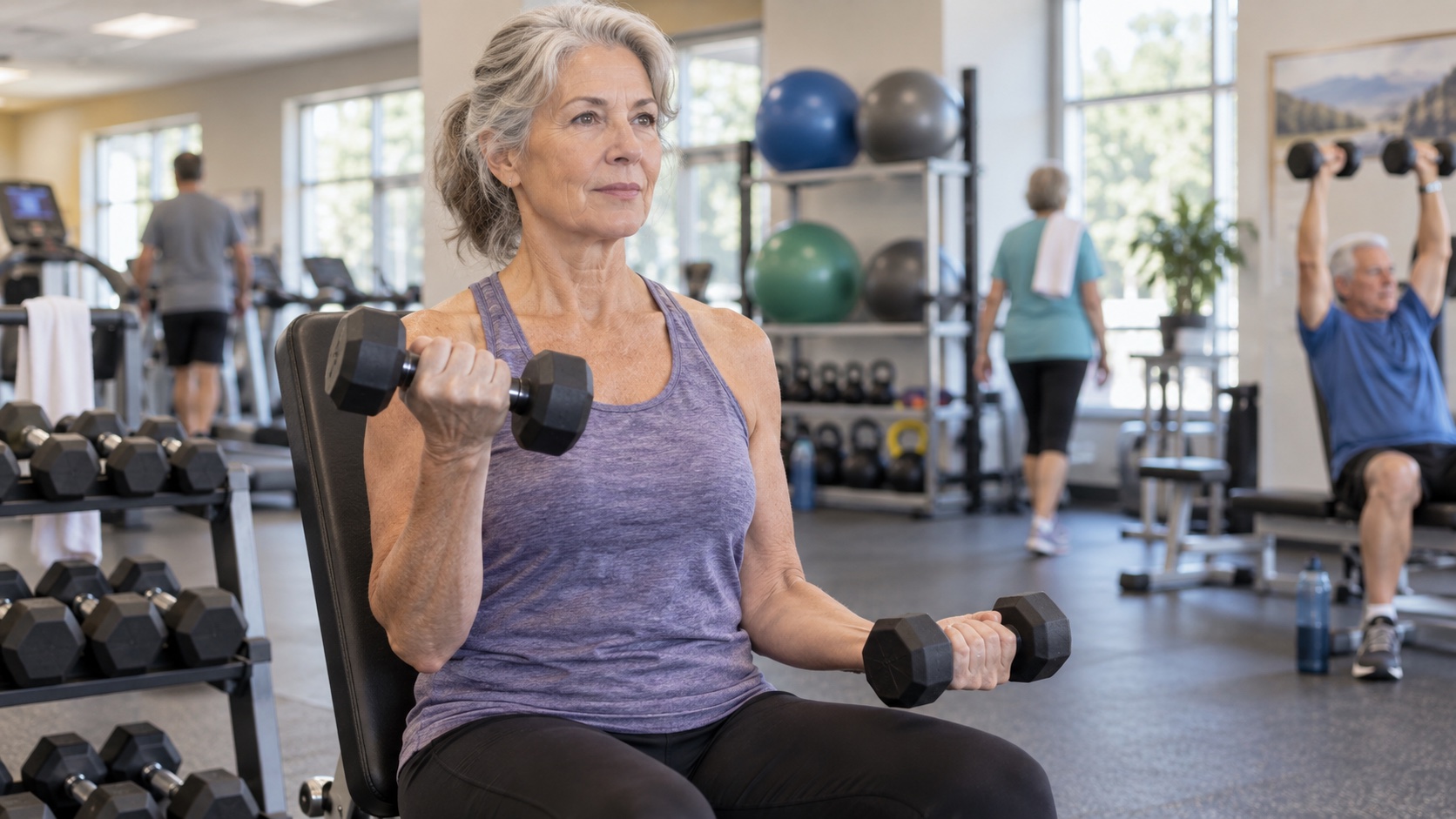
Bone Is a Load-Sensing Organ
The skeleton continuously measures strain and adjusts its architecture to match — the "mechanostat" model proposed by Harold Frost decades ago, since confirmed in every setting where loading is removed. Astronauts lose bone density in microgravity; bed rest thins the hip and spine; the unloaded limb of an injury atrophies while the loaded one holds. The corollary is the useful part: bone laid under load is bone kept. After menopause the rules change — estrogen's decline tilts the remodeling balance toward resorption, which is why postmenopausal women are the population where loading studies are most numerous. The Women's Bone Health topic covers the hormonal and clinical machinery in detail; the menopause page explains the estrogen timeline itself.
Product picks are generic categories, not brands. We may earn a commission on Amazon or iHerb purchases at no cost to you — this never changes our evidence conclusions. Full disclosure
Smart band or smartwatch
Can make activity, exercise, and routine patterns easier to notice over time.
⚠️ Step, heart-rate, and sleep estimates can be inaccurate and may encourage unhelpful over-monitoring; consumer readings are not medical diagnoses.
Check price on Amazon →What the Trials Actually Show
The evidence separates into two honest buckets. First, exercise preserves and modestly builds bone: a Cochrane review of exercise for postmenopausal bone found small but consistent improvements in bone mineral density, strongest for programs combining resistance with high-force or high-impact loading (Howe et al., 2011). Second, the dose-response ceiling is higher than most people train: the LIFTMOR randomized trial put postmenopausal women with osteopenia or osteoporosis through eight months of twice-weekly, 30-minute supervised sessions of heavy deadlift-style lifting plus jumping — and measured about a 3% gain in lumbar spine density against continued loss in the control group, with no serious adverse events (Watson et al., 2018). Longer-term resistance studies in calcium-replete women show the same shape on a slower clock: maintained or slightly improved hip density over two years where controls lost ground (Kerr et al., 2001). The honest scale-setting: bone is a slow responder — expect density changes over months to years, not weeks.
The meta-analytic layer points the same direction with smaller numbers: resistance training programs produce modest but consistent density improvements at the lumbar spine and hip in postmenopausal women, with combined loading modes — resistance plus impact — doing best (Zhao et al., 2015). Position statements have followed the trials: the Exercise and Sports Science Australia guidance recommends high-intensity progressive resistance training with impact work, twice weekly and supervised, as the exercise core for bone (Beck et al., 2017). None of this promises dramatic density gains — the realistic effect is preservation plus single-digit-percent improvement at loaded sites, set against a background of continued annual loss.
Does Walking Count?
It depends on what you are counting for. For bone density specifically: mostly no. Walking produces forces only slightly above everyday loading, and the trials agree — walking-only programs do little for density at the hip or spine, and neither do swimming or cycling, which unload the skeleton entirely (Howe et al., 2011). That site-specificity is the sharpest practical lesson on this page: only the loaded skeleton adapts. For everything else, walking counts a great deal — it preserves function, supports metabolic health, and keeps the fall-risk machinery practiced, which is why the site gives it its own topic. The honest division of labor: walk for life, lift for bone.
Adjustable dumbbells
Allows progressive loading at home across common strength movements.
⚠️ Poor technique or rapid load increases raise injury risk; not required to begin moving more.
Check price on Amazon →The Loading Principles
Five principles, each with a distinct body of support, translate the trials into a program. The through-line: bone responds to magnitude, rate, and novelty of loading more than to repetition.
| Principle | What it means in practice | Example | Evidence |
|---|---|---|---|
| 🧱 Progressive overload | Load must climb over time, not just repeat | Adding weight to the goblet squat when sets get easy | Good |
| 📍 Site specificity | Only loaded sites respond | Hip and spine need squats, hinges, and pulls — walking alone won't do it | Good |
| ⚡ Strain rate | Bone senses how fast load arrives, not just how much | Hops, jump squats, and quick step-ups where cleared | Moderate |
| 🔄 Novel direction | Unusual loading angles stimulate adaptation | Carries, side lunges, and varied grips | Moderate |
| 📅 Years, not weeks | Bone remodeling cycles run months long | Commit to 12+ months before judging density | Good |
Impact: The Part Most Programs Skip
Resistance loading is necessary but slow; impact is the accelerant. Bone is most responsive to brief, high-rate forces — the same reason the hip and heel respond well to jumping-style loading while long, low-force activities like cycling do little. In a 30-month randomized trial, daily impact exercise produced measurable density gains at weight-bearing sites in elderly women who started with low bone mass (Vainionpää et al., 2006). Meta-analytic work points the same direction: the programs that blunt postmenopausal loss best combine resistance with impact — the "mixed loading" prescription (Martyn-St James & Carroll, 2009). The translation for someone with no contraindications: a few sets of light hops, jump squats, or a fast step-down, once or twice a week, after the main lifting. One caution belongs right here — see the box below.
⚠️ Clinician territory
With diagnosed osteoporosis — or a history of vertebral fracture, kyphosis, or very low spine scores — high-impact and loaded spinal flexion carry real risk, and the loading plan is a clinician's call, not this page's. Screening, DEXA interpretation, and medication decisions all belong to the Women's Bone Health topic and a qualified professional. If your bone status is unknown, the safe default is progressive resistance without impact, supervised progression, and a DEXA before adding jumps.
Where Bone Meets Falls
A fracture needs two things: fragile bone and a fall. Most of the exercise literature's fracture protection runs through the second door. Large Cochrane reviews of fall-prevention exercise find that balance-challenging, functional programs reduce fall rates by about a quarter (Sherrington et al., 2019) — and the parent topic's power section explains why: leg strength that arrives quickly is what actually stops a stumble. In practical terms, the bone-friendly program and the fall-proof program are the same program: heavy compound lifting for density, quick-force work for reaction speed, and balance challenges for the systems in between. The grip and balance topic covers the cheap, home-testable version of both.
The Bone-Friendly Two Sessions
Folded into the twice-weekly structure this topic recommends, bone loading costs nothing extra:
- 🦵 Main lifts do the heavy lifting for bone. Squat patterns, hinges, and loaded carries compress the spine and hips axially — the loading bone registers most. Progress them steadily.
- ⚡ End one session a week with power work. Where cleared: 2–3 sets of light jump squats, hops, or fast step-ups — short ground-contact work, quality over quantity.
- 🤸 Add a balance challenge. Single-leg stands, tandem walking, or eyes-closed balance drills — a few minutes, twice a week.
- 🛡️ Respect the slow lane. Bone and tendon adapt on similar calendars — months. Progress load before adding impact, and revisit the injury-proofing page before either.
For postmenopausal women specifically, the strength and menopause page connects this loading advice to the hormonal picture.
Resistance bands
A low-space way to begin or supplement resistance training.
⚠️ Bands can snap and unstable anchoring can cause injury; stop movements that provoke pain.
Check price on Amazon →Questions, Answered Briefly
- 🚶 Will walking or swimming protect my bones? They support function and health broadly, but density responds to loading well above everyday levels — walk for function, load for density.
- 🏋️ How heavy is heavy enough? The trials that moved bone used loads at which five to eight reps were genuinely hard, progressed over months, under supervision. Start lighter and climb — the progression, not the starting point, is the intervention.
- 💊 Can exercise replace medication? That is a clinician's decision made against your fracture risk. Exercise complements treatment; it does not substitute for it — the Women's Bone Health topic runs the medication evidence.
- ⏳ When will I know it's working? Expect density changes on a 12-month-plus horizon. The earlier, more reliable signals are stronger legs and fewer near-falls.
The Bottom Line
- Bone builds where it's loaded. Progressive, site-specific loading is the training lever for density; inactivity is the enemy.
- The trials are real but modest: roughly 3% spine gains in months of heavy supervised training, versus slow compounding loss without it.
- Impact is the accelerant — a little jumping-style loading goes a long way, once cleared.
- Falls matter as much as density. The same program that loads bone also cuts fall risk — and that's where fractures are actually prevented.
Related Topics
- Frost, "Bone 'mass' and the 'mechanostat': a proposal," Anat Rec (1987)
- Howe et al., "Exercise for preventing and treating osteoporosis in postmenopausal women," Cochrane Database Syst Rev (2011)
- Watson et al., "High-Intensity Resistance and Impact Training Improves Bone Mineral Density and Physical Function in Postmenopausal Women With Osteopenia and Osteoporosis: The LIFTMOR Randomized Controlled Trial," J Bone Miner Res (2018)
- Kerr et al., "Resistance training over 2 years increases bone mass in calcium-replete postmenopausal women," J Bone Miner Res (2001)
- Zhao et al., "The effects of differing resistance training modes on the preservation of bone mineral density in postmenopausal women: a meta-analysis," Osteoporos Int (2015)
- Martyn-St James & Carroll, "A meta-analysis of impact exercise on postmenopausal bone loss: the case for mixed loading exercise programmes," Br J Sports Med (2009)
- Vainionpää et al., "Effect of impact exercise on bone mineral density in elderly women with low BMD: a population-based randomized controlled 30-month intervention," Osteoporos Int (2006)
- Sherrington et al., "Exercise for preventing falls in older people living in the community," Cochrane Database Syst Rev (2019)
- Beck et al., "Exercise and Sports Science Australia (ESSA) position statement on exercise prescription for the prevention and management of osteoporosis," J Sci Med Sport (2017)