Barbells vs machines vs bands
Every gym has a tool war — free weights versus machines versus the humble elastic band — and most of it is noise. The head-to-head evidence is thinner than either side admits, and the differences that do exist are small, specific, and swamped by one variable no equipment can fix: whether you keep showing up.
What the evidence supports
- In untrained adults, bands, machines, and free weights all produce meaningful strength gains over 8–12 weeks, with few differences among tools.
- When effort is matched, light loads build muscle about as well as heavy ones — which is why light tools like bands work at all.
- Free-weight versions of a movement recruit stabilizing muscles more than fixed-path machine versions.
- Variable resistance added to a barbell produces a small extra strength benefit in meta-analysis.
What remains uncertain
- Direct long-term randomized comparisons between tools are rare — most conclusions are inferences from short studies.
- Whether free-weight training transfers to daily function better than machines is plausible but not well quantified.
- No tool has a demonstrated injury-rate advantage in randomized trials.
Evidence last reviewed: August 15, 2026. Conclusions may change as new research is published.
The Debate That Outlived the Evidence
The tool question is argued with religious intensity and studied with surprising laziness. True randomized comparisons pitting barbells against machines against bands over meaningful timescales are rare; most of what we know comes from short studies, acute laboratory measures, and indirect evidence. That asymmetry is itself the first finding: if one tool were dramatically better, decades of argument would have produced the trial by now. The honest summary is that all three tools work, and each has a specific job it does slightly better. The rest of this page maps those jobs.
Product picks are generic categories, not brands. We may earn a commission on Amazon or iHerb purchases at no cost to you — this never changes our evidence conclusions. Full disclosure
Adjustable dumbbells
Allows progressive loading at home across common strength movements.
⚠️ Poor technique or rapid load increases raise injury risk; not required to begin moving more.
Check price on Amazon →What Machines Actually Do
A machine fixes the path of the movement, so your joints don't have to. That simplification is usually framed as a weakness, but it is also the machine's real strength: the skill barrier drops to near zero, loads are safely quantifiable, and you can push a single muscle group near failure without the rest of your body failing first. Laboratory comparisons bear out the trade — in matched tests, the free-weight squat activates the thigh and stabilizer muscles meaningfully more than a Smith-machine squat at the same relative load (Schwanbeck et al., 2009), while both versions produce similar strength outcomes in training studies. Machines are the sensible entry point for a deconditioned or rehabilitating adult, and the sensible accessory for everyone else. What machines don't do well is demand coordination — and coordination is part of what the over-40 body needs to train.
Free Weights: The Coordination Tax
A barbell or dumbbell doesn't fix your path; you stabilize it in three dimensions while producing force. That extra demand has costs — a longer learning curve, more technique risk at high effort — and benefits: greater stabilizer recruitment, and a training stimulus that looks more like real life, where nothing you lift follows a rail. The transfer argument is plausible and repeatedly stated in the literature, though direct proof that free weights preserve daily function better than machines is thinner than its advocates admit. Where compound free-weight and machine exercises have been compared directly, the free-weight versions have tended to produce at least equal strength outcomes with greater stabilizer demands — back-squat training outperformed leg-press training on maximal strength and jump measures in one such comparison (Wirth et al., 2016). One transfer effect is better documented: the loaded, upright, ground-based positions free weights demand are also the positions that load bone and practice balance. For a longevity-focused adult, the barbell's real argument is that its five basic patterns — squat, hinge, push, pull, carry — map directly onto the movements of independent living, as the parent topic lays out.
Bands: The Cheap, Travel-Ready Option
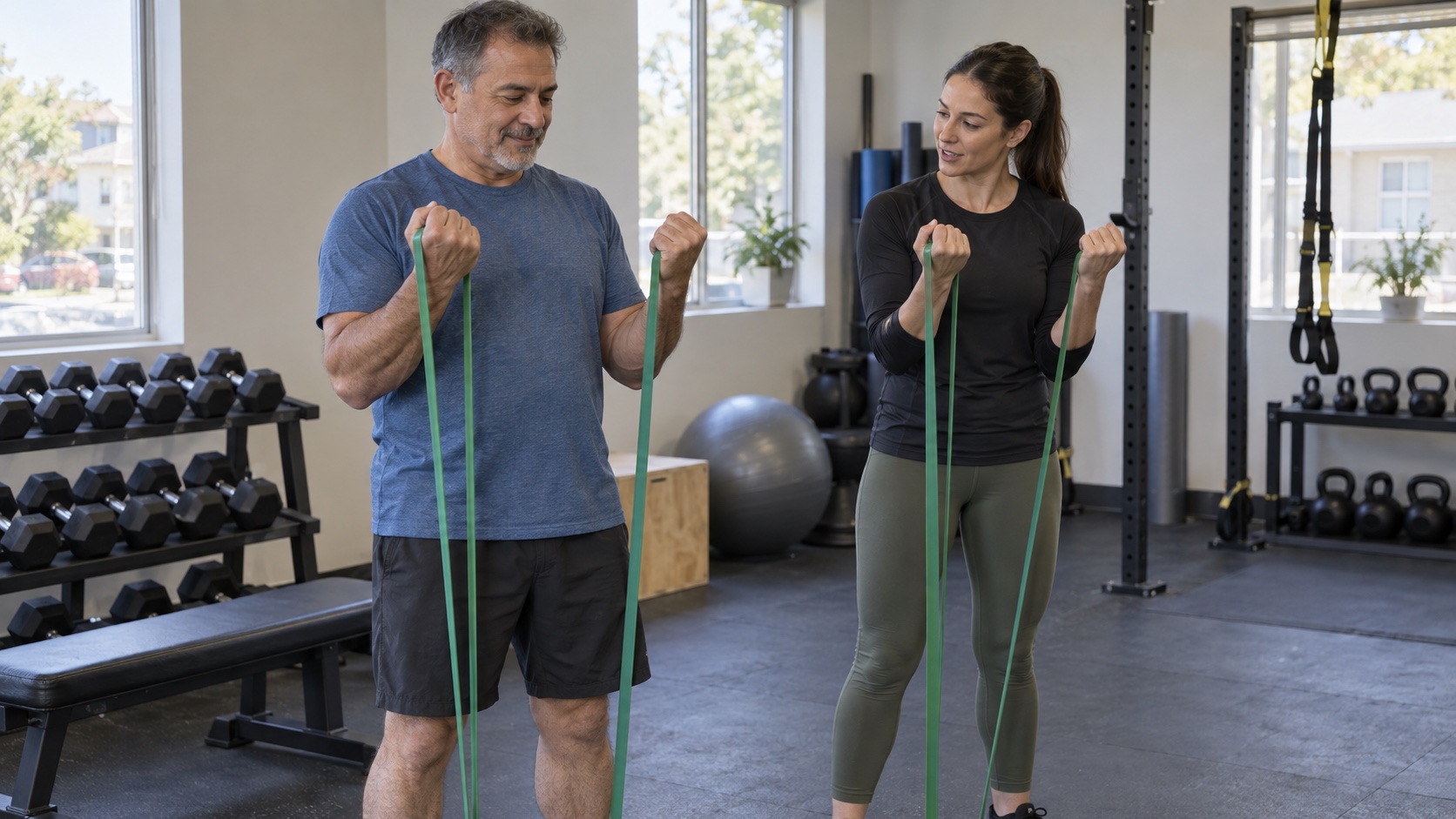
Elastic bands get dismissed as warm-up toys, which is exactly wrong. In randomized work with sedentary middle-aged women, elastic-band programs produced strength gains comparable to weight machines over the same period (Colado & Triplett, 2008), a finding repeated when tubing was compared with isotonic training (Colado et al., 2010) and in a systematic review concluding elastic and conventional resistance produce similar strength improvements in untrained adults (Lopes et al., 2019). The reason bands work is the one this topic keeps circling: with effort matched near failure, resistance is resistance — the muscle mostly cares that the last reps are hard. Bands have real limits: tension rises through the range, loads are awkward to quantify for progression, and very strong lifters outgrow them for primary movements. But for travel, injury layoffs, deload weeks, and the person who will train at home but not commute to a gym, a band is a complete enough gym.
Non-slip exercise or yoga mat
Provides a stable, comfortable surface for mobility or floor-based exercise.
⚠️ None expected; it does not treat pain or replace injury-specific care.
Check price on Amazon →The Comparison, Row by Row
| Tool | Strength evidence | Best for | Watch out for | Verdict |
|---|---|---|---|---|
| 🏋️ Barbells & dumbbells | Strong for strength and muscle across decades of studies | Main compounds; anyone with sound technique | Technique risk at high effort; needs space and equipment | Good |
| ⚙️ Machines | Good — comparable outcomes to free weights in training studies | Beginners, rehab, isolation work, safe failure | Less stabilizer demand; fixed paths skip balance practice | Good |
| ➰ Bands | Good in untrained adults; thinner for trained lifters | Home and travel, deloads, accessories, beginners | Hard to quantify loads; limited ceiling | Moderate |
Variable Resistance: The Hybrid Case
One more evidence thread belongs on the table: attaching bands or chains to a barbell so resistance rises through the range of motion — "variable resistance" in the literature. The logic is that a band compensates for the mechanical disadvantage at the top of a squat or press, keeping the muscle working hard through the whole movement. Meta-analysis supports a small but consistent benefit for maximal strength over constant resistance alone (Soria-Gila et al., 2015). It is an optimization, not a foundation: the effect is modest, and it assumes you already have a barbell program worth optimizing. The practical read for most adults over 40: bands make a fine finisher or a travel substitute, not a reason to complicate week three of a new habit.
Adherence Is the Whole Game
Every tool comparison above assumes the sessions actually happen. The empirical reality is that equipment convenience predicts training survival better than equipment quality does: home-based programs match or beat gym-based programs on adherence in many trials simply because the friction is lower, and roughly half of new gym memberships go quiet within months. A band in the drawer you use twice a week beats a squat rack you drive past. The Habit Formation protocol treats this as a design problem — environment, friction, and cue — not a character problem. Choose the tool your life will tolerate, then argue with nobody about it.
The same logic resolves the tool question for life's interruptions. A home band can hold a training habit together through travel, illness, or a gym closure in a way a barbell cannot — and a barbell can push progress in ways a band cannot. Owning both is not indecision; it is redundancy for a habit that has to survive decades. The tools are cheap relative to the cost of the habit dying.
🎯 The boring answer
After forty years of exercise science, no tool has won. What the evidence actually says: train close to failure with any resistance your joints tolerate, twice a week, forever — and pick the implement that makes "forever" most likely. Barbells if you love them, machines if you're rebuilding, bands if your life moves. The tool is the vehicle; the habit is the destination.
The Over-40 Mix, in Practice
- 🔁 Start machine-assisted, graduate to free. Machines earn their place first — low skill barrier, quantifiable, safe — then compound barbell work replaces them as technique solidifies.
- 🏠 Keep bands deployed at home. A band plus a doorway anchor covers rows, presses, and hinges on weeks when the gym isn't reachable — the anti-fragile half of the program.
- 🩹 Use machines during layoffs. After injury or illness, the fixed path lets you train around a cranky joint — the injury-proofing page covers the return-to-loading rules.
- 📏 Quantify progress with one tool. Pick one implement per movement pattern as your measuring stick — same tool, same rep range — so progression decisions in the minimum effective dose stay legible.
The Bottom Line
- No tool wins on evidence. Bands, machines, and free weights all produce real strength gains; differences are specific, not decisive.
- Each tool has a job: machines lower the barrier, free weights train coordination and bone-loading positions, bands remove every excuse.
- Effort near failure is the common denominator that makes all three work — the tool is downstream of the effort.
- Adherence decides the contest. The best tool is the one your life will actually keep using twice a week.
Related Topics
- Colado & Triplett, "Effects of a short-term resistance program using elastic bands versus weight machines for sedentary middle-aged women," J Strength Cond Res (2008)
- Colado et al., "A comparison of elastic tubing and isotonic resistance exercises," Int J Sports Med (2010)
- Lopes et al., "Effects of training with elastic resistance versus conventional resistance on muscular strength: a systematic review and meta-analysis," SAGE Open Medicine (2019)
- Schwanbeck et al., "A comparison of free weight squat to Smith machine squat using electromyography," J Strength Cond Res (2009)
- Wirth et al., "The Impact of Back Squat and Leg-Press Exercises on Maximal Strength and Speed-Strength Parameters," J Strength Cond Res (2016)
- Schoenfeld et al., "Strength and Hypertrophy Adaptations Between Low- vs. High-Load Resistance Training: A Systematic Review and Meta-analysis," J Strength Cond Res (2017)
- Soria-Gila et al., "Effects of Variable Resistance Training on Maximal Strength: A Meta-Analysis," J Strength Cond Res (2015)
- Andersen et al., "Muscle activation and perceived loading during rehabilitation exercises: comparison of dumbbells and elastic resistance," Phys Ther (2010)