Spine-Safe Exercise After a Vertebral Fracture
A vertebral fracture can make bending, lifting, and returning to exercise feel uncertain. The UK consensus supports staying active with adapted movement, strength, balance, and posture work, while advising people with vertebral or multiple low-trauma fractures to keep impact around brisk-walking intensity unless they receive individualized advice. The fracture phase, symptoms, and personal risks matter; this page is not an unsupervised rehabilitation prescription.
What the evidence supports
- 🧭 Adapt activity, not abandon it: the UK consensus supports strength and balance exercise, posture work, and return toward usual activity with appropriate advice.
- ↘️ Avoid high degrees of spinal flexion: especially repeated, sustained, end-range, or loaded flexion in exercise and daily tasks (Brooke-Wavell et al., 2022).
- 🚶 Limit impact after vertebral or multiple low-trauma fractures: usually no more than the equivalent of brisk walking unless a clinician provides personalized direction.
What remains uncertain
- 🧪 Exact dose: the optimal movements, load, pace, and timing differ and are not defined by one consensus schedule.
- 🩻 Fracture state: pain, healing, number and location of fractures, posture, balance, and other diagnoses need individual assessment.
- 📉 Fracture prevention: exercise may support mobility and posture, but this consensus does not establish a universal exercise-only fracture-prevention effect.
Evidence last reviewed: October 6, 2026. Conclusions may change as new research is published.
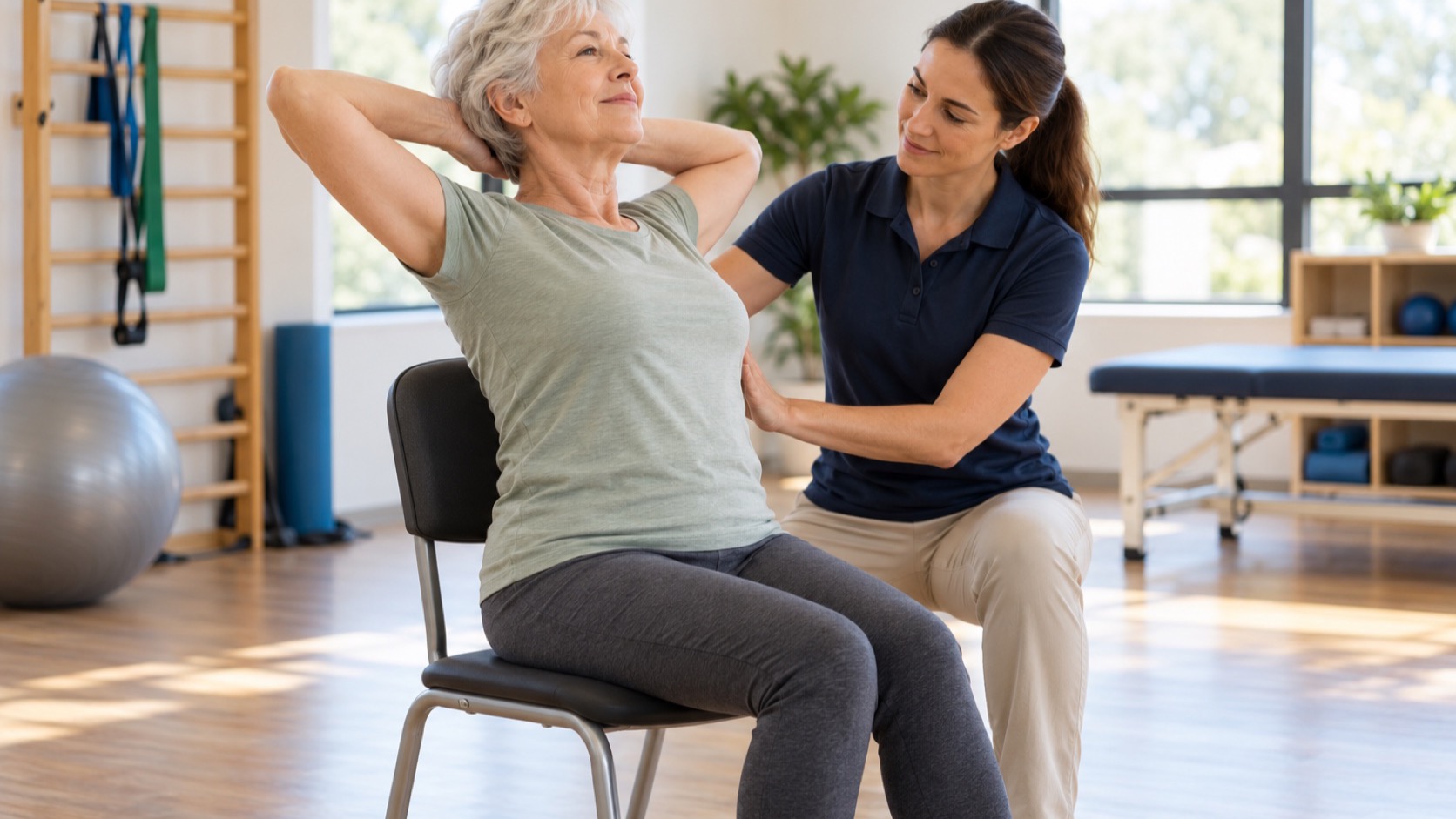
First, separate fracture care from exercise advice
A vertebral fracture is a clinical event, not merely a training limitation. New severe back pain after a fall or lifting episode, pain that is worsening, or pain with neurologic symptoms needs medical assessment. A clinician determines whether a fracture is present, whether additional imaging or treatment is needed, and what precautions apply. Exercise education cannot diagnose a fracture, decide whether it has healed, or replace prescribed pain management and osteoporosis care.
Once acute management and relevant restrictions are clear, the goal is generally not permanent inactivity. Vertebral fractures may be associated with pain, reduced mobility, altered posture, and fear of movement. The UK consensus notes that exercise may help symptoms, mobility, and quality of life, ideally with specialist advice that supports a return toward normal activities (Brooke-Wavell et al., British Journal of Sports Medicine, 2022). This is a direction of care, not a promise that a particular exercise will relieve an individual’s pain.
What “spine-safe” means in the consensus
The consensus recommends avoiding postures that involve a high degree of spinal flexion during exercise or daily life. Reports of vertebral fractures have been associated with end-range, sustained, repeated, or loaded flexion, including some sit-up and yoga positions. That evidence does not mean that a person must never bend forward or that a rounded back in every ordinary movement will cause a fracture. It supports reducing avoidable exposure to demanding positions, especially when fracture history and bone risk are known.
Practical movement coaching may include hinging at the hips, keeping loads close to the body, turning with the feet rather than twisting under load, and avoiding repeated loaded end-range spinal rounding. A physiotherapist can adapt everyday tasks such as reaching low shelves, getting dressed, lifting a light object, or moving from floor to standing. The right strategy depends on the person’s pain, movement confidence, strength, balance, and home environment.
Three useful domains, not a one-size plan
Brooke-Wavell and colleagues organized recommendations around bone strength, fall risk, and posture or vertebral-fracture symptoms. For a person with a fracture history, strength and balance work can support safe daily movement, while spinal extension exercise may help posture and may reduce symptoms for some people. The consensus recommends adapting all activity to ability. Someone who is unsteady or at risk of falling may need targeted strength and balance practice before increasing broader activity.
| Movement domain | Consensus direction | Individual question | Evidence |
|---|---|---|---|
| 🧍 Posture and bending | Avoid high-degree, repeated, sustained, or loaded spinal flexion; learn adaptations for daily tasks. | Which positions provoke pain or require modification for this fracture? | Consensus |
| 🚶 Impact | After vertebral or multiple low-trauma fractures, usually stay at or below brisk-walking-equivalent impact. | Has a specialist advised a different level for this individual? | Guidance |
| ⚖️ Balance and strength | Targeted work can support stability and function; people at fall risk may start here. | Is support, supervision, or an assistive device needed? | Consensus |
| ⬆️ Extension and mobility | Spinal extensor work may help posture and symptoms, with individualized selection. | Which movements are tolerable and appropriate now? | Limited |
Impact guidance is not an invitation to test a limit
For people with vertebral fracture or multiple low-trauma fractures, the UK statement advises that exercise should usually remain at an impact equivalent to brisk walking. It adds an exception for those receiving personalized instruction. “Usually” matters: it is consensus guidance for a group, not a precise mechanical threshold or an automatic clearance for any activity that feels like walking. A clinician can take account of fracture recency, balance, symptoms, other injuries, and the person’s goals.
For the same reason, this page does not prescribe jumps, weighted spinal flexion, heavy lifting, or a set-and-repetition program. People with osteoporosis but without vertebral or multiple fractures may receive different advice from a trained professional, and the appropriate plan still depends on ability and history. Readers who want the broader training evidence can refer to Lifting for Bone; its general loading discussion should not be used as a post-fracture protocol.
Small changes can make ordinary tasks more manageable
When pain settles and the care team agrees, adapting a familiar task may be more useful than beginning with a formal workout. A chair with arms can make sit-to-stand easier; a long-handled tool can reduce repeated low reaching; a stable counter or rail can give support during standing tasks. Such adjustments are not treatment for the fracture, but they may let a person remain active while a tailored rehabilitation plan is being developed.
- 🪑 Use support when balance is uncertain. A counter, rail, or prescribed walking aid can reduce unnecessary challenge while the person is rebuilding confidence.
- 🧺 Keep loads close. A light item carried near the trunk generally needs less reach than a load held far away; the therapist can show a comfortable strategy.
- 🧍 Change position before pain escalates. Shorter bouts and breaks may help maintain function while the clinician identifies a tolerable progression.
These are examples to discuss, not universal instructions. A task that feels easy for one person may be unsafe or painful for someone else. Do not continue through sharp, increasing, or new pain in order to “strengthen the spine.”
Why blanket avoidance is not the goal
Fear after a vertebral fracture is understandable, but avoiding nearly all movement can leave balance, strength, and confidence worse. The consensus encourages activity that is matched to ability, while advising people at risk of falls to prioritize targeted strength and balance before increasing other demands. The aim is to make necessary movement safer and more manageable, not to turn the home into a place where every bend is treated as dangerous.
That distinction is practical. A forward reach to wash, dress, or pick up a light object is not identical to repeated loaded sit-ups or a sustained end-range flexion posture. A therapist can teach a hip hinge, arrange objects to reduce repeated low reaching, or use a stable support where balance is limited. These adjustments may help people continue daily activities without assuming that any one technique is right for every spine.
Evidence for exact exercise dosage and fracture outcomes remains less settled than the broad safety principles. The consensus draws on reviews, individual studies, and expert agreement where trials are absent. It recommends a positive, adapted approach because restrictions can reduce function, but it does not prove that a specific exercise prevents a second vertebral fracture. That careful boundary allows the safety advice to be useful without overstating certainty.
Clinical territory: symptoms, imaging, and treatment
New weakness, numbness, loss of coordination, or changes in bowel or bladder control after a suspected spinal fracture require urgent medical attention. Severe new back pain, pain after a fall, or pain that does not settle also deserves assessment. A professional decides whether imaging, medication, a brace, or another intervention is appropriate. The exercise consensus informs movement advice; it does not replace diagnosis or acute fracture management.
A vertebral fracture may signal elevated risk of another fracture. Evaluation for osteoporosis, fracture risk, and evidence-based medical treatment belongs in shared care with the patient and clinician. Exercise can complement that care but cannot substitute for medication when prescribed, fracture healing, or osteoporosis treatment. See the bone-health topic for the screening and treatment overview.
Questions, answered briefly
- ↘️ Does this mean never bend forward? No. Consensus advises avoiding high-degree flexion and adapting demanding tasks. It does not prohibit every ordinary bend.
- 🚶 Is walking safe after every vertebral fracture? The consensus uses brisk-walking-equivalent impact as a usual limit, but a clinician must clarify what is safe in a specific case.
- 🏥 Can exercise replace fracture care? No. Symptoms, diagnosis, treatment, and activity progression are clinician territory.
⚠️ After a fracture, get a personal movement plan
This page summarizes consensus safety principles; it cannot account for fracture timing, pain, spinal shape, balance, other conditions, or treatment. A qualified clinician or physiotherapist should adapt the plan. Stop and seek assessment for worsening pain or new neurologic symptoms. Exercise supports recovery but is not a substitute for osteoporosis treatment or fracture rehabilitation.
The Bottom Line
- Movement can continue, with adaptation. The consensus supports strength, balance, posture work, and return toward usual activity with appropriate advice.
- Avoid demanding spinal flexion. High-degree, repeated, sustained, or loaded flexion is a practical position to modify.
- Keep impact modest after vertebral or multiple low-trauma fractures. Brisk-walking-equivalent impact is the usual consensus ceiling without personalized instruction.
- Assessment comes before a generic exercise plan. Fracture status, symptoms, and osteoporosis care belong with a clinician.
Related Topics
- Brooke-Wavell K, Skelton DA, Barker KL, et al. “Strong, steady and straight: UK consensus statement on physical activity and exercise for osteoporosis.” British Journal of Sports Medicine (2022). doi:10.1136/bjsports-2021-104634. PMID: 35577538.
- Giangregorio LM, McGill S, Warkenstin G, et al. “Too Fit To Fracture: outcomes of a Delphi consensus process on physical activity and exercise recommendations for adults with osteoporosis with or without vertebral fractures.” Osteoporosis International (2015). doi:10.1007/s00198-014-2881-4.
- McDonough CM, Harris-Hayes M, Kristensen MT, et al. “Physical Therapy Management of Older Adults With Hip Fracture.” Journal of Orthopaedic & Sports Physical Therapy (2021). doi:10.2519/jospt.2021.0301.