Building Peak Bone Mass: Why Activity in Youth Matters
Bone accrual happens while the skeleton is growing, so childhood and adolescence are important periods for bone health. A small school-based randomized trial found that a specific jumping program changed bone mineral content at the hip and spine over seven months. The result is informative about growing children; it is not evidence that the same program prevents adult fractures decades later.
What the evidence supports
- 🏫 One school-based trial: 89 prepubertal children were assigned to jumping or non-impact stretching for seven months (Fuchs et al., 2001).
- 📏 A bone-content signal: adjusted gains in bone mineral content were greater at the femoral neck and lumbar spine in the jumping group; the trial also reported site-specific BMD findings.
- 🌿 General activity guidance: WHO recommends an average of 60 minutes a day of moderate-to-vigorous activity for ages 5–17, with vigorous and muscle- and bone-strengthening activity on at least three days weekly (WHO, 2020).
What remains uncertain
- 🧪 Generalizability: one small, prepubertal sample and one structured intervention cannot define a universal youth training dose.
- 🧍 Later-life outcomes: the study did not test adult osteoporosis, adult fracture rates, or lifelong protection.
- 📐 Individual differences: growth stage, disability, existing injury, health conditions, and access to safe activity change what is appropriate.
Evidence last reviewed: October 6, 2026. Conclusions may change as new research is published.
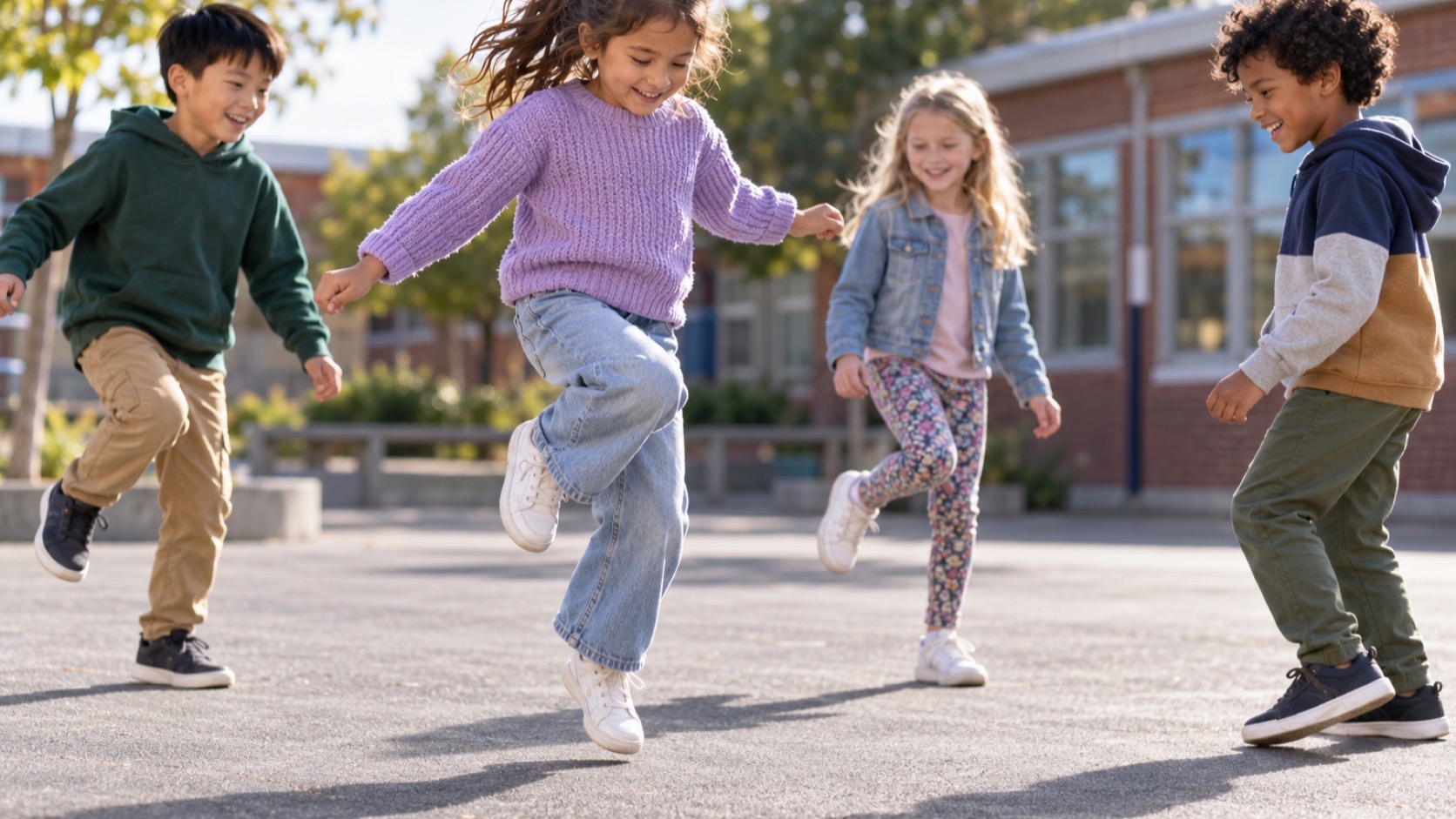
Growing bone is not adult bone in miniature
During childhood, bones lengthen and widen while mineral is added to a changing structure. A scan-derived number therefore needs context: bone mineral content (BMC) is the total mineral measured at a site; areal bone mineral density (BMD) divides mineral by projected area. Growth changes both the size of the bone and the measurement. A difference in BMC is not interchangeable with a difference in BMD, strength, or future fracture probability.
Puberty, height velocity, body size, maturation, nutrition, health, and movement all shape the rate of accrual. The central question here is narrower than “Does exercise make bones strong?” It is whether adding a defined activity during one developmental window measurably altered bone outcomes in a trial. That framing helps preserve the signal without turning it into a promise for every child.
What the Fuchs trial actually did
Fuchs, Bauer, and Snow randomized 89 children aged 5.9 to 9.8 years who had not yet reached puberty. During the school day, the intervention group performed 100 two-footed jumps from 61-centimetre boxes, three times per week, for seven months. The comparison group did non-impact stretching over the same period. Researchers measured BMC, bone area, and BMD at the left femoral neck and lumbar spine with DXA (Fuchs et al., Journal of Bone and Mineral Research, 2001).
After adjustment for starting age and bone measures and changes in height and weight, the intervention group had greater BMC gains than controls: 4.5% at the femoral neck and 3.1% at the lumbar spine. For secondary BMD outcomes, the between-group difference was 2.0% at the lumbar spine. At the femoral neck, the 1.4% difference did not meet conventional statistical significance (p = 0.085). The distinction matters: the headline BMC result should not be silently retold as a significant BMD result at both sites.
| Trial detail | What was compared | Outcome and interpretation |
|---|---|---|
| 🧒 Participants | 89 prepubertal children, ages 5.9–9.8 years | Small, specific sample; not a trial of every age or maturation stage. |
| 🦘 Activity | 100 two-footed jumps, three school-day sessions per week, seven months | Intervention tested as delivered; not a recommended home program. |
| 🦴 Femoral neck BMC | Adjusted change vs stretching control | 4.5% greater BMC change; this is not an adult fracture outcome. |
| 📍 Lumbar spine BMD | Secondary DXA outcome | 2.0% greater change; femoral-neck BMD difference was 1.4%, p=.085. |
The randomization was balanced by sex: 45 children entered the jumping group (25 boys and 20 girls) and 44 entered the stretching group (26 boys and 18 girls). The sample therefore included both boys and girls, but it was not large enough to establish that every subgroup responded identically. Pubertal status and the sites measured remain part of the result; the article does not establish a universal sex-specific effect or a forecast for an individual child.
What happened after the intervention stopped
A follow-up report tested 74 of the original children after seven months of detraining. At 14 months from the trial’s start, the former jumping group retained 4% greater femoral-neck BMC and 4% greater femoral-neck bone area than controls; the group difference at the lumbar spine did not persist (Fuchs et al., Journal of Pediatrics, 2002). This is a useful caution against speaking as if one short program produced identical lasting change at every site. It was a follow-up of the same cohort, not an independent replication or a lifetime study.
A later follow-up of participants from two school-based intervention cohorts reported an adjusted hip BMC difference that persisted at the final follow-up, nearly eight years after the original short intervention. The researchers explicitly framed adult fracture reduction as a possibility requiring further study, not a measured outcome (Gunter et al., 2008). Longitudinal bone accrual can be interesting without being proof that the trial prevented fractures.
How to read the result without overgeneralizing
- 📏 Keep the endpoint attached. The reported 4.5% and 3.1% differences refer to BMC at specific measured sites. They do not mean all bones increased by that amount.
- 🧬 Keep the age attached. Children who had not entered puberty are not a stand-in for adolescents, adults, or people with established osteoporosis.
- 🧪 Keep the comparator attached. The trial compared a structured jumping intervention with stretching; it did not compare sport participation with inactivity across an entire childhood.
- 🧍 Keep the outcome attached. Neither the original trial nor the follow-up measured adult fragility fractures or showed that youth jumping prevents them.
What families and schools can reasonably take forward
Public-health guidance is broader than the experimental protocol. WHO recommends children and adolescents average at least 60 minutes per day of moderate-to-vigorous activity across the week, mostly aerobic, and include vigorous activity plus muscle- and bone-strengthening activity on at least three days. That is a population activity recommendation for health, not a bone-specific prescription, a minimum for every child on every day, or an instruction to reproduce the trial’s box height and jump count.
In daily life, bone-strengthening activity may be part of play, physical education, dance, running games, court sports, gymnastics, or other activities with age-appropriate impact. Access, enjoyment, movement skill, and safe environments influence whether children can participate. A mix of activities gives children choices and supports broader fitness; the evidence does not establish that a single sport or exercise is required for peak bone mass.
Adults supporting youth can help by making movement routine rather than a performance test. Instructors can adapt impact, surface, and complexity to the child’s confidence and experience. A child who dislikes jumping can still be active and benefit from movement; one trial does not justify shame or a narrow standard. The outcome belongs to the group studied, not to a child’s worth or health future.
When a child needs an individualized plan
Persistent focal pain, a recent injury, a chronic medical condition, disability, a history of bone or joint problems, or concern about growth and nutrition changes the question from general activity to personal care. A clinician, pediatric physiotherapist, or other qualified professional can adapt movement and assess symptoms. Stop an activity that causes sharp or escalating pain; do not treat pain as a required sign that bone is adapting.
DXA measurements in a trial do not mean that healthy children need routine bone scans. Decisions about imaging, diagnosis, or a child’s fracture risk require clinical context. Bone density is one part of a larger picture and is interpreted differently while a skeleton is still growing. If a child has sustained a fracture or has a condition affecting bone, ask the treating team what activity is appropriate rather than borrowing an adult training plan from another page.
⚠️ A youth trial does not forecast an adult fracture
The Fuchs intervention measured childhood bone outcomes over months, with later follow-up of some participants. It did not test osteoporosis diagnoses or adult fracture rates. Youth activity is worthwhile for many health and development reasons, but this study cannot quantify an adult’s future fracture risk or promise lifelong protection. It is not a substitute for osteoporosis treatment when indicated or supervised rehabilitation after a fracture. Bone-health assessment and treatment questions belong with a clinician; see the bone-health clinical topic for the site’s osteoporosis overview.
Questions, answered briefly
- 🦘 Should every child do 100 box jumps? No. That was the trial’s protocol, not a universal family or school prescription. General activity guidance is broader and should be adapted to ability and setting.
- 🦴 Does the study prove jumping prevents osteoporosis? No. It found differences in pediatric BMC and BMD at selected sites. It did not measure adult osteoporosis or fractures.
- 🏥 Should an active child with pain keep training? Ongoing, focal, or worsening pain warrants clinical assessment; the right modification depends on the cause and the child.
The Bottom Line
- The study was pediatric and specific. It randomized 89 prepubertal children to a seven-month jumping or stretching program.
- BMC and BMD are separate outcomes. The largest reported differences were 4.5% at femoral-neck BMC and 3.1% at spine BMC; the femoral-neck BMD result was not statistically significant.
- Public guidance is not a trial recipe. WHO guidance covers broad activity for ages 5–17, with bone-strengthening activity among several movement types.
- Adult fracture prevention was not tested. Do not turn childhood scan differences into a prediction of adult osteoporosis or fracture protection.
Related Topics
- Fuchs RK, Bauer JJ, Snow CM. “Jumping improves hip and lumbar spine bone mass in prepubescent children: a randomized controlled trial.” Journal of Bone and Mineral Research (2001). doi:10.1359/jbmr.2001.16.1.148.
- Fuchs RK, Bauer JJ, Snow CM. “Gains in hip bone mass from high-impact training are maintained: a randomized controlled trial in children.” Journal of Pediatrics (2002). PMID 12219055.
- Gunter K, Baxter-Jones ADG, Mirwald RL, et al. “Impact exercise increases BMC during growth: an 8-year longitudinal study.” Journal of Bone and Mineral Research (2008). Full text.
- World Health Organization. WHO Guidelines on Physical Activity and Sedentary Behaviour (2020). doi:10.1136/bjsports-2020-102955.