Hip-Fracture Rehabilitation: Strength, Balance, and Mobility
Rehabilitation after a hip fracture begins with the operation, weight-bearing instructions, pain, medical stability, and the person’s goals—not with a generic workout. The APTA/JOSPT clinical practice guideline calls for structured progressive exercise and early assisted mobility when not contraindicated. This page explains that clinician-led framework without prescribing a personal postoperative plan.
What the evidence supports
- 🏥 Early supported mobility: clinicians should assist transfer out of bed and ambulation as soon as possible after surgery, then at least daily unless medically or surgically contraindicated.
- 🏋️ Structured rehabilitation: the guideline calls for progressive resistive strength, balance, weight-bearing, and functional mobility exercise.
- 🔁 Continued therapy: when deficits remain beyond 8–16 weeks, clinicians should provide opportunities for additional therapy (McDonough et al., 2021).
What remains uncertain
- 🧑⚕️ Personal dose: weight-bearing status, surgery, complications, pain, cognition, and prior function shape progression.
- 📈 Individual recovery: a guideline does not guarantee return to pre-fracture mobility or residence.
- 🦴 Secondary prevention: exercise rehabilitation alone does not treat osteoporosis or rule out another fracture.
Evidence last reviewed: October 6, 2026. Conclusions may change as new research is published.
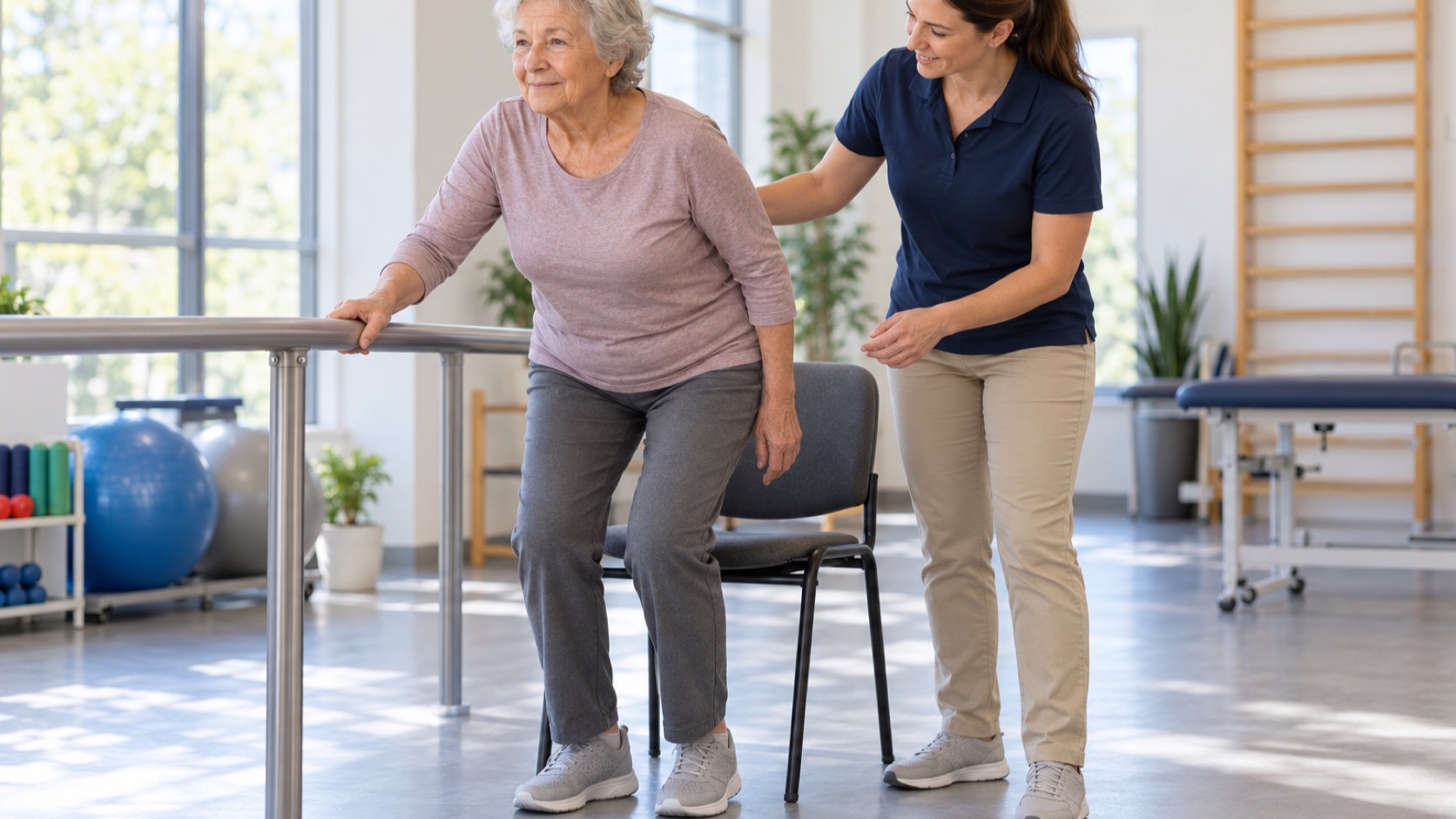
Rehabilitation starts with the clinical handoff
A hip fracture is a major injury in an older adult, often followed by surgery, pain, reduced strength, and a sudden change in independence. The first exercise question is not “How many repetitions?” It is “What did the surgical and medical team authorize?” The type of fracture and procedure, weight-bearing orders, wound and pain status, blood pressure, delirium, and other medical conditions all affect safe activity.
The Academy of Orthopaedic Physical Therapy and Academy of Geriatric Physical Therapy guideline describes physical therapy as part of multidisciplinary hip-fracture management. Clinicians coordinate with physicians, nurses, occupational therapists, and the person’s caregivers. The aim is functional recovery—such as bed mobility, transfers, walking, and daily activities—not a single number on a gym machine (McDonough et al., Journal of Orthopaedic & Sports Physical Therapy, 2021).
Early mobilization is supported, with a safety condition
The guideline recommends assisted transfers out of bed and ambulation as soon as possible after surgery and at least daily thereafter, unless medical or surgical reasons contraindicate it. That recommendation is about supported clinical care, not permission for a recently operated person to walk alone. In-hospital physical therapy should be offered at high frequency—daily—with duration as tolerated. The team selects assistance level, device, route, and rest intervals for that day.
Early activity may be small: sitting at the edge of the bed, moving to a chair, standing, or taking assisted steps. The exact starting point depends on alertness, pain control, blood loss or anemia, cardiopulmonary stability, and the surgical plan. If a session must be modified or paused, the team can reassess and try again when safe. One difficult session does not define what the person can regain.
What structured exercise includes
The guideline gives a grade A recommendation for structured exercise that includes progressive high-intensity resistive strength, balance, weight-bearing, and functional mobility training. “Progressive” means the therapist adjusts challenge in response to the person’s capacity and precautions. “High intensity” does not mean an unsupervised heavy lift; it describes a rehabilitation target delivered and monitored by clinicians as the patient’s status permits.
These parts address different tasks. Strength exercises target the muscles needed for standing and stepping. Balance activities train postural control. Weight-bearing practice lets a person rehearse supported loading within the authorized status. Functional mobility trains actions such as rolling, sitting up, moving between surfaces, and walking with an aid. A program may change from visit to visit as the person improves or has a setback.
| Care phase | Guideline direction | What changes the plan | Recommendation |
|---|---|---|---|
| 🏥 In hospital | Offer daily PT; assisted transfer and walking as soon as possible, at least daily unless contraindicated. | Medical stability, pain, procedure, weight-bearing orders, alertness, and safety. | A / B |
| 🏋️ Structured exercise | Progressive resistance, balance, weight-bearing, and functional mobility training. | Current capacity, assistance needs, equipment, goals, and response to activity. | A |
| 🏠 Postacute care | Use outpatient, home, or community exercise options when suitable and deficits persist. | Home layout, transport, caregiver support, cognition, and access to services. | A |
| 🔁 Ongoing deficits | Offer additional therapy opportunities beyond 8–16 weeks if strength, balance, gait, or function remain limited. | Measured impairment and patient-defined goals, reviewed with the care team. | A |
Rehab is measured by function, not a single score
Physical therapists can measure mobility and fall risk with tools such as the Timed Up and Go test when a patient can complete it without human assistance. Other measures may assess basic mobility, gait speed, walking distance, transfer ability, or confidence. The guideline recommends documenting test conditions, including pace and walking-aid use where relevant. A score has meaning only alongside the person’s symptoms, baseline abilities, assistive device, and goals.
Functional targets can be personal: getting to the bathroom safely, returning to a familiar chair, walking within the home, or participating in an activity that matters. Recovery may include relearning a task with a walker or accepting help for a period. Assistive devices are part of safe mobility, not evidence of failure. The team should tell the patient and caregivers what level of help is needed for each transfer and walking task.
What happens after hospital discharge
Discharge is a transition, not the end of rehabilitation. If the person continues to have strength, balance, gait, or functional limitations, the guideline calls for additional therapy opportunities beyond 8 to 16 weeks. Options can include outpatient services, a progressive home exercise program, or an evidence-based community program, selected to fit the remaining impairments and the person’s living situation. Home safety and adequate support matter as much as the exercise list.
The guideline also emphasizes individualized goals and reassessment. A person recovering from a hip fracture may have memory changes, frailty, vision limitations, heart or lung disease, or pain from another condition. The guideline recommends treating people with mild to moderate dementia using similar types of physical therapy interventions, while adjusting communication and support to the individual. Care partners can help reinforce safe practice, but should follow the therapist’s instructions rather than invent progressions.
- 🗣️ Agree on a concrete goal. Name the task that matters to the patient and check whether the current plan is moving toward it.
- 📝 Clarify assistance and device use. Ask the team to document what help is needed for transfers, standing, and walking.
- 📅 Keep follow-up connected. Persistent deficits, repeated falls, worsening pain, or a change in function deserve another clinical review.
Handoffs need instructions, not assumptions
When a person moves from hospital to a skilled nursing facility, rehabilitation program, or home, the team should communicate the current weight-bearing order, mobility aid, and level of assistance. The guideline says that people with continued impairments or functional deficits after hip fracture should receive evaluation by a facility or home-care physical therapist within 72 hours of the transition. That recommendation helps prevent a gap in care; it does not mean a person is expected to be independent by that point.
Caregivers can ask a short set of concrete questions before the transition: Is the person allowed to put full weight through the operated leg? What support is needed to stand or transfer? Which symptoms should prompt a call? Who will arrange the next therapy visit? The answers should come from the treating team and be written in the discharge or handoff plan. If instructions conflict or are unclear, contact the team rather than guessing.
Follow-up also provides a chance to revisit goals. Improvement may be uneven: pain can ease before strength returns, or walking confidence can lag behind a healed incision. A physical therapist can adjust assistance, exercise challenge, and equipment as the person’s ability changes. A slower recovery calls for reassessment and coordination, not pressure to follow someone else’s timeline.
Exercise is one part of fracture prevention
A hip fracture also raises the question of why the bone broke and how to reduce the chance of another fracture. The APTA/JOSPT guideline says physical therapists should contribute to interprofessional care so older adults are evaluated and treated for osteoporosis and future-fracture risk. That assessment may involve the person’s physician or another clinician. Exercise can help restore function and reduce fall risk, but it does not diagnose osteoporosis or replace medication when indicated.
After a fracture, avoid generic loading advice from a page written for healthy adults. New or worsening pain, wound concerns, shortness of breath, fever, sudden swelling, or acute change in mental status require contact with the treating team. Follow discharge instructions for medication, weight bearing, wound care, and follow-up. The bone-health clinical page covers osteoporosis assessment and treatment; the stability and mobility topic covers general balance training outside immediate postoperative recovery.
Questions, answered briefly
- 🚶 Should a person walk the day after surgery? The guideline supports early assisted ambulation unless a medical or surgical reason contraindicates it; the care team decides the safest timing and support.
- 🏋️ Does “high intensity” mean heavy lifting alone? No. The structured program also includes balance, weight-bearing, and functional mobility, progressed under clinical supervision.
- 🔁 What if progress is slow? Ongoing deficits are a reason to reassess and consider additional therapy, not to assume further rehabilitation cannot help.
⚠️ Post-fracture exercise is clinician territory
Surgeon precautions, pain, weight-bearing instructions, and medical stability determine what is safe. Do not use a general exercise page to set postoperative loads or attempt unsupervised rehabilitation. The guideline supports therapist-led structured exercise and early assisted mobility when appropriate; this overview is not a substitute for prescribed osteoporosis treatment or individualized postoperative fracture rehabilitation, and it does not guarantee a particular recovery.
The Bottom Line
- The guideline supports structured, progressive rehabilitation. Strength, balance, weight-bearing, and functional mobility all belong in the plan.
- Early activity is assisted and conditional. Transfer and ambulation should start as soon as possible and at least daily unless contraindicated.
- Progress is measured against individual function. Goals, equipment, assistance, symptoms, and surgical instructions shape each step.
- Persistent deficits deserve follow-up. Additional therapy should be offered when limitations remain beyond 8–16 weeks; bone-risk care is coordinated separately.
Related Topics
- McDonough CM, Harris-Hayes M, Kristensen MT, et al. “Physical Therapy Management of Older Adults With Hip Fracture: Clinical Practice Guidelines…” Journal of Orthopaedic & Sports Physical Therapy (2021). doi:10.2519/jospt.2021.0301.
- Cooper C, Campion G, Melton LJ III. “Hip fractures in the elderly: a world-wide projection.” Osteoporosis International (1992). doi:10.1007/BF01623184.
- Brooke-Wavell K, Skelton DA, Barker KL, et al. “Strong, steady and straight: UK consensus statement on physical activity and exercise for osteoporosis.” British Journal of Sports Medicine (2022). doi:10.1136/bjsports-2021-104634.