Low-Sodium Without Misery: The Flavor Shortcuts
Salt has three jobs — it brightens, it deepens, and it carries texture. Cut it and leave nothing in its place, and the food goes flat, the plan collapses, and the blood pressure wins. This page is the counter-plan: a ranked flavor arsenal that replaces each of salt's jobs instead of just deleting them. The science of why sodium matters lives in the Metabolic pillar; this is the operating layer — the part you actually taste.
What the evidence supports
- DASH-Sodium menus at 1,500 mg/day stayed acceptable to participants — low-sodium food can remain palatable.
- Salt-taste preference adapts downward within weeks of reduced exposure — the 2-week reset has a documented mechanism.
- Acid and umami (glutamate) measurably boost perceived saltiness; MSG-based reformulation cuts sodium 30–40% while acceptability holds.
- Roughly 70% of dietary sodium arrives pre-added in processed and restaurant food — swaps beat shaker willpower.
What remains uncertain
- Most individual tricks (finishing salt, herb substitution) have never been tested alone — their effect is plausible, not measured.
- How fast any given person's taste preference adapts varies — the 2-week window is a typical estimate, not a law.
Evidence last reviewed: August 13, 2026. Conclusions may change as new research is published.
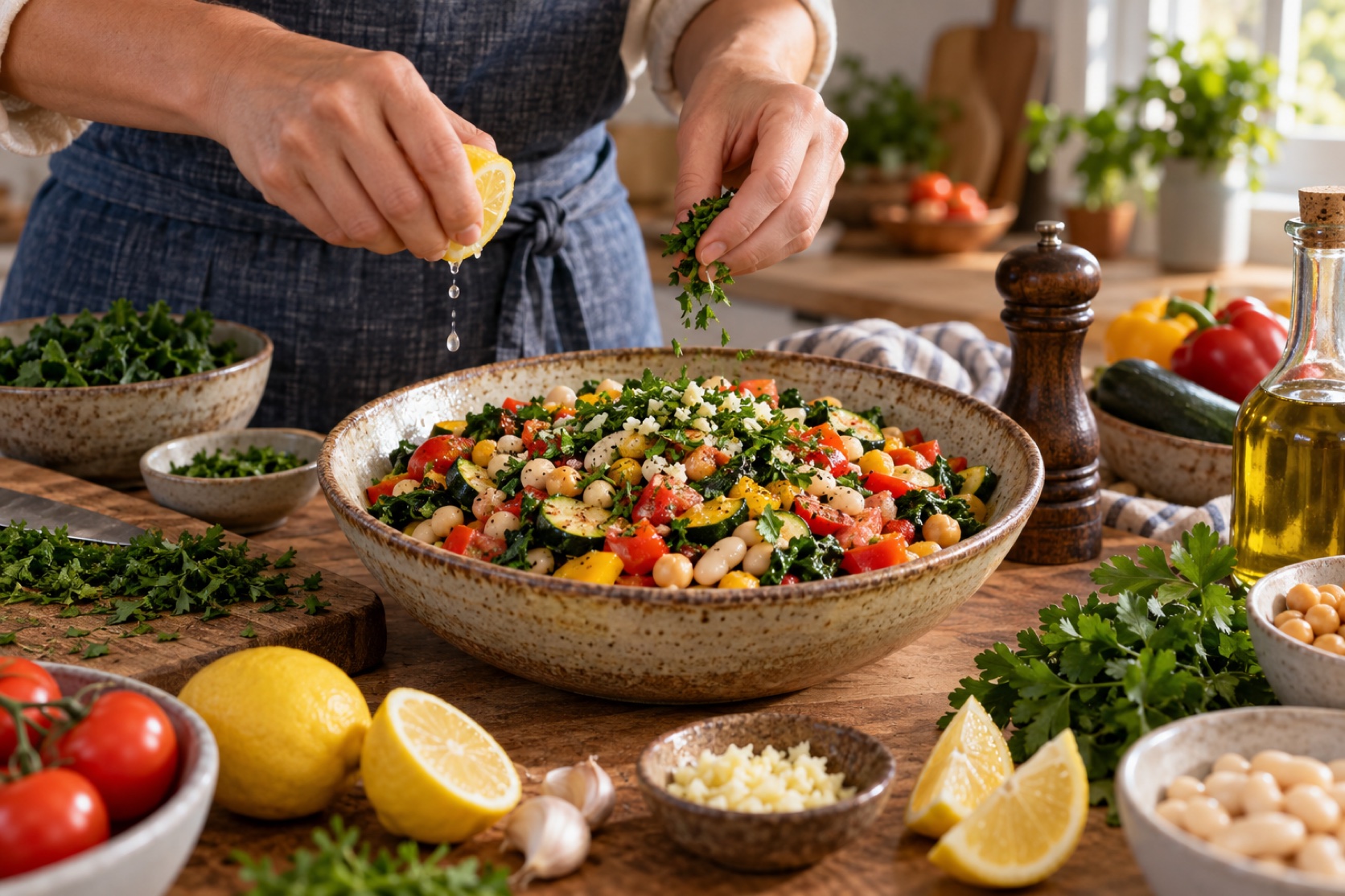
The Flavor Problem
Low-sodium diets fail in one predictable way: the sodium went out and nothing went in. The food gets bland, the resolve gets brittle, and by week three the shaker is back. The fixes below treat blandness as the real opponent — each trick replaces one of salt's three jobs (brighten, deepen, carry texture), and each one costs almost no daily willpower once the shelf is stocked.
The Tricks, Ranked
Fourteen tricks, ranked by real-world leverage — how much saltiness each one recovers per dollar and per decision. Each entry is what to do plus why it works; the mechanism is what lets you re-rank the list for your own kitchen.
- 🥇 #1 The allium base — start every savory dish with garlic, onion, shallot, or leek, sweated in oil before anything else joins the pan. Why it works: alliums are the universal flavor backbone — their sulfur compounds and natural glutamates build savory depth from zero added sodium, and they make every trick below land harder.
- 🥈 #2 Acid as the salt stand-in — finish dishes the way you used to finish them with salt: a squeeze of lemon, a splash of vinegar, a spoon of lime, a few drops of sherry vinegar on the vegetables. Why it works: acid brightens food on the same sensory channel salt does — taste-panel studies find acidity boosts perceived saltiness and overall savoriness, so less salt registers as enough.
- 🥉 #3 Umami without sodium — add glutamate-rich ingredients: mushrooms, tomatoes, nutritional yeast, a parmesan rind in the soup pot, kombu or dried porcini in stocks. Why it works: glutamate and nucleotides don't just add their own savoriness — they amplify perceived saltiness. MSG-based reformulation trials cut sodium 30–40% with acceptability ratings that hold.
- 🧂 #4 Finishing salt — move whatever salt your budget keeps to the end: on the surface of the finished dish, never dissolved in the pot. Why it works: surface crystals hit the tongue first and register strongest, while dissolved salt hides throughout the dish. Sensory work shows surface salt delivers more saltiness per milligram — most people cut 25–50% without noticing.
- 🌿 #5 The herb-and-spice map — match the herb to the dish (the swap table below): rosemary with roasted potatoes, dill with fish, cumin with beans, oregano with tomato. Why it works: herbs don't replace salt — they add a second flavor dimension that makes its absence less noticeable, and fresh or toasted aromatics carry the "something interesting" role salt used to play.
- 👅 #6 The 2-week taste-bud reset — cut sodium and hold the line for fourteen days without judging the food. Honest version: the first week genuinely tastes flat. Why it works: salt preference adapts downward with reduced exposure — early studies by Bertino and colleagues showed preference thresholds shift within weeks — and after roughly two weeks, most people find their old foods too salty.
- 🔥 #7 Toast, roast, and char — brown more of everything: roast vegetables instead of steaming, toast spices and grains before cooking, let proteins develop a crust. Why it works: Maillard browning creates hundreds of flavor compounds — the deep "cooked" taste that salt was standing in for, rebuilt with heat instead of sodium.
- 🏷️ #8 The label trick, run once — Part 3's rule, applied as a single pantry pass: 5% DV of sodium or less per serving is low, 20% or more is high; compare per 100 g and mind the serving size. Why it works: manufacturers add roughly 70% of the sodium in a typical diet, and you cannot taste-test your way under 2,300 mg. One pass through the pantry finds the real offenders — everything after that is a shopping decision.
- 🥫 #9 Swap the sauce shelf, don't empty it — replace jarred sauces rather than ban them: reduced-sodium soy sauce, no-salt-added pasta sauce, homemade salad dressings and marinades. Why it works: sauces are the densest sodium in the home kitchen, and a swapped shelf is a one-time decision that pays out at every meal afterward.
- 🗣️ #10 Eating-out scripts — three phrases, pre-decided before you sit down: "sauce on the side," "no added salt, please," "broiled or steamed, not battered." Why it works: restaurant items average roughly 1,000 mg of sodium or more each, and scripts run before the menu negotiates — the decision is made before hunger and hospitality team up.
- 🥜 #11 Texture does salt's other job — add crunch and cream where salt used to carry the dish: toasted nuts and seeds, crispy shallots, chopped fresh herbs at the end, a yogurt swirl. Why it works: salt partly earns its keep through mouthfeel and contrast, not just saltiness; replacing the texture keeps dishes interesting while the sodium drops.
- 🌶️ #12 Heat and sweet, balanced — use chiles, black pepper, and ginger, and a pinch of sugar or honey where the dish calls for it. Why it works: capsaicin and sweetness recruit other sensory channels, and cuisines built on heat and sweet-sour balance — Thai, Korean, Sichuan — deliver punch with far less salt than their flavor suggests.
- 🧺 #13 The DASH-friendly condiment shelf — stock the permanent shelf: vinegars, mustards, lemon and lime, garlic paste, salt-free spice blends, no-salt-added salsa, tahini, plain yogurt. Why it works: condiments are where restaurant-style flavor lives at home, and a stocked shelf makes the low-sodium plate the easy default instead of the deprived one.
- ⚖️ #14 The measured shaker — keep the salt, measure the shake: one eighth-teaspoon (about 300 mg sodium) per dish, treated like a budget line, not a reflex. Why it works: the goal is not zero salt — DASH allows up to 2,300 mg — and a measured budget beats an abandoned ambition. Potassium chloride blends cut sodium further, but check with your clinician first if you have kidney disease or take potassium-sparing medication.
Product picks are generic categories, not brands. We may earn a commission on Amazon or iHerb purchases at no cost to you — this never changes our evidence conclusions. Full disclosure
Salt-free herb-and-spice blend
Can support a low-sodium flavor strategy where an article specifically teaches salt-free seasoning substitutions.
⚠️ Check labels: many seasoning blends contain sodium; do not substitute potassium-chloride salt alternatives without appropriate medical guidance.
Check price on Amazon →The Flavor-Swap Table
The herb-and-spice map, made concrete: when a specific dish loses its salt, here is what goes in instead, and roughly what leaves with it. Sodium estimates are per serving against typical prepared versions.
| Missing salt in | Swap in | The mechanism | Sodium moved out |
|---|---|---|---|
| Roast chicken | Lemon, thyme, garlic under the skin | Acid + allium + herb | ~300 mg per serving |
| Jarred tomato pasta sauce | Garlic, oregano, splash of balsamic, nutritional yeast | Umami + acid | ~400 mg per cup |
| Rice and grain sides | Toasted cumin, lime zest, cilantro | Brightness + aroma | ~200 mg per serving |
| Scrambled eggs | Chives, black pepper, a drop of low-sodium hot sauce | Allium + heat | ~150 mg per serving |
| Leafy salads | Oil + vinegar + mustard dressing, torn fresh herbs | Acid-fat base | ~250 mg per 2 tablespoons |
| Stir-fries | Ginger, garlic, sesame oil, rice vinegar | Aromatics + acid | ~500 mg per serving |
| Soups and stews | Parmesan rind, dried porcini, bay leaf | Umami depth | ~350 mg per bowl |
| White fish | Dill, lemon, rinsed capers | Acid + brine note | ~250 mg per serving |
One swap per dish, not a full recipe rewrite — the mechanism column is the pattern, and the pattern transfers to anything you cook.
The Two-Week Reset, Run Properly
The taste-bud reset is the load-bearing wall of the whole page, so it gets an installer. Five steps, in order — and the honest expectation (a flat first week) is built in rather than discovered:
- Stock the shelf first — acids, alliums, herbs, umami items, and the condiment shelf go in before the salt goes down. An empty pantry on day one of a flavor reset is a relapse in waiting.
- Cut the biggest processed source — one swap from the sodium audit: bread, deli meat, canned soup, or frozen meals. The single largest offender, not everything at once.
- Run the base on every dish — every savory plate gets allium + acid + umami + herb for the full two weeks. No exceptions, and no judging the taste until the re-test.
- Expect the flat week — the first week will taste under-flavored. That is receptors recalibrating, not the food failing. Hold the line; this is the week that pays for the rest of your life.
- Re-test at the two-week mark — taste an old favorite: a salty chip, a restaurant soup. Most people now find it too salty. That shift is the reset working, and it is the entire point.
Eating Out: The Three Scripts
Restaurants are where low-sodium diets go to die — items average roughly 1,000 mg each, and the kitchen salts at every step. The fix is scripts, because scripts run before the menu negotiates:
- 🗣️ "Sauce on the side" — dressings, gravies, and sauces arrive separately; they carry most of the sodium, and a side ramekin puts the dose in your hands.
- 🧂 "No added salt, please" — the kitchen skips the finishing pinch and the salted water; ask for lemon wedges to brighten at the table instead.
- 🔥 "Broiled, steamed, or grilled — not battered or breaded" — batters and breadings are pre-salted; the plain cooking methods are not, and the char does the flavor work.
- 📱 Check the chain's nutrition page before you go — pick tonight's order at home where the label trick works; menus almost never carry sodium numbers.
- 🥢 The soy-sauce moment — at Asian restaurants, ask for reduced-sodium soy sauce and use it as a dip, not a pour. One pour can be half a day's budget.
The DASH-Friendly Condiment Shelf
The permanent shelf — stocked once, restocked cheaply, and the reason the low-sodium plate never has to be the boring one:
| Shelf item | Sodium | The job it does |
|---|---|---|
| Balsamic, sherry, and rice vinegar | 0–5 mg per tablespoon | The acid layer — brightens anything |
| Dijon and whole-grain mustard | ~120 mg per teaspoon (label-check) | Creamy acid with heat |
| Lemon and lime | ~0 mg | The portable finish |
| Fresh garlic and ginger paste | ~0 mg | The aromatic base |
| Salt-free spice blends | 0 mg (label-check) | Instant herb-and-spice layer |
| Nutritional yeast | ~5 mg per tablespoon | Cheesy umami |
| No-salt-added salsa | ~10 mg per 2 tablespoons | Tomato umami + heat |
| Tahini and plain yogurt | ~15–40 mg per serving | Cream and texture |
Labels still apply — mustards and hot sauces vary widely between brands, and the shelf is only as low-sodium as its least-checked jar.
Where the Evidence Lives
These tricks are the operational layer. The science behind each one has a home in the pillars and the earlier parts of this series:
- 🫀 Why sodium matters at all — the Blood Pressure topic owns the mechanism: sodium, volume, and vascular tone, and why the cuff responds.
- 🧂 The audit and the label math — Sodium & Potassium (Part 3) owns the 5/20 rule, the serving-size trap, and the potassium side of the equation.
- 🥗 The pattern this arsenal serves — The DASH Diet (Part 4) owns the food-pattern evidence; every trick here exists to make that pattern livable.
- 🍅 The herb-forward, acid-heavy template — the Mediterranean Diet topic shows the pattern in its original habitat: flavor from plants, oil, and acid rather than the shaker.
- 💊 When flavor tricks aren't enough — Medications & Handoff (Part 5) owns the decision point: if the cuff hasn't moved after the full plan, the next step is a clinician, not another spice blend.
What to Do When It Goes Wrong
The flavor plan fails in predictable ways, and each failure has a standard response. The theme: adjust the system, don't blame the palate.
- 🚩 Week one tastes like cardboard — expected. The reset is a chemistry event, not a cooking failure. Lean harder on acid and umami through days one to seven, and hold judgment until the re-test.
- 🚩 Salty-snack cravings spike in the evening — the tongue wants intensity, not sodium specifically. Run the intensity swap: unsalted roasted nuts with vinegar and smoked paprika, or yogurt with za'atar. Skip pickles and olives except as a measured garnish.
- 🚩 The household rejects the food — don't fight the table; move the salt to the table. Cook low-sodium for the pot and let eaters add a finishing pinch on their own plates — they'll use far less than the pot did, and dinner stays peaceful.
- 🚩 A restaurant meal blew the whole budget — one meal does not erase a week. Resume the next meal as normal: no skipping, no compensation, no guilt spiral. The pattern decides, not the single plate.
- 🚩 Everything you used to love now tastes too salty — that is not a failure, that is the reset completing. Your preference moved; stop cooking for the palate you used to have.
Common Pitfalls and How to Overcome Them
Six ways this plan actually falls apart in real kitchens — and the countermove that is already built into the page above.
| Pitfall | Why it happens | The countermove |
|---|---|---|
| Bland-food burnout | The sodium went out and nothing went in — flavor substitution was skipped | Rebuild every plate on the base — allium + acid + umami + herb — before you judge any dish; one bland week is a relapse in waiting |
| Hiding salt in "healthy" foods | Health halos — bread, cereal, cottage cheese, canned beans, dressings — carry more sodium than the label implies | Run Part 3's 5/20 rule on every packaged item once; swap the top offenders, not the whole pantry |
| All-or-nothing salt cuts | Cutting to near-zero overnight makes food foreign and the plan fragile | Step down in two-week stages and let the reset do the adapting; the target is under 2,300 mg, not zero |
| Restaurant relapse | Dining out averages 1,000+ mg per item and quietly erases home gains | Run the three scripts every single time; check chain nutrition pages ahead; one meal is noise, the pattern is the plan |
| Family pushback | The cook's new food tastes bland to everyone else at the table | Keep salt at the table instead of in the pot — the dish stays low-sodium, eaters add their own finishing pinch |
| Thinking spices are enough without the umami layer | Herbs add aroma but not depth — the food smells great and still tastes empty | Always pair herbs with one umami source — mushroom, tomato, nutritional yeast, parmesan rind; depth is chemistry, not garnish |
Questions, Answered Briefly
- ❓ Will food ever taste good again? — Yes, usually by day ten to fourteen. The first week is the price; after the reset, most people find their old favorites too salty, and the new baseline tastes normal.
- ❓ Is MSG actually okay? — Glutamate-based seasoning carries about a third of salt's sodium per gram, and consensus reviews regard it as safe at food levels; a minority of people report sensitivity symptoms. Used in place of salt, it is one of the better-supported sodium cuts available.
- ❓ What about salt substitutes like potassium chloride? — They swap sodium for potassium, which fits the DASH direction for most people — but check with your clinician first if you have kidney disease or take potassium-sparing medication. Not every shortcut is for every body.
- ❓ Do I have to give up bread forever? — No. Bread is the single largest sodium source in many diets, but the move is a lower-sodium loaf (the label trick), not a ban. Swap the version, keep the sandwich.
🌿 Flavor is the adherence layer
The sodium target is the medical ask; the arsenal is how you stay. When the food stays good, the protocol survives contact with real kitchens, real restaurants, and real 10pm cravings.
The Bottom Line
- Salt has three jobs — brighten, deepen, carry texture — and three stand-ins: acid, umami, and browning.
- The two-week reset is real: preference adapts downward, and afterward the old food tastes too salty.
- Most sodium arrives pre-added — the label trick and shelf swaps beat shaker willpower.
- You keep some salt: finished, measured, on the surface — the target is the audit's budget, not zero.
This Page in One Workflow
- Audit — run the sodium audit's label trick across the pantry; circle the worst offenders.
- Swap — replace the top offenders and restock the sauce and condiment shelves.
- Rebuild — every savory dish on the allium + acid + umami + herb base.
- Finish — salt only at the end, on the surface, measured.
- Hold and re-test — run two weeks without judging; taste the old favorites at the end, then re-rank the shelf monthly.
The Daily Checklist
- Every savory dish built on the base — allium, acid, umami, herb
- Salt used only as a finish — on the surface, measured, never dissolved in the pot
- One acid finish at lunch and dinner — lemon, vinegar, or citrus
- Eating out? One script run — sauce on the side, no added salt
- Sodium budget respected — under 2,300 mg (Part 3's audit target)
- Label checked on anything new before it enters the house
- Snacks are intensity-swaps, not salty defaults
The Weekly Checklist
- Pantry re-checked — one new high-sodium item swapped via the label trick
- Herb-and-spice shelf restocked — fresh herbs bought, salt-free blends refilled
- Restaurant week reviewed — scripts held, chain nutrition pages checked ahead
- One new low-sodium recipe cooked — the arsenal grows by one dish a week
- Reset progress logged — flat-week days counted, old-favorite re-test done
- Home cuff reading taken — flavor is the adherence layer; the cuff is the scoreboard
Go Deeper: Low-Sodium Without Misery
These five companion pages turn the topic into smaller, testable practices.
- 🔗 The 2-week taste reset
- 🔗 The flavor layering system
- 🔗 The herb & spice rotation
- 🔗 The low-sodium product audit
- 🔗 The eat-out compensation
Related Topics
- Appel et al., "A clinical trial of the effects of dietary patterns on blood pressure," New England Journal of Medicine (1997)
- Sacks et al., "Effects on blood pressure of reduced dietary sodium and the Dietary Approaches to Stop Hypertension (DASH) diet," New England Journal of Medicine (2001)
- Bertino, Beauchamp & Engelman, "Increasing dietary salt alters salt taste preference," Physiology & Behavior (1986)
- Yamaguchi & Takahashi, "Interactions of monosodium glutamate and sodium chloride on saltiness and palatability of a clear soup," Journal of Food Science (1984)
- Breslin & Beauchamp, "Salt enhances flavour by suppressing bitterness," Nature (1997)
- Liem, Miremadi & Keast, "Reducing sodium in foods: the effect on flavor," Nutrients (2011)