The Hot-Flash Sleep Cascade
One overheated moment can dismantle an entire night. Hot flashes and night sweats are the most common experience of the menopausal transition, and their effect on sleep is the mechanism behind its signature insomnia. This page follows the cascade from core temperature to the 3am awakening — then ranks the cooling countermeasures by what the evidence actually supports.
What the evidence supports
- Hot flashes and night sweats are a major driver of the sleep disruption that rises across the transition — consistent in the SWAN cohort and elsewhere.
- Nocturnal flashes are objectively associated with wakefulness, especially in the first half of the night.
- A cooler sleep environment reduces flash frequency and flash-related awakenings in laboratory studies, and paced breathing has cut flash frequency in trials.
What remains uncertain
- Why some flashes wake a woman and others pass unnoticed is not fully explained.
- Direct trials of specific cooling products — mattress pads, wicking bedding, fans — are scarce; recommendations rest mainly on mechanism.
- Herbal and supplement remedies for flashes show inconsistent results across trials.
Evidence last reviewed: August 15, 2026. Conclusions may change as new research is published.
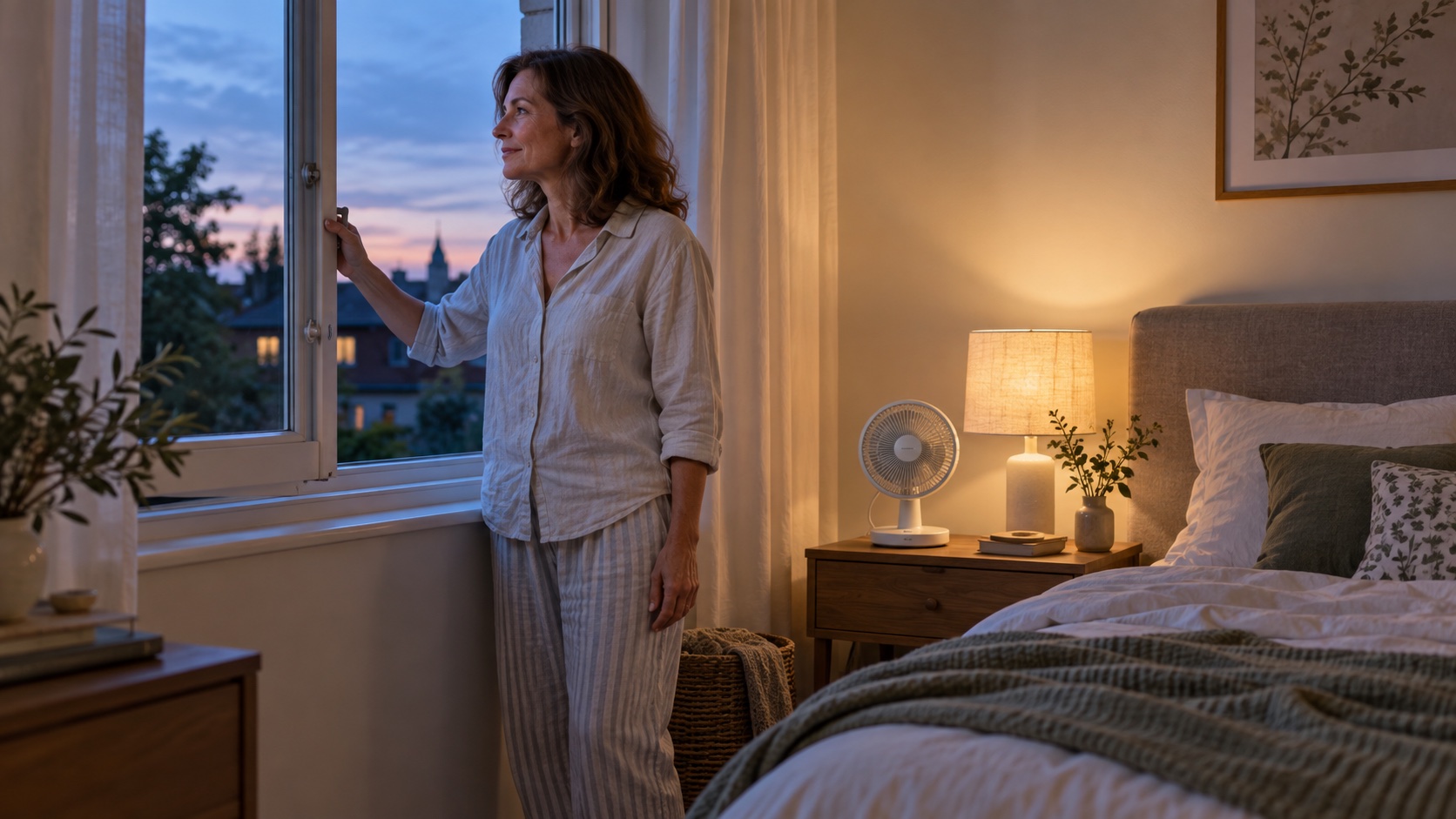
The Physiology of a Night Sweat
A hot flash is not a random spasm of discomfort; it is a thermoregulatory event with a script. Estrogen withdrawal shifts the brain's central thermostat, and the zone of core temperature the body tolerates without responding — the thermoneutral zone — narrows (Kronenberg, Annals of the New York Academy of Sciences, 1990). A woman whose body previously absorbed small temperature swings silently now treats them as emergencies: blood vessels in the skin dilate, the heart rate spikes, and the body dumps heat through the skin — the same heat-dissipation machinery it would use on a hot summer day, activated at bedroom temperature, at 2am.
At night the event wears a different costume: the night sweat. The surge arrives, skin temperature rises sharply, sweat follows, and then — because the body overshot — damp skin meets cool air and the woman wakes up cold, blankets kicked off, sleep already gone. What matters for this page is not the sensation itself but its timing: the surge fires against the sleep drive, and every firing is a roll of the dice against an arousal system that is already destabilized by years of erratically fluctuating estrogen. The parent topic page frames this correctly: most perimenopausal insomnia is not a mysterious new disease. It is temperature regulation hijacking the night.
Product picks are generic categories, not brands. We may earn a commission on Amazon or iHerb purchases at no cost to you — this never changes our evidence conclusions. Full disclosure
Layered, breathable bedding
Can make it easier to adjust bedding during overnight warmth or temperature swings.
⚠️ Comfort response varies; it does not evaluate or treat persistent sleep disruption, hot flashes, or sleep apnea.
Check price on Amazon →Why Flashes Wake You
The honest lab finding is more interesting than the folklore. When researchers record women sleeping with skin-conductance and EEG monitors, many nocturnal flashes pass without an awakening — the brain sleeps through the surge. But flashes that occur in the first half of the night, in lighter sleep stages, frequently pull a woman to wakefulness (Freedman & Roehrs, Fertility and Sterility, 2004). In a model that induced flashes in premenopausal women, objectively recorded nocturnal flashes were strongly associated with wake in exactly that window (Joffe et al., Sleep, 2013). The practical translation: the flash does not wake you by itself. It wakes you when it collides with the sleep system's most fragile hours — and every degree of room warmth lowers the bar for that collision.
This is where the environment becomes a medical variable. In a controlled laboratory study of symptomatic women, cooler ambient temperature reduced both the frequency of hot flashes and the awakenings that followed them (Freedman & Roehrs, Menopause, 2006). The mechanism is plain: the narrower your thermoneutral zone, the more the room temperature decides whether a surge breaks through. The bedroom at 16–19°C recommended by the Sleep Protocol is not a preference; for a woman with night sweats it is the single largest margin of safety she controls. The details of building that room live in the protocol's bedroom engineering page.
The Cascade: One Night, Unspooled
Follow the dominoes. The flash fires; the arousal system engages; sleep fragments. Two or three surges a night is enough to saw the night into pieces that never reassemble into a restorative whole — the deep-sleep consolidation and REM work the Sleep pillar's repair science documents. By morning the accounting shows up elsewhere: fatigue that no early bedtime fixes, a shorter fuse, and the fog that scares women into thinking their brains are failing. The mood page in this series walks the emotional half of that cascade; the mechanism link is that fragmented sleep is itself a mood depressant in every human, at every age, hormones aside.
And the cascade loops. Sleep loss impairs thermoregulation, which narrows the margin further — a bad night makes the next night's surge easier to trigger. The women in the SWAN cohort who reported vasomotor symptoms were the women most likely to report sleep difficulty at every stage of the transition (Kravitz et al., Menopause, 2003). Nothing about the loop is mysterious, which is the good news: it has identifiable joints where interventions actually bite.
The Cooling Countermeasures, Ranked
The ranking below is honest about a real asymmetry: the strongest evidence sits with the cheapest interventions, because they attack the mechanism — the narrowed thermoneutral zone — while the products marketed at the symptom carry the weakest trial base.
| Countermeasure | Why it works | Evidence |
|---|---|---|
| 🛏️ Bedroom at 16–19°C, all night | Restores thermal margin so surges are less likely to break through | Strong |
| 🧊 Layered, breathable bedding | Lets the body dump heat mid-surge without a full re-bedding ritual | Moderate |
| 🌬️ Fan or cross-breeze on the skin | Convective cooling works directly on skin temperature | Moderate |
| 🫁 Paced slow breathing | Reduced flash frequency by roughly half in ambulatory-monitoring trials (Freedman & Woodward, 1992) | Moderate |
| 🚿 Pre-bed cooling of hands, feet, and face | Starts the night from a lower core temperature; plausible, lightly studied | Moderate |
| 🌿 Herbal remedies for flashes | Trial results are inconsistent; placebo effects are large in flash trials | Weak |
Two glosses. First, temperature is the star because it is dose-like: every degree matters, and the 16–19°C band the seven habits topic recommends is the parent page's opening move for a reason. Second, the breathing finding deserves a second look: in Freedman and Woodward's ambulatory study, paced respiration roughly halved flash frequency — a zero-cost, zero-contraindication intervention with a plausible sympathetic-nervous-system mechanism. It is underused precisely because nothing can be sold with it.
🌡️ Two weeks, one thermostat
Before spending money on anything else, run the cheapest experiment in sleep medicine: two weeks with the bedroom at 16–19°C, layered bedding you can shed mid-surge, and no alcohol after dinner (alcohol is both a flash trigger and a sleep fragmenter — the alcohol page owns the details). If your nights improve meaningfully, you have identified the mechanism and saved yourself the supplement aisle. If they do not, the next conversation belongs to the treatment ladder.
What Does Not Help, and Why
- ☕ Evening stimulants add fuel. Caffeine raises sympathetic tone and core temperature in sensitive women; the three saboteurs topic documents the timing math.
- 🍷 Alcohol is a trap, not a tool. The warmth is vasodilation — the same mechanism as the flash — and the sedation is stolen from the second half of the night.
- 😴 Sleeping in to compensate backfires. A late morning rewinds the circadian clock and narrows the next night's sleep drive; the fixed wake time is the anchor, even after a bad night.
- 💊 Flash supplements rarely beat placebo. Flash trials show some of the largest placebo responses in medicine — which is why uncontrolled testimonials mislead.
- 📉 Blaming yourself is not a treatment. The cascade is physiology. The first night you stop treating a hot flash as a personal failure is the first night you run the experiment properly.
Questions, Answered Briefly
- 🔥 Why do my flashes only come at night? They do not — daytime flashes are just less disruptive. The night versions collide with sleep's fragile first half, which is when recorded surges most often pull women awake (Joffe et al., 2013).
- 🌡️ What is the ideal bedroom temperature? The 16–19°C band, because it restores the thermal margin a narrowed thermoneutral zone has eaten. Exact comfort varies; the direction matters more than the degree.
- 🧊 Do cooling mattress pads work? Plausible by mechanism, but direct trial evidence is thin. The order that works: room temperature first, bedding layers second, gadgets third.
- 💧 How long will this last? The median is about 7.4 years for frequent symptoms — but that hides the spread: flashes that start early in the transition last roughly 11.8 years, those that start after the final period roughly 3.4 (Avis et al., 2015).
- 🩺 When is it more than a hot flash? If awakenings come with gasping, choking, or a partner's report of snoring pauses, the question changes — that pattern belongs to the sleep apnea topic, and it is worth a clinical evaluation regardless of how many flashes you have.
The Bottom Line
- The flash is a thermoregulatory event, not a mystery — estrogen withdrawal narrows the thermoneutral zone, and a bedroom-temperature surge is the body over-responding.
- The cascade runs through sleep — flashes in the first half of the night pull women awake, fragment the night, and feed the fog-and-mood loop of the next day.
- Cool the room, not the symptom — 16–19°C, layered breathable bedding, and paced breathing are the countermeasures with the most mechanism and the least cost.
- If cooling fails, escalate properly — the next steps are the treatment ladder's: CBT-I for the insomnia and flash-specific treatment for the trigger, not another supplement.
Related Topics
- Kravitz et al., "Sleep difficulty in women at midlife: a community survey of sleep and the menopausal transition," Menopause (2003)
- Avis et al., "Duration of menopausal vasomotor symptoms over the menopause transition," JAMA Internal Medicine (2015)
- Joffe et al., "A gonadotropin-releasing hormone agonist model demonstrates that nocturnal hot flashes interrupt objective sleep," Sleep (2013)
- Freedman & Roehrs, "Lack of sleep disturbance from menopausal hot flashes," Fertility and Sterility (2004)
- Freedman & Roehrs, "Effects of REM sleep and ambient temperature on hot flash-induced sleep disturbance," Menopause (2006)
- Freedman & Woodward, "Behavioral treatment of menopausal hot flushes: evaluation by ambulatory monitoring," American Journal of Obstetrics and Gynecology (1992)
- Kronenberg, "Hot flashes: epidemiology and physiology," Annals of the New York Academy of Sciences (1990)