Nature as connection
The parent topic closed with a promise: the category "non-human bonds" is bigger than pets and screens, and its quietest member is the green one. This page delivers the evidence on nature as a health and loneliness buffer — one that requires no conversation, no reciprocity, and no other person at all, which is precisely why it earns a place in the relationships pillar.
What the evidence supports
- Greenspace exposure is associated with lower salivary cortisol, heart rate, and blood pressure, and with lower risk of type 2 diabetes and premature death in pooled analyses.
- Around 120 minutes a week of nature contact is the clearest measured threshold for self-reported health benefits; the pattern of visits doesn't seem to matter.
- Short nature experiences acutely reduce stress biomarkers — roughly a fifth drop in salivary cortisol per hour in one field study.
What remains uncertain
- Most large studies are observational; greener neighborhoods also come with wealth, walkability, and cleaner air.
- Whether nature directly reduces loneliness, or mainly softens the stress of aloneness, is unresolved.
- Indoor proxies — houseplants, images, nature sounds — show only small and inconsistent effects.
Evidence last reviewed: August 15, 2026. Conclusions may change as new research is published.
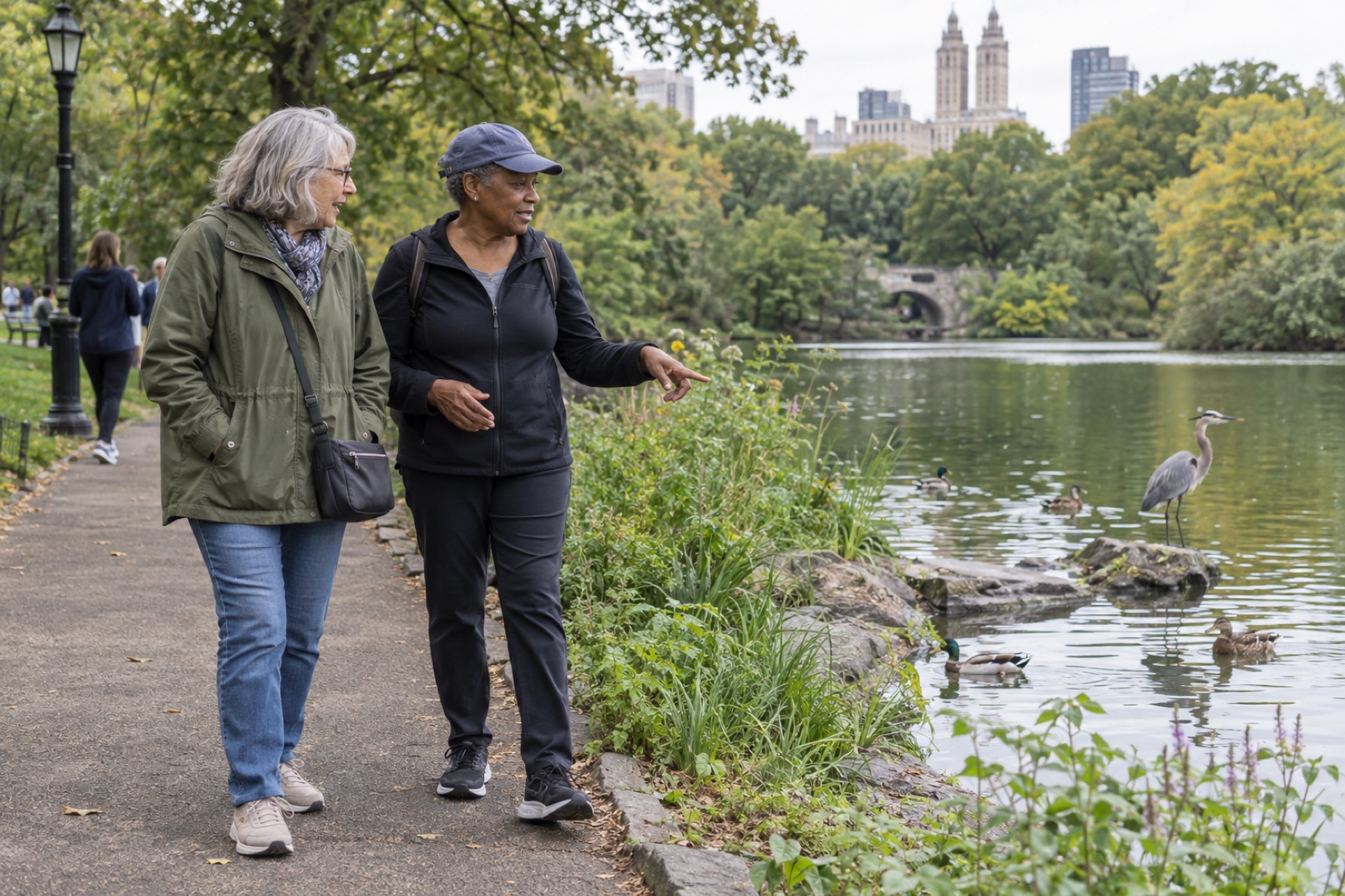
Green Space and the Body: The Pooled Evidence
The foundation is a 2018 meta-analysis by Twohig-Bennett and Jones, which pooled over a hundred studies of greenspace exposure and health outcomes. The direction is consistent: people with more greenspace exposure show lower salivary cortisol, lower heart rate, lower diastolic blood pressure, and reduced incidence of type 2 diabetes — and the same literature associates greenspace with lower all-cause mortality. The caveats are the usual ones for this pillar's territory: nearly all of it is observational, and greener neighborhoods arrive bundled with wealth, walkability, and cleaner air, so the greenspace itself is only part of the package. The physiological pathway, though, has direct experimental support — forest-bathing field experiments in Japan (Li, 2010) have repeatedly measured lower cortisol, pulse, and blood pressure in forest environments compared with city streets — which is why the pooled numbers deserve more than an "it's just correlation" shrug.
The Dose: How Much Nature, How Often
The best dose estimate comes from White and colleagues (2019), who asked nearly 20,000 adults in England about their nature contact in the previous week and compared it with self-reported health. The finding that made the paper famous: people who spent at least 120 minutes a week in nature were substantially more likely to report good health — about 59% higher odds — and high wellbeing, compared with people who had no nature contact at all. Three practical details matter. The pattern didn't matter: one long visit and several short ones worked equally well. The threshold did: below 120 minutes, benefits were thin. And there was a plateau — gains appeared to level off past 200 to 300 minutes, so this is not a more-is-always-better substance. On the acute side, a field study of urban adults (Hunter et al., 2019) found that a 20-to-30-minute nature experience — sitting or strolling — dropped salivary cortisol by roughly a fifth per hour, with the most efficient dose right around that window.
Why It Works: Four Mechanisms
- 🌿 Stress physiology. The cortisol, pulse, and blood-pressure findings are the direct route: nature experiences engage the parasympathetic side of the stress system, in the opposite direction from the threat-state physiology the biology of connection topic documents.
- 🧠 Attention and rumination. In a 2015 experiment (Bratman et al., PNAS), a 90-minute walk in nature — versus an urban walk — reduced self-reported rumination and quieted the prefrontal region associated with it. For the lonely mind that loops on its own isolation, that is a specific, relevant effect.
- 🤝 Social facilitation. Parks and gardens are among the most reliable weak-tie generators a neighborhood has — the dog-walker effect, minus the dog. Green space lowers the cost of incidental human contact, which is why it shows up in the tribe-building playbook.
- 🌌 Awe. The feeling of being small in a vast scene measurably shifts self-focus — laboratory work (Bai et al., 2017) links awe to a "small self," and an eight-week program of 15-minute awe walks in older adults (Sturm et al., 2020) increased positive emotions and reduced daily distress. Awe is where nature overlaps with the Purpose pillar: the same experiences that shrink rumination can reorient what matters.
The View From the Hospital Window
The field's most famous experiment is also its most practical: Ulrich (1984) compared gall-bladder surgery patients whose windows faced trees with those facing a brick wall. The tree-view patients had shorter postoperative stays, fewer negative nurse notes, and fewer doses of pain medication. The sample was small, the era was 1984, and the finding has since been replicated in direction if not always in magnitude — but the lesson it installed is now standard in hospital design: a view of living things is a measurable recovery input, not décor. For this site's purposes the translation is humbler: the cheapest nature intervention available to most people is the walk, the bench, or the window that already exists, used deliberately. Nature here is recovery support and a daily buffer — it is not a treatment for anything, and it does not replace care.
Nature as a Loneliness Buffer — the Part That Isn't Social
The deepest claim in this page's scope is the one the parent topic hinted at: nature may buffer loneliness without being social at all. The direct evidence for that specific claim is thin — most studies measure mood and stress, not loneliness scores. What the literature does support is the softer version: time in green space reduces the felt stress of aloneness — the rumination, the vigilance, the cortisol — even when it adds no relationships. That matters, because the loneliness topic's spiral model says felt threat and withdrawal feed each other: a walk under trees that quiets the threat response can make the next human interaction easier to attempt. In that sense nature is not a substitute for connection but a primer for it — and for people rebuilding a network, that sequencing is genuinely useful. None of this should be oversold: green space does not replace a confidant, and the site's position stands — the human core comes first, and these layers earn their place as buffers and bridges toward it.
🌳 For the person who can't get outside
Mobility limits, caregiving, and long winters are real. The honest ranking of indoor proxies: a window with a view of trees or sky (the Ulrich finding, at zero mobility cost), houseplants and a garden to tend (routine plus the being-needed element the small-purpose page formalizes), and — weakest but not nothing — nature images and sounds, whose effects are small and inconsistent. Expect fractions of the outdoor effect, not equivalents.
Which Nature, For What
| Form of contact | What the evidence best supports | Strength |
|---|---|---|
| 🚶 20–30 min sitting or strolling in green space | Acute cortisol reduction; the most efficient measured dose | Strong |
| 🌲 Weekly 120+ min across any visit pattern | Self-reported health and wellbeing, in a ~20,000-person sample | Good |
| 🪟 Window view of trees or sky | Recovery support (the 1984 hospital study) — small sample, direction replicated | Moderate |
| 🌅 Awe walks (15 min, weekly, older adults) | More positive emotion, less daily distress in one eight-week program | Moderate |
| 🪴 Houseplants and nature media | Small, inconsistent effects — fine as décor, thin as intervention | Limited |
Questions, Answered Briefly
- 🌳 Does nature replace human connection? No — the site's position is unchanged. It buffers the stress of aloneness and can prime the next interaction, but the human core remains the core.
- ⏱️ Do I need to hike for hours? No. Twenty to thirty minutes of sitting or strolling in green space is the efficient acute dose, and the weekly target is 120 minutes total in whatever pattern suits you.
- 🏙️ Does a city park count? Yes. The dose studies counted any green space — parks, gardens, canalsides — not wilderness. Urban nature is the version most people can actually dose weekly.
- 🪴 Are houseplants enough? They provide routine and mild pleasantness, but the measured health effects are small and inconsistent. Treat them as practice, not the prescription.
- 🌌 What's an "awe walk," practically? A short walk where you deliberately look for something vast or beautiful — sky, canopy, water — rather than walking to get somewhere. The older-adult program that tested this used fifteen minutes a week, which is a low bar with a real effect on daily distress.
The Bottom Line
- The pooled evidence is directionally consistent: greenspace exposure associates with lower cortisol, heart rate, and blood pressure, and with lower diabetes and mortality risk — observational, but backed by acute experiments.
- The dose is knowable: about 120 minutes a week, in any pattern, with a plateau beyond 200–300 minutes; 20–30 minutes is the efficient single session.
- Nature buffers the stress of aloneness without being social — it is a primer for connection, not a substitute for it.
- Use what exists: the park, the bench, the window. The most valuable nature intervention is the one you'll actually repeat.
Related Topics
- Twohig-Bennett & Jones, "The health benefits of the great outdoors: a systematic review and meta-analysis of greenspace exposure and health outcomes," Environmental Research (2018)
- White et al., "Spending at least 120 minutes a week in nature is associated with good health and wellbeing," Scientific Reports (2019)
- Hunter et al., "Urban nature experiences reduce stress in the context of daily life based on salivary biomarkers," Frontiers in Psychology (2019)
- Ulrich, "View through a window may influence recovery from surgery," Science (1984)
- Bratman et al., "Nature experience reduces rumination and subgenual prefrontal cortex activation," PNAS (2015)
- Sturm et al., "Big smile, small self: awe walks promote prosocial positive emotions in older adults," Emotion (2020)