The oxytocin loop with dogs
When you look a dog in the eyes for a few seconds, the chemistry of both of you changes — measurably, repeatedly, in controlled experiments. This page walks through those experiments step by step, separates what they actually demonstrate from what the headlines claim, and explains why the loop matters for more than just dog people.
What the evidence supports
- Brief, friendly dog interaction reliably lowers blood pressure and cortisol while raising oxytocin, prolactin, and beta-endorphin in humans — across multiple labs.
- Mutual gaze is associated with oxytocin increases in both dogs and owners, and dogs that gaze more trigger larger owner responses.
- Wolves, even hand-raised, rarely hold human gaze — which makes the coevolution story plausible if unproven.
What remains uncertain
- Samples are small (usually 10 to 30 pairs) and mostly female owners; replication is thin.
- Correlation between gaze and oxytocin is not proof that oxytocin causes the bond — the causal direction is still debated.
- Whether these acute hormone blips translate into long-term health is essentially unstudied.
Evidence last reviewed: August 15, 2026. Conclusions may change as new research is published.
The Gaze Experiment, Step by Step
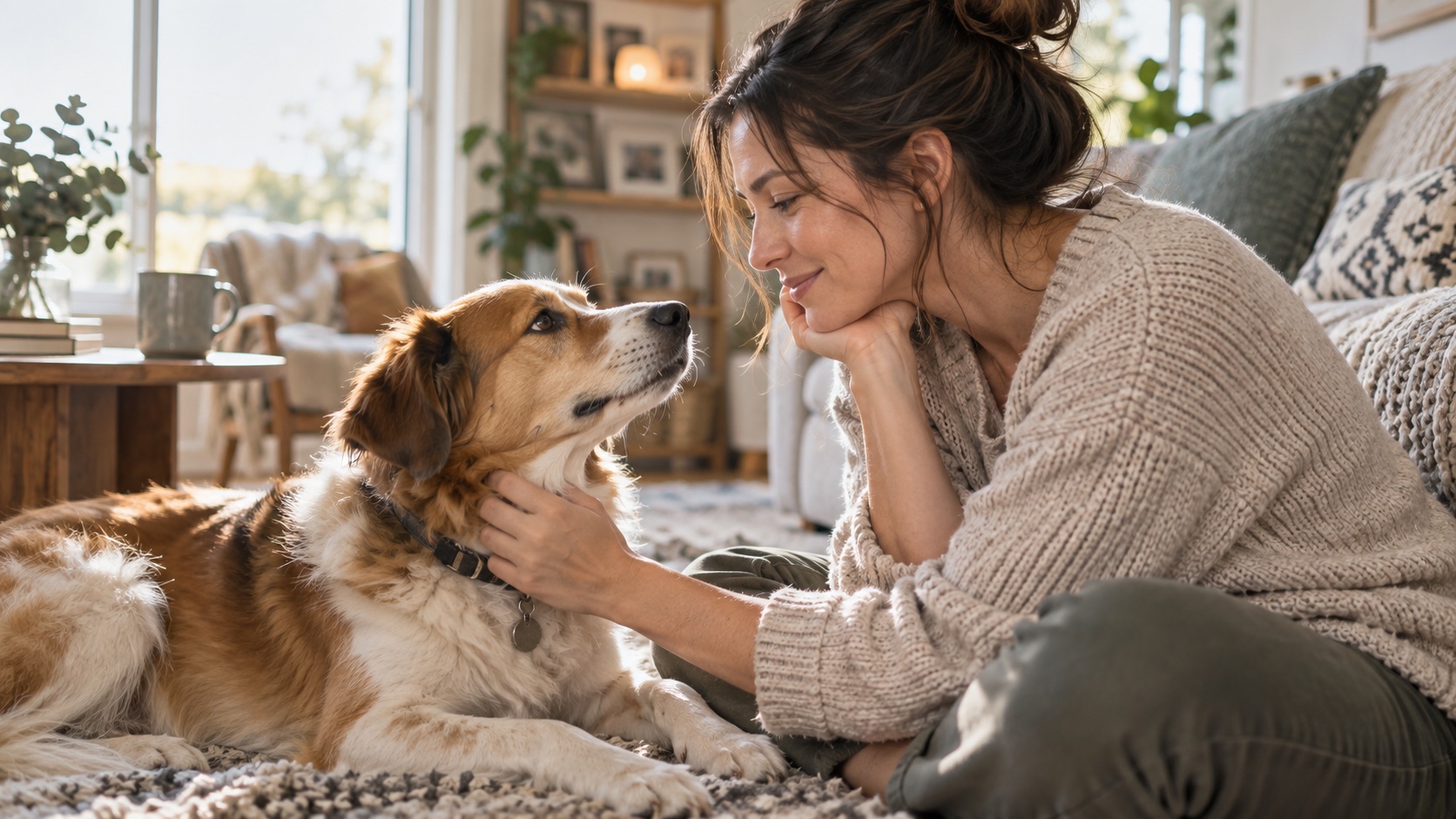
The landmark study is Nagasawa and colleagues (2015, Science), built in two stages. In the first, 30 owners and their dogs spent 30 minutes together in a room while researchers timed every episode of mutual gaze and collected urine samples from both species before and after. Two results emerged. Owners whose dogs gazed at them longest showed the largest increases in urinary oxytocin; and the dogs' own urinary oxytocin rose too, by roughly 130% on average after sustained mutual gazing. In the second stage, researchers gave some dogs a nasal spray of oxytocin (or saline) and watched what happened: female dogs given oxytocin gazed at their owners more, and their owners' oxytocin rose in response. Male dogs showed no such effect. The paper's name for this — an "oxytocin-gaze positive loop" — is now standard shorthand: gaze raises oxytocin in both parties, which promotes more gazing, which raises more oxytocin.
Does Oxytocin Explain the Bond? What the Numbers Actually Show
The loop is elegant, but the critical reviews are worth reading before the headlines. Thielke and Udell (2017) point out that the studies are small, the measures vary (urinary versus plasma oxytocin track different things over different timescales), and several replications have found null or inconsistent results. Correlation between gaze duration and hormone change cannot, by itself, prove that oxytocin drives the bond — it could equally reflect an already-strong relationship expressed through gazing. What the experiments do establish, cleanly, is the acute physiology: friendly dog contact shifts a measurable package of stress and bonding chemistry in humans, in the direction the biology of connection topic predicts. The honest summary: oxytocin is very likely one player in the human-dog bond — a strong candidate, not the whole story.
The Wider Physiology of a Good Scratch
The gaze studies sit inside a larger literature on what any warm dog interaction does to the body. The founding experiment (Odendaal & Meintjes, 2003) brought 18 people and their dogs into a quiet room for 5 to 24 minutes of petting and soft talk, and drew blood before and after. In the humans, blood pressure dropped, and plasma levels of oxytocin, prolactin, beta-endorphin, and dopamine all rose; cortisol fell. The dogs showed a similar pattern. A smaller study (Handlin et al., 2011) found the same oxytocin rise and cortisol fall after just three minutes of interaction with a familiar dog, and a later investigation (Petersson et al., 2017) linked the size of the oxytocin response to how the pair actually behaves together — more physical contact, larger hormonal shifts. None of these is a long-term health study; all of them agree on the acute direction of travel.
The Loop, Drawn
| Experiment | Who was measured | What changed |
|---|---|---|
| 🧪 Odendaal & Meintjes (2003) | 18 people + 18 dogs, 5–24 min of petting | Blood pressure down in both; human oxytocin, prolactin, beta-endorphin, and dopamine up; cortisol down |
| 🤲 Handlin et al. (2011) | 10 female owners, 3 min with their dog | Oxytocin up, cortisol down in owners |
| 👀 Nagasawa et al. (2015) | 30 owners + 30 dogs, 30 min together | Longer mutual gaze → larger oxytocin rises in both species; dogs' oxytocin up ~130% |
| 💉 Nagasawa et al. (2015, stage 2) | 27 dogs, nasal oxytocin vs saline | Female dogs given oxytocin gazed more at owners, raising owners' oxytocin |
Is This Unique to Dogs?
The most intriguing — and most cautiously worded — finding in the gaze study concerns wolves. Hand-raised wolves, living with humans from puppyhood, rarely hold a human's gaze and show little of the oxytocin response dogs display. The interpretation offered by Nagasawa's group is evolutionary: somewhere in domestication, dogs acquired the habit of looking humans in the eye, and the loop that runs on that gaze became one of the load-bearing walls of the relationship. It is a plausible story with thin evidence — a handful of wolves, one lineage of reasoning. Cats are less studied still, and their gaze behavior is different (a slow blink, not a held stare), which may explain why the cat data in the mortality literature is so inconsistent. What is not species-specific is the underlying physiology: the oxytocin system is ancient, and the same eye-contact chemistry shows up in human bonds from infancy onward. Dogs may simply have tapped into a channel that was already there.
What the Loop Buys You — and What It Doesn't
The practical value of this literature is real but bounded. A daily dog provides a small, repeated, zero-skill dose of the touch-and-presence chemistry that the touch-starvation page describes modern life as shortchanging — and unlike a human partner, a dog never schedules it or cancels. But the effects measured here are acute and transient: an oxytocin blip lasts minutes to an hour, not a week. Nothing in these experiments says a dog substitutes for human ties, for treatment of depression, or for the rest of the relationships pillar. And for people who can't keep a dog, the transferable core is worth naming: unhurried eye contact, unhurried touch, and calm warm presence are the active ingredients, and they are available in many species — and, imperfectly, in human form too.
🧪 What "proves" means here
These experiments prove that friendly dog contact acutely shifts stress and bonding chemistry in both species. They do not prove that oxytocin explains the human-dog bond, nor that any of this changes long-term health. When you see "oxytocin is the love hormone" framing in the wild, mentally substitute: "oxytocin is a bonding-related hormone with measurable short-term effects in specific experimental contexts." The rest is extrapolation.
Questions, Answered Briefly
- 👀 Do I need to stare into my dog's eyes? No. The experiments measured naturally occurring gaze during friendly interaction — petting, talking, and presence carry the physiology whether or not you hold eye contact.
- 🐈 Does this work with cats? The touch chemistry is likely similar, but cats are barely studied in this paradigm and their gaze behavior differs. Expect less data, not necessarily less effect.
- 💊 Could I just take oxytocin nasal spray? Not as a wellness practice. Human studies of intranasal oxytocin are inconsistent, and self-dosing a hormone is not supported by any of this animal research.
- 🧠 If I feel calm after petting a dog, is that the oxytocin? Partly, probably — but the drop in cortisol and blood pressure matters too, and the relaxed attention likely contributes as much as any single hormone.
- 🐺 Why do the wolves matter? Because they are the closest thing to a control group for domestication. If wolves don't gaze and don't loop, something about dogs specifically changed — but the wolf samples are tiny, so treat the story as suggestive.
The Bottom Line
- The acute physiology is solid: minutes of friendly dog contact lower blood pressure and cortisol and raise oxytocin and related bonding chemistry, in both species, across several independent labs.
- Mutual gaze is a real signal: longer gazing tracks larger oxytocin rises in both dog and owner, and oxytocin administration increases gazing in female dogs — a two-way loop, demonstrated step by step.
- The coevolution story is plausible but thin: wolves rarely hold human gaze, which fits the domestication narrative — but the evidence base is small and the causal direction unsettled.
- Oxytocin is one player, not the whole bond — and the acute effects shown here do not license long-term health claims. Enjoy the loop; skip the hype.
Related Topics
- Nagasawa et al., "Oxytocin-gaze positive loop and the coevolution of human-dog bonds," Science (2015)
- Nagasawa et al., "Dog's gaze at its owner increases owner's urinary oxytocin during social interaction," Hormones and Behavior (2009)
- Odendaal & Meintjes, "Neurophysiological correlates of affiliative behaviour between humans and dogs," The Veterinary Journal (2003)
- Handlin et al., "Short-term interaction between dogs and their owners — effects on oxytocin, cortisol, insulin and heart rate," Anthrozoös (2011)
- Thielke & Udell, "The role of oxytocin in relationships between dogs and humans and potential applications: a review," Behavioral Sciences (2017)
- Beetz et al., "Psychosocial and psychophysiological effects of human-animal interactions: the possible role of oxytocin," Frontiers in Psychology (2012)