The Restaurant Decision Map
A restaurant meal is a different eating environment, not a moral event: portions run large, oil hides in the sauce, and the menu is designed to steer you toward the densest plate. This page is a decision map for that environment — how to scan a menu, what to do about portion uncertainty, and which flexible choices preserve the bigger pattern of the weight-loss protocol without demanding perfection at the table.
What the evidence supports
- Restaurant and fast-food meals are associated with higher energy intake on the days people eat them, tracked across large national samples.
- Marketplace portion sizes have grown over decades and can exceed standard reference servings by several times (Young & Nestle, 2002).
- Serving a larger portion increases how much people eat within the same meal — people eat more when more is put in front of them (Rolls, 2002).
What remains uncertain
- Exactly how many calories any given dish contains varies widely with preparation, so printed and estimated figures are rough guides at best.
- Whether menu calorie labels change ordering habits over years, rather than modestly shifting a single purchase.
- How well ordering skills transfer to cuisines you rarely eat, where portion norms and ingredients are unfamiliar.
Evidence last reviewed: August 20, 2026. Conclusions may change as new research is published.
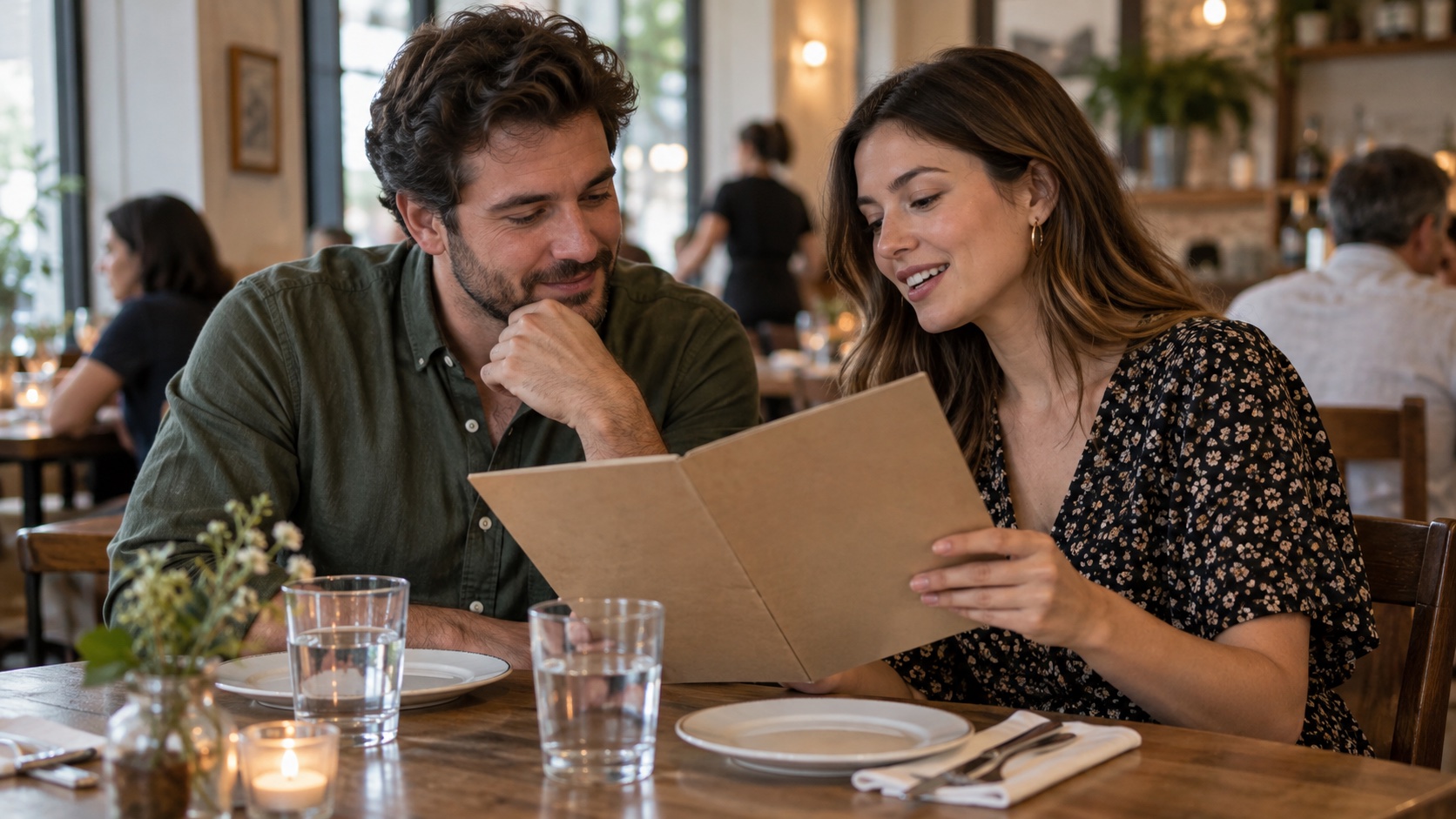
Why the Restaurant Is a Different Eating Environment
The same person who weighs chicken at home orders freely at a restaurant, and the environment deserves most of the credit. Portions are sized to sell value, not to match a reference serving. Cooking fat arrives invisibly — the sauté that looks lean can carry as much energy as the fried option. And the social setting adds its own pressure: the bread basket is already on the table, and dessert arrives with three forks. None of this is a test of willpower; it is a designed environment, and a map helps more than grit.
- 🍽️ Portions run large. A typical restaurant main can run two to three times a reference serving — the plate is the portion, and the plate is big.
- 🫒 Oil hides in the sauce. Dressings, cream sauces, and glazes are where a "healthy" dish quietly doubles in energy density.
- 🎉 The table decides. Shared appetizers, refills, and the round of desserts turn ordering into a group activity with its own momentum.
- 😵 Menu fatigue is real. A long menu exhausts the part of you that would normally make a careful choice — the default becomes the familiar, which is usually the dense.
The Decision Map: Scan Before You Order
The map is a fixed order of operations that runs before the waiter arrives. You are looking for the plate that already fits the pattern — protein plus produce, cooked simply — and then deciding which add-ons are worth their energy. The scan takes under a minute once it becomes a habit, and it removes most of the pressure from the actual ordering moment.
- 🔍 Read the whole menu first. One pass top to bottom before deciding; the second page often holds the grilled options the first page is hiding.
- 🥗 Find the protein-plus-produce plate. A grilled or roasted protein with vegetables is the base of the map; everything else is an addition to it.
- 🍳 Check the cooking method. Grilled, roasted, steamed, and broiled beat fried, breaded, and cream-sauced almost every time — the method matters more than the name of the dish.
- 🥄 Put sauces and dressings on the side. You control the spoon, not the kitchen; a side of dressing turns a mystery into a measured choice.
- 🥤 Decide the drink as its own line item. Soda, sweet tea, and the second cocktail are menu items too — give them the same scan you gave the entrée.
Portion Uncertainty: The Honest Math
You cannot weigh the plate, and pretending you can guess it precisely is where most restaurant plans break. The honest move is to assume a restaurant portion is roughly double your home reference, build the meal around that assumption, and let the plate itself do the portioning work — which is why the ordering moves above matter more than any estimate. Portion research shows people eat more when more is served (Rolls, 2002), so the leverage sits in choosing the plate, not in fighting it.
- 🧮 Assume two to three times your reference. Plan for a restaurant serving to exceed what you'd plate at home, and let that expectation guide whether you order the appetizer.
- 🫒 The sauce is the unknown. Dressings and cream sauces are the largest estimation errors in restaurant eating; on the side, they become known quantities.
- 📏 Hands still work. A palm-sized protein and two cupped handfuls of vegetables is a useful fallback when the menu offers no clues at all.
- ⚖️ The to-go box is a portion tool. Halving the plate before you start eating — not after you're full — is the simplest portion control a restaurant offers.
| Dish you see | What's really in it | The flexible move |
|---|---|---|
| 🍗 Grilled chicken salad | Dressing, fried croutons, and cheese can carry half the energy | Dressing on the side; protein first; skip the croutons if you want the dressing |
| 🍝 Creamy pasta main | The sauce is mostly butter and cream — a dense base, not a garnish | Half portion plus a protein side, or a tomato-based sauce instead |
| 🍔 Burger with fries | The bun, the sauce, and the fries each add a meal's worth of energy | Single patty, sauce on the side, fries split or skipped |
| 🥘 Stir-fry or curry | Oil content varies enormously between kitchens | Ask for light oil and rice on the side; the protein and vegetables stay the base |
| 🍰 Dessert | A dessert can rival the main course in energy | Share it, order the fruit plate, or make it the meal's one chosen extra |
Ordering Moves That Preserve the Pattern
These are the default moves that make the map automatic. Each one costs nothing socially — they read as normal ordering, not as a diet announcement — and together they keep a restaurant meal inside the pattern the way the rest of the week is shaped.
- 🥩 Protein first, always. The protein is the anchor of the meal; order it, then build everything else around it.
- 🥦 Produce on every plate. A vegetable side or a salad makes the plate bigger without making it denser.
- 🥄 Dressing and sauce on the side. This single request does more for the energy ledger than any menu choice.
- 🍞 The bread basket is a choice. It arrives free, but it is a menu item like any other; decide on it instead of absorbing it.
- 💧 Water before the meal. A glass of water before ordering does nothing magical, but it replaces the sweet drink that was going to arrive anyway.
- 🍰 One dessert, shared. When dessert matters, share it — three forks, one plate, the moment intact.
When the Menu Has No Obvious Choice
Some menus offer nothing that fits the map — the airport grill, the steakhouse with one vegetable, the place where everything arrives fried. The fallbacks are simpler than they look, and the staff has heard every request before.
- 🧾 Ask; it's normal. "Grilled instead of fried," "sauce on the side," and "double the vegetables" are standard requests in every kitchen.
- 🥗 Double the vegetables. Most restaurants will swap a side for extra produce without hesitation, and the plate stays big while the density drops.
- 🍚 Carbs on the side, not under. Rice, bread, and potatoes on a separate plate let you choose the amount instead of eating the pile.
- 📵 Decide before you arrive. Peeking at the menu online and picking the plate in advance is the strongest move of all — the environment can't talk you out of a decision you already made.
⚠️ A restaurant meal is data, not a verdict
One meal out does not require compensation. The scoreboard for this whole process is the weekly trend, and a single restaurant dinner is a rounding error on it — so order to protect the pattern, enjoy the company, and treat the meal as information about what the environment does, not as a judgment on you. No fasting, no punishing workouts, no "earning it back": that compensation cycle is the pattern that actually derails progress.
Questions, Answered Briefly
- 🧮 Should I estimate calories from the menu? Roughly, and only to rank your options, never as a ledger entry. The printed number is a guess; the ordering moves are the real control.
- 🥗 Is the salad always the safe choice? No — a salad can be the densest plate on the menu once dressing, cheese, and fried toppings land on it. The protein-and-produce base plus side dressing is the reliable version.
- 🍷 What about the wine with dinner? It is a menu item like any other — its energy lands in the ledger and it tends to loosen the rest of the ordering. The alcohol-and-energy-balance page covers this in detail.
- 📏 How do I know my home portions are a good reference? That is exactly what the calibrated tracking work on the food-tracking-calibrated page builds — a few weighed weeks give you the eye that restaurant menus cannot fool.
The Bottom Line
- Scan before you order — protein-plus-produce plate, simple cooking method, sauces and dressings on the side.
- Assume restaurant portions run two to three times your home reference — order accordingly, and use the to-go box as a portion tool.
- The weekly trend is the scoreboard — one meal out is data, not a verdict, and it never requires compensation.
- When the menu fights you, ask — grilled over fried, sauce on the side, vegetables doubled: every kitchen has heard it all before.
Related Topics
- Young & Nestle, "The contribution of expanding portion sizes to the US obesity epidemic," American Journal of Public Health (2002)
- Rolls, Morris & Roe, "Portion size of food affects energy intake in normal-weight and overweight men and women," American Journal of Clinical Nutrition (2002)
- Kant, Whitley & Graubard, "Away from home meals: associations with biomarkers of chronic disease and dietary intake in American adults, NHANES 2005–2010," International Journal of Obesity (2015)
- Bleich et al., "A systematic review of calorie labeling and its effects on managers, employees, and customers dining at restaurants and in food service settings," Obesity Reviews (2017)
- Fryar, Hughes & Ahluwalia, "Fast food consumption among adults in the United States, 2013–2016," NCHS Data Brief No. 322 (2018)