Testing Power at Home
One kitchen chair, a phone timer, and — if you choose — a chalk mark on the wall: the standard field tests for lower-body power run at home in minutes. The tests are validated and normed in older adults; what they predict about your future is where honesty thins. This page covers running each test repeatably, what published norms say, and how to track change over months, not days.
What the evidence supports
- Both chair-stand tests are validated field measures with published reference values — meta-analytic thresholds for the five-times version (Bohannon 2006), percentile tables for the 30-second version (Rikli & Jones 1999).
- Reliability is reasonable when the setup is identical; the 30-second version reported r = 0.89 test–retest reliability in its validation study (Jones et al. 1999).
- The countermovement jump is the field measure researchers most often use for lower-body power, tracking functional tests with moderate associations (Werner & Schumacher et al. 2026).
What remains uncertain
- What a single score says about your future: the associations are mostly cross-sectional, and longitudinal evidence is thin.
- How much of a home-measured change is signal; short of lab equipment, small swings may be noise.
- Reference values for adults under 60: the published tables begin at 60.
Evidence last reviewed: October 5, 2026. Conclusions may change as new research is published.
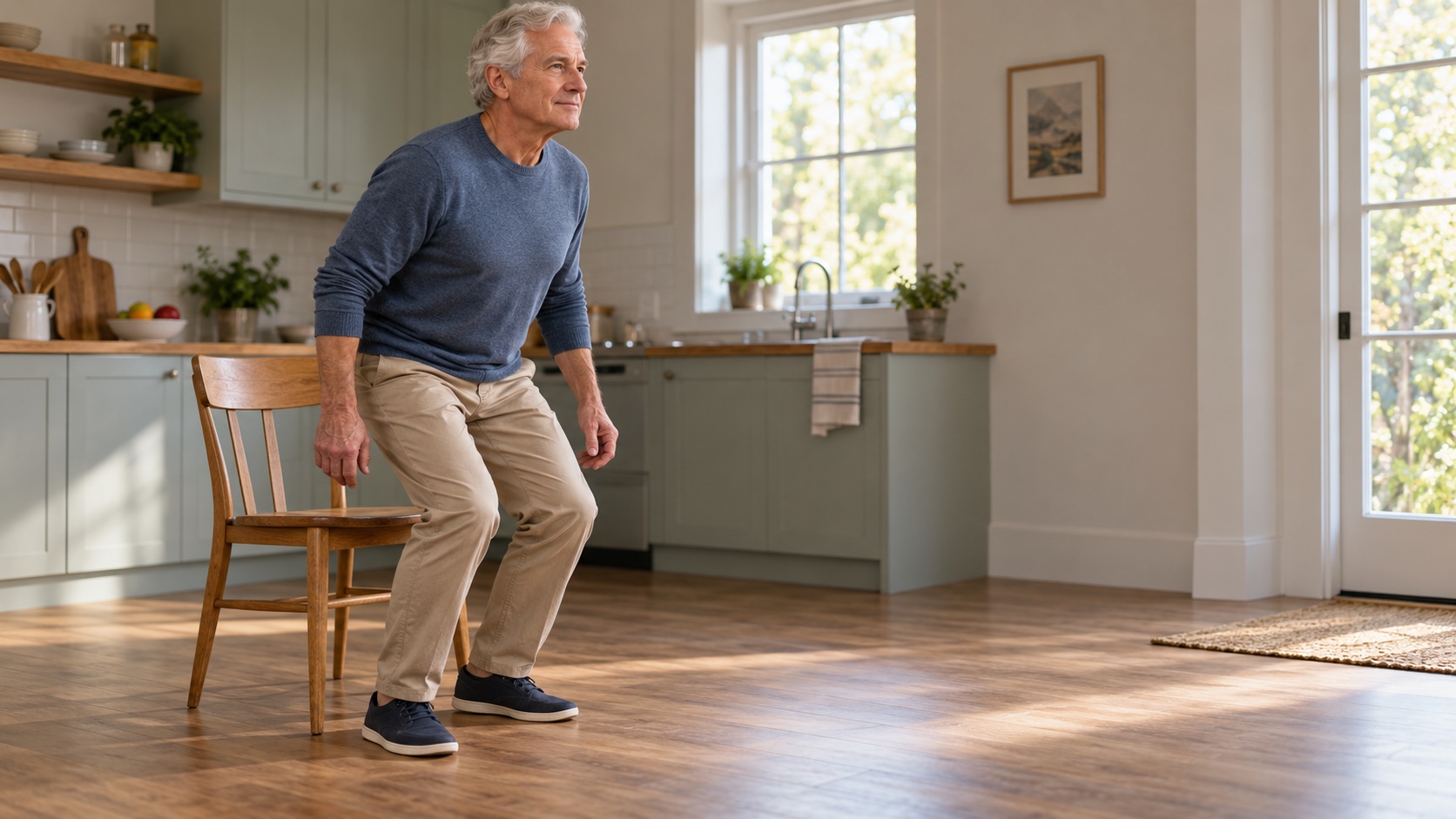
What a Field Test Can and Cannot Tell You
A field test measures a performance, not a prognosis. Your five-times sit-to-stand time is a data point about a body in motion today — not a medical test, not a diagnosis, and not a verdict on how you will age.
What a home test is reliably good for is comparison: a baseline before training starts, a trend line across months, and early notice of change — the logic the series applies to power itself in Why Power Declines First.
- 🎯 Today's performance, not tomorrow's forecast — a score describes one day; a pattern across months describes a direction.
- 📏 The setup is part of the measurement — same chair, footwear and time of day, or you are measuring conditions, not legs.
- ⚕️ Not a diagnosis — joint pain, dizziness or a sudden drop belongs with a professional; with a recent injury, a cardiac history or a no-impact instruction, get guidance before testing hard.
The Five-Times Sit-to-Stand
This is the faster and more precise chair test — you time a fixed task rather than counting against a clock. It captures the speed of rising, and it takes under a minute.
Seated, back straight, arms crossed over the chest: stand and sit five times as quickly as you safely can. Start a phone stopwatch on "go" and stop it on the fifth sit.
- 🪑 Same chair every time — a firm, straight-backed chair without wheels; note its height once and never change it between tests.
- 👟 Same footwear and floor — barefoot at home is fine; changing shoes between sessions is quietly a different test.
- 🕐 Same time of day — mid-morning, before training, is easier to repeat than "whenever".
- 🫱 The standard position — arms crossed over the chest, feet flat; stand fully, sit fully, no half-reps.
- 🔁 One rehearsal first — an easy practice stand, a short rest, then the timed attempt, so the legs are warm.
- 🛑 Stop rules — a joint that complains ends the test; pain is not a score to push through.
Slow times can come from strength, balance, confidence or pain — which is why the log below records conditions alongside the number. One slow morning is a weather report; twelve weeks of them is climate.
The 30-Second Chair Stand
The 30-second test keeps the chair and changes the clock: count full stands completed in half a minute. It exists for a practical reason — fixed-rep versions can floor out. In one study of more than 5,000 community residents, 22% could not complete five stands unaided (as described in Jones et al. 1999); the counted version still scores the weakest testers, from zero stands upward.
- 🪑 The standard setup — a 43 cm (17 in) chair without arms, backed against a wall so it cannot slide; arms crossed at the wrists against the chest.
- 🔢 The count — full stands within 30 seconds, sitting fully between them; a stand more than halfway up when time expires still counts. Need your arms? The standard protocol scores that attempt zero — information, not failure.
- 🧑⚕️ When to prefer it — balance concerns, or any sense the timed five-rep version is too rushed to be safe; it also has the deeper population data.
- 📊 What it tracks — lower-body strength in a basic daily task; the original validation study of 76 community-dwelling adults reported r = 0.89 test–retest reliability and a real relationship with measured leg strength.
- 🎯 One caveat — counting is coarser than timing: a stand is a big score change, so read it across weeks.
The Jump Test, If You Jump
If you want the most directly power-flavored number, it is the countermovement jump — the test researchers most often use for lower-body power (28 of 32 studies in a recent review). It is also optional in the strongest sense: testing must never be worth an injury, and the chair tests need no impact at all.
- 🦘 The movement — stand tall, dip, jump as high as you safely can, landing softly with knees and hips bending to absorb.
- 📐 Measure something repeatable — a chalk mark on a wall, or a jump-mat app; home tools are far from lab precision, so treat the result as a personal trend, not an exact number.
- 🔁 Two or three attempts, full rest, best counts — and pick one arm rule (hands on hips or free swing) and never change it.
- 🛑 Skip it entirely with symptomatic joints, a recent injury, or any no-impact instruction — make first jumps supervised or filmed, since quiet landings are the skill; the series' Landing Safely walks the rungs from speed on the floor to small hops.
What jumping buys as information: moderate associations with functional tests like gait speed and chair-stand time — pooled correlations around 0.36–0.48 — but mostly cross-sectional, in high-functioning older adults, with the longitudinal evidence thin. The safety record has fine print too: a 2019 review of plyometric training in older adults found no increased injuries across low-volume, progressive protocols — which is not the same as clearance for every joint.
The Norms Question
Two kinds of norm exist, answering different questions. The five-times version has meta-analytic reference values: pooled from 13 papers (14 studies) of adults 60 and older, times slower than 11.4 seconds (ages 60–69), 12.6 seconds (70–79) and 14.8 seconds (80–89) were worse-than-average performance (Bohannon 2006). The 30-second version has percentile tables from a national sample of more than 7,000 adults, plus criterion standards keyed to physical independence, separated by sex and five-year age bands from 60 to 94 (Rikli & Jones 1999; 2013).
- 🎯 "Worse than average" is a comparison, not a diagnosis — half of any group is slower than its average by definition; the thresholds are a prompt to train or to ask, never a sentence.
- 📊 Use your own band — norms move with age and differ between men and women; comparing across bands is a category error.
- 🧪 A norm is a group snapshot, not a forecast — the values come mostly from cross-sectional data; what one score says about your next decade is a much thinner claim.
- ⚕️ If a number alarms you — bring the trend, not the single test, to a professional who can examine you rather than your stopwatch.
⏱️ One number is not a verdict
One chair-stand time, one jump, one morning — a measurement, not a verdict. Scores wobble with sleep, shoes and effort, and even the published thresholds talk about averages, not individuals. The number worth believing is the one you meet again and again over months.
Tracking Over Months
You do not need more tests; you need a log. Record four things every time — date, test, score and conditions — because the conditions are what let you read the score without guessing.
| Date | Test | Score | Conditions |
|---|---|---|---|
| Sep 9 | 🪑 Five-times sit-to-stand | 9.8 s | morning, kitchen chair, shoes off, slept well |
| Oct 5 | 🪑 Five-times sit-to-stand | 9.2 s | morning, same chair and shoes, slight knee ache — flagged |
An example log — your numbers will differ; the pattern across rows is the point.
- 🗓️ Test every few weeks, in the same conditions — more often mostly buys noise, and noise looks dramatic.
- 📈 Read the 8–12 week trend, not single days — a stand or two, or a few tenths, can be sleep, shoes or the clock.
- 🧭 A flat or falling trend is information — check the log's conditions first, then the training side; The Programming Rules covers that ground.
- 💬 Pain in the log is different from noise — a persistent joint complaint goes to a professional, not into the next session.
This page is one piece of a five-page series: Why Power Declines First makes the case for the quality, Landing Safely grades the impact work, and What the Trials Show keeps score of the research. Progressive Overload covers adding stimulus without rushing, and the parent Building Power topic holds the series together.
Questions, Answered Briefly
- ❓ Can I run these under 60? — Yes, though published values begin at 60; younger testers track their own trend, the habit that matters most.
- ❓ How often should I retest? — Every few weeks, in identical conditions; judge progress across 8–12 weeks, not days.
- ❓ What if my score drops once? — Check the conditions log; single dips are usually sleep, shoes or effort. A trend falling for two months is the real signal.
- ❓ Should I test on a training day? — Same time of day, before the session rather than after.
- ❓ Are these tests a substitute for an assessment? — No: performance snapshots, not a clinician's exam; pain, dizziness or a worrying trend belongs in a professional's hands.
The Bottom Line
- These are field tests, not medical tests — they measure a performance today, not your prognosis.
- Repeat them identically: same chair, same footwear, same time of day, and keep a four-column log.
- Read the 8–12 week trend, not single days — one number is not a verdict.
- The jump is optional: skip it with symptomatic joints or a no-impact instruction; the two chair tests need no impact at all.
Related Topics
- Bohannon, "Reference values for the five-repetition sit-to-stand test: a descriptive meta-analysis of data from elders," Perceptual and Motor Skills (2006)
- Jones, Rikli & Beam, "A 30-s chair-stand test as a measure of lower body strength in community-residing older adults," Research Quarterly for Exercise and Sport (1999)
- Rikli & Jones, "Functional fitness normative scores for community-residing older adults, ages 60–94," Journal of Aging and Physical Activity (1999)
- Rikli & Jones, "Development and validation of criterion-referenced clinically relevant fitness standards for maintaining physical independence in later years," The Gerontologist (2013)
- Werner, Schumacher et al., "Cross-sectional and prospective associations between jump performance and functional outcomes in older adults: a systematic review and meta-analysis," BMC Geriatrics (2026)
- Vetrovsky, Steffl, Stastny & Tufano, "The Efficacy and Safety of Lower-Limb Plyometric Training in Older Adults: A Systematic Review," Sports Medicine (2019)