Food and Kitchen Agreements
The kitchen is the most negotiated room in the house, because food is the habit that repeats most often and most visibly. This page covers the agreements that make shared eating work — who shops, what stays visible, who cooks, and how one person's health goal stops being the whole household's surveillance project.
What the evidence supports
- Visible, reachable food is eaten more often than the same food hidden or farther away, even when intentions are unchanged (Painter et al., 2002; Wansink, Painter & Lee, 2006).
- Home food availability and the household eating environment shape intake patterns — the pantry is a policy (Story et al., 2008).
- Cooking and home food-preparation interventions are associated with better diet quality among adults (Reicks et al., 2014).
What remains uncertain
- Whether negotiated shopping agreements outperform one person's unilateral shopping in the long run has not been directly tested.
- Most food-environment studies run in offices, cafeterias, or single households — how the effects compound in a two-adult kitchen is genuinely individual.
Evidence last reviewed: August 20, 2026. Conclusions may change as new research is published.
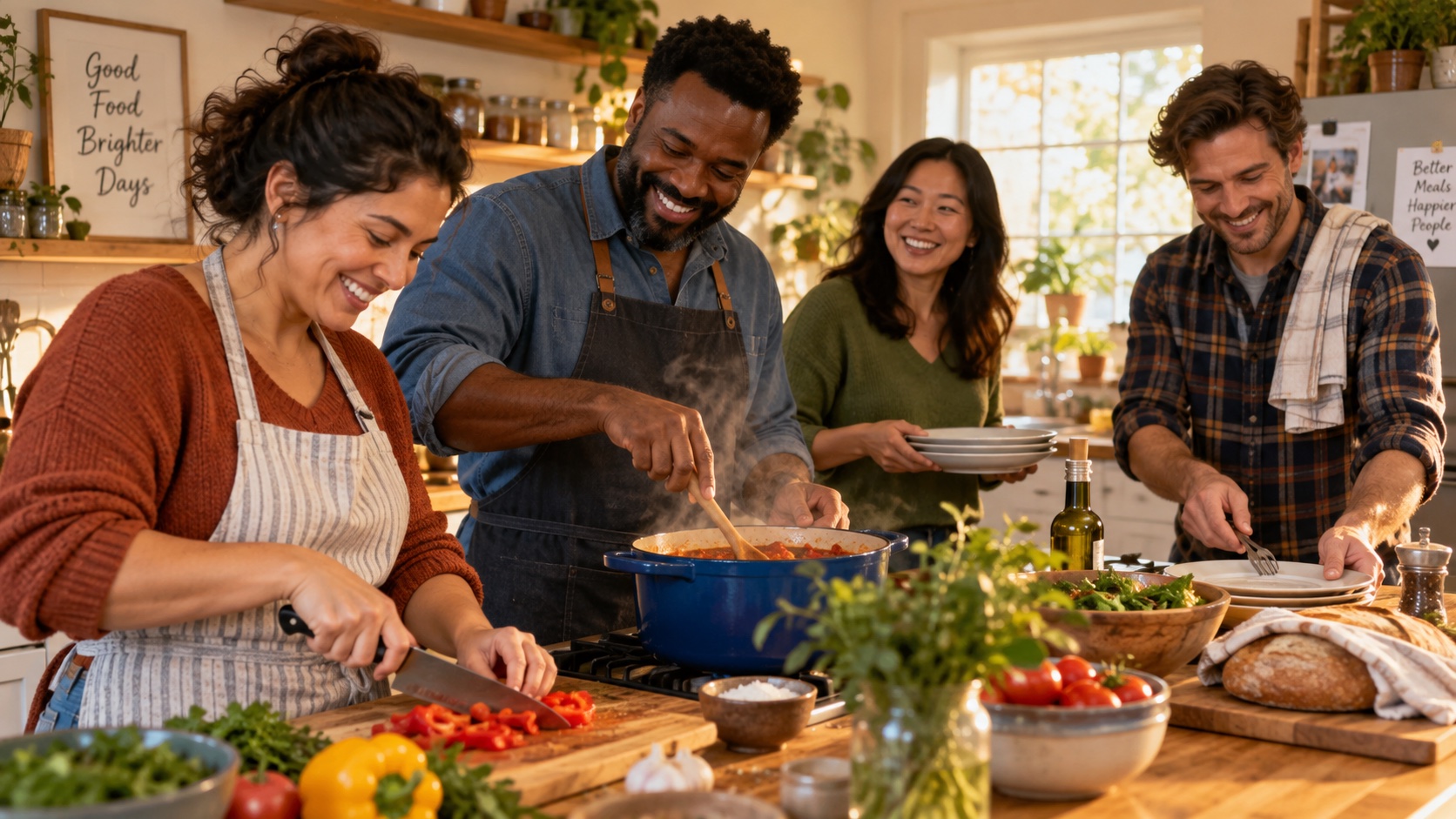
The Kitchen Is a Shared Environment
Everything the Habit Formation series says about environment design gets harder the moment two adults share a fridge, because the environment is now a negotiated object. Your health goal does not cancel your partner's snack preference, and their snack preference does not cancel your goal — the two just have to share shelf space. The evidence is clear that the room votes: in the office candy-dish studies, the same candy moved two meters changed how often it was eaten (Wansink, Painter & Lee, 2006), and visible food in transparent bowls out-ate the identical food in opaque ones (Painter et al., 2002). A kitchen pact is how two people aim that vote on purpose instead of by accident.
Product picks are generic categories, not brands. We may earn a commission on Amazon or iHerb purchases at no cost to you — this never changes our evidence conclusions. Full disclosure
Meal-prep containers
May lower the practical friction of preparing meals ahead.
⚠️ None expected; avoid treating meal-prep as an all-or-nothing dietary rule.
Check price on Amazon →Shopping Rules Are Household Rules
The grocery list is where the kitchen pact is actually written, because the store decides what the shelves can contain. A shopping agreement usually has five clauses, and each one is a negotiation about autonomy, not about vegetables.
- 🧺 One shared list, two columns. "Household staples" (everyone eats them) and "personal items" (one person's treat shelf). The second column is off-limits to commentary — it is the price of the first column's cooperation.
- 🚫 The one-item veto, used sparingly. Each person can veto one item per trip, no explanation required, once. The veto exists to protect the agreement from becoming a dictatorship; overusing it turns the list into a battlefield.
- 📏 Decide portions at the store, not the counter. A family-size bag of chips in the cart becomes a family-size serving at 9 p.m. Buying the single-serving version is a decision made once, at full attention.
- 🗓️ Shop on a schedule, not on a craving. Hunger-shopping and stress-shopping are how the pact quietly dissolves. A standing Saturday list keeps the store from being a midweek referendum on willpower.
- 🛒 Whoever shops, shops the list. The list is the agreement; improvisation at the store is a unilateral amendment. If a real need appears mid-week, it goes on next week's list — or it is an explicit, named exception.
🍽️ The treat shelf is a feature, not a leak
Every kitchen pact needs a designated personal zone — a shelf, a drawer, a cabinet — where each person's treats live without comment. It sounds like a loophole; it is actually the load-bearing wall. Prohibition is fragile, and the friction studies show that a small, agreed outlet beats a total ban that gets violated and then abandoned. The friction page in the sibling folder explains why the arrangement beats the ban.
Visibility, Negotiated
The visibility evidence cuts both ways in a shared kitchen: what is at eye level gets eaten, and that is true for the fruit bowl and the cookie jar alike. The pact is not about hiding everything from everyone — it is about agreeing, out loud, which foods get the eye-level shelf and which get the opaque bin. The Environment Design protocol page owns the mechanism; here is the two-person version.
- 🥗 Negotiate the prime shelf together. "Fruit and prepped vegetables at eye level" is a clause both people sign; it does not read as one person rearranging the other's kitchen.
- 🔒 Opaque bins for the personal column. The treat shelf gets a lid. Seeing the snack is half the battle, per the transparency studies — the lid is a shared favor, not a punishment.
- 📦 Agree on the counter's job description. If the counter is the "ready to eat" zone, then a fruit bowl belongs there and a cookie jar does not — the agreement decides, so no one has to referee nightly.
- 🍳 Prep is a two-person act. Washing and chopping vegetables for the week is a chore that lands better split: one shops, one preps, or both prep to music on Sunday. Home-prepared food is consistently linked to better diet quality (Reicks et al., 2014).
Meal Planning as a Pact
The dinner question — what, when, who cooks — is the daily test of every other clause. Shared meals are worth defending: family dinner has been associated with better diet quality in children and adolescents for decades (Gillman et al., 2000), and adult couples report the same pull toward better food when they plan and eat together. The pact version of meal planning is a short list of standing agreements.
- 📝 Plan the week in one sitting. A Sunday 15-minute planning session — three or four dinners, assigned cook nights — converts the 6 p.m. "what do you want?" negotiation into a scheduled decision.
- 👨🍳 Cook nights, not cooking guilt. Assigning nights ("I cook Mon-Wed, you cook Thu-Sat, Sunday is shared or takeout") removes the daily renegotiation and the resentment that rides on it.
- 🍲 The cook chooses the menu. The person cooking picks what to cook — within the agreed shopping list. Dinner is not a second election; the cook's call is final and free of commentary.
- 🥡 Takeout has a scheduled seat. A planned takeout night is part of the pact; an unplanned one is the pact failing quietly. Naming it converts a recurring leak into an approved clause.
- 🕖 A shared dinner window. If eating together is the goal, agree on the window (say, 7–8 p.m.) rather than a rigid minute, so schedules flex without the habit breaking.
When Food Is a Medical Matter
Some kitchen decisions stop being negotiable preferences and become clinician territory: diagnosed diabetes, food allergies, celiac disease, hypertension managed with diet, or a clinician-prescribed eating pattern. A kitchen pact still applies — but it is negotiated around a medical boundary, and the boundary is not a preference the household gets to vote on. If a household member's condition shapes what can be in the house, the pact's job is to make the medically necessary food the easy food and to protect the other person's autonomy everywhere it does not collide with safety. When in doubt about what a diagnosis requires, the clinician who made the call is the referee, not the partner with the strongest opinion.
| Zone | Agreement | Who it protects | Read |
|---|---|---|---|
| 🧺 | Shared list with a personal column and a rare veto | Both people's autonomy | Foundation |
| 🥗 | Eye-level shelf for fruit and prepped vegetables | The health goal, via visibility | Foundation |
| 🍿 | Opaque-bin treat shelf, off-limits to commentary | The partnership, via outlet | Mixed |
| 🍳 | Cook nights and a planned takeout seat | The schedule, via structure | Foundation |
Four zones, four clauses — the kitchen pact is a list you both sign, not a diet one of you enforces.
Questions, Answered Briefly
- 🍫 My partner keeps buying things I'm trying to avoid. Now what? The personal column exists for exactly this. If the item is genuinely a trigger for you, negotiate it into the opaque bin and the personal shelf — visibility, not presence, is the lever the studies point to.
- 🥦 We have different dietary styles entirely. Can a pact survive? Yes — the pact is about zones and schedules, not about one shared plate. Cook nights, a shared staples list, and separate personal shelves handle most mismatches without a single argument about protein sources.
- 🛒 One of us does all the shopping and resents it. Then the first clause to renegotiate is the division of labor, not the food. Shopping on a schedule with a list is far easier to share than improvisational shopping.
- 🍔 Takeout is how we survive busy weeks. Are we failing? No — a scheduled takeout night is a clause, not a confession. The pact fails only when the takeout becomes a silent weekly override of the plan, because then the plan stops being shared.
Keep the Pact an Experiment
Every clause in this page is a proposal, not a commandment — the kitchen pact is a two-week experiment like any other household habit, with a review date and a permission to adjust. If the eye-level fruit shelf is ignored, move it and re-test. If the cook-night split breeds resentment, rebalance it at the review. What keeps the pact alive is not the perfection of its clauses but the standing agreement that clauses can be changed by both people, out loud, on a schedule. The Purpose & Mind page on hobbies and habits makes the case for why these shared defaults are worth the negotiation at all.
The Bottom Line
- The grocery list is the pact. One shared list, a personal column, a rare veto — the store decides what the shelves can contain.
- Visibility is negotiated, not imposed. Eye-level shelf for the good food, opaque bin for the treat shelf, and a counter with a clear job.
- Meal planning is a standing agreement. Weekly plan, cook nights, a scheduled takeout seat — no nightly renegotiation, no quiet leaks.
- Medical food rules outrank preferences. A clinician's dietary boundary is the pact's fixed point; everything else stays adjustable.
Related Topics
- Painter, J. E., Wansink, B., & Hieggelke, J. B., "How visibility and convenience influence candy consumption," Appetite (2002)
- Wansink, B., Painter, J. E., & Lee, Y. K., "The office candy dish: proximity's influence on estimated and actual consumption," International Journal of Obesity (2006)
- Story, M., Kaphingst, K. M., Robinson-O'Brien, R., & Glanz, K., "Creating healthy food and eating environments: policy and environmental approaches," Annual Review of Public Health (2008)
- Reicks, M., Trofholz, A. C., Stang, J. S., & Laska, M. N., "Impact of cooking and home food preparation interventions among adults: outcomes and implications for future programs," Journal of Nutrition Education and Behavior (2014)
- Gillman, M. W., et al., "Family dinner and diet quality among older children and adolescents," Archives of Family Medicine (2000)