The Protein-in-One-Meal Problem
"The body can't absorb more than 30 grams of protein per meal" is the internet's most confident nutrition claim — and it is wrong about the gut and right about something subtler. This page separates digestion from muscle-building, works the real math of an 80–100 gram single sitting, and explains what the OMAD plate must do about it.
What the evidence supports
- The gut digests and absorbs far more than 30 g in a sitting; the surplus is used for energy and other body proteins (Schoenfeld & Aragon 2018).
- Muscle-protein synthesis responds to each meal up to a per-meal ceiling around 0.4 g per kg (Moore 2015), and a moderate 30 g serving saturates the response in young and older adults alike (Symons 2009).
- Spreading protein across meals produces a higher 24-hour muscle response than concentrating it in one (Mamerow 2014).
What remains uncertain
- No trial has fed a realistic OMAD-style 100–160 g dinner for months and measured muscle outcomes directly.
- Whether a very large single meal can trigger a second, later synthesis wave is plausible but not established in humans.
- Longer eating windows inside the "one meal" (2–3 hours) blunt the single-sitting disadvantage — at the cost of the 23:1 purity the folklore prizes.
Evidence last reviewed: August 21, 2026. Conclusions may change as new research is published.
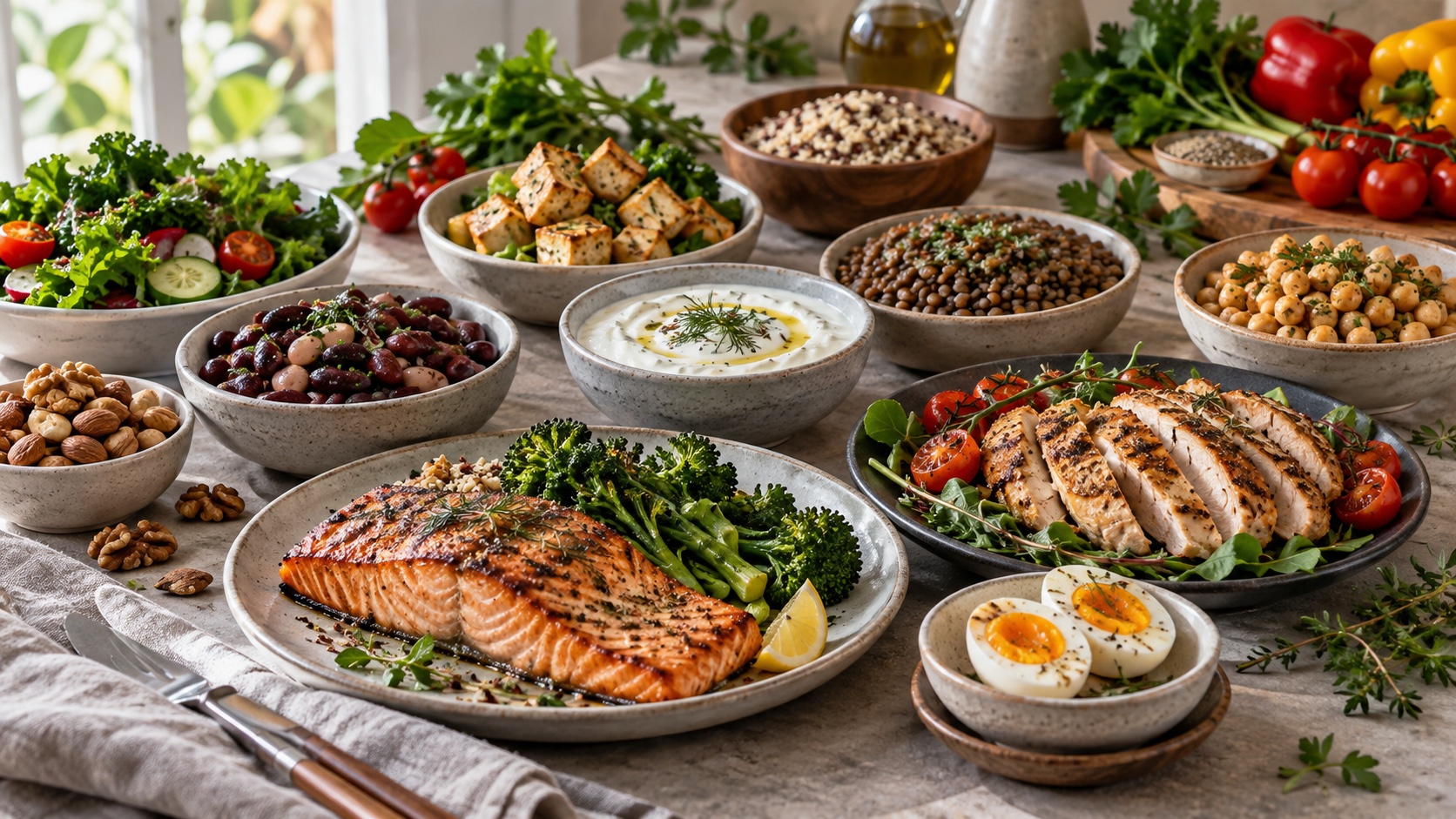
The Question Beneath the Question
The headline question — can one meal "absorb" the day's protein? — contains two different questions that have been welded together. The first is digestive: does the gut take up 80–100 grams in a sitting? The second is anabolic: does muscle use that protein as well as it would have across three meals? The gut answers yes; the muscle answers "yes, but less efficiently." Which answer matters depends on what you are eating for:
- 🧬 For tissue maintenance and immune proteins — a single large meal is largely sufficient; digestion absorbs it, and the body routes amino acids where they are needed.
- 💪 For muscle, specifically — each meal triggers one synthetic pulse, and pulses are the currency. One giant pulse is real but smaller in total than several moderate ones.
- 🔥 For energy — the protein a meal cannot usefully deploy is oxidized. A 150 g dinner is partly a fuel meal, which matters if the goal is a deficit and changes nothing if it is not.
Product picks are generic categories, not brands. We may earn a commission on Amazon or iHerb purchases at no cost to you — this never changes our evidence conclusions. Full disclosure
Protein powder
A convenient way to add dietary protein when food intake is insufficient or impractical.
⚠️ May cause digestive symptoms; formulation matters for allergies and intolerances. It does not replace a varied diet.
Check price on Amazon →The 30-Gram Myth, Corrected
The claim that any protein beyond 30 g in one sitting is "wasted" comes from a misreading of the muscle-synthesis studies and was directly addressed by Schoenfeld and Aragon's review of the per-meal dosing evidence (2018). What the tracer studies actually show: a ~30 g serving of quality protein maximally stimulates muscle-protein synthesis in that meal (Symons 2009, using beef in young and elderly subjects), and a ~90 g serving raises the response no further. The remaining protein is not discarded — the gut absorbs nearly all of it, blood amino acid levels stay elevated for many hours, and the surplus is oxidized or used for other proteins. "Wasted" was the wrong word; "beyond the muscle's per-meal ceiling" is the accurate one.
The myth's kernel is real, though: the muscle's per-meal response does top out, and Moore's dose-finding work (2015) puts that ceiling near 0.24 g per kg per meal in younger adults and ~0.4 g per kg in older adults — which is one reason the Protein pillar recommends splitting the day's 1.6–2.2 g per kg across several meals when you can.
What One Giant Meal Actually Does
- 🔑 One leucine trigger — muscle synthesis is switched on, per meal, by hitting a leucine threshold. A single meal gives you one strong switch, not several.
- 📊 The 24-hour ledger — Mamerow and colleagues (2014) found a roughly 25% higher 24-hour synthetic response when the same daily protein was spread as three moderate meals than when it was skewed into one large dinner. One sitting is not wasted — it is a smaller total.
- ⏳ A long tail of amino acids — blood amino acid levels stay elevated for many hours after a large meal, which is why a single OMAD dinner is workable for muscle maintenance even if it under-delivers on maximization.
- 🕒 The stretched hour as a second trigger — a meal drawn across 60–90 minutes partially mimics two smaller sittings, which is the closest thing to a free lunch this page offers. Slow service is a feature on OMAD nights.
- 🫁 A fuel component — the portion beyond the anabolic ceiling gets oxidized. In a deliberate deficit that is harmless; framed as "the body can't use it," it is a myth.
| Serving pattern | What happens to the protein | Reading |
|---|---|---|
| 🥚 3–4 meals of 25–40 g | Several complete synthetic pulses across the day (Mamerow 2014) | Reference |
| 🍽️ One meal of 100–160 g | One large pulse, plateau after ~0.4 g/kg, long tail, rest oxidized | Workable, weaker |
| 🥞 Skewed day (10 g morning, 65 g night) | One useful pulse plus one inadequate trigger — lower 24-hour response | Weaker |
| 🍗 OMAD held to one hour, protein eaten last | Fullness wins the race against the plate — the day's target quietly shrinks | Avoid |
What This Means for the OMAD Plate
The practical translation for a 75 kg adult: the day's target is 120–165 g (1.6–2.2 g/kg, the number the Protein pillar owns), and it has to arrive in one sitting. That is roughly 500–700 g of cooked chicken breast equivalent — physically a lot of food, which is why the plate rules in the parent page exist. Four adjustments make the single sitting do more of the muscle work:
- 🧂 Protein first, literally — eat the protein carriers before the starches and vegetables. One sitting is a race against fullness, and order decides the finish.
- ⏱️ Use the whole hour (or two) — a stretched one-to-two-hour meal behaves like two smaller sittings, giving the muscle a second, weaker trigger. If your plate is 150 g of protein, stretch it deliberately.
- 🔁 Vary the protein sources — meat, eggs, dairy, and legumes together push past what any single source delivers, and the leucine-rich carriers (meat, eggs, whey) do the switching-on.
- 📅 Let the other days carry the ledger — on the four or five 16/8 days of a part-time OMAD week, two moderate protein meals each restore the distribution advantage. The muscle-protection rules page sets this up day by day.
🥚 The number that resolves the argument
The daily total matters more than the single-sitting efficiency: keep 1.6–2.2 g per kg of body weight on OMAD days, hit it in the one meal, protein first, stretched across the full hour. You will not "absorb" less than the gut can take up — you will simply fire one muscle pulse instead of several, and the part-time schedule is how you get the several back. The Protein pillar owns the dosing evidence; this page only applies it to a 23:1 day.
Questions, Answered Briefly
- ❓ Is 100 g in one meal "wasted"? — No. The gut absorbs nearly all of it; the muscle's response plateaus and the surplus becomes fuel or other proteins. "Wasted" is the myth; "beyond the muscle's per-meal ceiling" is the fact.
- ❓ Should I add a protein shake inside the hour? — Only if the plate is falling short of the target. A shake is a dense, easy-to-finish protein carrier; it is a tool for the gram count, not a requirement.
- ❓ Will spreading the plate over two hours "break" OMAD? — It stretches the eating window, which is a choice with trade-offs, not a violation of anything metabolic. If two sittings across two hours keep the gram target, that beats one rushed hour that misses it.
- ❓ Does this matter more as I age? — Yes. The per-meal ceiling rises with age (Moore 2015 found ~0.24 g/kg in younger, ~0.4 g/kg in older adults), and a single-sitting day is the harder pattern to fill in later decades — another argument for the part-time OMAD week.
- ❓ How much can I realistically eat in one sitting? — Physically, a 1,500–2,000 kcal plate is finishable for most adults when it is built protein-first and spread across the full hour. The real constraint is behavioral — fullness arriving before the protein does — which is why the ordering rules matter more than any absorption ceiling.
The Bottom Line
- Absorption is not the problem — the gut handles 100+ g in a sitting; the 30 g limit is a myth built from a misreading.
- The per-meal muscle ceiling is real — one giant pulse is smaller in total than several moderate ones (Mamerow 2014), so OMAD is workable but not optimal for muscle.
- The daily target rules everything — 1.6–2.2 g/kg must land in the one meal; protein first, full hour used, plate built backward from the gram count.
- Part-time OMAD fixes the pattern — the 16/8 days' two moderate meals restore the distribution advantage the one-sitting day gives up.
Related Topics
- Schoenfeld & Aragon, "How much protein can the body use in a single meal for muscle-building? Implications for daily protein distribution," Journal of the International Society of Sports Nutrition (2018)
- Symons et al., "A moderate serving of high-quality protein maximally stimulates skeletal muscle protein synthesis in young and elderly subjects," Journal of the American Dietetic Association (2009)
- Moore et al., "Protein ingestion to stimulate myofibrillar protein synthesis requires greater relative protein intakes in healthy older versus younger men," Journals of Gerontology A: Biological Sciences and Medical Sciences (2015)
- Mamerow et al., "Dietary protein distribution positively influences 24-h muscle protein synthesis in healthy adults," Journal of Nutrition (2014)
- Morton et al., "A systematic review, meta-analysis and meta-regression of the effect of protein supplementation on resistance training-induced gains in muscle mass and strength in healthy adults," British Journal of Sports Medicine (2018)