Running Your Own Cooper Test
The Cooper 12-minute run is the cheapest honest VO2 max test that exists: run as far as you can in twelve minutes on a flat measured course, then let a 1968 equation convert the distance into milliliters per kilogram per minute. This page walks the protocol one step at a time, gives you the age-and-sex distance bands for a rough read, and spends the rest of its effort on the caveats — because a test you cannot repeat identically is a test you cannot trust.
What the evidence supports
- Twelve-minute running distance correlates well with lab-measured maximal oxygen uptake in validation studies.
- The published equation converts distance into a VO2 max estimate within roughly ±4–5 ml/kg/min of the lab value for most adults.
- Repeated under matched conditions, the test reliably tracks changes in fitness over months — which is the use that matters.
What remains uncertain
- Individual error can exceed the group average — pacing skill, running economy, and motivation all leak into the distance.
- Age-and-sex norm bands come from published tables that differ by a few hundred meters across sources.
- The equation was derived decades ago on specific populations; extrapolating to very old, very young, or non-running adults gets shakier.
Evidence last reviewed: August 15, 2026. Conclusions may change as new research is published.
Why Twelve Minutes
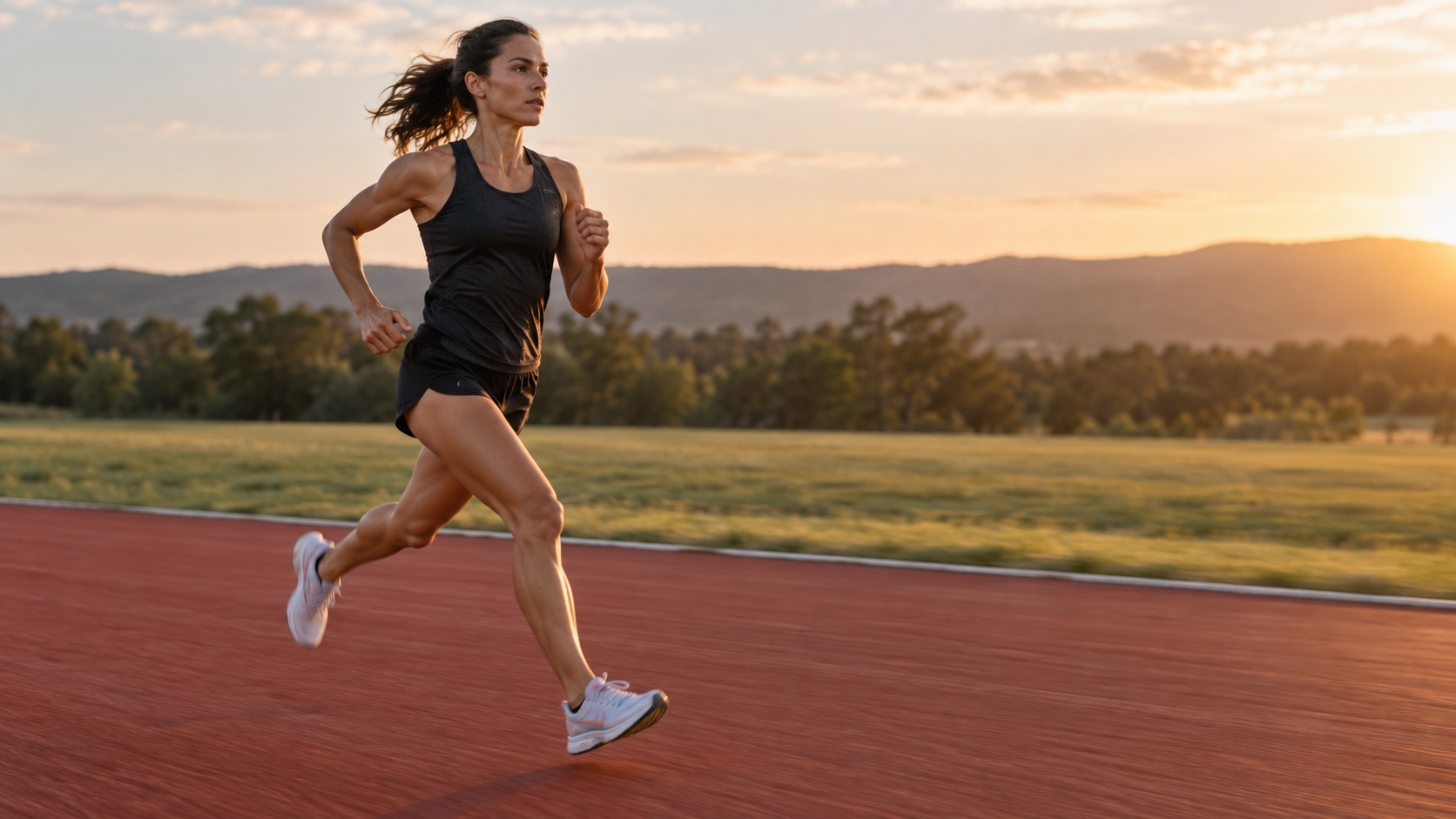
The test's inventor, Kenneth Cooper, chose twelve minutes because it is long enough to make the aerobic system the limiting factor — a shorter effort leans on sprinting power and pacing luck — and short enough to finish at a genuinely maximal, uncomfortable effort that people can actually sustain. The result is closer to the true ceiling than any submaximal estimate, without a mask or a lab visit. The original study (Cooper, JAMA, 1968) compared running distance against treadmill measurement and published an equation that has survived fifty-plus years of follow-up validation: heavier on honesty and much lighter on cost than anything else at its accuracy level.
Product picks are generic categories, not brands. We may earn a commission on Amazon or iHerb purchases at no cost to you — this never changes our evidence conclusions. Full disclosure
Comfortable walking shoes
May improve comfort and consistency for walking-based activity.
⚠️ Footwear cannot correct every pain problem; persistent foot, knee, or hip pain warrants appropriate evaluation.
Check price on Amazon →The Protocol, Step by Step
The protocol's whole point is repeatability. Standardize everything you can, so that when the number moves, you know it is you moving it. Run the same course, the same time of day, the same shoes, and never the morning after a hard session. Then:
- 📍 Measure the course once. A flat 400-meter track in lane one for three laps is ideal — 1,200 meters, no route-guessing on test day. A measured flat out-and-back works too; just commit to it forever.
- 🔥 Warm up for ten minutes. Easy movement plus two short pickups near the effort you plan to run, then a couple of minutes easy. The warm-up is part of the protocol, covered in detail by the warm-up page.
- 🎯 Start the clock and go. Run twelve minutes at the hardest pace you believe you can hold to the line — the classic failure is going out ten seconds per lap too hot and dying at minute eight.
- 🧭 Pace with a rough plan. Decide your target lap time beforehand and check the watch at each split. If you are laps ahead early, ease off — the distance you bank in minute two is paid back in minutes ten and eleven.
- 📏 Record the exact distance — not "about a mile and a half," but 2,410 meters. The raw distance is the datum that survives everything, including future equation changes.
The Distance Bands, by Age and Sex
Published norm tables grade distances into bands from "very poor" to "excellent," with the bar moving down with age and differing between men and women. The table below shows the approximate "good" band — mid-range, comfortably above the middle of the pack. Treat it as context, not verdict: the tables vary by source by a few hundred meters, and the comparison that actually matters is your own history.
| Age band | Men — approx. good | Women — approx. good | Read |
|---|---|---|---|
| 🎯 20–29 | 2,600–2,800 m | 2,200–2,400 m | Elite of the everyday |
| 🎯 30–39 | 2,400–2,700 m | 2,000–2,300 m | Strong |
| 🎯 40–49 | 2,200–2,500 m | 1,900–2,100 m | Healthy |
| 🎯 50–59 | 2,000–2,300 m | 1,700–2,000 m | Good for the decade |
| 🎯 60 + | 1,800–2,100 m | 1,500–1,800 m | Decade-adjusted |
Two things to notice. First, the bands decline roughly a hundred meters per decade — that is the age slope, and it is entirely normal. Second, the whole spread from twenties to sixties is smaller than the gap between "sedentary" and "moderately active" at any single age, which is the quiet point: the years of training you control move your distance far more than the years you do not. The fitness-to-longevity page puts a number on that exchange.
Reading Your Result
The equation turns distance into an estimate: (meters − 505) ÷ 44.7 = VO2 max in ml/kg/min. Run 2,400 meters and you get about 42. Run 2,700 and it is about 49. Every 100 meters of improvement is worth roughly 2.2 ml/kg/min — a useful ruler for the months ahead, because it links the distance you can actually see improving to a number you can plot.
🎯 Log the meters, not just the estimate
The 2,410 meters you covered is the primary record; the 42.6 ml/kg/min a formula derived from it is secondary. Raw distances survive formula changes, survive you switching calculators, and let you recheck the arithmetic years later. Write both down, with the date and the conditions — the trend page builds entirely on this habit.
The Honest Caveats
The Cooper test is a good test with real limits, and naming them is what keeps the number honest. Pacing skill matters: two people with the same true fitness can split 200 meters apart on pacing alone, which is more than a full year of typical training gain. Running economy and body weight enter the estimate too — the equation was built on general adult populations, not on you specifically. And motivation sets the ceiling: it is a maximal test, and a half-hearted day reads as lost fitness. None of these flaws sink the test — every one of them shrinks under repeatability, because the same pacing tendencies and the same body show up every time, and their biases cancel out of the comparison.
- 🐌 The pacing tax is real. A bad first half costs you a measurable number of meters at the end. Fix it by planning splits, not just showing up.
- 🌡️ Conditions are part of the score. Heat, wind, and humidity change the distance as much as fitness does. Log them with every test so you never compare a hot August run to a cool October one.
- ⚖️ Body weight bends the estimate. The equation divides by weight; a few kilograms of change alter the number even with fitness constant — which is fine, because the unit is per kilogram by design.
- 🚩 One test proves nothing. A single Cooper run is a photograph through a moving lens. The retesting cadence page turns it into a practice, and three matched tests become the smallest trustworthy signal.
Questions, Answered Briefly
- 🎯 Can I run the Cooper test on a treadmill? It is possible but not ideal — you cannot set the speed mid-run the way a track invites, and treadmills flatter the distance. If a treadmill is all you have, lock the incline at one percent, keep the same settings every test, and never compare the result to a track test.
- 🫁 I can't run a full twelve minutes yet — what do I do? That is a fitness fact, not a failure. Walk-jog as far as the twelve minutes allow, record the exact distance, and let the equation do its work. Many adults start by running far less than they hoped; the trend page is where that baseline gets its meaning.
- 📉 Why did my number drop if I've been training? Look at conditions before concluding anything: heat, a hard week, poor sleep, or a first-half pacing mistake each cost real meters. Log them, retest fresh on the schedule, and let three matched tests — not one — make the call.
- 🧮 Do I need to calculate the equation by hand? No — dozens of free calculators do it. What matters is that you log the raw distance alongside the estimate, so the number survives whatever calculator you use in five years.
Before You Run
A maximal twelve-minute effort is real cardiovascular work and should get the respect one: if you have unexplained chest symptoms, dizziness on exertion, a known heart condition, or an overnight fever, skip the test day and talk to a clinician instead of pushing through. The warm-up deserves its full ten minutes, and a test belongs at the end of a recovery week — never after a hard session, never on poor sleep. Nothing on this site prescribes a testing protocol for you; this page simply describes how the test is meant to be run for people cleared for it.
The Bottom Line
- The test is twelve maximal minutes on a measured flat course — warm up properly, plan your splits, and record the exact distance.
- The bands are context, not grading sheets — they decline with age by design, and your own baseline is the comparison that counts.
- 100 meters ≈ 2.2 ml/kg/min — the equation links the distance you can see improving to a number you can plot over years.
- Repeatability is the whole game — same course, same conditions, same effort; three matched tests beat any single dramatic one.
Related Topics
- Cooper, "A means of assessing maximal oxygen intake: correlation between field and treadmill testing," Journal of the American Medical Association (1968)
- Grant et al., "A comparison of methods of predicting maximum oxygen uptake," British Journal of Sports Medicine (1995)